

Spindle Grinding Service: Restoring Precision Without the Downtime
Why Spindle Grinding Service Is Critical for Industrial Manufacturing Precision
Spindle grinding service is a precision process that restores worn or damaged spindle tapers and components back to their original tolerances — without replacing the entire spindle assembly.
Here’s what it does at a glance:
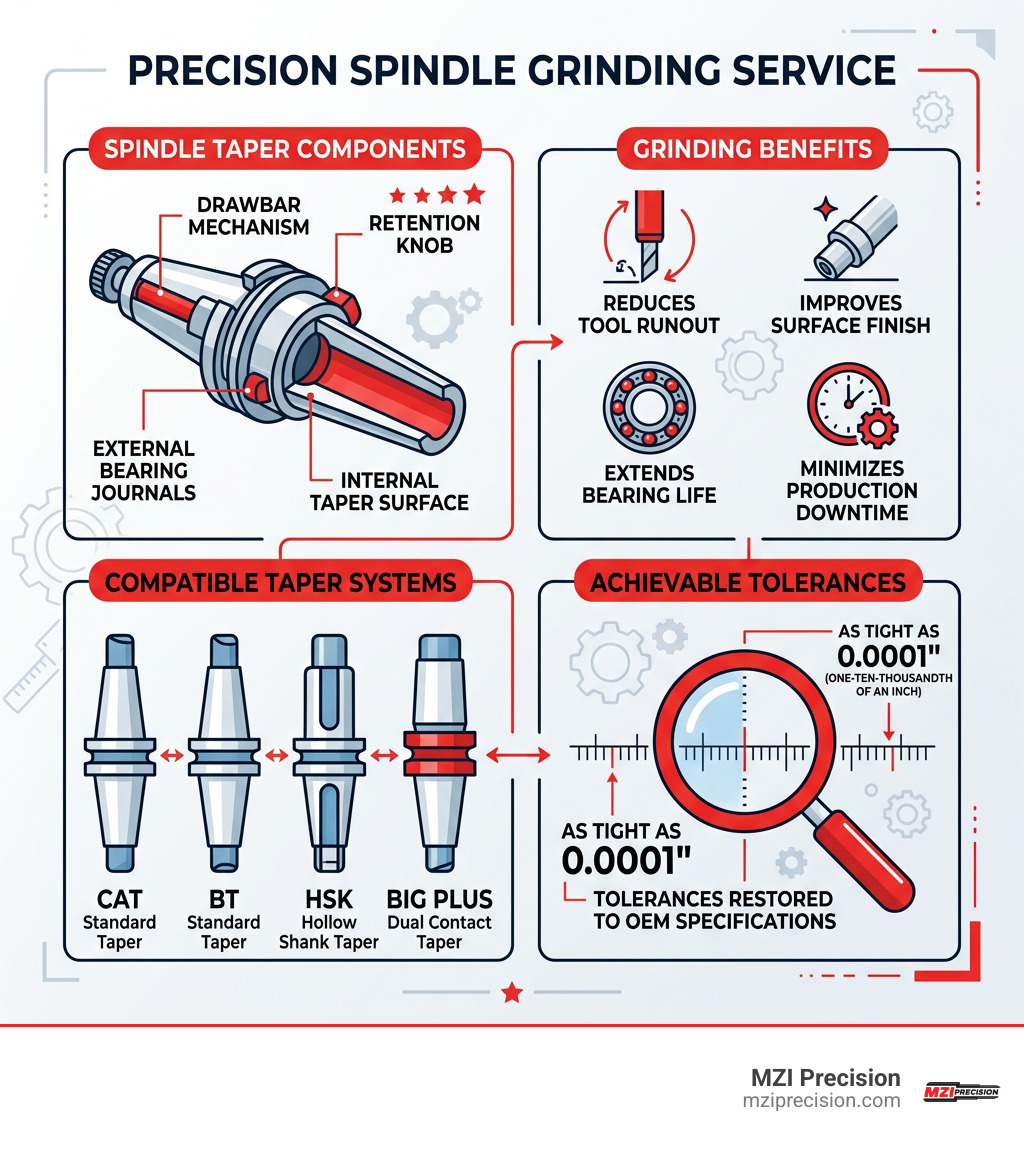
- Restores spindle tapers (CAT, BT, HSK, Big Plus) to OEM specifications
- Achieves tolerances as tight as 0.0001″
- Extends spindle service life and protects bearing performance
- Reduces unplanned production downtime
- Supports both repair and full rebuild programs for industrial manufacturing spindles
When a spindle taper wears down or gets damaged, even slightly, the effects ripple across your entire machining operation. Tool runout increases. Surface finish degrades. Part accuracy suffers. And in precision-driven industries like aerospace and defense, those consequences are not acceptable.
The good news? Full spindle replacement is rarely necessary. Professional grinding services can restore spindle components to factory-level performance — often at a fraction of the cost of a new spindle.
For manufacturing operations that depend on high-speed, high-accuracy machining, understanding what spindle grinding can and cannot do is essential to making smart maintenance decisions.
What is a Spindle Grinding Service?
At its core, a spindle grinding service is a highly specialized machining process used to refine the internal and external surfaces of an industrial manufacturing spindle. Unlike standard machining, which might use a cutting tool to peel away material, grinding uses an abrasive wheel. This wheel rotates at high speeds to “kiss” the surface of the metal, removing microscopic amounts of material to create a perfectly smooth, geometrically accurate finish.
We use this process to address internal features like holes, bores, and slots, as well as non-flat surfaces like tapers and curves. In industrial manufacturing spindle repair, precision is measured in microns. When a spindle shaft or housing bore becomes “out of round” due to heat or mechanical stress, grinding is the only way to bring it back to a state of perfect concentricity.
The process involves several critical stages:
- Assessment: We inspect the spindle for wear, runout, and surface damage.
- Planning: We establish parameters such as spindle speed and material removal rates to ensure we meet the required tolerances without overheating the metal.
- Execution: The grinding wheel is trued and dressed, then applied to the workpiece.
- Quality Control: We verify the final dimensions against OEM specifications.
Whether you are looking for grinding-spindles-101-everything-you-need-to-start or need a deep dive into restoration, the goal remains the same: achieving a surface texture and dimensional accuracy that turning or milling simply cannot match.
The Role of Spindle Grinding Service in Taper Restoration
The taper is the “handshake” between your machine and your cutting tool. If that handshake is loose or uneven, the tool will vibrate, leading to chatter marks on your parts and premature tool failure. A professional spindle grinding service focuses heavily on restoring these critical interfaces.
We service a wide variety of precision grinding spindles and taper systems, including:
- CAT and BT Tapers: The workhorses of the machining world.
- HSK Systems: High-speed hollow shank tapers that require extreme precision.
- Big Plus® Systems: Dual-contact systems where both the taper and the face must be ground in a perfect relationship to ensure maximum rigidity.
By regrinding the taper, we eliminate runout—the “wobble” that occurs when the tool isn’t spinning perfectly on its center axis. This restores the concentricity of the spindle to its bearings, ensuring that the tool rotates true every single time.
Why Choose a Professional Spindle Grinding Service?
You might be tempted to try a quick fix in-house, but industrial manufacturing spindle rebuilding is a science, not a hobby. Professional services provide several advantages that simply aren’t available in a standard maintenance shop.
First, there is the matter of OEM specifications. We don’t just make the spindle “look good”; we restore it to the exact measurements required by the original manufacturer. This requires high-precision grinding complete guide knowledge and specialized equipment that can hold tolerances to 0.0001″.
Second, shop-based precision is superior because it allows for a controlled environment. In our facilities in California, we use temperature-controlled rooms and vibration-isolated stations to ensure that external factors don’t interfere with the grinding process. Expert calibration ensures that every micron removed is intentional, preventing the “over-grinding” that can ruin a spindle shaft beyond repair.
Advantages and Limitations of Precision Grinding
Precision grinding is the gold standard for industrial manufacturing spindle repair because it offers a level of control that other methods lack. However, it is important to understand both the “pros” and the “cons” of this technique.
The Advantages:
- Extreme Accuracy: We can hold tolerances to 0.0001” (one ten-thousandth of an inch). To put that in perspective, a human hair is about 0.003” thick. We are working at a level 30 times finer than a hair.
- Surface Integrity: Grinding produces a superior surface finish, which is vital for bearing fits and tool-holding surfaces.
- Life Extension: By restoring a spindle rather than replacing it, you can extend the life of your equipment by years, saving tens of thousands of dollars.
- Adherence to Standards: We adhere to industry-specific standards as detailed in ISO 9001, ensuring that our quality management systems produce consistent results.
The Limitations:
- Heat Management: Grinding generates significant friction. If not managed correctly through CNC programming and proper coolant use, this heat can cause “grinding burns” or even crack the material.
- Material Removal Limits: You can only grind a part so many times. Once the case hardening of the steel is ground away, or the dimensions fall below a certain threshold, the part may require a “Grind-Plate-Grind” process (where we add chrome plating and then regrind) or a full replacement.
- Not a “Quick Fix” for Bad Bearings: While cnc-precision-grinding can fix a taper, it cannot fix a spindle with crashed bearings. Grinding is often part of a larger rebuilding process that includes bearing replacement and dynamic balancing.
Compatible Materials and Industrial Applications
Industrial manufacturing spindles are made from tough materials designed to withstand high RPMs and heavy cutting forces. Our spindle grinding service is compatible with the most common materials found in high-end manufacturing.
- Steel Alloys: Most spindles are made of high-grade, heat-treated steel. These respond beautifully to grinding, allowing for a mirror-like finish.
- Aluminum: Often found in specialized high-speed spindles (like those used in certain aerospace applications), aluminum requires specific grinding wheel types to prevent “loading” (where the soft metal clogs the abrasive wheel).
- Ceramics: Increasingly used in high-tech diagnostic equipment and medical implants. Ceramics are incredibly brittle, so we take extra care to prevent cracking during the grinding process.
These materials are utilized across a range of vital industries. In Aerospace and Defense, where a single component can cost more than a luxury car, spindle-grinding-guide techniques are used to ensure that turbine blades and landing gear components are machined to perfection. In Solar Energy and Power Generation, large-scale spindles used to machine generator components require the same level of precision to ensure long-term reliability. Even Medical Diagnostics equipment relies on spindles that have been ground to exacting standards to ensure the accuracy of imaging and testing devices.
Enhancing Maintenance with Industrial Manufacturing Spindle Rebuilding
Grinding is rarely a standalone service. In our Huntington Beach and Los Angeles facilities, we view it as a critical component of a comprehensive maintenance strategy. When a spindle comes in for repair, it undergoes a rigorous industrial manufacturing spindle rebuilding process.
One of the most important steps is Root Cause Analysis. We don’t just fix the wear; we look for why it happened. Was it a drawbar force issue? Was there bearing fretting? By identifying the source of the problem, we can often modify the spindle to prevent the issue from recurring.
Key elements of our rebuild process include:
- Vibration Analysis: We use sensors to detect even the slightest imbalance in the rotating assembly.
- Bearing Fit Inspection: We ensure the housing bores and shaft seats are ground to the exact “interference fit” required by the bearing manufacturer.
- Dynamic Balancing: We balance the spindle to a standard tolerance of 0.1 mil or less. This is crucial for high-speed operation; a spindle that is perfectly ground but poorly balanced will destroy itself in hours.
- Drawbar Testing: We measure the retention force to ensure the tool is being held securely in the newly ground taper.
By combining these services, we don’t just “repair” a spindle; we remanufacture it to run as well as—or better than—new.
Frequently Asked Questions about Spindle Grinding
What materials are compatible with industrial spindle grinding?
Most industrial spindles are made of hardened steel alloys, which are the primary candidates for grinding. However, we also work with aluminum and specialized ceramics. Each material requires a different type of grinding wheel and coolant strategy to ensure the integrity of the surface.
How does grinding contribute to industrial manufacturing spindle repair?
Grinding is the “correction” phase of a repair. While cleaning and bearing replacement address the internal mechanics, grinding addresses the physical geometry of the spindle. It ensures that the taper is straight, the shaft is round, and the tool sits exactly where it should. It is the difference between a machine that “runs” and a machine that “performs.”
What tolerances can professional grinding services achieve?
With our specialized equipment and experienced technicians, we can achieve tolerances as tight as 0.0001”. This level of precision is necessary for high-speed spindles (10,000+ RPM) where even a tiny deviation can lead to catastrophic failure or poor part quality.
Conclusion
A high-quality spindle grinding service is more than just a maintenance task; it is an investment in your facility’s productivity. By choosing a shop-based professional service, you ensure that your equipment is handled by experts who understand the nuances of OEM specifications and precision calibration.
At MZI Precision, we specialize in OEM rebuilt spindles and comprehensive industrial manufacturing spindle rebuilding. Whether you are in the aerospace, defense, or solar energy sector, we are committed to providing the exceptional service and support needed to keep your operations turning smoothly. Based in the United States with a focus on California, including Huntington Beach and Los Angeles, we are your partners in precision.
Don’t let a worn taper slow down your production. Contact MZI Precision for Spindle Services today and let us restore your spindles to their peak performance.