
 (714) 379-6505



Spindle Bearing Replacement Procedure: Best 4-Step Guide
Why Precision Manufacturing Depends on Healthy Spindle Bearings
The spindle bearing replacement procedure is a critical maintenance operation that keeps your manufacturing equipment running at peak performance. When spindle bearings fail, the entire production line suffers – and the costs add up fast.
Quick Answer: Essential Steps for Spindle Bearing Replacement
- Safety First – Implement lockout/tagout procedures and drain all fluids
- Careful Disassembly – Document component positions and remove bearings with proper tools
- Thorough Inspection – Check spindle shaft and housing for wear using precision measuring tools
- Professional Installation – Press new bearings onto correct races with proper preload
- Testing & Validation – Perform run-in procedures and verify performance specifications
Spindle bearings are the unsung heroes of precision manufacturing. They maintain the axial and radial stability that keeps your machining operations within tight tolerances. A single day of downtime for high-volume CNC equipment can cost tens of thousands of dollars in lost production – making proper bearing maintenance absolutely critical.
As bearings degrade, they lose their ability to maintain shaft alignment. This results in deviations in machining tolerances, poor surface finishes, and the dreaded chatter marks that signal bearing wear. The excessive heat generation during operation often indicates issues with lubrication, contamination, or increased internal friction due to bearing wear.
Whether you’re running aerospace manufacturing operations where precision and reliability are non-negotiable, or managing any high-precision machining environment, understanding when and how to replace spindle bearings can mean the difference between smooth operations and costly shutdowns.
Identifying the Need for Replacement: Signs and Diagnostics
Your industrial manufacturing spindle bearings work incredibly hard – they handle massive radial and axial forces while maintaining the precision your operations depend on. But even the toughest bearings don’t last forever, and recognizing when they’re failing can save you from costly disasters.
When spindle bearings start to degrade, your entire operation feels the impact. Machine performance takes a nosedive, and suddenly those tight dimensional tolerances you’ve always hit become impossible to maintain. The surface finish on your parts starts looking rough, and you might notice those telltale chatter marks that make your heart sink – they’re often the first visible sign that your spindle’s ability to maintain perfect shaft alignment is compromised.
The good news? Your machinery is constantly talking to you, giving you plenty of warning before a complete failure occurs. Learning to listen to these signals is a crucial part of any spindle bearing replacement procedure.
Warning Signs From Your Machine
Think of your industrial spindle as a patient that can’t speak – it communicates through symptoms that, once you know what to look for, are pretty hard to miss.
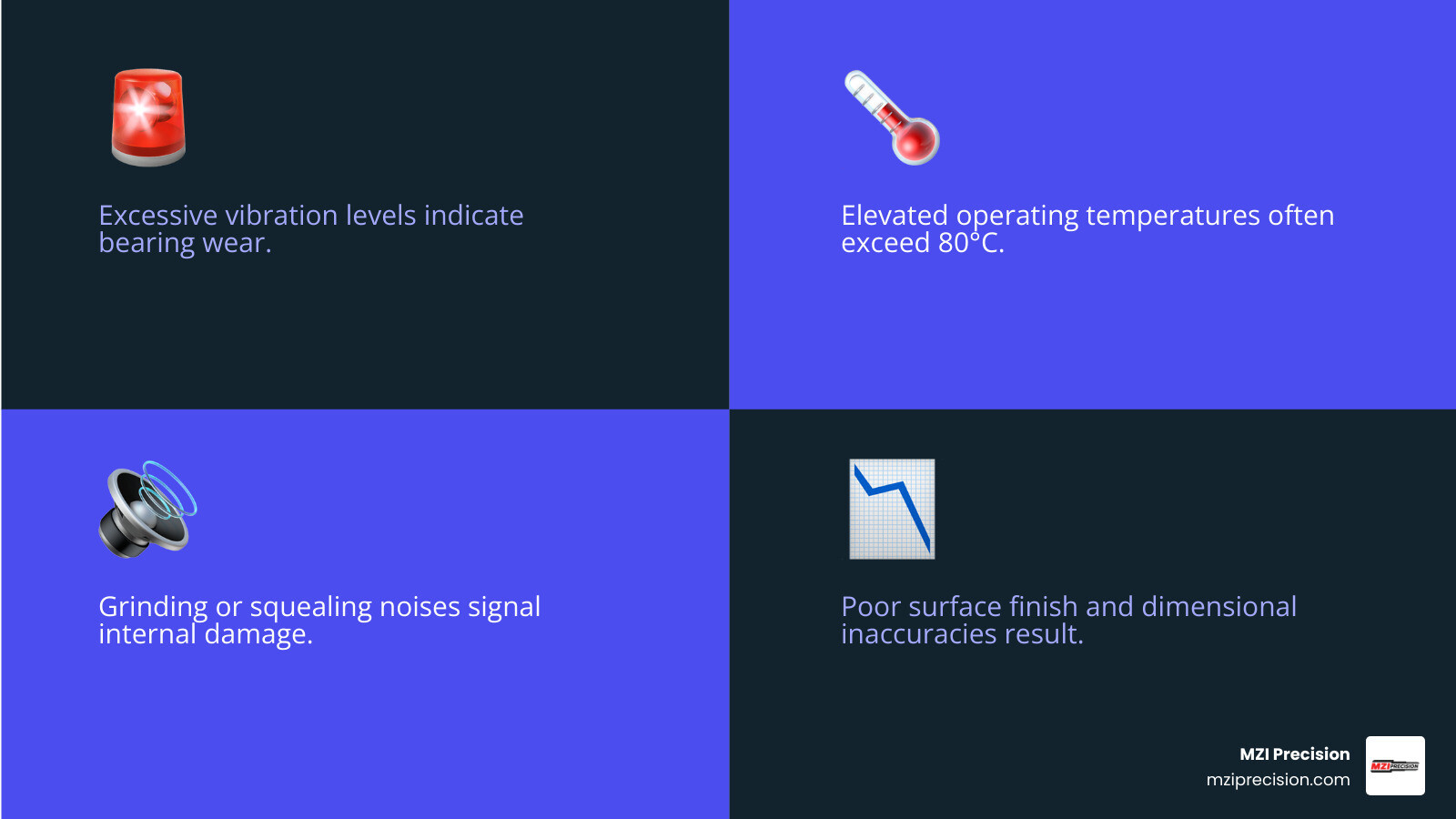
Excessive vibration is probably the most obvious red flag your spindle will wave. As bearings wear down, their internal clearances get sloppy, creating instability that you can literally feel. If your precision industrial spindles are showing vibration levels above 0.5–2 mm/s RMS, it’s time to pay attention. This isn’t just annoying – it’s your spindle crying for help.
Rising operating temperatures tell another important story. Healthy bearings run smooth and cool, typically staying between 40–60°C during normal operation. But when bearings start failing due to wear, contamination, or lubrication problems, internal friction skyrockets. If your spindle temperatures climb above 80°C, consider it a serious warning that something’s going wrong inside those bearing assemblies.
Your ears are surprisingly good diagnostic tools too. Unusual noises like grinding, clicking, or squealing usually mean you’ve got metal-on-metal contact or damaged rolling elements inside your bearings. That high-pitched whine? It could signal inadequate lubrication or excessive preload – either way, it’s not a sound you want to ignore.
Lubrication leaks around your spindle assembly often point to seal failure. When seals wear out, they can’t keep contaminants out or vital lubricants in. This creates a downward spiral that rapidly accelerates bearing degradation – and trust us, you don’t want to let this one slide.
Finally, keep an eye out for contamination signs like dark, discolored grease or metallic particles in your lubricant. Once contaminants get inside your bearings, they act like sandpaper on the internal components, dramatically shortening bearing life.
Using Data to Confirm Bearing Failure
While those physical warning signs are important, modern industrial manufacturing gives us much more precise ways to diagnose bearing problems. Data-driven diagnostics beat guesswork every time.
Vibration analysis is like having X-ray vision for your spindle bearings. By measuring vibration amplitude and analyzing specific fault frequencies, you can pinpoint exactly which bearing element is failing. Different components create distinct vibration signatures – ball pass frequencies, fundamental train frequencies, and shaft rotational frequencies all tell their own stories. This level of analysis lets you predict failures weeks or even months before they cause downtime.
Temperature monitoring provides real-time insights into bearing health. Consistent monitoring helps you establish a baseline for your specific equipment, making it easy to spot deviations that signal trouble brewing.
Spindle runout measurements reveal how much your spindle deviates from perfect rotation. For high-precision spindles, runout exceeding 1–3 microns is a clear signal of bearing wear. You might notice that a spindle rated for 20,000 RPM starts getting unstable above 15,000 RPM as its bearings degrade – that’s runout at work, and precision spindles should typically stay below 1 micron.
Understanding different bearing failure modes – wear, contamination, fatigue, or brinelling – helps you get to the root cause and prevent future problems. Each type of failure has its own signature and implications for your operation, from gradually reduced accuracy to sudden, catastrophic shutdown.
The key is catching these issues early, before they force you into an emergency spindle bearing replacement procedure that could shut down your entire production line.
The Complete Spindle Bearing Replacement Procedure
When it comes to replacing industrial spindle bearings, think of it as performing surgery on the heart of your manufacturing equipment. The spindle bearing replacement procedure demands precision, patience, and the right tools – because one small mistake can turn a routine maintenance job into an expensive nightmare.
Before you even think about touching that spindle, let’s talk about setting yourself up for success. Safety always comes first – and that means having proper safety goggles to protect your eyes from metal shavings, clean gloves to prevent contamination (your skin’s natural oils can cause corrosion), and ear protection for when you’re testing that rebuilt spindle later.
Your tool arsenal should include a comprehensive wrench set, a specialized bearing puller (trust us, you don’t want to try removing bearings without one), and either a hydraulic or mechanical press for precise installation. Precision measuring tools like micrometers and gauges are absolutely critical – this isn’t the time for eyeballing measurements. A calibrated torque wrench rounds out your essential toolkit.
Here’s something many technicians overlook: maintaining an impeccably clean workspace is just as important as having the right tools. Even microscopic contaminants can dramatically reduce the lifespan of your new precision bearings. Think of it as working in a mini clean room – because in many ways, you are.
Step 1: Preparation and Safe Disassembly
Safety isn’t just a suggestion when you’re working with industrial manufacturing spindles – it’s a matter of protecting both yourself and expensive equipment. Lockout/tagout procedures are absolutely non-negotiable. Power down the machine completely and isolate it from all energy sources. We’ve seen too many close calls when someone skipped this step.
Once you’ve secured the machine, drain all coolants and lubricants from the spindle assembly. This prevents messy spills and contamination during disassembly. Pro tip: have plenty of absorbent materials ready – these fluids have a way of getting everywhere.
Documentation during disassembly is your best friend. Take detailed photos or notes at each step. That complex spindle assembly that seems so obvious when you’re taking it apart? It won’t be nearly as clear when you’re putting it back together three days later. Trust the voice of experience here.
Keep small parts organized in labeled containers as you work. There’s nothing worse than spending an hour searching for a tiny but critical component that rolled under your workbench. A controlled, dust-free environment isn’t just recommended – it’s essential for preventing contamination that could sabotage your entire repair effort.
Step 2: Removing the Old Bearings and Inspecting Components
Now comes the detective work. Removing old bearings requires finesse, not force. If components seem stuck, resist the urge to grab a bigger hammer. Instead, use specialized extraction tools like bearing pullers to coax them out without damaging the spindle shaft or housing.
Once those old bearings are out, it’s time for a thorough inspection. Look for scoring, brinelling, or any discoloration on the spindle shaft and housing. These aren’t just cosmetic issues – they’re potential death sentences for your new bearings. Any imperfections you find now could lead to premature failure later.
Cleaning is where patience pays off. Use appropriate solvents to remove every trace of old lubricant, debris, and contaminants. Avoid abrasive materials that could scratch those precision surfaces. Think of it as preparing a canvas – the quality of your preparation directly affects the final result.
Here’s where those precision measuring tools earn their keep. Use micrometers and gauges to verify that components are within the manufacturer’s specified tolerance levels. Deviations here aren’t just numbers on a page – they can prevent proper fitting of new bearings and compromise the entire assembly’s performance.
If you find any burrs on the spindle shaft or keyway, carefully file them down. These seemingly minor imperfections can score new bearings during installation, turning a successful repair into a future failure.
Step 3: Installing the New Spindle Bearings
This is where the rubber meets the road – or more accurately, where precision meets performance. New bearings must be handled like the precision instruments they are.
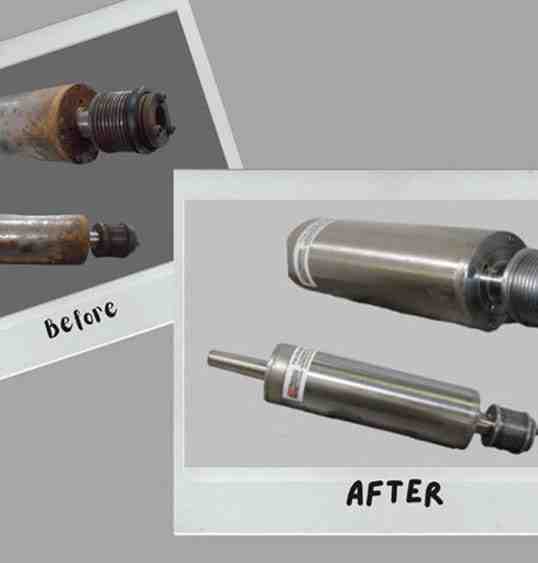
Always handle new bearings with clean, lint-free gloves. Your skin’s natural oils might seem harmless, but they can cause corrosion over time. Never drop or mishandle bearings – even a small impact can cause internal damage that won’t show up until the bearing fails prematurely.
Pre-lubrication is crucial for a successful installation. Use the manufacturer-recommended grease or oil to reduce friction during the initial run-in period. For angular contact bearings, aim for about 15% of the bearing’s internal free volume with grease. Cylindrical roller bearings need slightly less – around 10%.
When it’s time for installation, alignment is everything. Use a hydraulic or mechanical press to seat the bearings with even pressure. Here’s a critical point that can make or break your installation: always press on the correct race. For shaft installations, apply pressure to the inner race. For housing installations, press on the outer race. Never, ever apply force to the rolling elements or cage – this causes immediate damage.
Listen and look for proper seating. You should hear a solid “thud” when the bearing is fully seated, and there should be no visible tilt or misalignment. The new spindle bearing assembly must align perfectly with both the shaft and housing.
Step 4: Reassembly, Testing, and Final Adjustments
The home stretch requires just as much attention to detail as everything that came before. Replace any worn seals and O-rings during reassembly – these small components are your bearings’ first line of defense against contamination.
Proper torque specifications aren’t suggestions – they’re requirements. Use a calibrated torque wrench to tighten all fasteners to the manufacturer’s recommended values. Too loose and components can shift; too tight and you risk distorting bearing raceways or damaging the housing.
The spindle run-in procedure is your victory lap, but take it slowly. Start at low speeds and gradually work up to full operating speed. This allows the new lubricant to distribute evenly and helps bearing components seat properly. Think of it as breaking in a new pair of work boots – rushing the process only leads to problems later.
During run-in, continuously monitor for any unusual noises, vibration, or temperature increases. Use vibration analysis tools and temperature probes to ensure everything operates within acceptable parameters. Measure radial and axial runout to confirm specifications are met.
The ultimate test is a real machining operation. This confirms your spindle’s performance under actual working conditions, verifying surface finish quality and dimensional accuracy. If everything checks out, congratulations – you’ve successfully completed a precision spindle bearing replacement procedure that will keep your manufacturing equipment running smoothly for years to come.
Advanced Considerations for Optimal Spindle Life
Successfully completing the spindle bearing replacement procedure is just the beginning of ensuring your industrial manufacturing equipment runs at peak performance. The real secret to maximizing spindle lifespan lies in understanding the advanced considerations that separate good maintenance from exceptional care.
Think of it this way: replacing bearings is like giving your spindle a new heart, but choosing the right bearings, setting proper preload, and maintaining optimal lubrication is what keeps that heart beating strong for years to come. These decisions directly impact everything from machining accuracy to production uptime.
Professional spindle selection and maintenance requires expertise that goes far beyond basic replacement procedures. That’s where MZI Precision’s comprehensive spindle services become invaluable – our team understands the intricate relationships between bearing types, operating conditions, and long-term performance.
Choosing the Right Bearings for Your Application
Not all bearings are created equal, and choosing the wrong type can lead to premature failure even with perfect installation. The heart of your industrial manufacturing spindle deserves careful consideration.
Angular contact bearings excel in high-speed applications where precise axial and radial load handling is critical. These bearings can handle the complex forces generated during precision machining operations, making them ideal for aerospace and defense manufacturing where tolerances are measured in microns.
Cylindrical roller bearings, on the other hand, shine when heavy radial loads dominate your application. They’re particularly effective in agricultural equipment spindles where robust performance under varying load conditions is essential.
Ball bearings vs. roller bearings each have their sweet spot. Ball bearings typically offer lower friction and higher speed capabilities, while roller bearings provide superior load capacity. The choice depends on your specific operating conditions – speed rating, load capacity, and precision requirements all play crucial roles.
| Feature | Ball Bearings | Roller Bearings |
|---|---|---|
| Primary Contact | Point Contact | Line Contact |
| Load Capacity | Lower | Higher |
| Speed Capability | Higher | Lower |
| Friction | Lower | Higher |
| Best For | High-speed, lower-load applications | High-load, moderate-speed applications |
Hybrid bearings represent the cutting edge of bearing technology, combining ceramic rolling elements with steel races. While they cost more upfront, they offer exceptional performance in high-speed, high-temperature applications common in solar energy manufacturing equipment.
The load capacity and speed rating of your chosen bearings must match your spindle’s operating envelope. Pushing bearings beyond their design limits is a recipe for premature failure, regardless of how perfectly you execute the installation procedure.
The Critical Role of Lubrication and Preloading
Here’s where many maintenance teams get into trouble: improper lubrication causes more bearing failures than all other factors combined. It’s not just about having lubrication – it’s about having the right type, in the right amount, at the right intervals.
Grease vs. oil isn’t just a preference – it’s an engineering decision. Grease offers simplicity and stays where you put it, making it ideal for many industrial applications. Oil provides superior heat dissipation and is essential for high-speed operations, but requires more complex sealing and monitoring systems.
Preload setting is perhaps the most misunderstood aspect of spindle bearing installation. Radial preload affects how well your bearings handle side loads, while axial preload determines your spindle’s ability to maintain position under thrust forces.
Getting preload wrong has serious consequences. Too little preload leads to bearing chatter and poor surface finish quality. Too much preload generates excessive heat and dramatically shortens bearing life. The impact on accuracy and lifespan is immediate and measurable.
Professional preload setting requires specialized tools and deep understanding of bearing mechanics. This is where the expertise of seasoned spindle rebuilders becomes invaluable – they’ve seen the consequences of improper preload settings and know how to get it right the first time.
Proactive Maintenance Practices
The best spindle bearing replacement procedure is the one you never have to perform because your proactive maintenance caught problems early. Smart maintenance teams don’t wait for failures – they prevent them.
Regular inspection schedules should be based on your operating conditions, not calendar dates. A spindle running 24/7 in a demanding aerospace application needs more frequent attention than one used intermittently in lighter-duty work.
Lubrication analysis reveals bearing health before problems become visible. Oil analysis can detect microscopic wear particles weeks before you’d notice performance changes. This early warning system allows for planned maintenance rather than emergency repairs.
Vibration monitoring and temperature monitoring provide real-time insights into spindle health. Modern monitoring systems can detect bearing problems in their earliest stages, when intervention is still possible and cost-effective.
The most successful manufacturing operations understand that spindle maintenance is an investment, not an expense. Learn about our comprehensive spindle services and find how professional maintenance partnerships can transform your equipment reliability.
When you combine proper bearing selection, precise installation procedures, and proactive maintenance practices, you create a synergy that extends spindle life far beyond standard expectations. That’s the difference between running equipment and optimizing performance.