

CNC Spindle Repair Near Me: Getting Your Machine Back on Track
When Your CNC Spindle Goes Down, Every Minute Counts
TITLE: CNC SPINDLE REPAIR NEAR ME: GETTING YOUR MACHINE BACK ON TRACK META DESCRIPTION: DISCOVER HOW TO FIND THE BEST CNC SPINDLE REPAIR NEAR ME. LEARN ABOUT INDUSTRIAL SPINDLE REBUILDING, DIAGNOSTIC TESTING, AND EMERGENCY REPAIR SERVICES.

If you’re looking for CNC spindle repair near me, here’s what you need to know right away:
Quick answers for finding local industrial spindle repair:
- Ship your spindle – Most reputable repair shops accept spindles shipped from anywhere in the U.S., so physical proximity matters less than you might think.
- Look for ISO 9001 certification – This confirms the shop follows a documented, quality-controlled repair process.
- Require clean room assembly – Class 10,000 HEPA clean rooms are the industry standard for precision spindle work.
- Check brand coverage – Top shops service over 350 OEM brands including Mazak, Okuma, Mori Seiki, and Fanuc.
- Ask about rush service – Emergency and expedited repair options are widely available for production-down situations.
- Verify warranty terms – Quality shops offer 6 months to 1 year of warranty coverage on all repair work.
When an industrial CNC spindle fails, production stops. Completely.
There’s no workaround. No temporary fix. The machine sits idle while costs pile up — and every hour without a running spindle is revenue your shop isn’t earning.
The good news: spindle repair is almost always faster and cheaper than buying new. Repaired spindles can cost 20–30% less than a new unit and, with quality parts and proper rebuilding, can last twice as long on average. For aerospace, semiconductor, and defense manufacturers running high-duty-cycle machines, that difference is significant.
The challenge is knowing where to turn — and what to look for in a shop you can actually trust with a precision component this critical.
This guide walks you through everything you need to find, evaluate, and work with a reliable industrial CNC spindle repair provider.
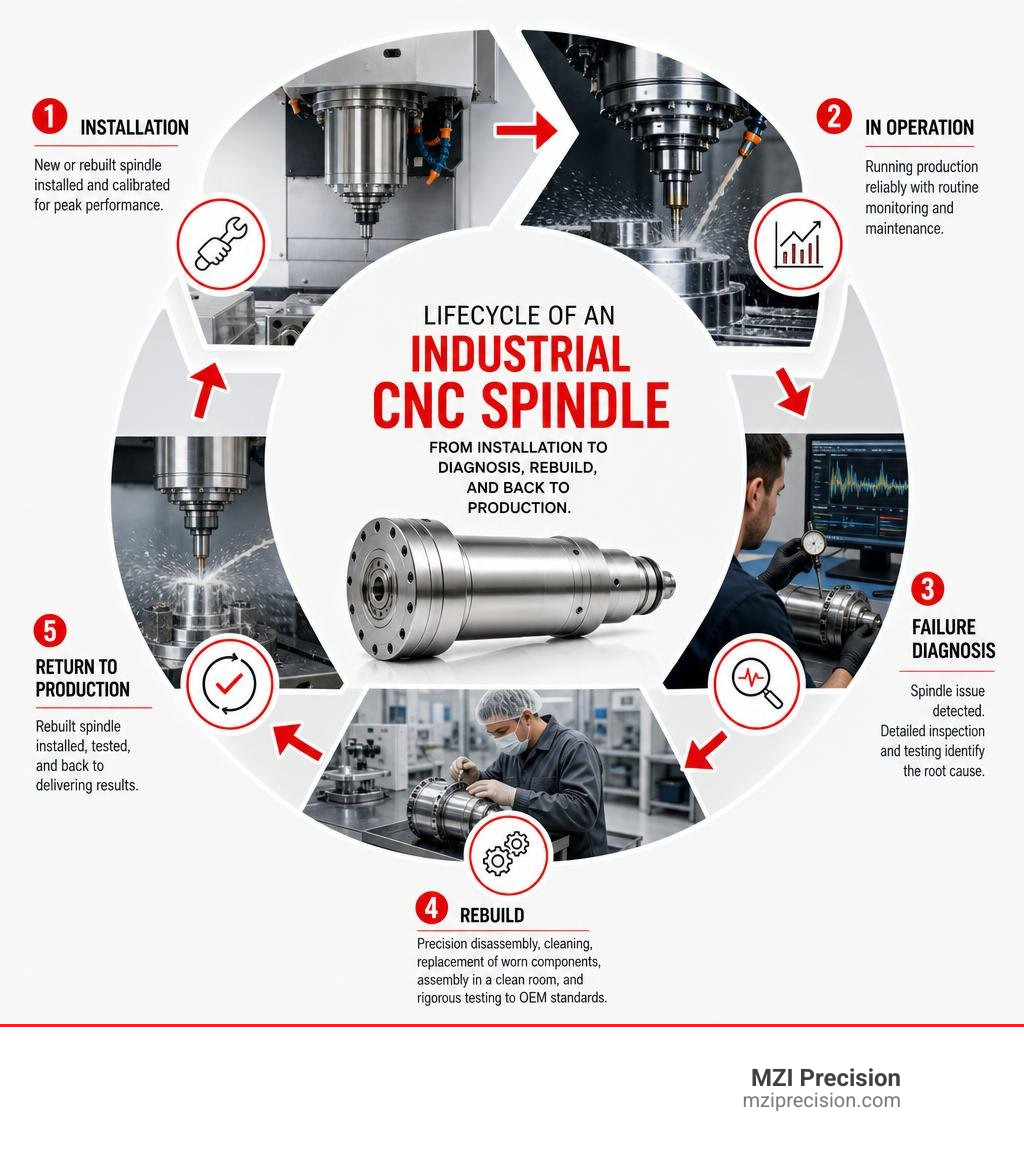
Quick CNC SPINDLE REPAIR NEAR ME definitions:
Understanding Industrial CNC Spindle Repair and Rebuilding
At the heart of every high-precision CNC machine is the spindle. In industrial manufacturing, the spindle is the component that directly dictates the surface finish, dimensional accuracy, and overall quality of your machined parts. Because it operates under immense mechanical and thermal stress, even the most robust industrial manufacturing spindle will eventually require professional attention.

When we talk about industrial CNC spindle repair, we are looking at a highly specialized engineering discipline. It is not a simple matter of swapping out worn parts; it is a meticulous process of restoring the entire rotating assembly to its original design tolerances, often measuring in microns.
Depending on your specific machinery and applications, your facility likely utilizes one of several key spindle configurations:
- Mechanical Spindles: These traditional workhorses rely on external drive systems, such as belts or gears, to rotate the shaft. They are incredibly durable and designed to handle heavy cutting loads, but they are still susceptible to bearing wear and taper damage over time.
- Belt-Driven Spindles: A subset of mechanical spindles, these offer excellent torque transmission at lower to mid-range speeds. When they fail, the issue is often a combination of bearing degradation and belt-tension-induced runout.
- Motorized Spindles: These modern, integrated units house the electric motor directly inside the spindle housing. This design allows for incredibly high speeds and compact footprints, but it also means a repair technician must be an expert in both precision mechanics and electric motor stator rewinding.
- Air-Bearing Spindles: Frequently utilized in ultra-precision environments, these spindles use a thin film of pressurized air instead of physical ball bearings. Because there is no physical contact, they offer sub-micron accuracy and virtually zero friction, but repairing them requires specialized clean-room environments that typical shops simply do not possess.
In high-stakes sectors like aerospace manufacturing, defense electronics, and semiconductor fabrication—which are highly concentrated right here in Southern California—there is zero margin for error. A spindle running with even a fraction of a micron of unauthorized runout can scrap an expensive aerospace alloy or ruin a delicate semiconductor wafer processing tool. Learn more about professional spindle repair to see how these tight tolerances are achieved and maintained.
How to Find a Reliable CNC Spindle Repair Near Me
When your machine tool goes down, your first instinct is likely to pull out your phone and search for a local provider. If your facility is located in Southern California—specifically around the manufacturing hubs of Huntington Beach or Los Angeles—you are in luck. This region is home to some of the most advanced technical facilities in the country.
However, when searching for a partner, you must balance geographic proximity with shipping logistics and technical capability. While having a shop down the street is convenient, shipping a spindle via freight to a highly qualified facility is often much smarter than handing it over to a general machine shop that lacks specialized clean room standards and ISO certifications.
If you are looking to keep your logistics local and want to work with West Coast experts who understand the unique demands of California’s strict manufacturing landscapes, you can Find local spindle repair services in California to ensure your equipment is handled by regional specialists who offer the highest level of technical support.
Evaluating Local CNC Spindle Repair Near Me Facilities
Not all spindle repair shops are created equal. If a shop looks like a dusty, cluttered garage, it is probably not the place to send a high-speed motorized spindle that spins at 24,000 RPM. When evaluating a facility, you should look for several non-negotiable infrastructure standards:
- Class 10,000 HEPA Clean Rooms: Dust is the absolute enemy of precision bearings. Even a single microscopic speck of dust trapped inside a bearing assembly during rebuild can cause premature failure within weeks. A quality facility must assemble spindles in an atmospherically controlled, HEPA-filtered clean room.
- Advanced Metrology Equipment: The shop must have the tools necessary to measure runout, roundness, and balance down to the micron. This includes air gauges, electronic test bars, and load cells.
- In-House Cylindrical Grinding: Over time, spindle tapers wear out or suffer “bell-mouthing.” A top-tier repair shop should have in-house cylindrical grinding machines to restore the critical tool-holder interface without outsourcing the work, which saves you both time and money.
Before committing your valuable machinery to a provider, it is always wise to verify their credentials and industry standing. You can Verify certified local listings on IndustryNet to ensure you are partnering with an established, vetted organization.
Choosing Independent Shops Over OEM Services
When a spindle fails, many shop managers immediately call the Original Equipment Manufacturer (OEM). While this seems like the safest route, it often comes with major drawbacks:
- Excessive Turnaround Times: OEMs are in the business of selling new machines, not necessarily prioritizing rapid repairs. It is not uncommon for an OEM to quote weeks or even months for a standard spindle rebuild.
- Premium Pricing: OEM repairs can be incredibly expensive, sometimes costing nearly as much as a brand-new spindle.
- Rigid Policies: OEMs will often refuse to repair a spindle if they deem it “too old,” forcing you into an expensive upgrade cycle.
By contrast, an independent, high-quality repair shop offers complete manufacturer independence. Whether you run a Mazak, Okuma, Mori Seiki, Fanuc, or Haas, an independent specialist can service them all under one roof.
Furthermore, independent shops can perform custom upgrades that the OEM won’t offer—such as upgrading standard steel bearings to high-performance ceramic bearings, installing improved air purge systems to prevent coolant ingression, or applying encapsulated windings to protect motorized stators from moisture. To weigh your options carefully, you can Read everything you need to know about CNC spindle repair shops.
Common Signs of Industrial Spindle Failure and Diagnostic Testing
Spindles rarely fail without warning. Usually, they drop subtle (and sometimes not-so-subtle) hints that something is going wrong inside the housing. Paying attention to these warning signs can mean the difference between a simple bearing swap and a catastrophic failure that ruins your entire spindle shaft.
Keep an eye and ear out for the following indicators:
- Unusual Noise: If your spindle starts whining, grinding, or buzzing, the bearings are likely failing.
- Excessive Vibration: Increased vibration degrades the surface finish of your machined parts and accelerates wear on the entire machine tool.
- Thermal Expansion (Overheating): If the spindle housing feels unusually hot to the touch or your machine’s thermal sensors are triggering alerts, it indicates friction buildup from failing lubrication or overloaded bearings.
- Runout Errors: If you notice your parts are losing dimensional accuracy or your tooling is wearing out prematurely, spindle taper runout is a likely culprit.
- PLC Error Codes: Modern CNC controllers will throw specific spindle-related alarms when they detect electrical resistance, over-current, or encoder feedback issues.
- Drawbar Force Loss: If the internal spring pack loses tension, the spindle won’t hold the tool holder securely, leading to tool chatter and severe machining errors.
If you are noticing any of these issues on your shop floor, do not wait for the machine to seize. Explore comprehensive CNC spindle repair options to address these symptoms before they turn into a complete production shutdown.
Advanced Diagnostic and Testing Protocols
A professional repair process always begins with comprehensive diagnostics. Rather than guessing what is wrong, technicians utilize advanced testing protocols to pinpoint the exact failure mode:
- Vibration Analysis: By placing accelerometers on the spindle housing, we can read the vibration signature. This tells us precisely which bearing is failing and whether the issue is imbalance, misalignment, or mechanical looseness.
- Dynamic Balancing: To eliminate vibration at operating speeds, the entire rotating assembly must be dynamically balanced. High-quality shops balance spindles to 0.3 G’s or better at maximum rated RPM.
- Run-In Testing: Before a spindle is returned to you, it must undergo a rigorous run-in test. The spindle is run progressively up to its maximum speed while technicians monitor temperature stabilization and vibration levels.
- Stator Winding Analysis: For motorized spindles, electrical testing of the stator windings is critical to check for insulation breakdown or short circuits caused by coolant ingression.
For high-speed applications, these testing protocols must meet incredibly strict guidelines. You can Learn about high-speed spindle repair standards to see how precision balancing protects your high-RPM operations.
The Technical Process: Repair vs. Rebuild vs. Replacement
When your spindle arrives at a certified facility, the engineering team must determine the best course of action. It helps to understand the distinct differences between a quick repair, a complete rebuild, and a full replacement:
| Service Option | What It Involves | Typical Cost | Best For |
|---|---|---|---|
| Spindle Repair | Targeted fix of a specific issue (e.g., replacing a damaged seal or correcting minor taper runout). | Lowest | Minor, isolated issues where the bearings are still in excellent condition. |
| Spindle Rebuild | Complete disassembly, thorough cleaning, replacement of all bearings, seals, and O-rings, taper grinding, drawbar service, and full dynamic balancing. | Moderate (20-30% less than new) | High-mileage spindles, general wear-and-tear, or after a minor crash. Restores to OEM specs. |
| Spindle Replacement | Scrapping the old unit and purchasing a brand-new spindle from the OEM. | Highest | Catastrophic structural failures (e.g., cracked housing or shattered shaft) where rebuilding is physically impossible. |
During a standard rebuild, the spindle undergoes a meticulous journey. It is completely disassembled, and every component is geometrically inspected. Precision cylindrical grinding is used to restore worn tapers, new matched bearing sets are installed with exact factory preloads, and the entire unit is dynamically balanced before final quality control testing.
If your business operates across state lines or you have regional facilities in neighboring states, you can Find spindle repair services in Arizona to keep your Southwestern production lines running smoothly.
Emergency CNC Spindle Repair Near Me Options
We understand that when a primary production machine goes down, you don’t have weeks to wait. That is why top-tier independent repair shops offer expedited and emergency services.
In a production-down situation, your spindle is given immediate priority. Technicians work overtime to tear down, diagnose, and rebuild your unit, often cutting turnaround times down to just a few days.
Additionally, some shops offer spindle exchange programs. Under this model, you are shipped a pre-rebuilt, OEM-spec spindle immediately so you can get back to work within 24 to 48 hours. Once installed, you ship your damaged spindle back to the shop as a “core” return. This is the ultimate way to minimize costly downtime. If you are currently facing a critical shutdown, do not hesitate to Request emergency CNC spindle repair to get your operations back online immediately.
Frequently Asked Questions About CNC Spindle Repair
To help you make the best decision for your manufacturing facility, we’ve compiled some of the most common questions we receive from shop managers regarding industrial spindle rebuilding and maintenance. For a deeper dive, you can also Access our local CNC spindle repair near me guide.
How long does a typical industrial spindle repair take?
A standard, non-emergency rebuild typically takes 1 to 3 weeks, depending on the complexity of the spindle and the availability of replacement parts (such as specialized precision bearings). However, for urgent “machine down” situations, expedited services can reduce this timeline to 2 to 5 business days. If a spindle exchange program is available for your specific machine model, you can often have a replacement spindle on your floor within 24 hours.
What is the average cost of rebuilding a CNC spindle?
Because every spindle failure is unique, pricing is determined after a thorough physical evaluation. The cost depends heavily on the spindle’s make, model, operating speed, and the extent of the internal damage. Generally, a professional rebuild costs 20% to 30% less than purchasing a brand-new spindle from the OEM. This represents thousands of dollars in direct savings, not to mention the secondary savings of getting your machine back in production weeks faster than waiting on an OEM shipment.
What warranty coverage should a quality repair shop offer?
Any reputable spindle repair provider should stand behind their work with a solid warranty. A quality shop will offer a 6-month to 1-year warranty covering both workmanship and replaced components. Crucially, you should ask when the warranty begins; top-tier shops will start the warranty period when the spindle is delivered or installed on your machine floor, rather than the date it was repaired or shipped from the facility, ensuring you get full, fair coverage.
Conclusion
Your CNC spindle is the mechanical heart of your industrial manufacturing operation. When it fails, you don’t just need a quick fix—you need an engineering partner who can restore your equipment to OEM-specification accuracy and reliability.
At MZI Precision, we specialize in the meticulous rebuilding and repairing of high-precision industrial manufacturing spindles. Serving critical industries across California—including aerospace, defense, and semiconductor manufacturing—we combine state-of-the-art metrology, clean-room assembly, and decades of technical expertise to deliver rebuilds that perform as good as, or better than, new.
By utilizing advanced diagnostics and predictive maintenance advice, we don’t just fix your current problem; we help you prevent future failures and maximize your spindle’s operating life.
Don’t let spindle downtime drain your shop’s profitability. Contact our specialists for a custom spindle repair quote today, and let us get your production line back on track.