


Spindle Grinding: Flawless Precision 2025
Why Spindle Grinding is Critical for Manufacturing Precision
Spindle Grinding is a specialized machining process that restores worn or damaged industrial manufacturing spindles to their original precision specifications. This process uses high-speed grinding wheels with abrasive materials to remove metal and achieve extremely tight tolerances.
Key Facts About Spindle Grinding:
- Purpose: Restores spindle accuracy and extends equipment life
- Tolerance: Achieves precision within 0.0001 inches (0.0025mm)
- Types: Includes ID grinding, OD grinding, thread grinding, and tapered grinding
- Benefits: Reduces downtime, saves costs compared to replacement
- Service Options: Available both in-shop and on-site at your facility
Manufacturing companies in aerospace, medical devices, and precision machining rely on spindle grinding to keep their equipment running at peak performance. When a spindle loses its precision due to wear, heat damage, or contamination, grinding can often restore it to like-new condition.
The process requires specialized equipment, expert knowledge, and years of experience. A poorly ground spindle can cause vibration, poor surface finishes, and premature tool wear – making professional service essential.
On-site spindle grinding has become increasingly popular because it eliminates the need to remove heavy spindles from machines. This approach can cut repair time from weeks to days while maintaining the same precision standards.
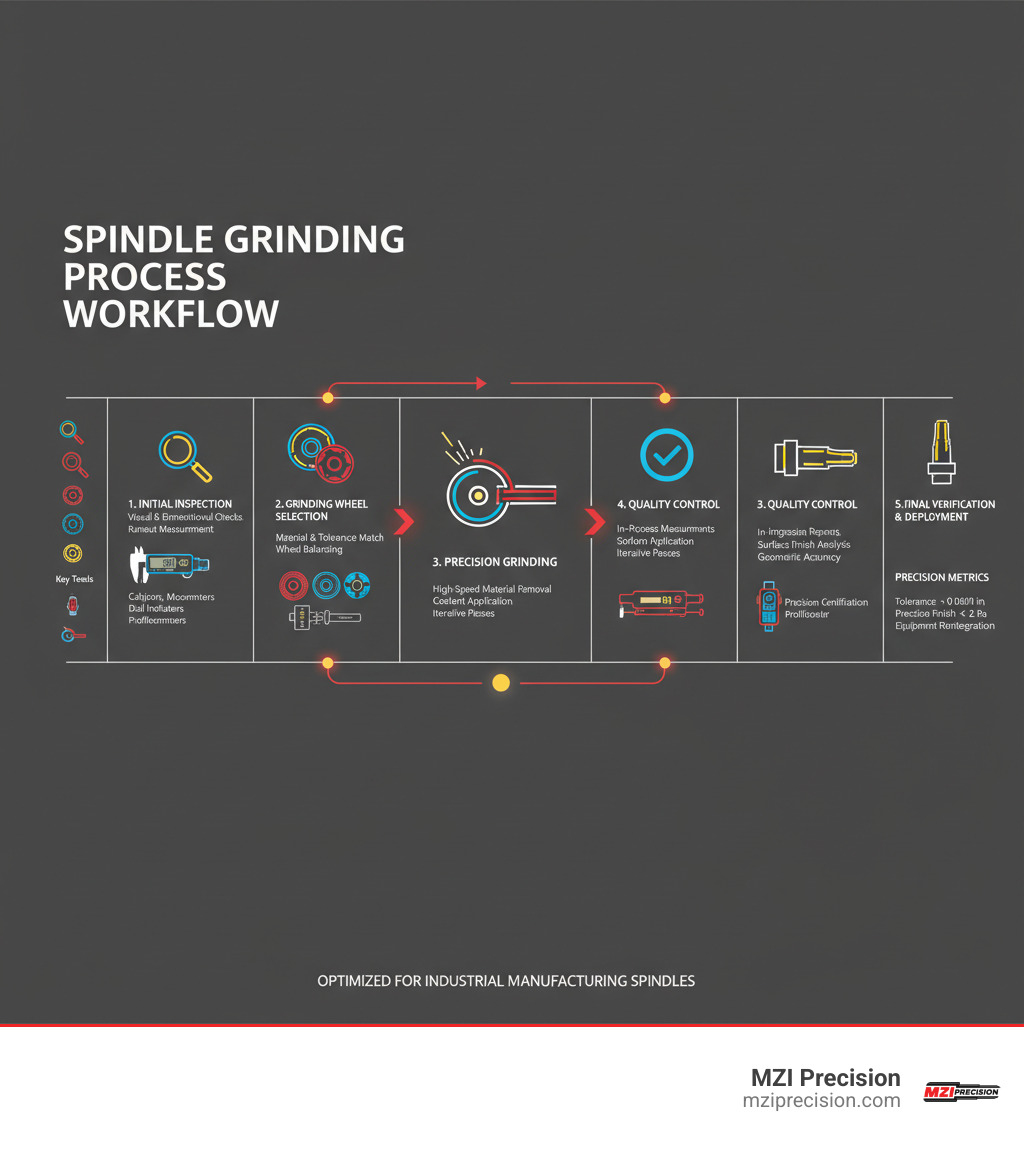
Understanding Spindle Grinding
Spindle Grinding is essentially a high-tech restoration process for industrial manufacturing spindles. Picture this: your spindle has been working hard for months or years, and like any hardworking piece of equipment, it’s showing signs of wear. That’s where we come in with our grinding expertise.
The process falls under what we call subtractive manufacturing – which is a fancy way of saying we carefully remove tiny amounts of material to bring your spindle back to life. Unlike additive processes that build things up, we’re precision sculptors who take away just the right amount to restore perfect function.
Here’s how the magic happens: We use high-speed grinding wheels that spin at incredible speeds. These aren’t your average workshop grinding wheels – they’re specialized tools covered with millions of super-hard abrasive grains. When these wheels make contact with your spindle’s surface, they methodically remove microscopic amounts of material.
This controlled grinding process allows us to correct all sorts of problems that develop over time. We’re talking about issues like runout, taper, and surface irregularities that happen naturally from constant use, heat exposure, or the occasional bump that happens in busy manufacturing environments.
The precision we achieve is honestly pretty amazing. We regularly hit tolerances within 0.0001 inches – that’s thinner than a human hair! This level of accuracy isn’t just impressive; it’s absolutely essential for industries where even the tiniest deviation can mean the difference between a perfect part and a costly reject.
For aerospace and medical device manufacturers, this kind of precision isn’t optional – it’s mission-critical. When your spindle performs at this level, every part that comes off your machine meets those demanding quality standards your customers expect.
Types of Spindle Grinding
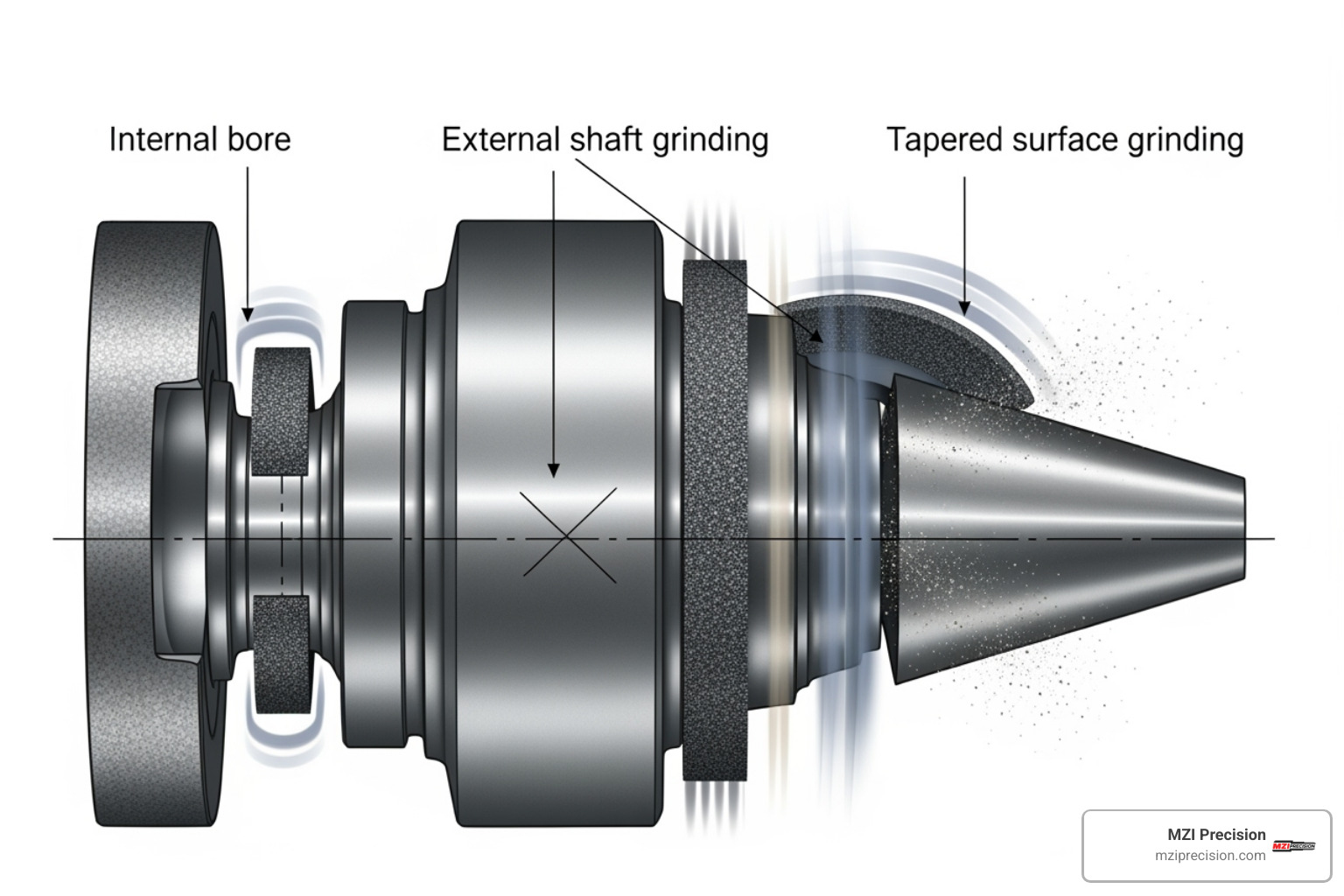
When it comes to spindle grinding, there’s no one-size-fits-all approach. Just like a master craftsman selects the right tool for each job, we use different grinding techniques depending on what part of your industrial manufacturing spindle needs attention. Each method has its own specialty, and knowing which one to use makes all the difference between a good repair and a great one.
ID grinding tackles the inside story of your spindle. This internal diameter grinding focuses on all those critical interior surfaces – the bore holes where bearings live, the taper bores that need perfect geometry, and any internal features that must be precisely sized. It’s like working inside a narrow tunnel, requiring specialized equipment and a steady hand. When these internal surfaces are off even slightly, your bearings won’t seat properly, and that leads to vibration, noise, and early failure.
The external surfaces get their turn with OD grinding. This outer diameter grinding method handles everything you can see from the outside – straight shafts, journals, and external tapers. Think of it as giving your spindle a perfect shave. The goal is achieving perfect concentricity, which means your spindle will rotate around its center axis without any wobble. When we get this right, everything runs smoothly and your other machine components last longer.
Thread grinding comes into play when your industrial manufacturing spindle has precision threads that need restoration. Regular cutting methods just can’t deliver the accuracy these applications demand. We’re talking about threads that need exact pitch, lead, and form tolerances. These aren’t your everyday hardware store threads – they’re precision components that must be perfect for secure clamping and precise movement.
Tapered grinding deserves special attention because so many spindles rely on tapered connections. Whether it’s HSK, CAT, or another taper system, these conical surfaces must be absolutely perfect. The angle has to be exact, the surface finish must be just right, and everything needs to be concentric. A worn or inaccurate taper means tools that chatter, lose precision, or worse – come loose during operation.
Finally, gear grinding handles those integrated spindle units where gears are part of the assembly. While not every spindle needs this service, when it’s required, it’s critical. We refine tooth profiles to ensure smooth meshing, reduce noise, and extend the life of the entire drive system. It’s all about making those gears work together like a well-rehearsed orchestra.
The Importance of On-Site Spindle Grinding
Picture this: it’s Tuesday morning, and your most critical production line just went quiet. A key industrial manufacturing spindle has failed, and suddenly you’re staring down weeks of costly downtime. Here’s where on-site spindle grinding becomes your manufacturing superhero – cape optional, results guaranteed.
Traditional spindle repair means playing a waiting game nobody wants to win. First, you shut down the machine. Then comes the complex dance of disconnecting electrical systems, hydraulic lines, and pneumatic connections. Next, you need specialized equipment to carefully remove a spindle that might weigh hundreds or even thousands of pounds. After that? Pack it up, ship it out, and cross your fingers nothing gets damaged in transit.
Our mobile service flips this entire process on its head. Instead of bringing your spindle to us, we bring our expertise directly to your factory floor. Think of it as having a precision machine shop roll up to your door, complete with all the specialized equipment needed for in-plant grinding.
The time savings alone can be staggering. What traditionally takes weeks – removal, shipping, repair, return shipping, and reinstallation – can often be completed in just a few days with on-site service. We’re talking about reduced downtime that can literally save your production schedule and keep your customers happy.
But let’s talk about the real winner here: your bottom line. Cost savings start piling up from day one. You eliminate expensive rigging and transportation costs. No need for specialized shipping containers or insurance for valuable equipment in transit. Plus, you avoid the labor costs of complex machine disassembly and reassembly.
The risk factor drops dramatically too. Heavy industrial manufacturing spindles don’t enjoy travel – they’re precision instruments that can be damaged by vibration, impacts, or improper handling during shipping. When we perform the work right where your spindle lives, we eliminate these risks entirely.
At MZI Precision, we’ve seen how on-site spindle grinding transforms what could be a manufacturing nightmare into a manageable maintenance event. Whether you’re in aerospace, defense, or solar energy, keeping your production lines running isn’t just about fixing problems – it’s about fixing them fast, efficiently, and with the precision your industry demands.
Techniques and Tools for Spindle Grinding
The precision we achieve in spindle grinding doesn’t happen by accident. It’s the result of carefully selecting the right tools and mastering techniques that have been refined over decades. Think of it like a master chef who knows exactly which knife to use for each cut – except we’re working with tolerances that would make a Swiss watchmaker jealous.
Grinding wheels are the stars of our show, and they’re far more sophisticated than most people realize. These aren’t just rough discs that scrape away metal. Each wheel is engineered with specific materials like aluminum oxide, silicon carbide, cubic boron nitride (CBN), or industrial diamonds. The choice depends entirely on what your spindle is made of and what we’re trying to achieve. It’s like matching the right medicine to the patient – get it wrong, and you won’t get the results you need.
The real magic happens at the microscopic level with abrasive grains. Picture millions of tiny cutting tools, each one smaller than you can see, working together to shave away material with incredible precision. Coarser grains work like a rough saw – they remove material quickly but leave a rougher surface. Finer grains are more like a delicate scalpel, creating that mirror-smooth finish but taking their time to do it right. Our expertise lies in knowing exactly which grain size to use at each stage of the process.
What holds all those abrasive grains together? That’s where bond types come into play. The bond material – whether it’s vitrified ceramic, resinoid, rubber, or metal – determines how the wheel behaves under pressure. A good bond knows when to hold tight and when to let go, releasing worn-out grains to expose fresh, sharp ones underneath. It’s like having a smart assistant that knows exactly when to step in and when to step back.
Here’s something most people don’t know about: dressing the grinding wheel. No, we’re not putting a tuxedo on it! Dressing is how we keep the wheel in peak condition. Over time, even the best grinding wheels get dull or slightly out of shape. We use specialized tools to carefully remove those worn grains and true up the wheel’s geometry. This step is absolutely critical for maintaining those ultra-tight tolerances that make your industrial manufacturing spindles perform like new again.
Every technique we use is aimed at one goal: bringing your spindle back to specifications that meet or exceed the original manufacturer’s standards. It’s precision work that requires both the right tools and the experience to use them properly.
Frequently Asked Questions about Spindle Grinding
Over our years of working with spindle grinding and repair, we’ve noticed that our clients often have similar questions. It’s completely natural – after all, these are complex pieces of equipment that are critical to your operation! Let’s explore some of the most common questions we hear.
What is a grinding spindle?
This is one of those questions that can be a bit confusing because the terminology sounds similar. When we talk about spindle grinding, we’re referring to the process of repairing and restoring your industrial manufacturing spindles. But a grinding spindle is actually a completely different animal – it’s a high-speed tool that’s part of the grinding machine itself.
Think of a grinding spindle as the powerhouse behind the grinding wheel. It’s what holds and spins that abrasive wheel at incredibly high speeds, sometimes tens of thousands of RPMs. Just like the spindles we repair for you, a grinding spindle needs to be absolutely precise. Any wobble or inaccuracy would ruin the entire subtractive manufacturing process we use to restore your equipment.
It’s actually pretty fascinating – we use one type of precision spindle to fix another type of precision spindle. Both need to work flawlessly for the magic to happen!
How do I know if my spindle is damaged?
Your industrial manufacturing spindle is usually pretty good at letting you know when something’s wrong. The trick is learning to recognize the warning signs before a small problem becomes a big, expensive headache.
Noise is often the first clue. If your spindle starts making sounds it didn’t make before – maybe a high-pitched whine, grinding, or even a rhythmic knocking – that’s your spindle’s way of asking for help. These unusual sounds typically point to bearing wear or internal damage that’s getting progressively worse.
Vibration is another telltale sign that something’s not right. You might feel it through the machine frame, or you might notice it in the quality of parts you’re producing. When a spindle starts vibrating excessively, it’s like a ripple effect that impacts everything downstream.
Heat is your friend when it comes to diagnosis. A spindle housing that feels unusually hot to the touch, especially after normal operation, is often crying out for attention. This excessive heat usually means bearings are failing or there’s insufficient lubrication causing internal friction.
The effects show up in your work too. If your parts suddenly have rougher surfaces, chatter marks, or are falling out of tolerance, your spindle might be the culprit. Similarly, if your cutting tools are wearing out faster than usual, a wobbly spindle could be putting extra stress on them.
What are the symptoms of spindle bearings?
Here’s where things get really interesting, because spindle bearings are often the root cause of most spindle problems. These tiny but critical components are what allow your spindle to rotate smoothly and maintain incredible precision. When they start to fail, they create a domino effect of issues.
Parts finish problems are usually one of the first things you’ll notice. When bearings lose their precision, the spindle can’t hold its position accurately, leading to inconsistent cutting action. Your parts might develop chatter marks, poor surface quality, or dimensional inconsistencies that weren’t there before.
Toolholders sticking is another frustrating symptom that points directly to bearing issues. If you’re suddenly struggling to insert or remove toolholders from your spindle taper, or they feel like they’re seized in place, that’s often a sign of bigger problems brewing.
Fretting is a particularly nasty issue that develops when bearings can’t maintain proper rigidity. You’ll see reddish-brown marks or small pits on your spindle taper or toolholder. This happens when there are tiny, repetitive movements between surfaces that should be rock-solid. It’s like metal fatigue, but in microscopic movements that add up over time.
The key is catching these symptoms early. The sooner you address bearing-related issues, the more likely we can restore your spindle through spindle grinding rather than requiring a complete rebuild.
Conclusion
When we step back and look at the bigger picture, spindle grinding isn’t just another maintenance task – it’s the lifeline that keeps your entire operation running smoothly. When even the tiniest deviation can mean the difference between a perfect part and costly scrap, this precision restoration process ensures your industrial manufacturing spindles continue to deliver the accuracy you absolutely depend on.
Think about it: your spindles are working hard every single day, spinning at incredible speeds and handling enormous forces. Over time, they’re bound to show some wear. That’s not a failure – that’s just physics! The beauty of spindle grinding is that it gives these hardworking components a second life, often making them perform even better than when they were new.
The game-changer here is on-site service. Gone are the days when a spindle problem meant weeks of downtime while you dealt with the headache of shipping heavy machinery back and forth. When we bring our expertise directly to your facility, we’re not just saving you time – we’re saving you money, stress, and the countless complications that come with traditional repair methods.
At MZI Precision, we understand that you’re not just looking for someone to fix a broken part. You need a partner who gets how critical these components are to your success. Whether you’re manufacturing precision parts for aerospace applications, defense systems, or solar energy equipment, we know that downtime isn’t just inconvenient – it’s costly.
Our commitment goes beyond simply restoring your industrial manufacturing spindles to their original specifications. We’re here to give you peace of mind, knowing that when precision matters most, you have a team of experts ready to help. After all, when your spindles are running perfectly, everything else falls into place. And that’s exactly what we’re here to deliver – exceptional service that keeps your operation moving forward.