


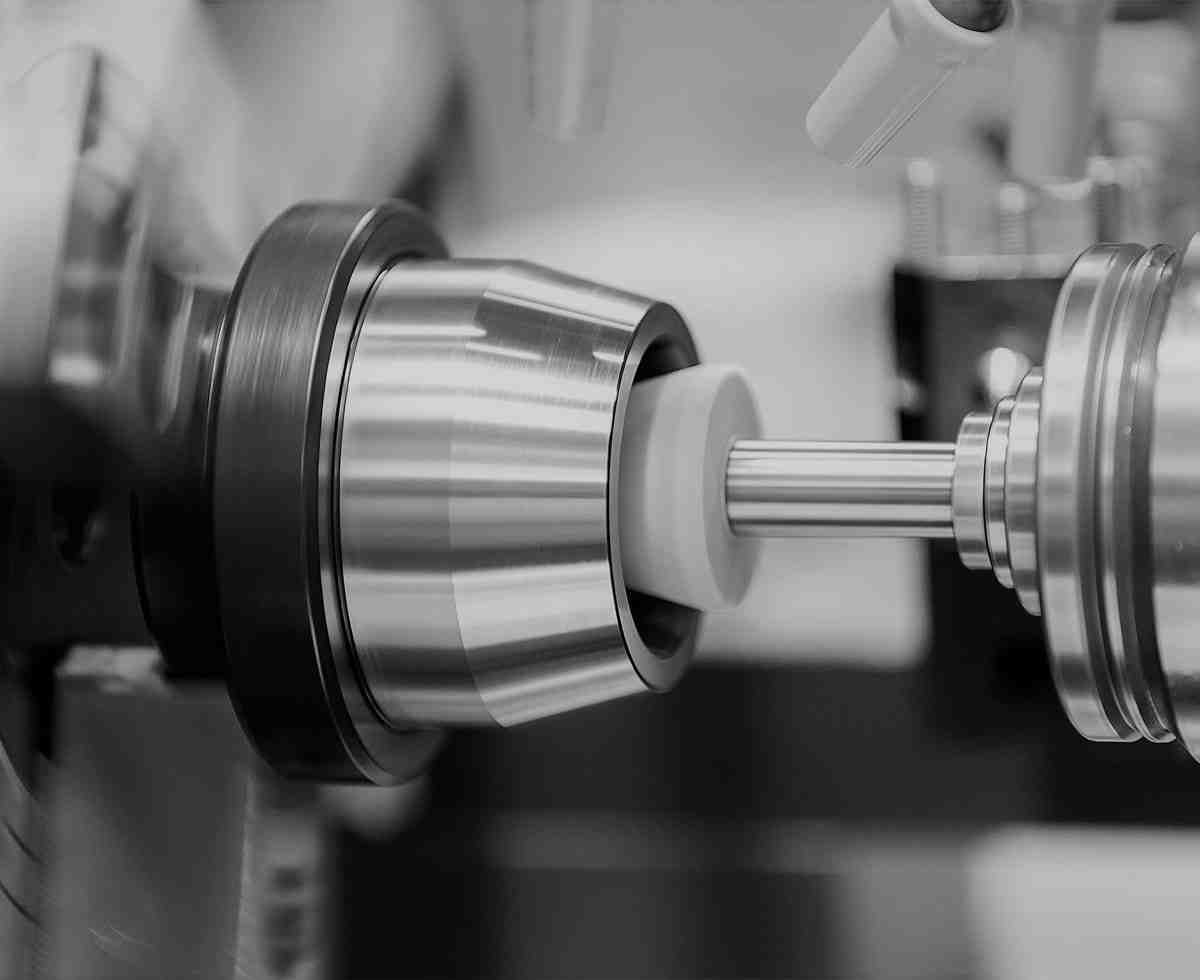
CNC Precision Grinding: Mastering Unrivaled Accuracy 2025
WHY CNC PRECISION GRINDING MATTERS IN MODERN MANUFACTURING
CNC precision grinding is an advanced manufacturing process using computer-controlled abrasive wheels to achieve tolerances as tight as ±0.001 mm and surface finishes smoother than Ra 0.1 micrometers. It is the essential final step in creating high-precision components for demanding industries like aerospace, medical, and industrial machinery.
QUICK ANSWER: WHAT IS CNC PRECISION GRINDING?
- Process: Automated abrasive machining controlled by computer programming.
- Accuracy: Achieves tolerances within ±0.001 mm.
- Surface Quality: Produces mirror-like finishes (Ra ≤0.1μm).
- Applications: Hard materials, complex geometries, and critical components.
- Key Advantage: Removes microscopic amounts of material with extreme precision.
When a part must be flatter than 0.002mm per meter or have roundness within 0.5 micrometers, CNC precision grinding is often the only solution, as traditional methods like milling or turning cannot hold such tight tolerances. The process has evolved from manual operations to fully automated systems where software controls every variable, from wheel speed to coolant flow.
Unlike CNC milling, which cuts with a sharp tool, grinding uses an abrasive wheel to shear away microscopic particles. This makes it ideal for hardened steels, ceramics, and other materials that would destroy conventional cutting tools.
The stakes are high. A turbine blade with the wrong tolerance can cause catastrophic failure in aerospace. In medical devices, surgical tools need ultra-smooth surfaces for sterilization. For industrial manufacturing spindle repair, precision grinding is key to meeting OEM specifications for reliable performance.
This guide covers the principles, machines, and techniques of CNC precision grinding.
THE CORE OF CNC PRECISION GRINDING: PRINCIPLES AND PROCESSES
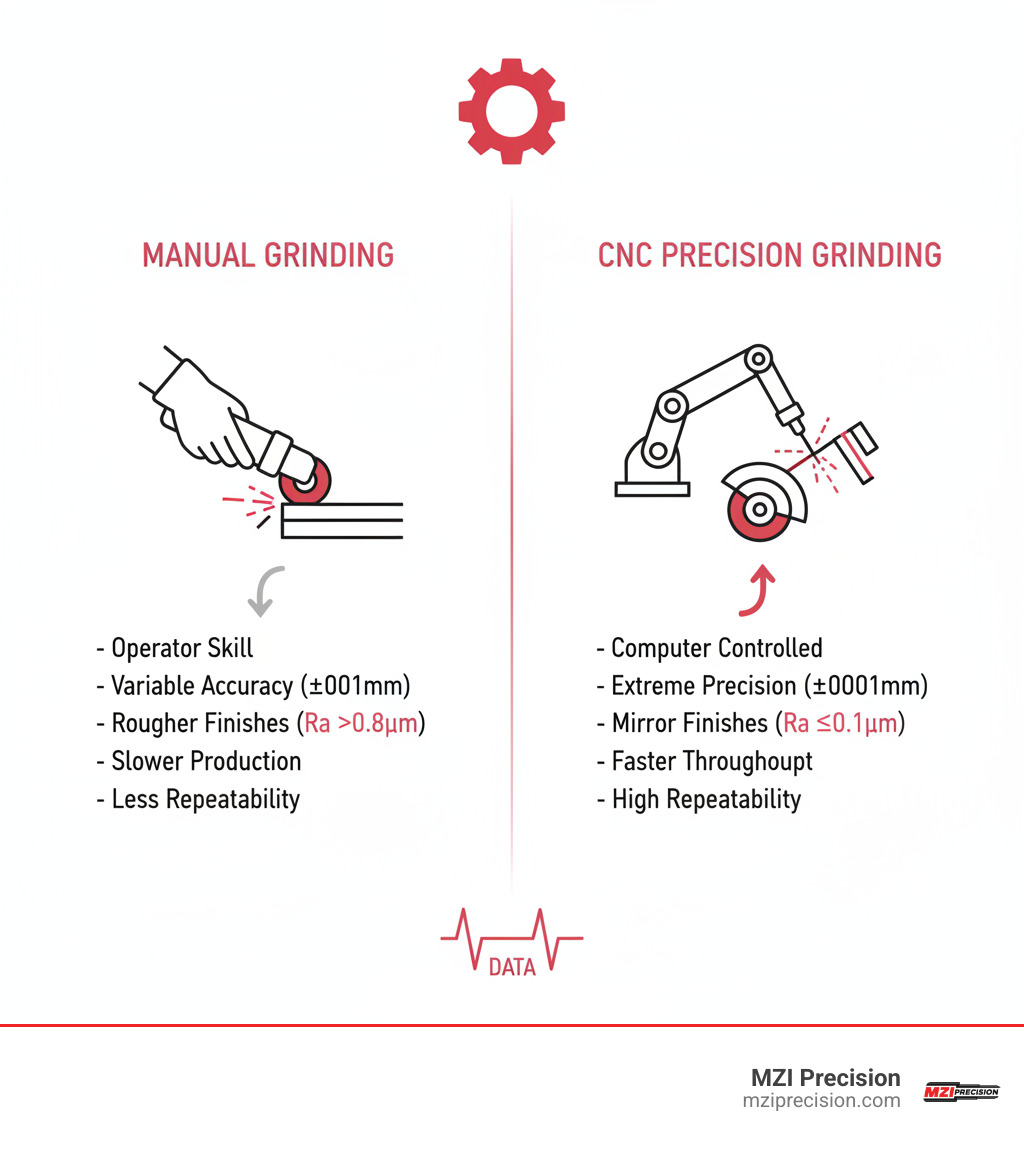
CNC precision grinding translates the art of manual grinding into a repeatable, mathematical science. Where traditional grinding relied on an operator’s feel, CNC uses Computer Numerical Control to execute flawless operations based on G-code programming generated from CAD/CAM software. This code dictates every movement, speed, and material removal amount down to the micrometer, achieving a level of precision physically impossible to replicate by hand.
A CNC grinding machine’s core components work in harmony. A rigid frame provides stability against vibrations, a workhead fixture holds the part securely, and the grinding wheel head controls the abrasive wheel’s movement. The spindle in a CNC machine is critical here; any wear or runout will destroy accuracy. The CNC controller acts as the brain, while a coolant system manages heat and removes swarf (material particles).
Grinding’s material removal mechanism is what sets it apart. Instead of slicing large chips like a milling machine, grinding uses an abrasive wheel with countless microscopic cutting grains. Each grain shears off tiny particles, making the process ideal for hard materials like hardened steels, ceramics, and carbides that would break conventional tools. This slow, deliberate removal is perfect for achieving tolerances measured in thousandths of a millimeter. For more detail, see these precision grinding fundamentals.
HOW A CNC GRINDING PROCESS WORKS
The journey from a digital design to a finished component is a highly controlled sequence:
- Part Design: An engineer creates a detailed CAD drawing with all dimensions and surface requirements.
- Toolpath Generation: In CAM software, the grinding strategy is defined, including wheel selection and the precise paths it will follow. Simulations can catch errors before production begins.
- G-Code Output: The CAM software generates the G-code, the instruction set for the CNC machine.
- Machine Setup: An operator mounts the correct wheel, secures the workpiece, and calibrates the machine.
- Grinding Cycle: The CNC controller executes the program. The wheel removes microscopic material layers while coolant prevents thermal damage.
- In-Process Measurement: Advanced machines use probes or lasers to monitor dimensions in real-time, allowing the controller to make micro-adjustments for perfect consistency.
- Final Inspection: High-precision measuring tools verify that all specifications have been met.
KEY ADVANTAGES: PRECISION, EFFICIENCY, AND VERSATILITY
The benefits of CNC precision grinding are essential for high-stakes manufacturing.
- Remarkable Precision: Achieves tolerances as tight as ±0.001 mm and surface finishes of Ra 0.1 micrometers or better. This creates truly flat or round surfaces essential for high-performance parts.
- Superior Surface Finish: An ultra-smooth surface reduces friction, improves wear resistance, and is critical for parts that require a perfect seal or biocompatibility in medical applications.
- Flawless Repeatability: A perfected CNC program produces thousands of identical parts, locking in quality regardless of operator or shift. This consistency is a cornerstone of modern manufacturing economics.
- Increased Efficiency: Automated cycles are much faster than manual grinding. Single-setup operations reduce handling, minimize damage risk, and lower the cost per part.
- Hard Material Versatility: Grinding excels with materials that are too hard for conventional machining, such as hardened tool steels, aerospace alloys, ceramics, and carbides.
- Complex Geometries: Multi-axis CNC grinders can create internal contours, curved profiles, and compound angles in a single setup, enabling designs that would otherwise be impractical.
These advantages make CNC precision grinding indispensable in industries where performance and reliability are non-negotiable, aligning with global quality standards like ISO 9001.
TYPES OF CNC GRINDING MACHINES AND THEIR APPLICATIONS
Different workpiece shapes and production needs require different types of CNC precision grinding machines. Choosing the right one is critical, and in every case, the health of your precision grinding spindles is paramount to success. A worn spindle will negate the benefits of even the most advanced machine.
| Grinding Type | Workpiece Shape | Typical Applications | Achievable Tolerances |
|---|---|---|---|
| Surface Grinding | Flat surfaces | Die plates, mold components, machine tool guideways | Flatness ≤0.002mm/m, Ra 0.4-1.6μm |
| Cylindrical Grinding | External cylindrical surfaces | Shafts, spindles, bearing races | Roundness ≤0.5μm, ±0.003mm |
| Internal Grinding | Internal cylindrical surfaces | Bearing races, hydraulic sleeves | Aperture ±0.005mm, Ra 0.1-0.4μm |
| Centerless Grinding | External cylindrical surfaces (high volume) | Rods, pins, rollers | Diameter ±0.002mm, Roundness <1μm |
SURFACE GRINDING
Surface grinding creates exceptionally flat surfaces, achieving tolerances of ≤0.002mm per meter. It uses a rotating abrasive wheel that moves across a workpiece to produce a smooth finish (Ra 0.4-1.6μm). This process is essential for die plates, mold components, and machine tool guideways, where flatness directly impacts the quality of the final product and the accuracy of machinery.
CYLINDRICAL (OD/ID) GRINDING
Cylindrical grinding produces perfectly round surfaces on the outside (OD) or inside (ID) of a part. The workpiece rotates as the grinding wheel shapes it with extreme precision.
- Outer Diameter (OD) grinding handles external surfaces, achieving roundness of ≤0.5μm and dimensional tolerances of ±0.003mm.
- Inner Diameter (ID) grinding machines internal bores with aperture tolerances of ±0.005mm and surface roughness as low as Ra 0.1-0.4μm.
Applications like industrial shafts, precision spindles, and bearing races depend on the high concentricity and roundness provided by cylindrical grinding to prevent vibration and premature failure.
CENTERLESS GRINDING
As the workhorse for high-volume cylindrical parts, centerless grinding is unique because it doesn’t require the workpiece to be held between centers. The part rests on a work blade between a regulating wheel and the grinding wheel, allowing for continuous processing. It excels at producing rods, pins, and rollers with diameter tolerances of ±0.002mm and exceptional roundness (<1μm), making it highly efficient for simple cylindrical shapes.
COMMON APPLICATIONS FOR CNC PRECISION GRINDING
The precision of CNC precision grinding is indispensable across several key industries:
- Aerospace: Turbine blades, landing gear, and jet engine parts are ground to withstand extreme stress and temperatures. Specialized aerospace spindle repair is crucial for maintaining these critical components.
- Medical: Surgical tools and orthopedic implants require ultra-smooth, biocompatible surfaces to ensure safety and performance. Mirror-like finishes minimize wear and prevent bacterial growth.
- Industrial Machinery: Gears, dies, and molds are precision-ground to ensure consistent, high-quality production runs, preventing costly errors that multiply with each part made.
- Electronics: The microscopic accuracy of grinding is necessary for producing flat, smooth semiconductor wafers, which directly impacts microchip performance.
KEY PARAMETERS AND OPERATIONAL BEST PRACTICES
Achieving top results from CNC precision grinding requires harmonizing key operational parameters. Even a machine capable of micrometer precision will fail if its settings are incorrect.
Key parameters include grinding wheel speed (e.g., ~5000 rpm for surface grinding), workpiece speed, and feed rate (~3500 mm/min), which together control the material removal rate. The depth of cut is intentionally small, often just 0.03 mm per pass, to prevent thermal damage and maintain tight tolerances. Coolant flow and type are also critical for managing heat, lubricating the process, and flushing away metal particles to ensure a superior surface finish.
Grinding wheels require regular dressing and truing. Dressing exposes fresh abrasive grains, while truing restores the wheel’s perfect shape. Neglecting this maintenance leads to poor finishes and longer cycle times. Furthermore, these parameters cannot compensate for a faulty spindle. Spindle vibration analysis is vital for catching issues like imbalance or wear before they compromise part quality.
ABRASIVE SELECTION AND MATERIAL CONSIDERATIONS
Choosing the right abrasive is crucial for efficient grinding. The selection depends on the material being processed, which can range from hardened steels and high-strength alloys (titanium, Inconel) to extremely hard ceramics and carbides.
- Aluminum Oxide: A versatile workhorse for most steel and iron alloys.
- Silicon Carbide: Ideal for non-ferrous metals (brass, titanium) and ceramics.
- Cubic Boron Nitride (CBN): A superabrasive for high-speed grinding of hardened steels (above 60HRC), offering long life and excellent heat resistance.
- Diamond: The ultimate choice for the hardest materials, including carbides, ceramics, and superalloys.
Beyond the abrasive type, grit size determines the balance between removal speed and surface finish, while the bond material affects wheel life and performance.
COMMON CHALLENGES AND HOW TO AVOID THEM
Most problems in CNC precision grinding are preventable with proper practices.
- Wheel Wear: This is inevitable but managed with a consistent schedule of wheel dressing and truing to maintain sharpness and shape.
- Thermal Damage: Burning or discoloration is prevented by optimizing coolant flow, depth of cut, and feed rates. Once a part is burned, it is often scrap.
- Surface Defects: Chatter marks or scratches often point to a wheel that needs dressing, improper coolant flow, or machine vibration, which frequently traces back to the spindle.
- Dimensional Inaccuracies: Errors from thermal expansion or improper setup are avoided through regular machine calibration, rigid workpiece clamping, and allowing parts to stabilize before final measurement.
- Workpiece Chatter: This wavy pattern is caused by vibration. The root cause can be an unbalanced wheel, worn components, or a lack of rigidity in the setup.
Avoiding these issues starts with a healthy CNC machine spindle. A true, balanced spindle provides the stability needed for smooth, precise operation. Combined with proper machine maintenance and operator training, it’s the foundation for consistent success.
THE FUTURE OF PRECISION GRINDING TECHNOLOGY
The landscape of CNC precision grinding is rapidly advancing, with next-generation technologies moving from concept to the shop floor.
Multi-axis grinding machines with five, six, or more axes are enabling the completion of highly complex geometries in a single setup. This reduces cumulative errors from repositioning and saves significant time.
Integration with robotics is evolving beyond simple part loading. Collaborative robots will soon handle tasks like polishing, in-process quality checks, and autonomous tool changes, freeing skilled operators for higher-level work.
In-process metrology with advanced feedback loops is a game-changer. Future systems will continuously monitor dimensions and surface finish, automatically adjusting parameters to compensate for factors like wheel wear or thermal drift, effectively eliminating scrap.
Artificial Intelligence (AI) for process optimization is another exciting frontier. Machine learning algorithms can analyze thousands of cycles to predict maintenance needs, optimize feed rates, and identify performance patterns invisible to humans. Research in ultra-precision grinding highlights AI’s potential to push the boundaries of what’s possible.
Advanced abrasive materials are also in development, promising better thermal conductivity and longer life for grinding previously challenging materials.
Smart sensors and digital twins offer unprecedented operational visibility. Sensors monitor everything from spindle vibration to coolant temperature, feeding data to a virtual machine replica (a digital twin). This allows engineers to simulate process changes and diagnose issues instantly, enabling predictive maintenance that services components exactly when needed, preventing both waste and unexpected failures.
While this technology is sophisticated, it all relies on the mechanical integrity of the machine tool spindle. The most advanced AI cannot fix a worn or unbalanced spindle, making expert maintenance more critical than ever.
FREQUENTLY ASKED QUESTIONS ABOUT CNC GRINDING
WHAT LEVEL OF TOLERANCE CAN CNC GRINDING ACHIEVE?
CNC precision grinding operates at the micron and sub-micron levels. It can consistently achieve tolerances as tight as ±0.001 mm (one micrometer), which is about 1/30th the diameter of a human hair. The exact tolerance depends on the specific process (surface, cylindrical, etc.), machine condition, and material, but this level of precision is essential for high-performance components where even a tiny error can lead to failure.
HOW DOES CNC GRINDING DIFFER FROM CNC MILLING?
While both are computer-controlled material removal processes, they are fundamentally different in their tools and applications.
- Tooling: Grinding uses an abrasive wheel with thousands of microscopic cutting points. Milling uses a cutting tool with a few defined, sharp edges (e.g., an end mill).
- Material Removal: Grinding shears away microscopic particles, making it a slow, precise finishing process. Milling cuts away larger chips, making it ideal for roughing and bulk material removal.
- Application: Grinding is used to achieve final dimensions, superior surface finishes, and tight tolerances, especially on hardened materials. Milling is used to create the initial shape of a part.
In short, milling roughs out the shape, while grinding provides the final, perfect finish.
WHY IS COOLANT ESSENTIAL IN CNC GRINDING?
Coolant is not optional in CNC precision grinding; it serves several critical functions:
- Heat Dissipation: Grinding generates intense friction and heat. Coolant prevents thermal damage like burning, warping, or changes to the material’s properties, which can ruin a part.
- Lubrication: It lubricates the interface between the wheel and workpiece, reducing friction, improving cutting efficiency, and extending wheel life.
- Chip Removal: It flushes away tiny metal particles (swarf), preventing them from clogging the wheel or marring the workpiece surface.
Together, these functions are essential for achieving the ultra-smooth surface finishes and dimensional accuracy that define precision grinding. Proper coolant management is vital, especially when relying on a well-maintained CNC machine spindle for optimal performance.
ACHIEVE UNRIVALED PRECISION WITH EXPERT SPINDLE SERVICES
CNC precision grinding is the pinnacle of finishing processes, delivering the unparalleled accuracy (tolerances of ±0.001 mm) and mirror-like surface finishes that modern manufacturing demands. These specifications are not just numbers; they are the difference between flawless performance and catastrophic failure.
However, even the most advanced CNC grinding machine is only as good as its spindle. The machine tool spindle is the heart of the operation, rotating the grinding wheel with the stability required for such incredible precision. A compromised spindle introduces vibration, chatter, and dimensional inaccuracies, undermining the entire purpose of precision grinding.
For any manufacturer relying on this process, keeping grinding spindles in optimal condition is essential. This is where MZI Precision specializes. We focus exclusively on spindle repair, rebuilding, and maintenance, restoring them to OEM specifications or better. We understand the tolerances required by industries from aerospace to defense and know that a peak-performance spindle is what separates good results from exceptional ones.
Don’t let a failing spindle compromise your quality. Contact us today to learn more about our spindle grinding and repair services. We ensure your equipment performs at the level your work demands—because in precision manufacturing, excellence is the only standard.