


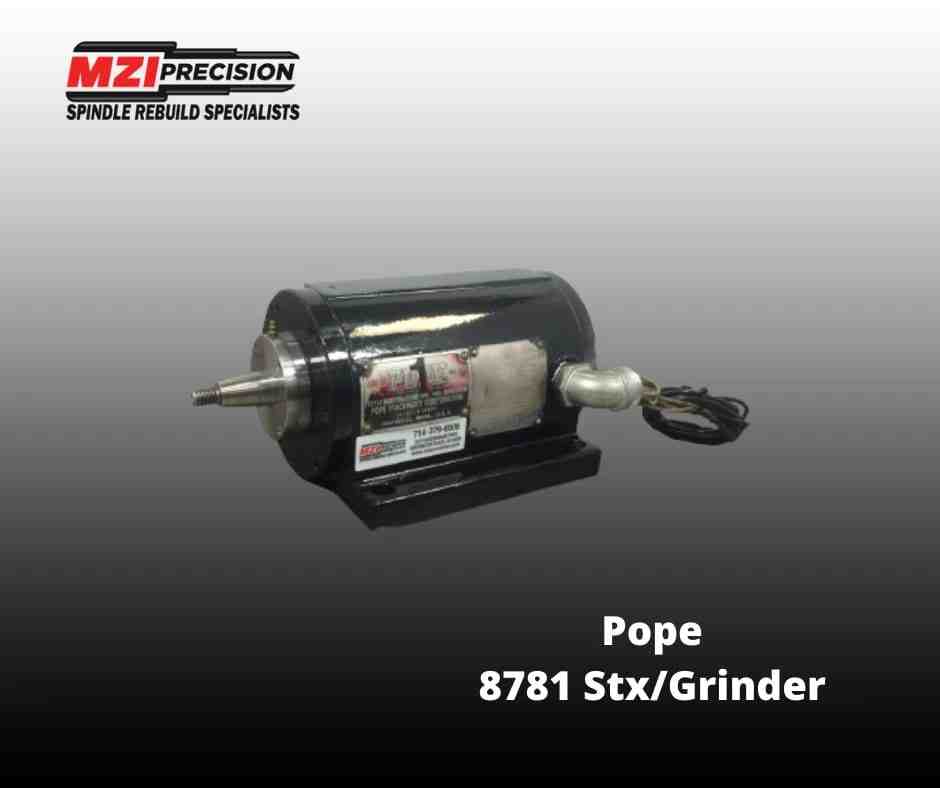
High precision grinding: 0.25 Micron Edge
Why Precision Matters in Modern Manufacturing
High precision grinding is a specialized machining process that removes tiny amounts of material using an abrasive wheel to achieve extremely tight tolerances and superior surface finishes that conventional machining methods cannot reach.
Quick Answer: What You Need to Know
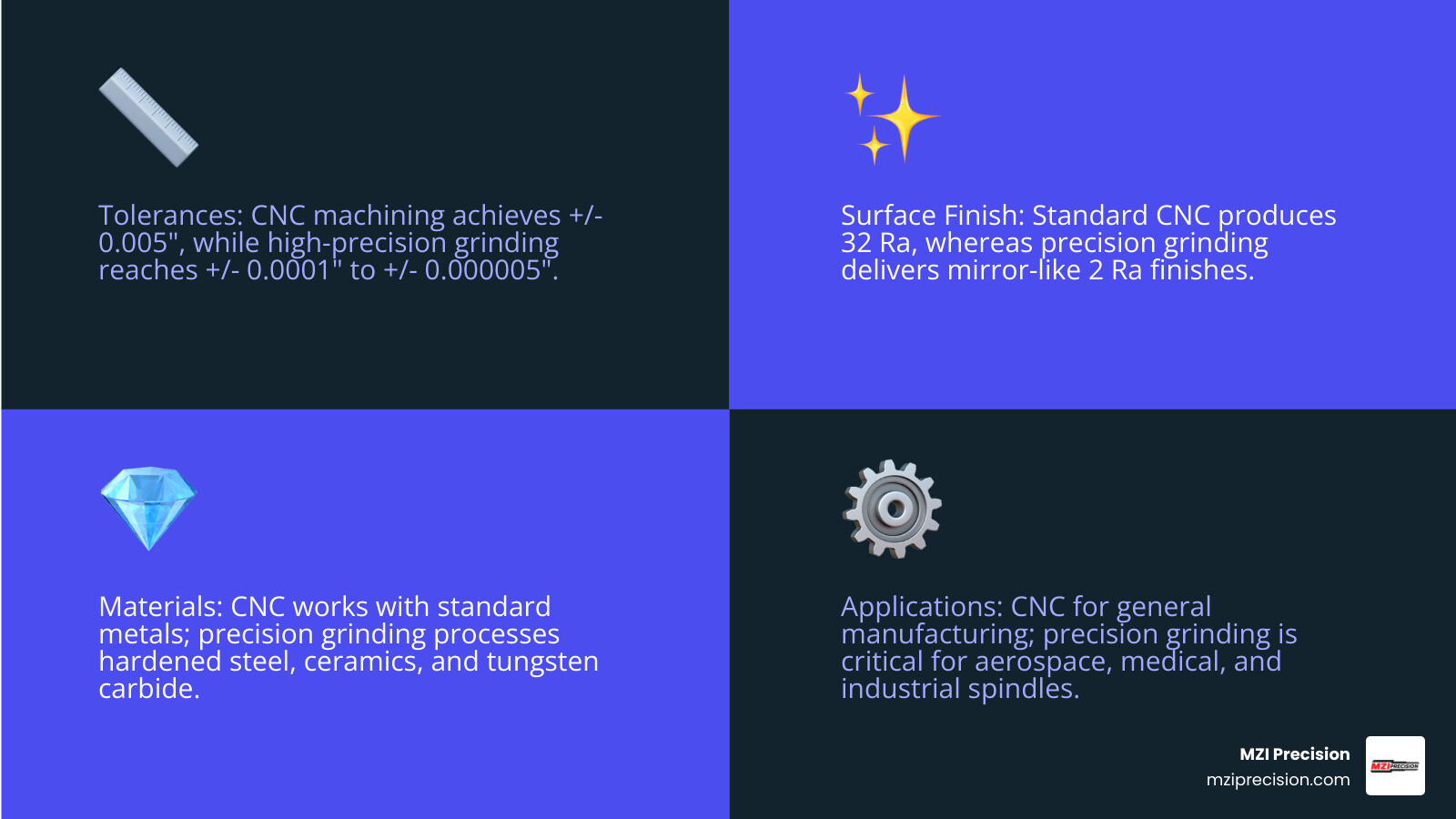
- Tolerances: Achieves +/- 0.0001″ to +/- 0.000005″ (compared to +/- 0.005″ for CNC machining)
- Surface Finish: Creates mirror-like 2 Ra finishes (versus 32 Ra from standard CNC)
- Materials: Works with hardened steel, ceramics, tungsten carbide, and other hard/brittle materials
- Applications: Critical for aerospace, medical devices, scientific instruments, and industrial manufacturing spindles
- Process Types: Surface grinding, cylindrical (OD/ID), centerless, and jig grinding
In today’s manufacturing landscape, the demand for high-precision components has grown dramatically. Whether you’re producing aerospace fasteners, medical implants, or rebuilding industrial manufacturing spindles, achieving dimensional accuracy at the sub-micron level isn’t just nice to have—it’s essential for performance, reliability, and safety.
The reality is simple: CNC machining alone often can’t deliver the tolerances your critical components require. That’s where high-precision grinding becomes not just valuable, but necessary.
What is High-Precision Grinding and Why Does It Matter?
When working with industrial manufacturing spindles or other critical components, “close enough” isn’t an option. High precision grinding is the process that transforms good parts into exceptional ones, meeting exacting specifications down to fractions of a hair’s width. It uses an abrasive wheel to remove incredibly small amounts of material, achieving dimensional accuracy and surface quality impossible with conventional methods, especially on hardened materials.
The Fundamentals of High-Precision Grinding
High precision grinding is a finishing process that operates at an extreme level of accuracy, removing material in depths as small as 0.25 to 0.50mm to create geometrically perfect surfaces. While standard CNC milling is accurate at +/- 0.005 inches, high-precision grinding routinely reaches tolerances of +/- 0.0001 inches and can go as tight as +/- 0.000005 inches. For diameter tolerances, this means working at +/- 1.3 microns, with roundness tolerances hitting 0.25 microns.
Surface finish tells an equally impressive story. The Ra value measures surface smoothness. Standard CNC machining typically produces a 32 Ra finish, where imperfections are visible. High-precision grinding achieves a mirror-like 2 Ra finish. For industrial manufacturing spindles, this improved surface finish directly translates to better performance, reduced friction, and longer service life.
| Metric | Conventional CNC Machining | Precision Grinding |
|---|---|---|
| Tolerance | +/- 0.005 inches | +/- 0.0001 inches to +/- 0.000005 inches |
| Surface Finish | 32 Ra (rough) | 2 Ra (mirror-like) |
| Material | Standard metals | Hardened, brittle materials |
| Accuracy | Good | Extremely high (sub-micron) |
Key Benefits in Modern Manufacturing
The advantages of high precision grinding are clear when repairing or rebuilding industrial manufacturing spindles.
- Tighter tolerances ensure components fit exactly as designed. For spindle components, even a few microns of deviation can cause premature failure.
- Superior surface finish reduces friction, minimizes wear, and keeps components running cooler. For high-speed industrial manufacturing spindles, this means greater efficiency and longevity.
- Machining hard and brittle materials like hardened steel, ceramics, and tungsten carbide becomes reliable and damage-free.
- Repeatability ensures every component, whether in a large production run or a single spindle rebuild, meets the same high standards, reducing defects.
- Cost-effectiveness comes from long-term savings. Reduced defects and improved component lifespan mean less rework and fewer replacements. Rebuilding a spindle costs a fraction of buying new.
- Improved component performance and reliability are guaranteed. Parts operate more efficiently, generate less heat, and last longer, making this level of precision essential in applications where downtime is costly.
A Guide to Precision Grinding Processes and Applications
Choosing the right high precision grinding method depends on workpiece geometry, material, and production volume. Matching the correct process to the application is critical, especially for the intricate components of industrial manufacturing spindles.

Primary Types of Grinding
Each precision grinding technique has a specialized purpose.
- Surface grinding creates perfectly flat surfaces, changing a rough 32 Ra finish into a mirror-like 2 Ra. It is ideal for materials compatible with magnetic chucks, like most steel grades.
- Cylindrical grinding is used for round parts. External diameter (OD) grinding ensures precise diameter and roundness, while internal diameter (ID) grinding handles inside surfaces. We often combine ID grinding with honing for critical spindle components, as detailed in our spindle grinding services.
- Centerless grinding is highly efficient for high-volume production of cylindrical parts like rods and pins, delivering outstanding roundness and surface finish without needing centers or fixtures.
- Jig grinding is a specialized technique for holes and contours with extreme precision, even in hardened materials. It can perform internal and external grinding simultaneously, perfect for complex geometries.
- Thread grinding brings precision to threaded components like lead screws, ensuring accuracy in pitch, lead, and form that other methods cannot match.
Common Applications for High-Precision Grinding
High precision grinding is used wherever performance and reliability are non-negotiable.
- Aerospace: Turbine shafts and landing gear components require exacting tolerances to withstand extreme conditions.
- Medical: Surgical instruments and implants demand micro-level precision and flawless surfaces for patient safety.
- Scientific Instruments: Ultra-precise components are necessary for accurate measurements in optical systems and particle accelerators.
- Defense: Weapon systems and communication devices need robust, highly accurate components that perform reliably.
- Electronics: The production of semiconductor wafers and miniaturized components pushes precision to the nanometer scale.
For us at MZI Precision, the most critical application is industrial manufacturing spindles. The performance of any manufacturing operation depends on spindle accuracy. We use high precision grinding not just for new spindles but, critically, for repair and rebuilding. These techniques ensure tapers are concentric, bores run true, and surfaces are smooth enough to minimize friction and heat, restoring a spindle to like-new performance and saving manufacturers significant replacement costs.
Critical Factors for Achieving Nanometer-Level Accuracy
Achieving nanometer-level accuracy in grinding is a complex process requiring advanced machinery, controlled parameters, and exceptional operator skill. It’s not just about one element, but how they all work in harmony.
Key Parameters and Considerations
To master high precision grinding, several factors must be rigorously controlled:
- Grinding Wheel Selection: Choosing the right abrasive material (e.g., diamond, CBN), grain size, and bond type is paramount. The selection depends on the workpiece material, desired surface finish, and removal rate.
- Abrasive Grains: The sharpness, hardness, and distribution of these tiny cutting tools directly impact the cutting action and surface quality.
- Wheel Dressing: This process reshapes and sharpens the grinding wheel by exposing new abrasive grains, which is crucial for maintaining consistent performance and preventing clogging.
- Cutting Speed: The rotational speed of the grinding wheel affects material removal and surface finish. High-speed grinding can increase productivity and improve tool life.
- Depth of Cut: For ultra-precision, extremely shallow depths of cut are necessary to avoid thermal and subsurface damage to the workpiece.
- Coolant and Lubrication: An effective cooling system is vital to dissipate heat, prevent thermal distortion, and flush away chips for a cleaner cut.
- Machine Stability: The rigidity of the grinding machine is fundamental. Machines with hydrostatic guides minimize vibrations and deflection, ensuring the highest dimensional accuracy.
- Spindle Performance: The spindle, which rotates the grinding wheel or workpiece, is at the heart of precision. A high-frequency spindle provides the necessary rotational accuracy and power. At MZI Precision, ensuring the optimal performance of industrial manufacturing spindles is our core expertise.
Materials Suited for Precision Grinding
High precision grinding excels at finishing a wide array of materials that are challenging for other machining methods:
- Hardened Steel: Grinding is the ideal method for final shaping after heat treatment.
- Stainless Steel: Benefits from precision grinding for tight tolerances and smooth finishes.
- Inconel and High-Strength Alloys: These tough, heat-resistant superalloys are fabricated using precision grinding.
- Tungsten Carbide: One of the hardest man-made materials, it is exclusively shaped by grinding.
- Ceramics and Glass: Brittle but hard, these materials require the controlled removal of grinding to achieve complex geometries and fine finishes.
- Other Brittle Materials: Advanced composites and engineering materials benefit from the non-damaging material removal of grinding.
While exceptional for hard materials, grinding softer metals like aluminum or brass can be challenging as they can clog grinding wheels, requiring specialized techniques.
The Role of Automation and Technology in Modern Grinding
The world of high precision grinding has been transformed by automation and technology, enabling breathtaking speed and accuracy. For us at MZI Precision, who specialize in industrial manufacturing spindle repair, these advancements are essential for delivering the precision our customers depend on.
Automation and Advanced Machinery
Modern grinding is driven by several key technologies:
- CNC (Computer Numerical Control): As the brain of the operation, CNC systems precisely control every movement, executing complex grinding paths with high repeatability that would be impossible to achieve manually.
- Multi-axis Grinding Machines: With up to five axes, these machines create intricate geometries. A C-axis with direct drive enables positioning accuracies below one micrometer, perfect for non-circular grinding.
- High-Frequency Spindles: Running at speeds from 6,000 to 40,000 rpm, these provide the rotational accuracy and power needed for optimal cutting speeds, especially with small grinding wheels.
- Robotic Integration: Robotic arms handle repetitive loading and unloading, improving efficiency and safety while freeing skilled operators for more complex tasks.
- On-Machine Measurement (OMM): This technology inspects the workpiece on the machine, detecting variations of less than a micron. Error compensation software can then automatically adjust grinding parameters in real-time to ensure parts consistently meet specifications.
Latest Advancements and Technologies
The boundaries of high precision grinding continue to expand:
- Ultra-precision grinding now achieves accuracies measured in nanometers with near-atomic-level surface finishes, crucial for semiconductor and optical applications.
- ELID-Grinding (Electrolytic In-process Dressing) uses an electrolytic process to continuously self-sharpen the grinding wheel. This maintains optimal cutting performance, enabling ultra-precision fabrication on difficult-to-grind materials.
- Air-bearing spindles float on a cushion of air, providing virtually friction-free rotation. This results in exceptional rotational accuracy and minimal vibrations, delivering maximum form and surface quality.
- Chemo-Mechanical Grinding (CMG) combines chemical reactions with mechanical grinding for highly efficient surface finishing on challenging materials like silicon and sapphire.
- 3D printed superabrasives feature optimized geometries that were impossible with conventional methods, offering improved performance and greater precision.
At MZI Precision, we use the full power of modern grinding technology when rebuilding an industrial manufacturing spindle to ensure it meets or exceeds original specifications. This combination of advanced machinery and deep expertise allows us to deliver the precision our customers expect.
Frequently Asked Questions about High-Precision Grinding
When discussing high precision grinding with manufacturers, these common questions help clarify its capabilities and challenges.
What kind of tolerances can be achieved with high-precision grinding?
This is where the process truly excels. High-precision grinding routinely achieves overall tolerances of +/- 0.0001 inches, and in ultra-precision applications, can reach as tight as +/- 0.000005 inches. For cylindrical parts, diameter tolerances can be held to +/- 1.3 microns, with roundness controlled to 0.25 microns. Surface finishes can achieve a mirror-like 2 Ra (Roughness average) or even finer, down to 1 micro inch. For an industrial manufacturing spindle, these numbers are the difference between adequate performance and exceptional, long-term precision.
What are the main challenges associated with this process?
While powerful, high precision grinding presents several challenges that require expertise to manage:
- Wheel Clogging: Softer or porous materials like cast iron can clog the grinding wheel, reducing cutting efficiency. This is managed with proper wheel selection, regular dressing, and strategic coolant use.
- Thermal Damage: The heat generated during grinding can warp the workpiece or alter its material properties. This requires careful control of cutting parameters and effective cooling to prevent distortion, especially on critical components like spindle tapers.
- Subsurface Damage: Even with a perfect surface, grinding can create microscopic cracks and stress just beneath it. This hidden damage can affect a component’s strength and fatigue life if not properly managed.
- Initial Equipment Cost: The multi-axis CNC grinders, high-frequency spindles, and advanced controls required for this work represent a significant investment.
- Operator Skill: Achieving nanometer-level accuracy still demands experienced technicians who understand grinding principles and can optimize the process. Human expertise is irreplaceable.
How does precision grinding improve a component’s surface finish?
Precision grinding is a finishing process that uses a rotating abrasive wheel with thousands of microscopic cutting grains. These grains systematically shave off the microscopic peaks and valleys left by previous machining operations. By removing material in controlled, shallow passes, the process transforms a rough surface (e.g., 32 Ra) into an exceptionally smooth, often mirror-like finish (e.g., 2 Ra).
This superior surface finish is not just for aesthetics; it dramatically reduces friction and wear between moving parts, improves sealing capabilities, and can even improve resistance to fatigue and corrosion. For industrial manufacturing spindles, this level of finish is critical for ensuring better contact with toolholders, less vibration, reduced heat generation, and ultimately, a longer, more reliable operational life.
Conclusion: Ensure Your Equipment’s Precision with Expert Support
In modern manufacturing, producing components with extreme accuracy is essential. High precision grinding is the backbone of this effort, delivering tolerances and surface finishes unattainable by conventional methods. Achieving this level of precision requires a combination of advanced machinery, controlled processes, and deep expertise.
As technology evolves with CNC automation, multi-axis machines, and advanced techniques like ELID-Grinding, the limits of precision are constantly being pushed. At MZI Precision, this dedication to precision is at the core of what we do.
When it comes to industrial manufacturing spindle repair and rebuilding industrial manufacturing spindles, we know your spindles are the heart of your operation. Every micron of accuracy and every improvement in surface finish counts toward your production quality and efficiency. We have spent years mastering the art and science of high precision grinding specifically for this purpose. Whether you’re dealing with worn tapers, damaged bores, or surfaces that have lost their finish, we have the technology and expertise to restore your spindles to like-new condition or better.
Serving manufacturers throughout California, from Huntington Beach to Los Angeles and beyond, we are your partners in precision. We understand the pressure to maintain uptime and meet tolerances.
Don’t let worn or imprecise spindles compromise your manufacturing. Contact us for service today and find how MZI Precision can help you achieve the accuracy your operations demand. Your equipment deserves expert care, and your business deserves the peace of mind that comes with working with true specialists.