

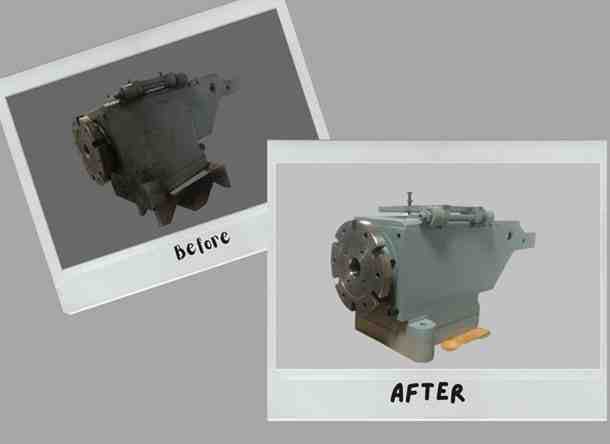
Why Your Machine Tool Needs a Professional Spindle Grinding Service
When a Spindle Grinding Service Is What Your Machine Tool Actually Needs
A spindle grinding service is a precision repair process that restores the accuracy of a machine tool spindle’s taper — without needing to replace the entire spindle. If your CNC machine is showing signs of poor surface finish, tool chatter, or increased runout, a worn spindle taper is often the root cause.
Here’s a quick overview of what spindle grinding service involves and why it matters:
- What it does: Removes microscopic wear from the spindle taper bore to restore concentricity and taper contact
- Who needs it: Manufacturers in aerospace, defense, medical, and other precision industries running CNC machining centers
- Key benefit: Restores spindle accuracy to OEM specifications — extending tool life and improving part quality
- Common taper types serviced: CAT40, CAT50, BT, Big Plus, HSK, and V-flange systems
- Typical turnaround: The regrinding process averages around two hours once the work begins
- When to act: Signs include tool chatter, runout beyond tolerance, poor surface finish, or visible taper wear (“bell mouth” condition)
For aerospace and high-precision manufacturers, even a few microns of runout can mean the difference between a part that passes inspection and one that doesn’t. Spindle taper wear is a normal result of thousands of tool changes, high torque loads, and radial forces — but left untreated, it compounds quickly into serious quality and productivity problems.
The good news? In most cases, a worn taper does not mean you need a new spindle. Professional spindle grinding can bring a worn taper back to spec, often restoring runout to within just a couple of microns.
Terms related to spindle grinding service:
The Role of a Professional Spindle Grinding Service in Manufacturing
In high-stakes industrial manufacturing, precision isn’t just a goal; it’s a requirement. Whether you are located in Los Angeles or Huntington Beach, California, your CNC machines are the workhorses of your production line. At the heart of these machines is the spindle, and the interface between that spindle and your cutting tool is the taper. Over time, this interface degrades. That is where a professional spindle grinding service comes into play.
Spindle grinding is a specialized machining process used to restore the internal geometry of the spindle taper. Think of it as a “facelift” for your machine’s most critical contact point. By using precision grinding wheels, we can remove damage, oxidation, and wear patterns that naturally develop over years of heavy use. This isn’t just about making it look shiny; it’s about restoring the concentricity of the taper relative to the spindle bearings.
When we perform spindle-grinding, we are looking to achieve tolerances that most people can’t even visualize. We are talking about microns—units of measurement so small that a human hair looks like a redwood tree by comparison. By adhering to a spindle-grinding-guide, we ensure that the material removal is kept to the absolute minimum necessary to reach a clean, true surface.
The process is essential for maintaining the “V-Flange” or “HSK” standards required by modern tooling. Without this service, a machine that was once capable of holding a half-thousandth tolerance might start struggling to stay within five thousandths. For industries like aerospace or defense, that kind of deviation is simply unacceptable. By utilizing a high-precision-grinding-complete-guide, manufacturers can ensure their equipment stays within the tightest OEM specifications.
How a Spindle Grinding Service Enhances Tool Life
You might be wondering, “Why not just push through and keep running the machine?” Well, a worn spindle doesn’t just hurt your parts; it eats your tools for breakfast. When a spindle taper is worn, the tool holder doesn’t sit perfectly flush. This creates a lack of rigidity.
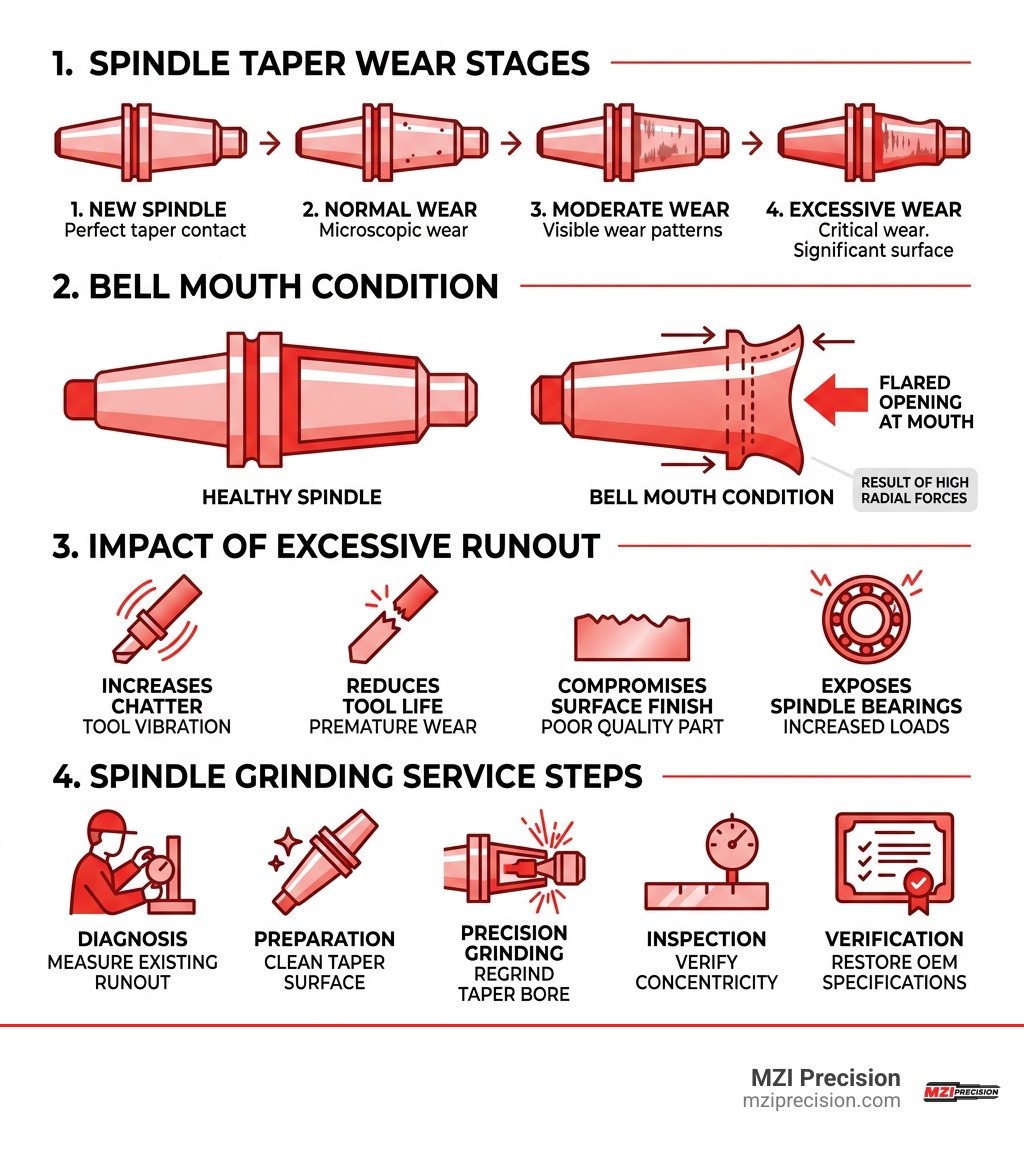
Imagine trying to write a letter while someone is shaking your elbow. That is essentially what your cutting tool experiences when the spindle taper is out of spec. This lack of rigidity leads to vibration and “chatter.” Vibration is the ultimate enemy of tool life. It causes micro-chipping on the cutting edges of expensive carbide end mills and drills, forcing you to replace them much more frequently than necessary.
A professional spindle grinding service restores the vibration damping characteristics of the spindle-tool interface. When the taper contact is nearly 100%, the tool and spindle act as a single, rigid unit. This stability allows for:
- Improved Surface Finish: No more “tiger stripes” or wavy patterns on your finished parts.
- Better Thermal Stability: A proper fit reduces friction and heat buildup at the interface.
- Increased Repeatability: Your first part of the day will match the last part of the day.
For specialized equipment, such as those used in the medical or aerospace sectors, this level of stability is non-negotiable. You can Watch video Robodrill Spindles to see how custom solutions and precision interfaces are vital for high-speed performance. By keeping the spindle in top shape, you’re not just saving the machine; you’re protecting your bottom line by extending the life of every tool you buy.
Technical Indicators and When to Schedule a Spindle Grinding Service
How do you know it’s time to call in the experts? You don’t want to wait until the machine throws a “spindle load” alarm or starts producing scrap. There are several technical indicators that suggest your spindle needs a professional touch.
One of the most common issues is the “bell mouth” condition. This happens when the very front of the spindle taper wears more than the rear, usually due to the radial forces exerted during heavy milling. If you picture the taper as a cone, a bell mouth spindle is a cone that has been stretched out at the opening. This prevents the tool holder from seating deeply and securely.
Another red flag is “fretting.” This looks like small, rusty-colored pits or patches on the surface of the taper. Fretting is caused by microscopic movement between the tool holder and the spindle. This “micro-rubbing” creates heat and oxidation, which eventually eats away at the precision-ground surface. If you see these marks, your precision-grinding-spindles are likely in need of a regrind.
Vibration analysis is a more advanced way to detect issues. By using specialized sensors, we can see the “signature” of the spindle. If the vibration levels are creeping up, even if you can’t hear it yet, it’s a sign that the balance or the taper seating is failing. Standard tolerances for dynamic balancing should be at 0.1 mil or less to ensure the longevity of the assembly.
When to Schedule a Spindle Grinding Service
Timing is everything in manufacturing. If you schedule a spindle grinding service as part of your preventative maintenance, you can avoid the “emergency” scenario where a spindle fails in the middle of a critical contract.
We recommend checking your spindle health using three primary tools:
- Test Bars: These are precision-ground cylinders that you insert into the spindle. By using a dial indicator on the test bar, you can measure “runout.” If the runout is greater than a few microns, it’s time for a service. Leading experts aim for less than two microns of runout after a successful grind.
- Air Gauging: This uses compressed air to measure the exact dimensions and “roundness” of the taper. It is incredibly accurate and can detect a bell mouth condition that the naked eye would miss.
- Drawbar Force Testing: Sometimes the taper is fine, but the drawbar (the mechanism that pulls the tool into the taper) has lost its “oomph.” If the retention force is low, the tool will move under load, causing the very taper wear we are trying to prevent.
If you are just getting started with a maintenance program, checking out griding-spindles-101-everything-you-need-to-start can provide a solid foundation for understanding these requirements. Don’t wait for “chatter” to become the soundtrack of your shop floor.
Precision Standards and System Compatibility
Not all spindles are created equal. Depending on whether you are machining aluminum for solar energy components or titanium for defense applications, your machine likely uses one of several standard taper systems. A professional spindle grinding service must be compatible with these varied systems to be effective.
Here is a comparison of the common industrial taper types we encounter:
| Taper Type | Typical Application | Key Characteristics |
|---|---|---|
| CAT40 / CAT50 | General Purpose Milling | The “workhorse” of American manufacturing. Uses a V-flange for automatic tool changers. |
| BT30 / BT40 | High-Speed Machining | Common in Japanese machinery. Similar to CAT but with different flange dimensions. |
| HSK (63A, 100A) | High Precision / High Speed | A “hollow shank” system that provides dual contact (taper and face) for extreme rigidity. |
| Big Plus (Dual Contact) | Heavy Duty Milling | A hybrid system that allows for contact on both the taper and the spindle face simultaneously. |
Each of these systems requires a different approach. For instance, cnc-precision-grinding for an HSK spindle is significantly more complex than a standard CAT40. With HSK and Big Plus systems, we aren’t just grinding the internal taper; we must also grind the “face” of the spindle. The relationship between the taper and the face must be held to incredibly tight tolerances (often within a few microns) to ensure the “dual contact” feature actually works. If the face-to-taper relationship is off, you lose the very rigidity you paid for when you bought the machine.
Whether your machine is an Okuma, Haas, or Fadal, the goal is always the same: return the spindle to its original OEM specifications. A high-quality repair ensures that the tool holder sits exactly where the machine’s engineers intended it to, maximizing the transfer of torque and minimizing the risk of runout.
Frequently Asked Questions about Spindle Grinding
What are the signs of a damaged spindle taper?
The most obvious signs are visual and audible. Look for “fretting” (the reddish-brown stains mentioned earlier) or visible scoring/gouges inside the taper. Audibly, you might hear a high-pitched squeal or a low-frequency “thumping” during heavy cuts. If your surface finishes are looking “cloudy” or “wavy” instead of mirror-like, your taper is likely the culprit. You may also notice that your tool holders are becoming difficult to eject, which indicates the geometry has changed and the tool is “sticking.”
How long does the grinding process typically take?
While every situation is unique, the actual spindle grinding service—the act of regrinding the metal—typically takes about two hours. However, the total “machine down” time includes the initial evaluation, setup of the grinding equipment, and the final quality control checks (like air gauging and test bar runs). Generally, a professional service can have you back up and running much faster than the weeks it would take to ship a spindle out for a full rebuild or to wait for a new one from the OEM.
Can a spindle be ground more than once?
Yes, in most cases! Because a professional spindle grinding service only removes a microscopic amount of material (just enough to “clean up” the surface), a spindle can often be reground multiple times over its lifespan. However, there is a limit. Eventually, the tool holder will sit too deep in the spindle, which can affect the drawbar’s ability to grip it or cause interference with the tool changer. A professional technician will always measure the “standoff” to ensure there is enough material left for a safe and effective grind.
Conclusion
In the competitive landscape of modern manufacturing, you cannot afford to let your equipment’s precision slip. Whether you are producing critical components for the aerospace, defense, medical, or solar energy sectors, the quality of your work starts with the health of your spindle.
A spindle grinding service is one of the most cost-effective ways to restore your machine’s performance. It eliminates the need for expensive spindle replacements, reduces your spend on cutting tools, and ensures that your parts meet the rigorous standards of your industry. By addressing issues like bell mouth wear and fretting early, you can keep your shop running smoothly and avoid the nightmare of unscheduled downtime.
At MZI Precision, we are dedicated to providing the highest level of expertise in industrial manufacturing spindle repair and rebuilding. Our commitment to OEM standards and our deep understanding of complex systems like Big Plus and HSK make us the preferred partner for shops across the United States, particularly in manufacturing hubs like Los Angeles and Huntington Beach.
If you’ve noticed your machine isn’t quite performing like it used to, don’t wait for a total failure. More info about industrial spindle services is just a click away. Let us help you maintain the precision, speed, and power that your business depends on. Reach out to us today to ensure your machine tools are operating at their absolute best.