


Spindle Rebuild 101: Why Your CNC Machine is Screaming for Help
WHEN YOUR CNC MACHINE STARTS FAILING, THE SPINDLE IS USUALLY THE CULPRIT
A CNC Spindle Rebuild is the process of fully disassembling an industrial machine spindle, replacing worn components like bearings, seals, and preload collars, and reassembling it to factory-original — or better — precision standards.
Here is what you need to know at a glance:
| Question | Quick Answer |
|---|---|
| What is a CNC spindle rebuild? | Full disassembly, component replacement, and precision reassembly of an industrial spindle |
| When do you need one? | Excessive vibration, poor surface finish, overheating, unusual noise, or machine alarms |
| How much can you save vs. new? | 25% to 70% less than buying a new spindle |
| How long does it take? | 3-10 business days standard; 1-3 days for emergency service |
| What precision is restored? | Runout within 2 microns; balanced to 0.3 G’s or better |
| What warranty should you expect? | Typically 6-24 months on parts and labor |
Industrial manufacturing spindles are the heart of your CNC equipment. They hold and rotate cutting tools at exact speeds — often exceeding 8,000 RPM — with tolerances measured in microns. In precision-critical industries like aerospace and medical device manufacturing, even slight wear can cascade into scrapped parts, missed tolerances, and costly production delays.
The problem is that spindle failure rarely announces itself all at once. It builds slowly — a faint vibration here, a slight drop in surface finish quality there — until one day the machine throws an alarm and production stops completely.
That unplanned downtime is almost always more expensive than the rebuild itself.
More than 100,000 industrial spindles are successfully rebuilt every year. Yet many manufacturers wait too long, either misreading the warning signs or underestimating what a professional rebuild can restore. This guide walks you through everything: how to spot failure early, what the rebuild process actually involves, and how to make the right call between rebuilding and replacing.
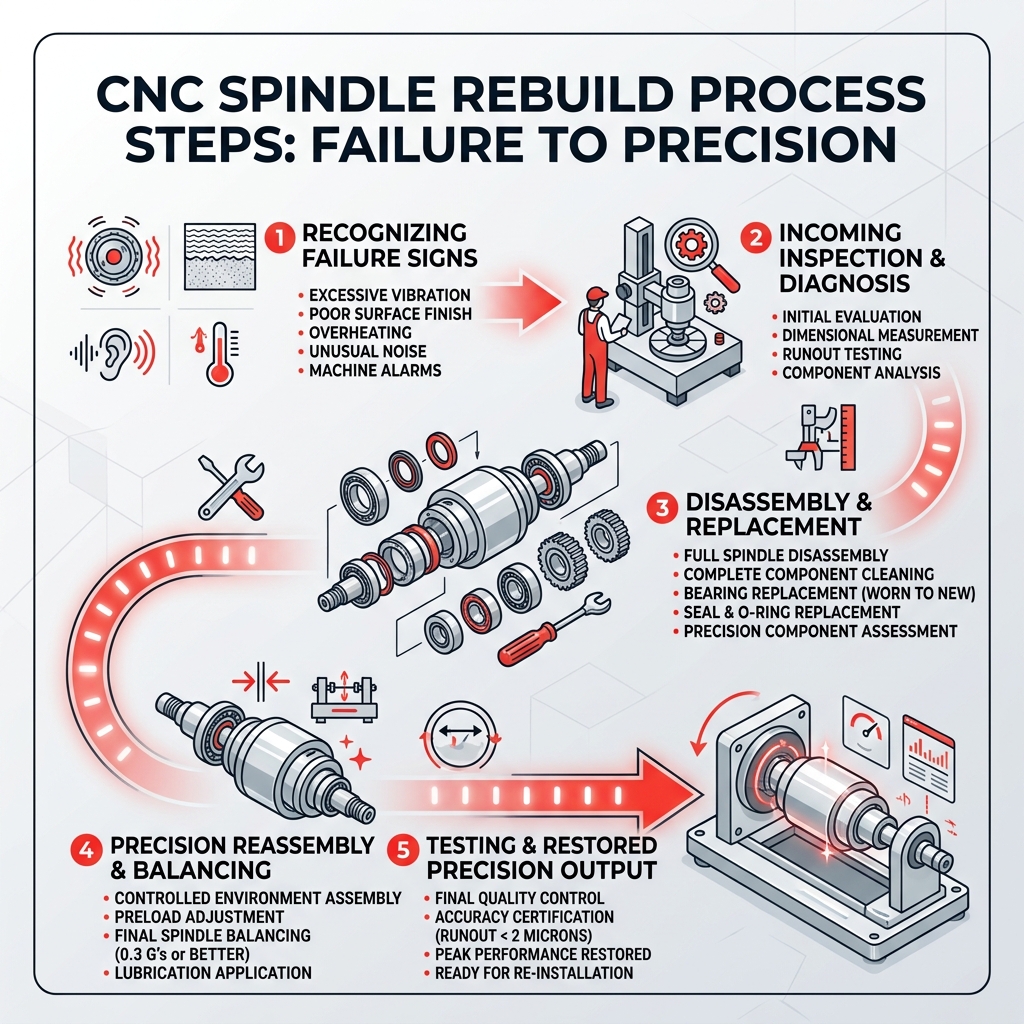
Recognizing the Signs of Industrial Spindle Failure
In industrial manufacturing, your spindle is like the conductor of an orchestra. When the conductor is “off-key,” the entire performance suffers. Detecting the early warning signs of failure can be the difference between a controlled, scheduled CNC Spindle Rebuild and a catastrophic machine crash that halts your entire production line.
One of the most common red flags is excessive vibration. If your machine starts sounding like a jet engine during takeoff, your bearings are likely reaching the end of their lifespan. This vibration isn’t just a noise issue; it creates chatter marks on your workpieces, leading to poor surface finishes and scrapped parts.
Thermal expansion and overheating are also critical indicators. While all industrial spindles generate some heat, a spindle that becomes too hot to touch or causes the machine to throw “spindle overload” alarms is in trouble. This often stems from bearing friction or clogged lubrication ports. Furthermore, taper runout — where the tool no longer sits perfectly true in the spindle — will cause dimensional inaccuracies that no amount of offset compensation can fix.
Common symptoms include:
- Unusual Noises: Grinding, clicking, or high-pitched whining.
- Machine Alarms: PLC error codes such as “encoder error” or “spindle drive fault.”
- Visible Damage: Scars or “bell-mouthing” on the spindle taper.
- Decreased Rigidity: Tools deflecting under standard cutting loads.
If you are seeing these signs, it is time to look at How to Rebuild a Spindle before the damage spreads to other machine components.
When to Prioritize a CNC Spindle Rebuild
Timing is everything. You should prioritize a rebuild the moment you notice a consistent loss of accuracy. When a spindle’s runout exceeds 2 microns, it is no longer capable of the high-precision work required in aerospace or defense applications.
Waiting for a total seizure is a risky game. Beyond the spindle itself, a failing unit puts immense stress on the motor and drive system. We often see manufacturers struggling with increased cycle times because they have to slow down their feed rates to compensate for a “screaming” spindle. If your bearing fatigue has reached the point of audible distress, a CNC Spindle Rebuild is no longer optional — it is an emergency.
The Technical Process of a Professional CNC Spindle Rebuild
A professional CNC Spindle Rebuild is much more than a simple “repair.” While a repair might only fix the broken part, a rebuild restores the entire unit to a “like-new” state. At MZI Precision, we treat every rebuild as a forensic engineering project.
The process begins with forensic disassembly. We don’t just take it apart; we document every step with photos and measurements. This allows us to perform a root cause analysis. Was the failure caused by coolant ingestion? Was it a lubrication failure or a crash? Identifying why it failed prevents the same issue from happening again two months later.
Once disassembled, every component undergoes chemical cleaning and a geometric inspection. We check for flaws down to half a micron (.0000019 inch). If the shaft or housing is out of tolerance, we perform precision grinding and chrome plating to restore the original dimensions. You can learn more about our specific workflow on our Spindle Rebuild service page.
Precision Standards in a CNC Spindle Rebuild
The “secret sauce” of a high-quality rebuild lies in the components and the environment. We only use Super Precision ABEC 7 or ABEC 9 bearings from authorized distributors. These bearings are designed to handle speeds exceeding 8,000 RPM with minimal heat generation.
Assembly must take place in a temperature-controlled HEPA cleanroom. Contamination is the number one enemy of high-speed bearings; even a single speck of dust can cause premature failure in a spindle spinning at 20,000 RPM.
Key precision steps include:
- Hand-Lapping Spacers: We lap spacers to tolerances of +/- 1 µm (50 millionths of an inch) to ensure perfect bearing preload.
- Taper Grinding: Restoring the tool-holding interface to ensure maximum contact and rigidity.
- Dynamic Balancing: Every rotating component is balanced according to the ISO 1940 standard for dynamic balancing before final assembly.
Quality Assurance and Final Testing
A spindle isn’t finished just because it’s put back together. It must prove itself on the test stand. We perform dynamic balancing to 0.3 G’s or better at full operating speeds. This ensures whisper-quiet operation and a long service life for your new bearings.
Our testing protocol includes a minimum 8-hour runoff. During this time, we monitor:
- Vibration Analysis: Checking for any frequencies that indicate imbalance or misalignment.
- Thermal Stability: Ensuring temperatures level off within acceptable OEM ranges.
- Drawbar Force Testing: Using digital dynamometers to ensure the tool retention system meets factory pull-force specifications.
Rebuild vs. Replacement: Maximizing ROI and Performance
Choosing between a CNC Spindle Rebuild and buying a new unit is a classic “math vs. time” problem. For most industrial manufacturers, the rebuild is the clear winner.
| Factor | Professional Rebuild | New OEM Spindle |
|---|---|---|
| Cost | 25% to 70% of new | 100% (Full Price) |
| Lead Time | 3-10 Business Days | 4-12+ Weeks (often) |
| Performance | Meets or Exceeds OEM | Standard OEM Specs |
| Warranty | 12-24 Months | 12 Months |
| Upgrades | Available (Ceramic, Seals) | None |
The cost savings are significant. Rebuilding typically costs between 30% and 50% of a new spindle, allowing you to reallocate those funds to other areas of your shop. For a detailed breakdown of these factors, see our guide on CNC Spindle Rebuild Costs Explained: A Guide to Budgeting.
Key Benefits of a CNC Spindle Rebuild
Beyond the immediate cost savings, a rebuild offers the opportunity for performance upgrades. We can often improve upon the original design by installing ceramic bearings, which run cooler and last longer at high speeds, or by adding improved sealing systems to prevent coolant contamination.
There is also an environmental benefit; rebuilding a 200-pound steel spindle instead of scrapping it is a much more sustainable practice for modern manufacturing. Plus, with a professional rebuild, you receive a comprehensive warranty that often matches or exceeds what the original manufacturer provides.
Frequently Asked Questions about CNC Spindle Restoration
How long does a typical rebuild take?
Standard turnaround for a CNC Spindle Rebuild is typically 3-10 business days. This includes the full evaluation, parts sourcing, assembly, and the mandatory 8-hour run-in period. For production-critical situations, we offer emergency services that can often get a spindle back to you in 1-3 days.
What types of industrial spindles can be rebuilt?
Almost any spindle used in industrial manufacturing can be restored. This includes:
- Cartridge Spindles: Common in VMCs and HMCs.
- Motorized Electrospindles: High-speed units with integrated motors.
- Belt-Driven Spindles: Heavy-duty units used for high-torque milling.
- Grinding Spindles: High-precision units requiring extreme balance.
- High-Speed Spindles: Units operating at 15,000 to 60,000+ RPM.
What maintenance extends the life of a rebuilt spindle?
To get the most out of your 15,000 to 30,000-hour bearing life, follow these practices:
- Warm-up Cycles: Never jump straight to max RPM. A 10-15 minute gradual warm-up distributes grease and stabilizes temperatures.
- Lubrication Monitoring: Ensure air-oil systems are delivering the correct volume and that grease-packed units aren’t contaminated.
- Contamination Prevention: Keep the taper clean and ensure your air purge system is functioning to keep coolant out of the bearings.
- Vibration Trending: Periodically check vibration levels so you can catch the next rebuild cycle before a crash occurs.
Conclusion
A CNC Spindle Rebuild is one of the most cost-effective ways to maintain the “health” of your machine shop. By choosing a rebuild over a replacement, you aren’t just saving money; you are often getting a spindle that performs better than it did the day it left the factory.
At MZI Precision, we specialize in high-precision industrial manufacturing spindle rebuilding. Whether you are in aerospace, defense, or automotive manufacturing, we understand that precision is your product. Our US-based team is dedicated to providing OEM-quality restoration with the fast turnaround times your production schedule demands.
Don’t wait for your machine to stop “screaming” and start seizing. Restore your machine with professional spindle repair today and keep your production line turning smoothly.