


Spindle bearing noise: 5 Costly Mistakes to Avoid
Why Spindle Bearing Noise Demands Your Immediate Attention
Spindle bearing noise is a critical warning sign from your machine. Ignoring it can lead to thousands of dollars in repairs and unplanned downtime. While healthy bearings produce a soft purring noise, any deviation from this sound signals potential trouble.
Quick identification guide for spindle bearing noise:
- Soft purring = Healthy bearings operating normally
- Grinding or squealing = Lubrication problems or contamination
- Roaring or rumbling = Advanced bearing wear or race damage
- Clicking or ticking = Loose components or misalignment
- Intermittent squeals = Early warning signs that worsen over time
A 1,700 RPM surface grinder spindle can last up to 20 years with proper care, while a 120,000 RPM high-speed spindle may only last three years. When bearing problems go unaddressed, these lifespans shrink dramatically.
Modern CNC spindles operate at tight tolerances, with runout measured in microns. High-speed spindle bearings can reach inner race temperatures over 113°F, making them sensitive to minor issues like contamination or improper lubrication.
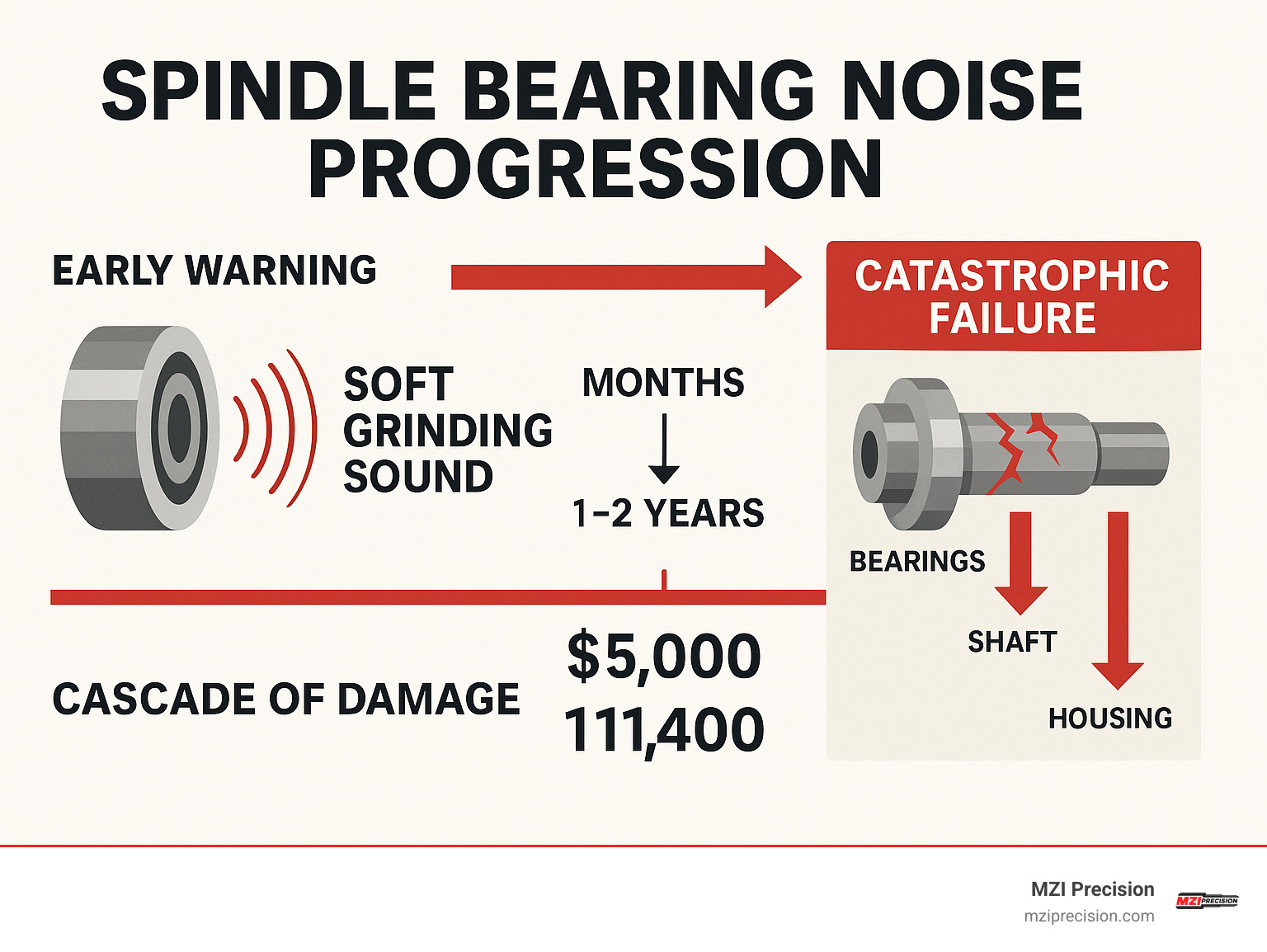
The cost of waiting is steep. One manufacturer delayed spindle service for over two years after noticing noise. Their repair cost jumped from $5,000 to $11,400 due to secondary damage to the shaft, housing, and other components.
Decoding the Sounds: Common Types of Spindle Bearing Noise
An industrial spindle is constantly communicating its health, and spindle bearing noise is often the first and most reliable warning sign. These sounds are not random; they are specific messages about problems developing inside your equipment. Learning to decode them can save you thousands of dollars and prevent weeks of downtime.
What a Healthy Spindle Sounds Like
When operating correctly, an industrial manufacturing spindle should produce a soft, steady purr. This gentle hum indicates that the bearings are properly lubricated, the preload is correct, and all components are moving smoothly. The volume should be low, and the sound should remain consistent as you vary the spindle’s speed range. Any change from this familiar sound warrants investigation.
Interpreting Problematic Noises
When the peaceful purr changes, it’s time to pay attention. Each type of spindle bearing noise tells a different story about what’s happening inside your precision equipment.
Grinding sounds are harsh and gritty, usually meaning contamination has entered the bearings. Metal chips, coolant, or dirt can act like sandpaper between the bearing races and rolling elements, causing progressive damage.
Squealing or whining is a high-pitched sound that occurs when there is metal-on-metal contact due to improper lubrication. The grease may have broken down from heat, or the wrong type of lubricant is being used. Squealing can also point to incorrect preload settings.
Roaring or rumbling is a deep, low-frequency noise indicating that the bearing races have developed serious damage. The smooth surfaces have become pitted or worn, creating an uneven path for the rolling elements. A bearing making this sound is often in its final stages of life.
Clicking or ticking is a sharp, distinct sound that usually means a component has come loose or there is a misalignment. It can also be caused by impact damage from a crash that has left components rattling.
Pay attention to whether these noises are intermittent or constant. An intermittent squeal might be an early warning, while a constant noise suggests a persistent problem needing immediate attention.
Also, note how the sounds change with RPM. Noise that gets louder or changes pitch at certain speeds can help pinpoint whether you’re dealing with bearing frequencies, balance issues, or resonance problems.
Why Is My Spindle So Loud? Uncovering the Root Causes
Once you’ve identified the type of noise, the next step is understanding why it’s happening. Spindle bearings are precision components whose function relies on a delicate balance of factors. When this balance is disturbed, noise is often the first symptom.
The Critical Role of Lubrication and Contamination
Lubrication is the lifeblood of a spindle bearing. It reduces friction, dissipates heat, and protects against wear. When it fails, the consequences are immediate and lead directly to spindle bearing noise.
- Insufficient Lubrication: A lack of lubricant increases friction and heat, causing squealing or whining. This often results from incorrect lubrication schedules or a faulty delivery system.
- Wrong Lubricant Type: Using a grease or oil unsuited for the spindle’s speed, temperature, or load leads to premature wear. Always follow OEM recommendations for lubricant type and viscosity.
- Lubricant Breakdown: High temperatures or prolonged use can degrade lubricant, causing it to lose its protective properties and increase friction.
- Debris Ingress (Coolant, Metal Fines): Contamination is a major cause of bearing failure. Dirt, metal chips, or coolant act like sandpaper inside the bearing, causing a distinctive grinding noise. You can learn more about the complex design of these parts on this Wikipedia page on rolling-element bearings.
- Failed Seals: Worn or damaged seals allow contaminants in and lubricant out, setting the stage for rapid bearing deterioration and noise.
Mechanical and Operational Stressors
Beyond lubrication and contamination, several mechanical factors can stress spindle bearings and cause noise.
- Improper Preload (Too Loose or Too Tight): Incorrect preload causes skidding (too loose) or excessive friction and heat (too tight), both of which create noise and shorten bearing life.
- Machine Crashes: A crash can impart significant shock loads, causing brinelling (indentations) or other damage that leads to noise.
- Spindle Imbalance: An unbalanced spindle creates excessive vibration, stressing the bearings and generating noise.
- Incorrect Belt Tension and Pulley Alignment: For belt-driven spindles, improper belt tension or misaligned pulleys can cause excessive load, friction, and wear, leading to squealing or rumbling.
- High Operating Temperatures (>113°F): While high-speed bearings run hot, excessive temperatures are a red flag. Overheating degrades lubrication and can cause component damage, contributing to noise and failure.
- Bearing Types: Some bearing types are more susceptible to noise. For instance, some Chinese spindle motors use 6xxx series bearings for cost efficiency. We often recommend replacing these with 7xxx series precision bearings for better rigidity, load capacity, and lifespan.
Pinpointing the Problem: A Step-by-Step Diagnostic Guide
Hearing unusual spindle bearing noise is the first step; confirming the source requires a systematic approach. A thorough diagnosis helps avoid costly mistakes by ensuring you fix the actual problem, not just a symptom.
Early Warning Signs Beyond Noise
Noise is just one way your spindle communicates. Paying attention to other signs provides a clearer picture of its health.
- Poor surface finish: Chatter marks or waviness on machined parts often indicate bearing instability and excessive runout.
- Out-of-spec parts: If part dimensions begin to drift, the spindle’s precision is likely compromised by bearing wear.
- Excessive vibration: While some vibration is normal, a noticeable increase or change in character points to a problem.
- Increased motor load: If the motor works harder to maintain speed, it may be fighting increased friction from failing bearings.
- Temperature changes: A spindle running hotter than usual is a sign of excessive friction in the bearings.
- Decreased drawbar force: Low retention force (e.g., below 3,000 pounds for an HSK63A tool holder) can signal internal issues.
- Increased runout: Measuring increased runout at the taper or tool is a clear sign of bearing wear.
How to Confirm a Spindle Bearing Noise Issue
These practical steps help confirm your suspicions and isolate the problem.
- Isolate the spindle: For belt-driven systems, remove the belts and run the motor alone to determine if the noise is from the spindle, motor, or drive system.
- Manually rotate the spindle: With the power off, turn the spindle by hand. It should feel smooth and quiet. Any roughness, grinding, or play indicates a bearing problem.
- Use a listening rod: A mechanic’s stethoscope or a long screwdriver can help localize the noise by placing it on different parts of the spindle housing.
- Measure runout: Use a dial indicator against the spindle taper. A significant increase in runout is strong evidence of bearing wear.
- Monitor temperature: An infrared gauge can spot trouble. Localized hot spots or overall temperature increases signal excessive friction.
Advanced Diagnostics: The Power of Vibration Analysis
For predictive maintenance, vibration analysis detects problems long before they become audible. This technology picks up the earliest signs of bearing trouble, allowing you to turn reactive repairs into planned maintenance.
Vibration analysis can identify specific fault characteristics, distinguishing between outer race, inner race, or rolling element damage. Trending this data over time creates a health history for your spindle. Any deviation from the baseline signals a change in condition, allowing you to predict when failure might occur and schedule repairs strategically.
The High Cost of Ignoring the Noise: Risks and Consequences
When you hear spindle bearing noise, you face a choice: act now or wait. The noise will not go away on its own, and the cost of waiting only increases.
Impact on Performance and Quality
A noisy spindle means something inside is no longer running smoothly. This instability directly impacts your ability to produce precise, consistent parts.
- Loss of precision: Failing bearings introduce play and runout, making it impossible to hold tight tolerances.
- Inconsistent part dimensions: Parts that should be identical begin to vary in size, roundness, and taper.
- Increased tool wear: A vibrating spindle puts undue stress on cutting edges, causing tools to wear out faster and driving up operational costs.
- Reduced machining efficiency: You may be forced to slow down speeds or lighten cuts to compensate for instability, reducing productivity.
- Scrap parts: As precision disappears, the number of rejected parts increases, representing wasted material, time, and revenue.
The Dangers of Continued Operation
Continuing to run a machine with spindle bearing noise is a gamble with catastrophic failure that can shut down production for weeks.
Catastrophic bearing failure can occur without further warning, often taking other expensive components with it. The uncontrolled movement can severely damage the spindle shaft, housing, and precision taper. What could have been a straightforward bearing replacement can turn into a complete rebuild, more than doubling the cost.
Seizure of the spindle can happen when bearings lock up completely. The sudden stop can damage the motor, drive system, and destroy the workpiece and tooling. The safety hazards are also real, as a catastrophic failure can eject metal fragments at dangerous velocities.
Delaying action leads to longer and more expensive rebuild times. At MZI Precision, our goal is to catch these problems early, before they cascade into costly, time-consuming repairs. The message is clear: spindle bearing noise is an urgent call for action.
From Diagnosis to Solution: Repair, Replacement, and Prevention
Once spindle bearing noise is confirmed, you must decide whether to repair the bearings, rebuild the spindle, or replace it. This decision is critical for a long-term solution.
| Feature | Spindle Bearing Repair (Minor) | Full Spindle Replacement / Rebuild (Major) |
|---|---|---|
| Pros | – Lower immediate cost | – Restores spindle to like-new condition |
| – Potentially faster turnaround for simple bearing swaps | – Addresses all underlying wear/damage (shaft, housing, taper) | |
| – Extends life of otherwise healthy spindle | – Long-term reliability and performance | |
| – Often comes with warranty | ||
| Cons | – Only addresses the bearing; other underlying issues might persist | – Higher upfront cost |
| – If secondary damage exists, it’s a temporary fix | – Longer downtime for rebuild process | |
| – May not restore full original precision if other components are worn | – Requires specialized expertise and equipment | |
| – Risk of premature re-failure if root cause (e.g., contamination) isn’t addressed | ||
| Cost Factors | – Cost of bearings (can vary, 7xxx series precision bearings are more expensive than 6xxx series) | – Varies widely based on spindle type, extent of damage (e.g., $5,000 to over $11,000 for severe damage) |
| When to Consider | – Early detection of bearing noise with no secondary damage | – Significant secondary damage (shaft, housing, taper) |
| – Clear signs of lubrication failure or contamination (if caught early) | – Catastrophic bearing failure | |
| – Spindle performance is only slightly degraded | – When precision and longevity are paramount | |
| – For high-speed, high-precision applications where minimal runout is critical |
Repair or Replace? Making the Right Decision
Assessing the extent of the damage is the first priority. If the problem is caught early and limited to the bearings, a targeted repair might be sufficient. However, if there is any secondary damage—even slight scoring on the shaft or marks in the housing bore—a full rebuild is almost always the more economical choice long-term, as these issues will quickly destroy new bearings.
Cost is also a factor. High-quality precision bearings are a significant investment. When factoring in labor, the cost can approach that of a professional rebuild. Furthermore, lead times for specialized bearings can be long, making a quick repair less feasible. When a spindle has a cracked housing, a severely damaged shaft, or excessive taper fretting, repair is not an option. These situations demand the expertise of a dedicated spindle repair facility. More info about spindle repair services.
The Best Fix: A Proactive Maintenance Program
The most effective way to deal with spindle bearing noise is to prevent it. A proactive maintenance program is the best defense against premature failure and costly downtime.
- Regular lubrication schedules: Adhere strictly to manufacturer specifications for lubricant type, amount, and interval. Lubrication problems cause about one-third of all bearing failures.
- Routine vibration monitoring: Trending vibration data allows you to spot bearing degradation months before it becomes audible, enabling planned repairs.
- Drawbar force checks: Low drawbar force can cause tool holder movement that stresses bearings. A simple twice-yearly check can prevent this.
- Coolant system maintenance: Ensure cooling systems are functioning properly to prevent overheating, which accelerates bearing wear.
- Operator training: Well-trained operators recognize unusual sounds, follow proper procedures, and avoid crashes that damage spindles.
- Proper warm-up and cool-down procedures: Gradual temperature changes prevent thermal shock and uneven wear, adding years to spindle life.
A comprehensive maintenance program costs far less than emergency repairs and unscheduled downtime.
Conclusion
When your industrial manufacturing spindle makes unusual sounds, it’s a critical message. Spindle bearing noise is not just background chatter; it’s a call for help before a small problem becomes a catastrophic and costly failure.
We’ve seen that different sounds signal specific issues, from contamination to advanced wear. The key takeaway is that ignoring these warnings is always more expensive than addressing them promptly. Proactive maintenance—including proper lubrication, vibration monitoring, and operator training—is the most effective strategy to ensure longevity and reliability.
A healthy spindle runs quietly and efficiently. A noisy one is a liability. At MZI Precision, our expertise in industrial spindle repair and rebuilding has shown us time and again that listening to your machine is one of the smartest investments you can make.
Don’t let spindle bearing noise turn into spindle failure. Your production schedule and budget will thank you for taking action sooner rather than later.