


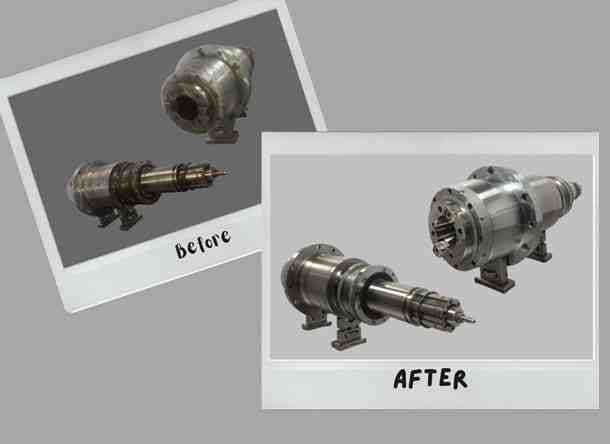
Spindle Bearing Replacement 2025: Pro
WHY SPINDLE BEARING REPLACEMENT MATTERS FOR YOUR PRODUCTION LINE
Spindle Bearing Replacement is a critical maintenance task that can mean the difference between precise, profitable manufacturing and costly downtime. When your machine tool spindle bearings fail, you’re not just facing a repair—you’re facing potential losses of tens of thousands of dollars per day in lost production, compromised part quality, and damage to your expensive machinery.
QUICK ANSWER: SPINDLE BEARING REPLACEMENT PROCESS
- Diagnose the failure – Check for vibration, noise, heat, and loss of accuracy
- Disassemble the spindle – Document everything with photos and careful measurements
- Remove old bearings – Use proper pullers or presses to avoid shaft damage
- Clean and inspect – Thoroughly clean all components and check for wear
- Install new bearings – Press onto correct race, ensure proper seating and alignment
- Adjust preload – Set bearing preload to manufacturer specifications
- Test thoroughly – Run at low speeds first, gradually increase while monitoring performance
Spindle bearings are the unsung heroes of precision manufacturing. They maintain the axial and radial stability that keeps your CNC machines, lathes, and mills producing parts within micron-level tolerances. But these bearings operate under extreme conditions—high rotational speeds, heavy loads, and constant exposure to heat and potential contamination.
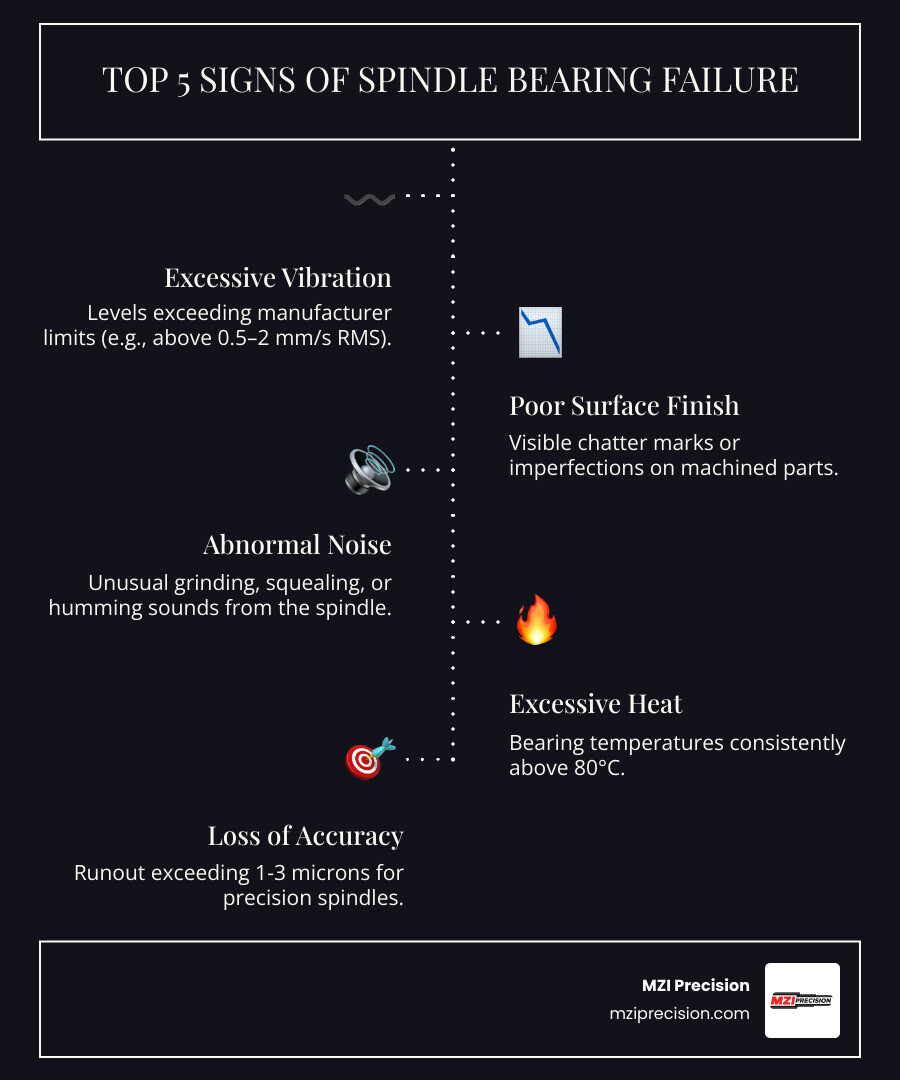
Early detection is everything. Vibration levels exceeding 0.5–2 mm/s RMS, runout beyond 1–3 microns, or temperatures spiking above 80°C all signal that your bearings are crying out for attention. Ignore these warning signs, and you’re looking at damaged spindles, scrapped parts, and dissatisfied customers.
This guide walks you through the complete process of replacing spindle bearings on industrial manufacturing equipment—from diagnosis through final testing. We will also reference widely accepted engineering resources, such as the Bearing (Mechanical)) overview, so you can understand the fundamentals behind the practices used by professional technicians.
But here’s the reality: Replacing spindle bearings isn’t a simple job. It requires specialized tools, precision measuring equipment, and deep technical knowledge. For many shops, especially those working with high-speed or high-precision spindles, professional spindle repair services offer guaranteed results without the risk of costly mistakes.
PRE-REPLACEMENT ESSENTIALS: DIAGNOSIS, TOOLS, AND SAFETY
Before we even think about touching a wrench, it’s crucial to understand when and why a Spindle Bearing Replacement is necessary. Early detection of spindle bearing wear is crucial to maintaining machine tool accuracy, minimizing downtime, and avoiding costly repairs.
SIGNS OF FAILURE
How do you know your spindle bearings are failing? Your machine will often tell you, if you know what to look for.
- Increased Vibration: This is one of the most common and earliest indicators. Spindle bearings are critical for maintaining axial and radial stability. As bearings degrade, they lose their ability to maintain shaft alignment, resulting in deviations in machining tolerances. Vibration levels exceeding manufacturer-recommended limits (e.5–2 mm/s RMS for precision spindles) indicate the need for inspection or replacement. You might feel excessive vibration in the machine frame or see it reflected in the workpiece.
- Poor Surface Finish: Are your machined parts showing chatter marks, inconsistent textures, or unexpected surface variations? This can be a direct result of failing bearings causing instability during machining.
- Abnormal Noise: While spindles can be noisy, listen for changes. Grinding, squealing, whining, or a general increase in noise level are classic symptoms of worn or damaged bearings. For more insights, check out our guide on Spindle Bearing Noise Complete Guide.
- Excessive Heat: Standard acceptable operating temperature for precision bearings is 40–60°C. Spikes above 80°C suggest lubrication breakdown or damage. Excessive heat indicates increased friction within the bearings, which can accelerate wear and lead to catastrophic failure.
- Loss of Accuracy: This is perhaps the most critical sign for precision manufacturing. Axial or radial runout exceeding 1–3 microns for high-precision spindles signals bearing wear. If your parts are consistently out-of-spec, or you’re experiencing unexpected dimensional deviations, worn bearings are a prime suspect. For more diagnostic tips, see How to Check Lathe Spindle Bearings and How to Recognize Bad Spindle Symptoms.
Recognizing these symptoms early can help you avoid unscheduled downtime, expensive repairs, and even potential machine damage. Ignoring them can turn a manageable repair into a complete spindle overhaul.
For a deeper dive into the root causes, explore Spindle Bearing Failure.
IDENTIFYING THE RIGHT SPINDLE BEARINGS
Not all bearings are created equal, especially in industrial spindles. Choosing the correct replacement bearings is paramount for performance and longevity.
- Angular Contact Bearings: These are highly common in precision spindles due to their ability to support both radial and axial loads. They are designed with a contact angle that allows them to handle thrust loads in one direction. Often used in pairs or sets with specific preloads. We discuss their suitability for high-speed precision spindles in Are Angular Contact Bearings Good for High-Speed Precision Spindles?.
- Tapered Roller Bearings: Excellent for heavy radial and axial loads, often found in machine tools requiring high rigidity. They can be separated into two parts, which can sometimes simplify installation.
- Cylindrical Roller Bearings: Primarily designed for heavy radial loads and high speeds. They typically offer high rigidity and can accommodate axial displacement of the shaft relative to the housing.
- Deep-Groove Ball Bearings: While versatile, they are less common in high-precision, high-load spindle applications compared to angular contact or tapered roller bearings, but can be found in less demanding industrial spindle positions.
Each type has unique characteristics and installation requirements. Always consult your spindle’s manufacturer specifications to ensure you’re getting the correct type, size, and precision class for your application. You can learn more about the various types in Spindle Bearing Types and Types of Super Precision and Spindle Bearings. For those demanding the utmost in performance, explore High Precision Spindle Bearings and Precision Spindle Bearings.
GATHERING YOUR TOOLS AND MATERIALS
A successful Spindle Bearing Replacement requires more than just brute force; it demands the right tools and materials. Here’s a checklist of what you’ll likely need:
- Bearing Puller: Essential for safely removing old bearings without damaging the spindle shaft or housing. Different types exist, including mechanical and hydraulic pullers. For guidance on selecting the right one, refer to our Spindle Bearing Puller Guide 2025.
- Arbor Press or Hydraulic Press: Crucial for installing new bearings with consistent, even pressure, ensuring they are seated squarely.
- Induction Heater or Oven: For the thermal installation method, allowing the bearing inner ring to expand slightly for a smooth fit onto the shaft.
- Torque Wrenches: Calibrated torque wrenches (covering a range from in-lbs to ft-lbs) are indispensable for tightening fasteners to manufacturer specifications and for setting bearing preload.
- Dial Indicators and Micrometers: High-precision measuring tools (with 1-2µm graduation for dial indicators) are needed to check runout, measure clearances, and verify dimensions before, during, and after installation.
- Bore Gauge: With micron calibration, for inspecting housing bores.
- Lint-Free Cloths and Approved Solvents: For thorough cleaning of all components to prevent contamination.
- Lubricant: The manufacturer-recommended grease or oil for pre-lubrication and final assembly.
- Plastic Parts Bins: To keep disassembled components organized and clean.
- Digital Camera: For documenting the disassembly process.
- PPE: Safety glasses, gloves.
- Basic Hand Tools: Wrenches, screwdrivers, punches, mallets (soft-faced).
Investing in the right tools is an investment in the accuracy and longevity of your spindle. For information on costs, see our CNC Spindle Bearing Price Guide.
CRITICAL SAFETY PRECAUTIONS
Safety is paramount. Working with heavy machinery and precision components requires a disciplined approach to prevent injuries and damage.
- Lockout/Tagout (LOTO): Always disconnect the machine from all power sources—electrical, hydraulic, and pneumatic. Strictly follow LOTO procedures to prevent accidental startup.
- Personal Protective Equipment (PPE): Always wear appropriate PPE, including safety glasses to protect against flying debris, and clean, lint-free gloves when handling bearings to prevent contamination.
- Clean Workspace: Perform the Spindle Bearing Replacement in a controlled, dust-free environment. Contamination is a leading cause of premature bearing failure.
- Proper Tool Handling: Use tools correctly. Never use an impact gun with a bearing puller, as it can damage the puller and components. Do not hold sockets or punches with your hands while hammering; use appropriate holding tools.
- Heavy Component Lifting: Spindle assemblies and gears can be heavy. Use proper lifting techniques or mechanical aids to prevent injury.
THE COMPLETE SPINDLE BEARING REPLACEMENT PROCEDURE
Replacing spindle bearings in an industrial setting is a precision-driven, meticulous process. It requires adherence to manufacturer specifications and careful documentation.
STEP 1: SPINDLE DISASSEMBLY
Before any physical work begins, prepare for a smooth reassembly.
- Photographing Process: Document every step with a digital camera. Take photos from multiple angles before and during disassembly. This visual record is invaluable for correct reassembly, especially for hose routing, sensor positions, balanced components, and lubrication jet placement.
- Marking Component Orientation: Use ‘marriage marks’ on components, especially for balanced rotating parts, to ensure they are reassembled in their original positions. Note the orientation of angular contact bearings, as they have a specific top and bottom.
- Removing Housing and Peripheral Components: Carefully remove the spindle housing, protective seals, retaining rings, and any other external components. Disconnect drawbar assemblies, noting spring assembly and nut positions. Handle sensors and wires with extreme care to avoid damage. Measure and record sensor distances using non-magnetic shims.
- Disassembling Your Spindle: Precision CNC spindles can be complex. Some may have oil mist lubrication jets that need careful removal. Others might feature hydraulic rotors or nuts with heavy interference fits that require specialized removal techniques (e.g., pressurizing to 10,000 PSI) rather than pressing. Pressing these off can damage sealing areas.
For detailed guidance on how to take apart your spindle, refer to Spindle Bearing Assembly and How to Repair Spindle Assembly Bearing.
STEP 2: REMOVING OLD BEARINGS
This step requires careful application of force to avoid damaging critical spindle components.
- Using a Bearing Puller: This is the safest method for removing old bearings. Apply even pressure to the appropriate race (usually the inner race if pulling from a shaft, outer race if pulling from a housing). Ensure the puller jaws are securely seated.
- Using a Press: For bearings pressed onto a shaft or into a housing, an arbor or hydraulic press can be used. Again, ensure force is applied evenly and to the correct race.
- Heat Methods for Stubborn Bearings: If bearings are particularly stubborn, applying localized heat (e.g., with a heat gun) to the housing or outer race can cause expansion, making removal easier. Always exercise caution with heat and avoid overheating.
- Avoiding Damage to Shaft or Housing: Never hit the end of the shaft directly with a hammer. Always use a protective cap or a socket that is smaller than the threaded end to prevent damage. The goal is to remove the bearings without marring critical surfaces.
This is a critical stage where precision prevents costly errors. For a detailed procedure, consult Spindle Bearing Replacement Procedure.
STEP 3: CLEANING AND INSPECTING COMPONENTS
After the old bearings are out, thorough cleaning and inspection are non-negotiable.
- Thorough Cleaning: Clean all spindle components—shaft, housing, spacers, and covers—using a non-abrasive solvent. Dry them completely with lint-free cloths or clean, dry compressed air. Any residual dirt, grease, or metal particles can contaminate new bearings and lead to premature failure.
- Inspecting Shaft for Scoring: Carefully examine the spindle shaft for any signs of scoring, pitting, corrosion, or wear. Pay close attention to the bearing journal areas. Confirm dimensions with precision measuring tools.
- Checking Housing for Cracks: Inspect the bearing housing bore for cracks, deformations, or signs of misalignment. Ensure the internal clips or rings inside the housing are intact and undamaged.
- Measuring Journals and Shoulders: Use micrometers and bore gauges to measure the critical dimensions of all journals (shaft and housing) and shoulders. Any deviations from manufacturer specifications could compromise the fit and performance of the new bearings. Replace seals and O-rings as a matter of best practice. Polish any rough surfaces or burrs.
This meticulous inspection ensures that the new bearings will be installed on pristine surfaces, maximizing their lifespan and performance. For more on the importance of these components, see Machine Bearings.
STEP 4: PREPARING AND INSTALLING NEW BEARINGS
New bearings are delicate precision instruments. Handle them with the utmost care.
- Handling New Bearings with Gloves: Always handle new bearings with clean, lint-free gloves. Keep them in their original sealed packaging until immediately before installation to prevent contamination.
- Pre-lubrication: Pre-lubricate the new bearings with the manufacturer-recommended grease or oil. This initial lubrication is vital for their first moments of operation. For comprehensive guidance on this, refer to Greasing Spindle Bearings Ultimate Guide and Spindle Bearing Lubrication.
- Installation Methods:
- Pressing on the Correct Race: When pressing a bearing onto a shaft, apply force only to the inner race. When pressing a bearing into a housing, apply force only to the outer race. Never apply force through the rolling elements, as this can damage the bearing.
- Using Heat/Cold Method: This is a professional technique that minimizes force during installation. Heat the inner ring of the bearing in an induction heater or oven (not exceeding 180°F/82°C, recommended 150°F/66°C) to expand it slightly, then slide it onto the cooled spindle shaft. Alternatively, cool the spindle shaft in a freezer to shrink it. This allows for a smooth, stress-free fit.
- Ensuring Proper Seating: Use a press to seat the bearing, applying consistent, even pressure until it is fully seated against the shoulder or spacer. Verify proper seating with a dial indicator or feeler gauges to ensure it’s perfectly parallel to its mating surface.
This step is where precision truly pays off. A properly installed bearing will perform as intended, while a poorly installed one is destined for early failure.
STEP 5: REASSEMBLING THE SPINDLE
With new bearings in place, it’s time to put everything back together.
- Reinstalling Components in Reverse Order: Follow your photographic and written documentation to reassemble the spindle. This includes gears, spacers, covers, and seals.
- Replacing Seals and O-rings: Always replace old seals and O-rings with new ones. These components are crucial for preventing contamination and retaining lubrication.
- Following Marriage Marks: Ensure all components with marriage marks are aligned perfectly to maintain the spindle’s balance and original configuration.
- Tightening Fasteners to Torque Specs: Use calibrated torque wrenches to tighten all fasteners, bolts, and retaining mechanisms to the manufacturer-recommended torque values. Improper torque can lead to misalignment, vibration, or component damage.
This careful reassembly is the final mechanical step before testing. For more on the assembly process, visit Bearing Spindle Assembly.
POST-INSTALLATION: PRELOAD, TESTING, AND RUN-IN
The journey doesn’t end with assembly. Final verification and performance validation are crucial for ensuring the longevity and accuracy of your newly serviced spindle.
HOW TO CHECK AND ADJUST SPINDLE BEARING PRELOAD
Bearing preload is the internal axial force applied to the bearings to achieve the desired stiffness and rigidity. It’s a delicate balance.
- Defining Preload: Proper preload eliminates internal clearances, increases rigidity, and improves accuracy. Too little preload leads to excessive runout and chatter; too much causes excessive heat, premature wear, and reduced lifespan.
- Importance of Correct Preload: The correct preload is critical for optimal performance. It’s typically specified by the spindle manufacturer.
- Using a Torque Wrench and Dial Indicators: Preload is often adjusted by tightening a lock nut to a specific torque while monitoring axial play or rolling torque with dial indicators. The process may involve tightening the nut, rotating the spindle several times to seat the bearings, and then re-checking. For example, a final preload torque might be 235 in-lbs, and axial play might need to be checked after each adjustment.
- Measuring Rolling Torque: After preload adjustment, the rolling torque (the torque required to keep the spindle rotating) should be within a specified range (e.g., 45 to 55 in-lbs). The breakaway torque (initial torque to get it moving) might be slightly higher (e.g., 65 to 75 in-lbs). The difference between breakaway and rolling torque should be minimal.
This is a highly specialized step. For a comprehensive understanding, consult Spindle Bearing Preload Complete Guide and CNC Spindle Bearing Preload.
CRITICAL TESTING AND SPINDLE RUN-IN
Once preload is set, the spindle needs to be brought up to speed gradually.
- Initial Low-Speed Run: Begin by running the spindle at a very low RPM (e.g., 10-20% of maximum speed) for a period.
- Monitoring Temperature and Vibration: Continuously monitor the spindle’s temperature and vibration levels. Listen for any abnormal noises. Any spikes or unusual readings indicate a problem that needs immediate attention.
- Gradually Increasing RPM: Increase the spindle speed in increments, allowing the spindle to stabilize at each step. This allows the new bearings to seat properly and the lubrication to distribute effectively.
- Measuring Runout: After the run-in procedure, measure the spindle’s radial and axial runout to confirm it meets manufacturer specifications.
- Final Machining Test: Before putting the machine back into full production, perform a test cut under normal operating conditions. Monitor the surface finish and dimensional accuracy of the workpiece.
This run-in procedure is essential for achieving the rated lifespan of new bearings and ensuring the spindle’s accuracy.
COMMON MISTAKES AND WHEN TO CALL THE EXPERTS
Even with the best intentions, Spindle Bearing Replacement can be fraught with potential pitfalls.
| RISK OF IMPROPER DIY REPLACEMENT | BENEFIT OF PROFESSIONAL SERVICE |
|---|---|
| Improper Tools: Using incorrect tools can damage bearings, shaft, or housing. | Professionals use specialized, calibrated tools and equipment. |
| Incorrect Preload: Leads to premature failure, chatter, or excessive heat. | Experts precisely set preload to OEM specifications. |
| Contamination: Even a tiny particle can drastically reduce bearing life. | Repairs performed in cleanrooms or controlled environments. |
| Damaging Components: Accidental scoring, bending, or breaking of delicate parts. | Technicians have the experience to handle complex disassemblies. |
| Misdiagnosing Problem: Replacing bearings when the issue lies elsewhere (e.g., drawbar, motor). | Comprehensive evaluation identifies the true root cause. |
| Lost Production: Extended downtime due to repair attempts gone wrong. | Faster, guaranteed repairs reduce downtime and get you back to production. |
| Warranty Void: DIY repairs often void manufacturer warranties. | Professional repairs often come with a warranty. |
THE PROFESSIONAL SPINDLE BEARING REPLACEMENT DECISION
While this guide provides a detailed roadmap, sometimes the best course of action is to seek professional help.
- Complexity of the Spindle: Some industrial spindles, especially high-speed or integrated motor spindles, are incredibly complex. They may have specialized lubrication systems, hydraulic nuts, or sensor arrays that require expert knowledge and unique tools.
- Lack of Specialized Equipment: Few in-house maintenance departments have access to induction heaters, precise bore gauges, or the various pullers and presses needed for every spindle type.
- High-Precision Requirements: If your production demands micron-level accuracy, the consequences of an imperfect bearing replacement are severe. Professionals have the expertise and calibration equipment to guarantee precision.
- When Downtime is Critical: A single day of downtime for high-volume CNC equipment can cost tens of thousands of dollars in lost production. Professional spindle repair services, like ours at MZI Precision, offer expedited, guaranteed repairs to minimize your losses. We serve industries from aerospace to solar energy, understanding the critical nature of your production.
At MZI Precision, with locations in California, including Huntington Beach and Los Angeles, we specialize in industrial manufacturing spindle repair and rebuilding. Our expertise in OEMs rebuilt spindles ensures that your equipment is returned to peak performance, often exceeding original specifications. When in doubt, trust us to provide the expert service your valuable machinery deserves. Explore our Spindle Repair Services by MZI Precision.
FREQUENTLY ASKED QUESTIONS ABOUT INDUSTRIAL SPINDLE BEARING REPLACEMENT
HOW LONG DO SPINDLE BEARINGS LAST?
The lifespan of industrial spindle bearings varies significantly based on several factors: the application (e.g., heavy milling versus high-speed grinding), operating RPM, the loads they endure, environmental conditions (temperature, contamination), and the adherence to maintenance and lubrication schedules. A 1,700 RPM surface grinder could last up to 20 years, while a 120,000 RPM ID grinding spindle might only last three years. Proper lubrication and contamination prevention are key to maximizing their life.
CAN I REPLACE JUST ONE FAILED BEARING IN A SET?
While technically possible, it is generally not recommended for industrial spindle applications. Spindle bearings are often matched sets, and replacing only one can lead to unbalanced loads, uneven wear, and premature failure of the new bearing or the remaining old bearings. The best practice is to replace all bearings in the spindle assembly simultaneously to ensure balanced load distribution, consistent performance, and maximum longevity for the entire system.
WHAT IS THE MAIN CAUSE OF PREMATURE SPINDLE BEARING FAILURE?
Improper lubrication accounts for a significant percentage of premature bearing failures. This includes using the wrong type of lubricant, insufficient lubrication, or contaminated lubricant. Other major causes include:
- Contamination: Dirt, debris, coolant, or metal particles entering the bearing.
- Incorrect Installation: Improper pressing, misalignment, or incorrect preload.
- Overloading: Exceeding the bearing’s rated load capacity.
- Vibration from Other Machine Issues: External vibrations can induce stresses on the bearings, leading to early wear. Regular preventative maintenance, proper lubrication, and careful installation are critical to preventing these issues.
CONCLUSION
We’ve journeyed through the intricate process of Spindle Bearing Replacement, from diagnosing the subtle signs of wear to the meticulous steps of installation and testing. The takeaway is clear: precision is key at every stage. Proper bearing replacement not only restores performance but also prevents costly downtime and extends machine life, ensuring your industrial manufacturing equipment operates at its peak.
While tackling a spindle bearing replacement can be a rewarding endeavor for skilled technicians, the complexity, specialized tooling, and high-precision requirements of industrial spindles often make professional intervention the most reliable and cost-effective choice. When you need guaranteed results, minimal downtime, and the assurance that your spindle is in expert hands, remember us.
For comprehensive spindle repair and rebuilding services, trust the professionals at MZI Precision. We’re here to keep your operations running smoothly. Visit our main page to learn more: https://mziprecision.com/spindle-bearing-replacement/