

The Fast and the Flawless: A Guide to High Speed Spindle Rebuilding
Why High Speed Spindle Rebuilding Matters for Industrial Manufacturing
High speed spindle rebuilding is the professional restoration of industrial manufacturing spindles to OEM or better-than-new performance standards through disassembly, failure analysis, precision part replacement, and dynamic balancing. This process extends spindle life, reduces downtime, and costs significantly less than buying new equipment.
Quick Overview: What You Need to Know About High Speed Spindle Rebuilding
| Key Aspect | What It Means |
|---|---|
| Typical Timeline | 5-10 business days for standard repairs; 2-3 days for emergency service |
| Precision Standard | Within 2 microns, dynamically balanced to 0.3 G’s or better |
| Compatible Systems | BT, ISO, CAT, HSK, motorized electrospindles, cartridge spindles |
| Cost vs. New | Rebuilding typically costs 50-70% less than replacement |
| Common Warranty | 12-24 months on professional rebuilds |
When your CNC machining center starts producing inconsistent surface finishes or you hear unusual vibration during operation, your high-speed spindle may be telling you it needs attention. Industrial manufacturing spindles operate at speeds exceeding 8,000 RPM in some applications, with tolerances measured in microns. At these speeds, even minor bearing wear or imbalance creates problems that cascade through your entire production line.
The good news? Professional spindle rebuilding restores precision machining capabilities without the cost and lead time of purchasing new equipment. More than 100,000 spindles are successfully rebuilt each year by qualified technicians using ABEC 7 or better bearings, climate-controlled assembly environments, and precision balancing equipment.
Whether you’re running aerospace components requiring unmatched precision or managing production-critical machining operations, understanding the rebuilding process helps you make informed decisions about equipment maintenance. This guide walks through everything from recognizing early failure signs to understanding quality standards and testing procedures used by professional rebuild specialists.
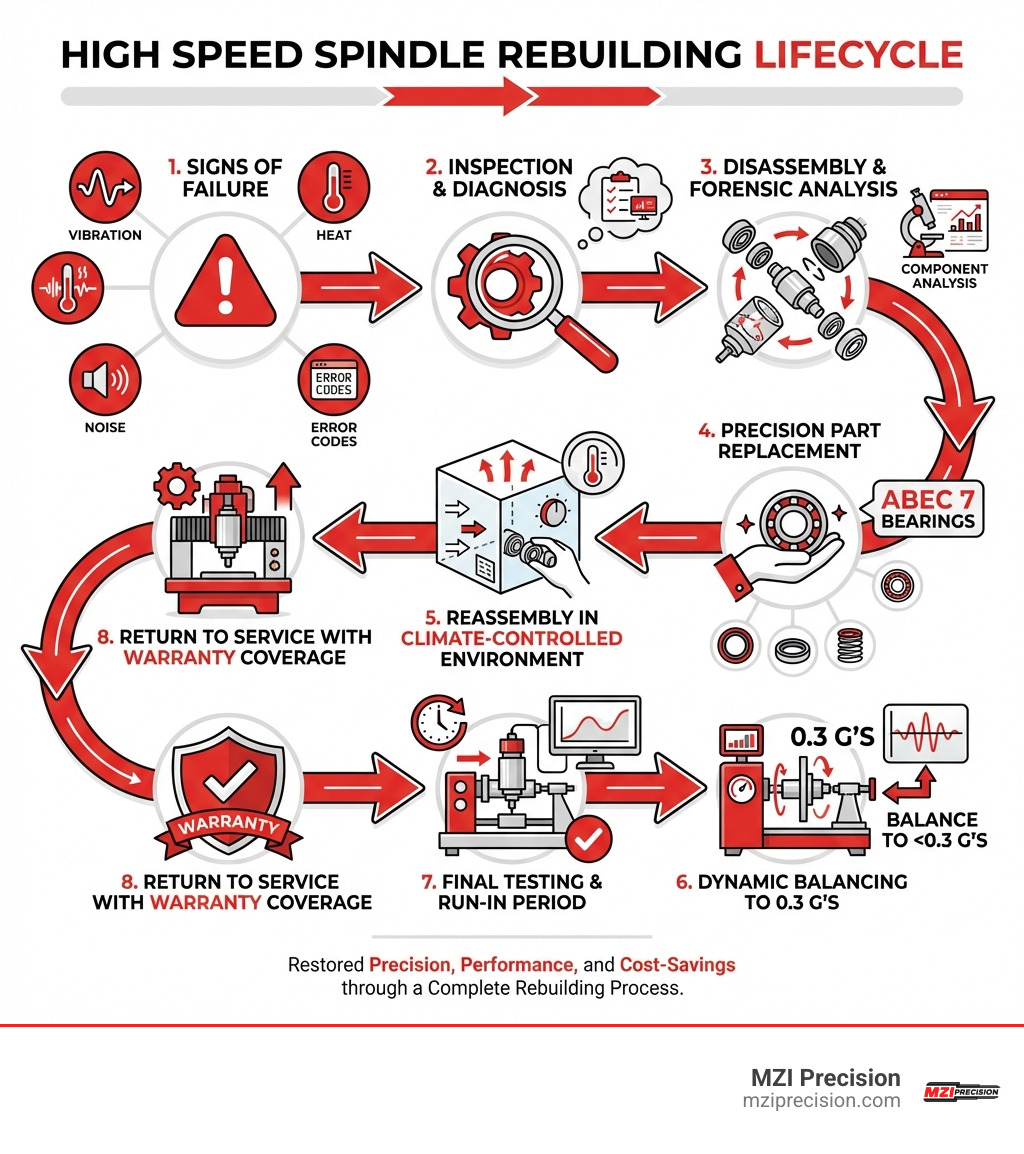
Simple guide to high speed spindle rebuilding terms:
Recognizing the Signs of Industrial Spindle Failure
In high-speed machining, your spindle is the heart of the operation. When it starts to falter, it rarely goes quiet about it. Recognizing the early warning signs of failure can mean the difference between a scheduled high speed spindle rebuilding project and a catastrophic machine crash that halts your entire production floor.
Excessive Noise and Vibration
One of the most common red flags is a change in the spindle’s “voice.” If your machine starts sounding like a jet engine during takeoff or develops a low-frequency growl, it’s likely due to bearing contamination or wear. Vibration analysis is a critical diagnostic tool here. When vibrations exceed standard thresholds, it indicates that the internal components are no longer rotating on a true axis, which directly impacts your part quality.
Thermal Expansion and Overheating
High-speed spindles are designed to run cool, often utilizing sophisticated liquid or air-oil cooling systems. If you notice the spindle housing is hot to the touch or your sensors indicate a spike in operating temperature, the grease may be contaminated or the bearings may be seizing. Overheating causes thermal expansion, which can lead to “shaft end play” and ruined tolerances. To keep your machines running smoothly, monitoring these thermal trends is essential.
PLC Error Codes and Sensor Glitches
Modern CNC machines are smart. They often throw PLC (Programmable Logic Controller) error codes when they detect something is amiss. This could be a “spindle orient” failure, a drawbar sensor error, or a drive fault. Before you pull the unit, check if it’s a simple sensor adjustment. However, recurring errors often point to deeper mechanical issues that require professional intervention.
Runout and Surface Finish Issues
Are your parts coming off the machine with “chatter” marks? Is the runout—the inaccuracy of the rotating tool—exceeding OEM specifications? Even a few microns of deviation can scrap an expensive aerospace component. If you can’t achieve the required surface finish despite using fresh tooling, it’s time to learn more about spindle troubleshooting.
The Technical Process of High Speed Spindle Rebuilding
Rebuilding a high-speed spindle isn’t just about swapping out parts; it’s a forensic engineering project. We follow a rigorous, multi-step process to ensure every unit we touch returns to the customer in better-than-new condition.
Step 1: Forensic Disassembly and Failure Analysis
Every high speed spindle rebuilding project begins with a complete teardown. We don’t just take it apart; we document the condition of every seal, O-ring, and bearing. This “forensic” approach allows us to identify the root cause of failure—whether it was lack of lubrication, a collision, or coolant ingestion.
| Inspection Phase | Full Rebuild Phase |
|---|---|
| Visual check of exterior components | Complete disassembly to individual parts |
| Clamp force testing | Replacement of all bearings and seals |
| Vibration signature recording | Precision grinding of spacers and shoulders |
| Runout measurement at the taper | Dynamic balancing and 24-hour run-in |
Step 2: Component Restoration and Precision Grinding
Often, the spindle shaft or housing has suffered wear. We utilize precision spindle rebuild techniques like “kiss grinding” bearing spacers and shaft shoulders. This restores the perfect perpendicularity and preload required for high-speed operation.
Step 3: High-Precision Bearing Selection
The bearings are the most critical component. We use ABEC 7 or better super-precision bearings. For ultra-high-speed applications, we often evaluate whether angular contact bearings are good for high-speed precision spindles or if ceramic hybrids are a better fit for the specific RPM requirements.
Step 4: Dynamic Balancing
At 10,000, 20,000, or even 60,000 RPM, the slightest imbalance becomes a destructive force. We dynamically balance every spindle to 0.3 G’s or better at full operating speed. This ensures whisper-quiet operation and an extended service life for your bearings. Watch this video on spindle coupling systems to see how precision components interact at high speeds.
Benefits of Rebuilding vs. Replacing Industrial Spindles
When a spindle fails, the immediate reaction might be to call the OEM for a replacement. However, rebuilding your spindle offers several distinct advantages that can significantly impact your bottom line.
Massive Cost Savings
On average, a professional rebuild costs between 30% and 50% of the price of a brand-new spindle. For high-end motorized electrospindles, this can represent a savings of tens of thousands of dollars. You aren’t sacrificing quality for price; you are simply restoring the high-value steel and copper components that haven’t reached their end of life.
Reduced Lead Times
In today’s supply chain environment, waiting for a new spindle from overseas can take months. A professional rebuild typically takes 5 to 10 business days. For “machine down” emergencies, some services can even expedite the process to just 2 or 3 days, getting your production back on track in a fraction of the time.
Performance Upgrades
A rebuild is an opportunity to restore your machine with better-than-OEM specifications. We can often upgrade bearing materials (like switching to ceramic) or improve sealing designs to prevent the contamination that caused the original failure. This results in a spindle that is actually more robust than the one that originally came with the machine.
Micron Precision and Proven Quality
By the time a spindle leaves a professional rebuild facility, it has been tested more rigorously than many new units. With precision within 2 microns and dynamic balancing that often exceeds factory standards, you can trust that your “rebuilt” unit will perform flawlessly from the first cut.
Quality Standards and Testing Procedures
Precision is not an accident; it is the result of strict adherence to quality standards. In our United States-based facilities, we treat every high speed spindle rebuilding job with the same level of care as a surgical procedure.
The Cleanroom Environment
Contamination is the number one enemy of high-speed bearings. Even a single speck of dust can cause a bearing to fail prematurely at 15,000 RPM. That’s why all assembly is performed in a climate-controlled, dust-free environment. This ensures that the specialized grease and precision surfaces remain pristine during the build.
Bearing Preload and Drawbar Force
We don’t just “tighten” things. We use calibrated equipment to set the exact preload on angular contact bearings. Furthermore, we test the drawbar pull force to ensure it meets OEM specs. If the drawbar isn’t pulling with the correct force, your tool holder will vibrate, ruining your surface finish and potentially damaging the spindle taper.
Comprehensive Testing and Run-in
A spindle shouldn’t be pushed to its limit the second it’s installed. We perform a comprehensive “run-in” procedure, slowly ramping up the RPMs while monitoring temperature and vibration. This allows the bearing grease to distribute evenly and ensures that the unit is thermally stable. Our high-speed spindle balancing guide details the importance of this final verification step.
Frequently Asked Questions about Spindle Restoration
How long does a professional high speed spindle rebuilding project take?
Standard turnaround for a comprehensive rebuild is usually 5 to 10 business days. This timeframe includes the initial inspection, part sourcing (if specialty bearings aren’t in stock), the actual rebuild, and the mandatory 24-hour run-in and testing period. For production-critical situations, we offer emergency services that can complete the process in as little as 3 days. Choosing spindle rebuild specialists with a large in-house inventory of GMN and other high-precision bearings is the best way to ensure a fast return to service.
What types of tool-holding systems can be rebuilt?
We can rebuild virtually any industrial tool-holding system used in CNC machining. This includes:
- HSK (63F, 63A, 100A, etc.): Common in high-speed aerospace and woodworking.
- CAT (40, 50): The standard for many North American machining centers.
- BT (30, 40): Often found in high-speed, high-precision Japanese machinery.
- ISO (30): Frequently used in lighter-duty high-speed applications.
- Motorized Electrospindles: Complex units where the motor is integrated into the spindle shaft.
- Cartridge Spindles: Self-contained units that can be easily swapped. Even advanced precision micro-spindles used in specialized electronics manufacturing can be fully restored.
Can high speed spindle rebuilding improve performance beyond OEM specs?
Absolutely. This is often referred to as “remanufacturing” rather than just rebuilding. By analyzing why the original spindle failed, we can implement design upgrades. For example, the balancing game allows us to achieve vibration levels far lower than the original factory settings. We can also integrate ceramic bearings, which offer lower thermal expansion and higher RPM capabilities than standard steel bearings, or install upgraded seal kits to better handle aggressive high-pressure coolants.
Conclusion
In the competitive landscape of industrial manufacturing, you cannot afford to have your precision machinery sitting idle. High speed spindle rebuilding is a strategic maintenance choice that combines technical excellence with fiscal responsibility. By choosing to rebuild rather than replace, you are investing in the longevity and accuracy of your CNC operations.
At MZI Precision, we understand the stakes. Whether you are machining critical parts for the aerospace industry, defense manufacturing, or automotive components, our commitment to OEM-quality restoration ensures your spindles return to the line ready for high-performance service. Located in the United States and serving key industrial hubs like Huntington Beach and Los Angeles, California, we are your partners in maintaining operational uptime.
Don’t wait for a catastrophic failure to occur. If you’ve noticed noise, heat, or vibration in your equipment, reach out to our team of experts. We provide the technical precision and fast turnaround you need to keep your shop floor running at peak efficiency.