

How to Stop Chips from Ruining Your Spindle Chuck Parts
Why Protecting Spindle Chuck Parts Is Critical in Industrial CNC Operations
Spindle chuck parts are the core workholding components in industrial CNC lathes — and they are under constant threat from one of the most overlooked hazards in precision machining: metal chips.
Here is a quick breakdown of the key spindle chuck parts and what they do:
| Part | Function |
|---|---|
| Master jaws | Hold and guide the top jaws that grip the workpiece |
| Hard/soft jaws | Direct contact with the workpiece; hard jaws for standard gripping, soft jaws for custom fits |
| Scroll gear | Simultaneously moves all jaws for centered clamping |
| Wedge hooks / T-nuts | Transmit clamping force in power chucks |
| Collets | Provide 360° contact for high-precision, high-RPM workholding |
| Chuck body | The structural housing that holds all internal components |
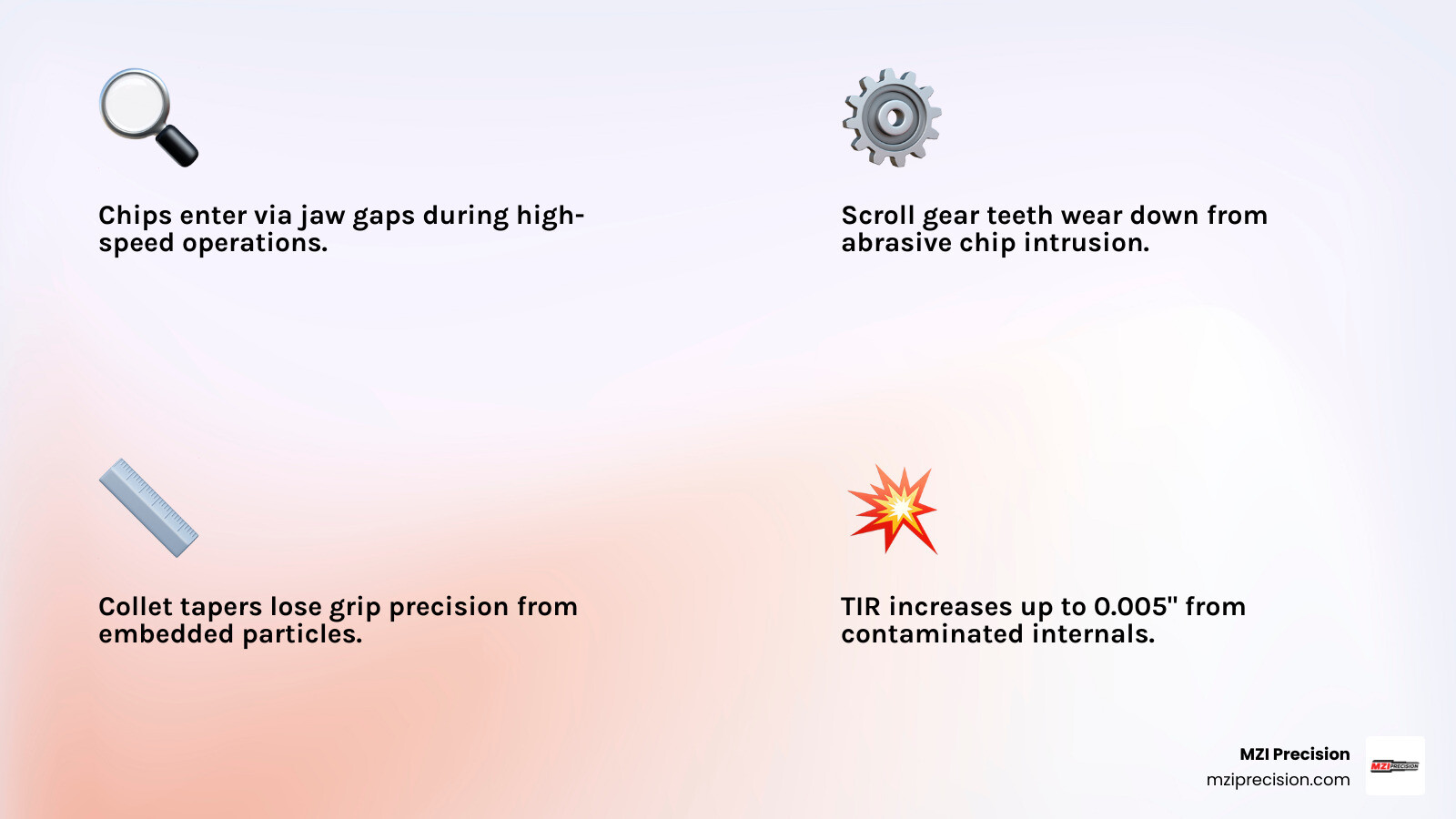
Chips are a normal byproduct of machining. But when they migrate into the internal mechanisms of a chuck — the scroll, the jaw slides, the collet taper — the damage compounds fast. Runout increases. Gripping force drops. Accuracy suffers.
For aerospace manufacturers, even a small deviation in TIR (Total Indicated Runout) can mean scrapped parts, failed inspections, or unplanned downtime. The stakes are high.
This guide explains how chips infiltrate chuck components, which parts are most vulnerable, and what you can do to stop the damage before it starts.
Relevant articles related to Spindle chuck parts:
- Spindle Parts
- how does a multi spindle screw machine do large parts
- how to identify spindle part number
Essential Spindle Chuck Parts for Industrial Lathes
In industrial manufacturing, the “chuck” is rarely just one solid piece of metal. It is a complex assembly of high-precision components working in harmony. When we look at a disassembled industrial power chuck, we see a sophisticated system designed to convert hydraulic or pneumatic energy into massive gripping force.
The heart of a power chuck involves master jaws and wedge hooks. The wedge hook is a critical internal component that moves axially to pull the master jaws inward. If metal chips find their way into the wedge hook assembly, they act like sandpaper, grinding down the precision-fit surfaces and reducing the clamping efficiency.
T-nuts and scroll gears are equally vital. In manual scroll chucks, the scroll gear is a large threaded disk that moves all jaws simultaneously. For power chucks, T-nuts secure the top jaws to the master jaws. If these spindle parts are compromised by debris, the jaws may not seat correctly, leading to “jaw lift” and significant loss of accuracy.
Internal Components: Manual vs. Power Chucks
| Component | Manual Scroll Chuck | CNC Power Chuck |
|---|---|---|
| Actuation | Chuck key / Scroll gear | Hydraulic cylinder / Wedge hook |
| Grip Force | Limited by operator strength | High (consistent hydraulic pressure) |
| Chip Vulnerability | Open scroll threads | Internal piston and seals |
| Precision | Standard | Ultra-precision / High-RPM |
Understanding these lathe spindle assembly internals is the first step in preventing chip-related failure.
Identifying Critical Spindle Chuck Parts for Replacement
Knowing when to replace your Spindle chuck parts is an art form backed by data. We often see wear patterns that tell a story. For instance, “bell-mouthing” on hard jaws occurs when the front of the jaw wears faster than the back, causing the workpiece to tilt.
Hard jaws are typically through-hardened and used for roughing operations, while soft jaws are made of aluminum or unhardened steel, allowing them to be bored to a specific diameter for a perfect, mar-free grip. In high-volume industrial environments, soft jaws are considered consumables, but the master jaws they attach to should last years if maintained.
Technical specifications for spindle spare parts often include weight and material density. For example, some high-end manual chuck spindles weigh between 0.14 kg and 0.35 kg, depending on the variant. Always stick to OEM specifications or high-quality equivalents to ensure the balance of your cnc machine spindle assembly remains intact.
Selecting High-Precision Spindle Chuck Parts for CNC Operations
When operating at high RPMs, centrifugal force becomes your enemy. As the chuck spins faster, the jaws want to fly outward, which naturally reduces the gripping force on the workpiece. High-precision Spindle chuck parts are engineered to counteract this.
Total Indicated Runout (TIR) is the gold standard for accuracy. Industrial-grade collet chucks, like those from Royal, can achieve a TIR of 0.0002″ or better. This level of precision is mandatory for aerospace tolerances where a hair’s breadth of error is unacceptable.
To maintain this accuracy, you must consider spindle tool holders and component balancing. A single mismatched T-nut or a slightly heavier replacement jaw can introduce vibrations that ruin surface finishes and accelerate bearing wear. In the bearing spindle assembly, these vibrations are the primary cause of premature failure.
Collet Systems vs. Traditional Jaw Chucks
While 3-jaw and 4-jaw chucks are versatile, collet systems are the kings of precision in industrial manufacturing. A collet provides 360-degree contact with the workpiece, distributing clamping force evenly. This is especially beneficial for thin-walled tubing or delicate aerospace components that would be crushed or distorted by the concentrated pressure of three individual jaws.
CNC collet chucks offer several advantages:
- 360° Contact: Greater gripping force and reduced vibration.
- High-Speed Stability: Less mass means less centrifugal force loss at high RPM.
- Quick-Change Technology: Some systems allow for collet changes in as little as 10 seconds, compared to the minutes required to bore and swap jaws.
- Bar Feeding: Collet chucks are the preferred choice for bar-fed machines because they provide superior tool clearance and centerline accuracy.
For those running secondary spindles in dual-spindle machines, collets are often the only way to ensure a seamless part handoff. Systems like the A2-5 Secondary-Spindle utilize synchronized chucks to finish parts in a single setup, drastically reducing labor costs.
Pullback vs. Accu-Length Performance
If you’ve ever struggled with a part shifting along the Z-axis during clamping, you’ve experienced the “pullback” effect. Traditional pullback collet chucks draw the collet into the tapered seat, which inevitably moves the workpiece slightly toward the spindle.
Accu-Length™ (or Dead-Length) chucks solve this. They use a stationary collet and a moving tapered sleeve. Because the collet doesn’t move axially, the workpiece stays exactly where you positioned it. This is vital for secondary spindle operations where the part must be handed off at a precise coordinate.
ER Collet Specifications and Torque Requirements
ER collets are the most widely used tool-holding system in the world, following the DIN 6499 standard. They are made from through-hardened alloy spring steel and precision ground for maximum accuracy.
When assembling these Spindle chuck parts, torque is everything. Over-tightening can deform the collet, while under-tightening leads to tool slippage and runout.
Recommended Torque for ER Collets:
- ER16 (Tools < 2mm): 30 ft/lbs
- ER16 (Tools > 2mm): 42 ft/lbs
- ER32 (Standard Nut): 100 ft/lbs
Most ER collets, such as the ER16 Collet 5/16 Inch, have a collapsing range of about 0.039″. This means a 5/16″ collet can safely grip shanks ranging from 0.273″ to 0.312″. For the best results, always use a torque wrench and ensure surfaces are free of those pesky metal chips.
Maintenance Strategies to Prevent Chip Damage
If we had to give you one piece of advice to save your Spindle chuck parts, it would be this: Grease is your best friend.
Industrial power chucks require specialized high-pressure grease. Standard lubricants are often flung off by centrifugal force at high speeds. Products like CHUCK GREASE PRO are designed to stay put, providing up to 1.5 times the gripping force and 3 times the service life compared to standard grease.
Our Recommended Maintenance Cycle:
- Daily: Wipe down the chuck face and use compressed air (carefully!) to clear chips from jaw ways.
- Every Shift: Lubricate the grease nipples. This “purges” the internal cavities, pushing old grease and microscopic chips out.
- Weekly: Remove jaws and T-nuts. Clean the master jaw serrations with a wire brush.
- Monthly: Perform a full teardown for high-production machines. Inspect internal spindle parts for scoring or rust.
Rust prevention is also key. When using water-based coolants, the concentration must be monitored. If the concentration is too low, your precision-ground surfaces will begin to corrode, leading to permanent accuracy loss. We recommend a rust preventative spray if a machine is going to sit idle for more than 24 hours. For more in-depth care, check out our spindle restoration guide.
Troubleshooting Runout and Component Wear
Even with the best maintenance, parts eventually wear out. The first sign of trouble is usually an increase in Total Indicated Runout (TIR).
If you notice your parts are coming off the machine eccentric, start by checking the easiest components first. Is there a chip trapped in the collet taper? Is a T-nut loose? If the basics are fine, you may need a jaw force tester. This device measures the actual clamping pressure at various RPMs, helping you identify if the internal wedge hook or hydraulic cylinder is failing.
Scoring on the chuck body or master jaws is a “red flag.” It indicates that metal chips have entered the sliding surfaces and are physically carving grooves into the hardened steel. Once scoring occurs, the only solution is often professional spindle repair or replacement.
If you are experiencing excessive vibration alongside runout, the issue might be deeper in the spindle bearing assembly. Vibration analysis can help determine if the imbalance is coming from the chuck or the spindle bearings themselves. When the chuck is no longer salvageable, our spindle replacement guide can walk you through the next steps.
Frequently Asked Questions about Spindle Chucks
How often should I lubricate my spindle chuck parts?
In a high-production industrial environment, you should lubricate your chuck at least once per shift. For high-speed operations (above 3,000 RPM), you may need to lubricate more frequently to counteract the grease being “spun out” by centrifugal force.
What causes excessive runout in a collet chuck?
The most common causes are:
- A “crushed” collet from over-tightening.
- Metal chips or dried coolant trapped in the spindle taper or collet grooves.
- Using a tool shank that is outside the collet’s collapsing range.
- Wear on the internal spindle-bearing-assembly.
Are all spindle chuck parts universally interchangeable across different CNC machines?
No. While some standards exist (like A2-5 or A2-6 spindle noses), internal Spindle chuck parts like wedge hooks, master jaws, and T-nuts are usually specific to the manufacturer (e.g., SCHUNK, Kitagawa, or Royal). Always verify part numbers and series (like SJ, HB, or B-200) before ordering replacements. For manual lathes, thread sizes like 1″ x 8 TPI or M33 x 3.5mm are common, but adapters are often needed for cross-brand compatibility.
Conclusion
Protecting your Spindle chuck parts from chip damage isn’t just about cleanliness — it’s about protecting your bottom line. By implementing a rigorous lubrication schedule, choosing the right collet systems for high-precision work, and monitoring wear patterns, you can extend the life of your equipment and maintain the tight tolerances your customers demand.
At MZI Precision, we understand the complexities of industrial workholding. Based in the United States with a focus on serving the aerospace, defense, and automotive sectors, we specialize in the repair and rebuilding of high-performance spindles. Whether you are dealing with catastrophic failure or simply need to restore your machine’s original accuracy, our expertise in OEM rebuilt spindles ensures you get back to production with minimal downtime.
Don’t let a few stray metal chips ruin your precision. If you’re seeing signs of wear or excessive runout, Contact MZI for Spindle Repair Services today and let our experts restore your spindle to peak performance.