

Spindle Bearing Puller: Best Tools for 2025
The Role of Specialized Tools in Spindle Maintenance
A spindle bearing puller is a specialized tool designed to safely remove bearings from industrial manufacturing spindles without damaging the spindle shaft or housing. These precision instruments are essential for maintaining the high-performance machinery that keeps aerospace, automotive, and manufacturing operations running smoothly.
Key spindle bearing puller types and functions:
- Mechanical pullers – Use threaded forcing screws for controlled removal
- Hydraulic pullers – Provide high force capacity for stubborn bearings
- Bearing separators – Split bearing races for extraction from tight spaces
- Internal pullers – Remove bearings from blind holes or confined areas
- Slide hammer kits – Use impact force for seized or corroded bearings
The right bearing removal tool can mean the difference between a quick maintenance job and costly spindle damage. As one forum user finded when trying to remove a seized pulley, “I tried a 3-jaw puller on the center spindle and bent the pulley really bad with no luck removing it.” This highlights why choosing the correct puller for your specific application is crucial.
Why specialized tools matter:
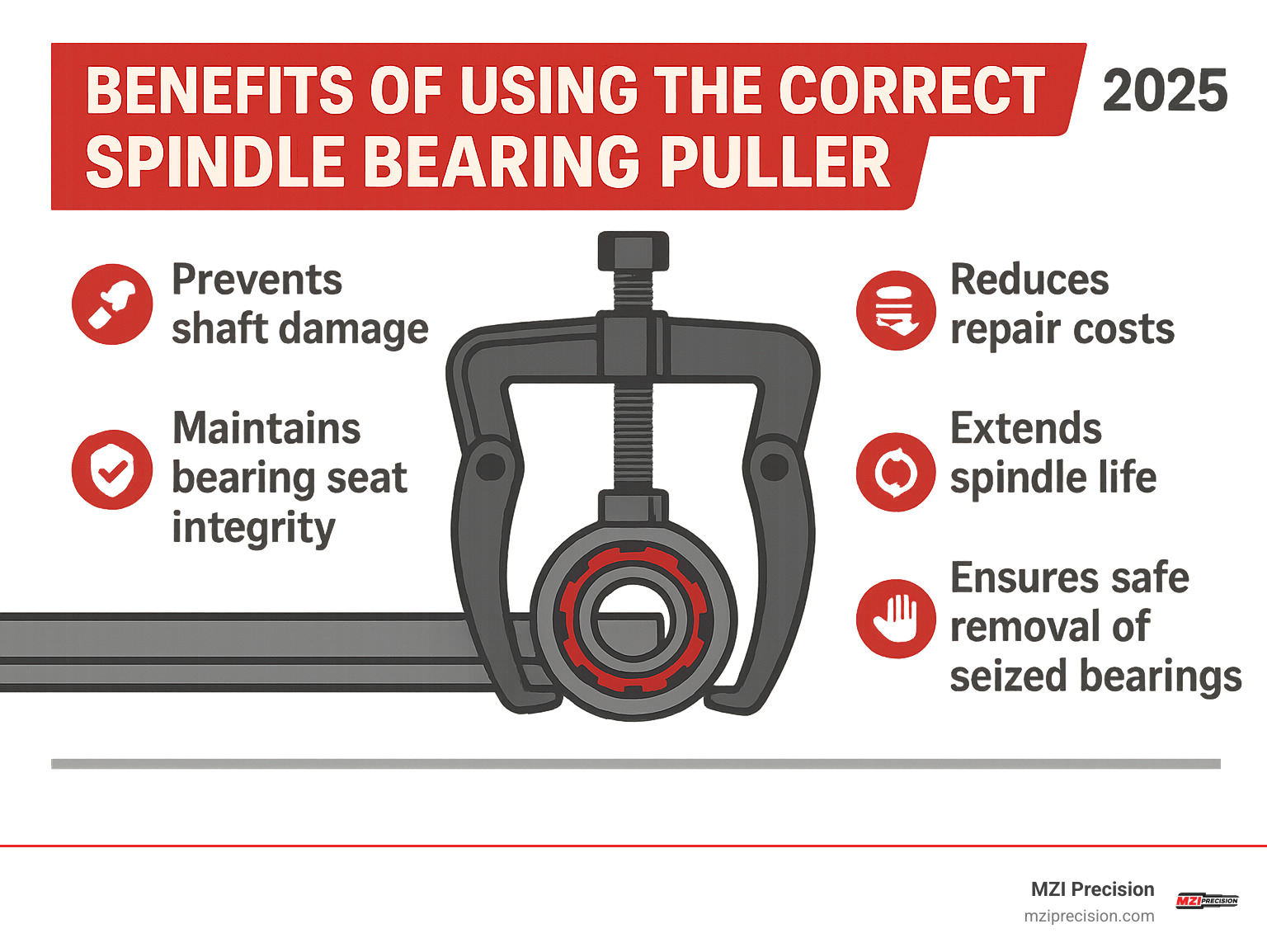
Industrial spindles operate at extremely high speeds and require precise tolerances. Using improper removal techniques can damage bearing seats, create shaft scoring, or cause housing distortion. The cost of spindle replacement or major repairs far exceeds the investment in quality bearing removal tools.
Professional maintenance teams understand that preventing damage during bearing removal protects the entire spindle assembly and extends equipment life. The research shows that specialized pullers like those with a clamshell design can handle specific applications safely, while universal kits offer versatility across different bearing types and sizes.
Spindle bearing puller further reading:
Types of Bearing Pullers for Industrial Spindles
When you’re working with industrial manufacturing spindles, having the right spindle bearing puller can make all the difference between a smooth maintenance job and a costly nightmare. Trust me, we’ve seen plenty of both scenarios over the years at MZI Precision.

Let’s start with mechanical pullers – these are your reliable workhorses. They use a threaded forcing screw to apply steady, controlled pressure, slowly coaxing bearings from their seats. Think of them as the patient, methodical approach to bearing removal. They’re perfect when you’re dealing with bearings that haven’t been completely seized by years of operation.
When mechanical pullers meet their match, hydraulic pullers step up to the plate. These powerful tools can generate anywhere from 5 to 15 tons of force – that’s serious pulling power. If you’ve ever tried to remove a large bearing that’s been press-fitted onto a spindle shaft for years, you’ll appreciate what hydraulic force can accomplish. The steady, controlled pressure they provide is exactly what you need for those stubborn industrial applications.
Bearing separators, also called splitters, are the problem-solvers of the bearing removal world. Picture this: you’ve got a bearing pressed tight against a shoulder, and there’s simply no way to get traditional puller jaws behind it. That’s where bearing separators shine. Their clever design splits the bearing races, creating a flat surface that other pullers can push against. It’s like having a key that open ups impossible removal situations.
For those tricky internal or blind hole pullers, we’re talking about bearings seated where you can’t access them from behind. These specialized tools expand inside the bearing’s bore to create a grip, then use either a slide hammer or forcing screw to extract the bearing. They’re absolute lifesavers when dealing with complex spindle designs where access is severely limited.
| Feature | Mechanical Pullers | Hydraulic Pullers |
|---|---|---|
| Force Capacity | Moderate | High to Very High |
| Control | Excellent, manual feedback | Good, often with pressure gauges |
| Cost | Generally lower | Higher |
| Application | Versatile, general-purpose | Large, stubborn, industrial |
JAW-TYPE PULLERS
Jaw-type pullers are the backbone of most bearing removal operations. Two-jaw pullers are your go-to choice when space is tight. They’re compact and maneuverable, perfect for smaller bearings or when you’re working in cramped quarters around complex spindle assemblies.
Three-jaw pullers bring superior stability to the table. By gripping at three points instead of two, they distribute force more evenly and dramatically reduce the risk of the bearing tilting during removal. This even pressure distribution is crucial – it protects both your spindle shaft and the bearing’s seating area from damage.
Many modern jaw-type pullers feature reversible jaws, which means you can flip them around for both internal and external pulling applications. It’s like having two tools in one, and that versatility really comes in handy when you’re dealing with different bearing configurations on the same spindle.
The key to success with jaw-type pullers is even force distribution. When all jaws grip uniformly, you’re pulling straight and true, which prevents the kind of binding and damage that can turn a routine maintenance job into an expensive repair.
HYDRAULIC AND SLIDE HAMMER KITS
When bearings refuse to budge with conventional methods, it’s time to bring out the heavy artillery. Hydraulic pullers excel in high-force applications where you need serious pulling power delivered in a controlled manner. Some models can deliver up to 15 tons of force – enough to overcome even the most stubborn press-fit situations.
Slide hammer kits take a completely different approach, using impact force instead of steady pressure. Picture a heavy weight sliding along a shaft and delivering a sharp, percussive blow to break free seized bearings. It’s the mechanical equivalent of a controlled shock treatment.
These kits really shine with their versatility. Most quality slide hammer sets come with multiple attachments for both internal and external pulling scenarios. You might have adapters for different bearing sizes, internal expanding attachments, and even specialized fittings for other press-fit components.
The beauty of slide hammers lies in their ability to deliver that crucial “shock” needed to break the bond between a seized bearing and its seat. Sometimes steady pressure just isn’t enough – you need that sharp impact to overcome years of corrosion and friction that have essentially welded the bearing in place.
How to Choose the Right Spindle Bearing Puller

When it comes to selecting the perfect spindle bearing puller for your industrial manufacturing needs, we can’t stress enough how crucial this decision is. Think of it like choosing the right key for a lock – the wrong choice can leave you frustrated and potentially damage expensive spindle components.
The journey starts with understanding your specific bearing and its unique challenges. We always tell our clients that matching the puller to bearing size is your first priority. You’ll need to measure the bearing’s outer diameter, inner diameter, and check how much space you have to work with around the spindle assembly.
Tonnage rating becomes critical when you’re dealing with industrial manufacturing spindles that have been running for years. These bearings can be incredibly stubborn, and a puller rated for only light duty simply won’t cut it. For most industrial applications, we recommend looking at pullers with at least 5-ton capacity, though 15-ton models aren’t overkill for larger or severely seized bearings.
Don’t overlook reach and spread requirements either. The reach determines how far the puller’s jaws extend from the center, while spread tells you the maximum diameter the jaws can handle. These measurements must work with your specific spindle configuration, or you’ll find yourself stuck before you even start.
Key Features of a Spindle Bearing Puller
The best spindle bearing pullers share several important characteristics that make the difference between a smooth operation and a nightmare job.
Adjustability tops our list of must-have features. A fully adjustable puller gives you the flexibility to handle various bearing sizes without needing a complete arsenal of specialized tools. This versatility proves invaluable in busy manufacturing environments where different spindle types are common.
The forcing screw design deserves special attention. Look for fine-threaded screws that provide better mechanical advantage and smoother operation. Some high-quality models include thrust bearings on the forcing screw, which reduces friction and makes the whole process easier on your hands and more controlled.
Jaw configuration plays a huge role in successful bearing removal. Well-machined jaws that maintain a secure grip are essential, and reversible jaws add tremendous value by enabling both internal and external pulling applications from a single tool.
Safety should never be an afterthought. Safety cages on larger pullers help contain components if something goes wrong, protecting both you and nearby equipment. It’s a feature we always appreciate when working with high-force applications.
Compatibility with accessories extends your puller’s usefulness significantly. The ability to add bearing separators, different jaw lengths, or slide hammer adapters transforms a single tool into a comprehensive bearing removal system.
How Material and Construction Affect Performance
The materials and construction quality of your spindle bearing puller directly impact how well it performs and how long it lasts. We’ve seen too many cheap tools fail at critical moments, causing delays and potential damage.
Forged steel construction represents the gold standard for puller durability. The forging process creates stronger, more reliable tools with improved grain structure compared to cast alternatives. When you’re applying tons of force to remove a stubborn bearing, this extra strength makes all the difference.
Carbon steel offers an excellent balance of strength and affordability for most applications. It provides good hardness and wear resistance, making it suitable for regular industrial use without breaking the budget.
Chrome vanadium steel takes performance up another notch. This alloy delivers superior strength, toughness, and corrosion resistance. It’s particularly valuable for puller components that experience the highest stress, such as jaws and forcing screws.
Durability and longevity aren’t just nice-to-have features – they’re essential for tools that need to perform reliably in demanding industrial environments. A well-constructed puller will handle repeated heavy use without deforming or failing, providing consistent performance for years.
Corrosion resistance becomes important when you’re working in various industrial settings where moisture or chemicals might be present. Materials like chrome vanadium steel help maintain both performance and appearance over time, protecting your investment.
The impact on effectiveness cannot be overstated. Quality materials and construction ensure your puller can apply the necessary force without flexing or breaking. This reliability means bearings come off smoothly without damaging valuable spindle components – exactly what you need for successful industrial manufacturing spindle maintenance.
A Step-by-Step Guide to Removing a Spindle Bearing

When it comes to removing a bearing from an industrial manufacturing spindle, there’s no room for guesswork. We’ve learned through years of spindle repair and rebuilding that a systematic approach makes all the difference between a smooth maintenance job and a costly disaster.
The process begins long before you actually touch the spindle bearing puller. Preparation is everything in precision work. You’ll want to create a clean, well-lit workspace with all your tools within easy reach. This includes your chosen puller, any necessary attachments, penetrating oil for stubborn bearings, and all required safety equipment.
Safety checks should become second nature. Before every job, we inspect our workspace for stability and ensure the spindle is properly secured. There’s nothing worse than having a valuable spindle shift or fall during the removal process. Take a moment to verify that your work surface can handle the forces you’re about to apply.
Tool setup requires careful attention to detail. The wrong puller or improper positioning can turn a routine bearing removal into an expensive repair job. Match your tool to the specific bearing size and type, and double-check that all components are in good working condition.
Finally, applying force should be done with patience and control. Industrial bearings don’t always come out easily, but rushing the process often leads to damaged spindle shafts or housings that cost far more than the time you thought you were saving.
For complex spindle issues or when you need professional expertise, our comprehensive repair services can handle everything from routine maintenance to complete rebuilds.
More info about spindle services.
PROPER USE OF A SPINDLE BEARING PULLER
Getting the technique right with a spindle bearing puller makes the difference between professional results and amateur mistakes. We’ve refined this process through countless spindle repairs, and these steps will help you achieve consistent, damage-free bearing removal.
Step 1: Inspect the spindle and bearing thoroughly. Start by examining the entire assembly under good lighting. Look for signs of corrosion, unusual wear patterns, or any damage that might complicate removal. Understanding what you’re working with helps you anticipate challenges before they become problems. Pay special attention to how the bearing is seated and whether there’s any visible damage to the spindle shaft or housing.
Step 2: Select the correct puller and attachments carefully. Based on your inspection, choose the appropriate type of puller – whether mechanical, hydraulic, internal, or separator style. Verify that the tonnage rating exceeds what you expect to need, and confirm that the reach and spread dimensions will work with your specific bearing configuration. Using an undersized tool is a recipe for failure and potential damage.
Step 3: Securely attach the puller jaws with precision. Position the jaws or separator firmly behind the bearing’s race, ensuring even contact all around. For jaw-type pullers, all jaws must grip equally to prevent the bearing from tilting during removal. With bearing separators, make sure the clamp is tight around the bearing. Internal pullers require the expanding collet to be properly seated and tightened within the bearing bore.
Step 4: Center the forcing screw with absolute accuracy. The forcing screw must align perfectly with the spindle shaft centerline. Even slight misalignment can cause the bearing to bind or damage the shaft surface. Take your time with this step – precision here prevents problems later.
Step 5: Apply gradual and even pressure with patience. Turn the forcing screw slowly and steadily, maintaining consistent pressure. Avoid sudden movements or excessive force. If the bearing resists movement, stop and reassess rather than forcing it. For hydraulic pullers, monitor the pressure gauge to stay within safe operating limits. You should feel steady resistance as the bearing begins to move.
Step 6: Remove the bearing completely and inspect the results. Continue applying pressure until the bearing is fully free from its seat. Once removed, carefully extract both the puller and bearing from the assembly. Inspect the spindle shaft and housing for any damage that occurred during removal, and clean all surfaces thoroughly in preparation for the new bearing installation.
ESSENTIAL SAFETY PRECAUTIONS
Working with a spindle bearing puller involves substantial forces that can cause serious injury if safety protocols aren’t followed. We’ve seen what happens when shortcuts are taken, and it’s never worth the risk.
Personal Protective Equipment isn’t optional – it’s essential for every bearing removal job. Eye protection through safety glasses or goggles protects against flying debris when bearings suddenly release or fragment under pressure. Heavy-duty work gloves shield your hands from sharp edges, pinch points, and chemical exposure from penetrating oils. In noisy environments or when using impact tools, hearing protection should also be part of your standard gear.
Inspecting the tool before use should become an automatic habit. Check every component of your puller for cracks, bends, wear, or any other damage before applying it to expensive spindle components. Examine the jaws for proper alignment, test the forcing screw for smooth operation, and verify that hydraulic components show no signs of leakage. A damaged tool can fail catastrophically under load, potentially causing injury and destroying the spindle you’re trying to repair.
Ensuring stable footing means working on level, stable surfaces and properly securing the spindle assembly. Use appropriate fixtures or vises to prevent movement during the removal process. An unstable setup not only increases injury risk but also makes precise tool positioning nearly impossible.
Never exceeding tool capacity is a rule that should never be broken. Every puller has a specified tonnage rating for good reason. Attempting to remove a bearing that requires more force than your puller can safely provide leads to tool failure, component damage, and potential serious injury. When faced with an exceptionally stubborn bearing, consider alternative removal methods or invest in a more powerful puller rather than risking catastrophic failure.
Common Challenges and Advanced Techniques
Let’s be honest – even with the perfect spindle bearing puller and meticulous preparation, some bearings simply don’t want to cooperate. After years of working on industrial manufacturing spindles, we’ve learned that these stubborn situations are more common than we’d like to admit. The good news? There’s almost always a solution.
The biggest headaches we encounter typically fall into three categories. First, there are those bearings that have essentially become one with the spindle shaft through years of corrosion or what we call “cold welding” – where metal surfaces bond together under pressure over time. Then there are the access nightmares, where the spindle design leaves barely enough room to get your hands in, let alone position a proper puller. Finally, there’s the constant worry about damaging those precision-machined surfaces that make industrial spindles so valuable in the first place.
These challenges can turn what should be a straightforward maintenance task into a real puzzle. But don’t worry – we’ve developed some tried-and-true techniques that can save the day.
OVERCOMING STUBBORN BEARINGS
When a bearing decides it’s not going anywhere, we have several tricks up our sleeve. The key is patience and using the right combination of methods.
Penetrating oils are often your first line of defense against seized bearings. We’re not talking about a quick spray and immediate action here. The real magic happens when you apply a high-quality penetrating oil generously and then walk away. Give it time – sometimes days – to work its way into those microscopic gaps between the bearing and its seat. The oil breaks down corrosion and creates lubrication where there was none before.
Controlled heat application can work wonders, but it requires a careful touch. By heating the component that the bearing is seated in, you cause it to expand slightly, which can break that stubborn bond. We’ve seen cases where heating a component until it’s almost red hot, then quickly cooling it, creates thermal shock that loosens even the most determined bearing. Just remember – industrial spindles have tight tolerances, so any heat application must be precise and controlled.
Strategic vibration is another valuable technique. Sometimes a bearing just needs a good talking-to in the form of controlled tapping or rapping while maintaining pressure with your spindle bearing puller. The vibration helps break up corrosion and can dislodge debris that’s creating extra friction.
When all else fails, there are destructive removal methods. Nobody likes to go this route, but sometimes it’s the most practical solution. This might involve carefully cutting away portions of a seized bearing or breaking it into pieces. It’s always a last resort, but it’s better to sacrifice a bearing than risk damaging an expensive spindle assembly.
TOOL MAINTENANCE FOR LONGEVITY
Your spindle bearing puller is a precision instrument that deserves proper care. Think of it as an investment that pays dividends through reliable performance and safety.
Cleaning after each use might seem obvious, but it’s surprising how often this gets overlooked in busy shops. Every bit of grease, metal shavings, or debris that stays on your puller is working against you for the next job. A clean tool operates smoothly and gives you better feedback about what’s happening during a bearing removal.
The forcing screw needs regular attention because it’s doing the heavy lifting. Keep it properly lubricated with quality grease or oil. This isn’t just about smooth operation – it’s about preventing wear and ensuring you can apply force evenly and controllably. For hydraulic pullers, this extends to checking fluid levels and inspecting hoses for any signs of wear or leaks.
Proper storage protects your investment. A clean, dry environment keeps corrosion at bay and prevents damage from other tools. If your puller came with a case, use it. If not, dedicate a specific spot in your toolbox where it won’t get banged around.
Most importantly, inspect for wear or damage before putting your puller away and again before using it. Look for bent jaws, stripped threads, stress cracks, or any deformation. A damaged puller isn’t just ineffective – it’s dangerous. The forces involved in bearing removal are substantial, and tool failure can cause serious injury.
A well-maintained spindle bearing puller will serve you faithfully for years, making those challenging bearing removals manageable and keeping your valuable industrial manufacturing spindles in top condition.
Conclusion: Ensuring Precision and Longevity in Your Machinery
Throughout this comprehensive guide, we’ve explored how the right spindle bearing puller can make all the difference between a smooth maintenance operation and a costly disaster. These specialized tools aren’t just nice-to-have equipment – they’re essential guardians of your industrial manufacturing spindles.
Think about it: your spindles are the heartbeat of your precision machinery, operating at incredible speeds with tolerances measured in thousandths of an inch. When it’s time for bearing maintenance, using the wrong approach or inferior tools can turn a routine job into an expensive nightmare. We’ve seen too many cases where well-meaning technicians ended up with damaged shafts, scored bearing seats, or worse – complete spindle replacement bills that could have been avoided.
The journey from mechanical pullers with their reliable threaded forcing screws to powerful hydraulic systems capable of generating 15 tons of force shows us that there’s truly a tool for every challenge. Whether you’re dealing with a stubborn bearing that’s been seized for years or working in the tight confines of a complex spindle assembly, the right puller – combined with proper technique – will get the job done safely.
We’ve walked through the critical selection criteria, from matching tonnage ratings to your specific needs, to understanding how forged steel construction and chrome vanadium materials contribute to tool longevity. The step-by-step removal process we outlined isn’t just about following instructions – it’s about respecting the precision engineering of your spindles while working efficiently.
Even when you encounter those challenging situations – the corroded bearings that seem welded in place, or the limited access scenarios that test your creativity – the advanced techniques we discussed provide a roadmap to success. Sometimes a little penetrating oil and patience work better than brute force.
At MZI Precision, we understand that proper spindle maintenance is an investment in your operation’s future. Our commitment to quality spindle repair and rebuilding comes from years of seeing how the right approach to maintenance can extend equipment life and prevent unexpected downdowns. When you’re working with aerospace, defense, or other critical manufacturing applications, there’s simply no room for shortcuts.
The value of professional spindle maintenance extends far beyond the immediate repair. It’s about maintaining the precision that keeps your production lines running smoothly, your quality standards high, and your customers satisfied. Whether you’re facing routine bearing replacement or complex spindle rebuilding challenges, having the right tools and expertise makes all the difference.
When your spindles need expert attention, we’re here to help you maintain the precision and reliability your operation demands.