

CNC Spindle Bearing Price: Uncover 3 Hidden Costs
Why Understanding CNC Spindle Bearing Costs Matters
The CNC spindle bearing price can be shocking. Quotes for a rebuild can vary dramatically; one shop owner received quotes from $3,000 (independent) to $13,500 (OEM) for the same service—a 350% difference.
Quick Price Guide:
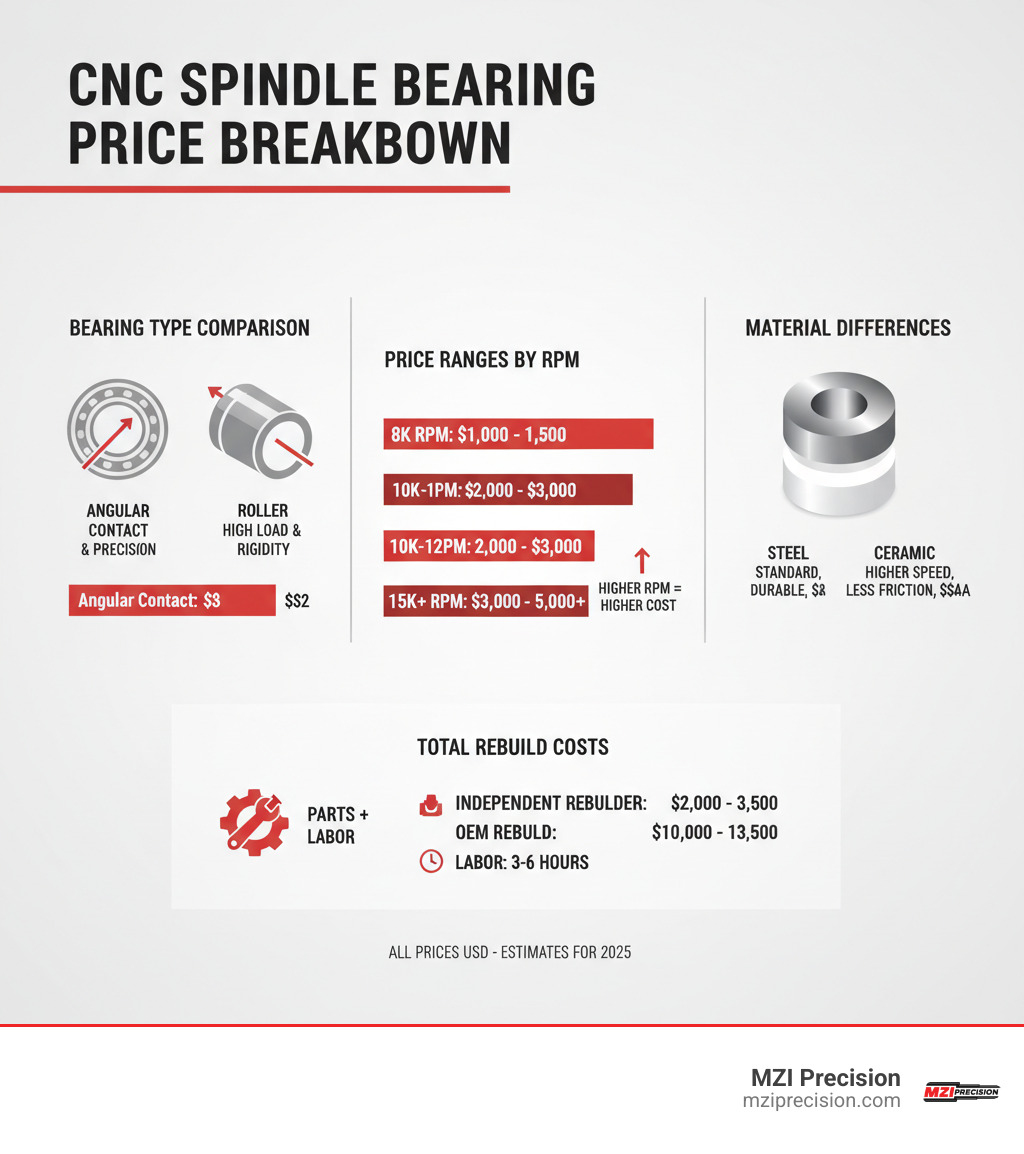
- Basic Bearings (8K RPM): $1,000-$1,500
- High-Performance Bearings (10K-12K RPM): $2,000-$3,000
- Complete Spindle Rebuild (Independent): $2,000-$3,500
- OEM Spindle Rebuild/Exchange: $10,000-$13,500
- Labor Costs: 3-6 hours per rebuild
Understanding these costs is about balancing upfront investment with long-term value. The wrong bearing can cause premature failure, unplanned downtime, and spindle damage, quickly erasing any initial savings. Knowing the real cost drivers helps you evaluate quotes, choose reliable suppliers, and protect your manufacturing operations, whether you’re performing preventative maintenance or facing an unexpected failure.
THE CORE COMPONENT: UNDERSTANDING BEARING PRICES

Spindle bearings are highly specialized components engineered for extreme speeds and microscopic tolerances. The CNC spindle bearing price reflects this critical role. A quality bearing set for an 8,000 RPM spindle costs around $1,000, while high-performance bearings for 10,000-12,000 RPM can exceed $2,000. Individual angular contact bearings can range from a few hundred to over $800 each.
The main types are angular contact ball bearings, ideal for high-speed applications handling both radial and axial loads, and various roller bearings (cylindrical, spherical, etc.), built for heavier loads. The material choice—typically steel or ceramic—also has significant performance and cost implications.
PERFORMANCE VS. COST: CERAMIC VS. STEEL BEARINGS
Steel bearings are the reliable, affordable standard for many applications. However, hybrid ceramic bearings (ceramic balls, steel races), despite a higher initial price, offer compelling advantages.
- Higher RPMs: Lighter, harder ceramic balls spin faster with less heat generation.
- Durability: Superior hardness means ceramic resists wear longer, extending spindle life.
- Heat Resistance: Ceramic creates less friction and dissipates heat better, which is crucial for maintaining precision in high-speed operations.
The question isn’t just about the initial cost, but the total cost of ownership. For demanding applications, ceramic bearings often pay for themselves through extended life, reduced maintenance, and fewer failures.
DECODING BEARING SPECIFICATIONS AND THEIR PRICE IMPACT
Bearing specification codes explain price differences.
- Precision Class: Graded on standards like the ABEC scale or ISO classes (e.g., P4, P4S), higher precision means tighter manufacturing tolerances, smoother operation, and a higher price.
- Contact Angle: Typically 15° (for high speeds) or 25° (for higher axial loads), this angle affects the bearing’s design complexity and cost.
- Preload: Bearings are preloaded (low, medium, or high) to eliminate internal clearance and increase stiffness, adding to manufacturing costs.
- Size and Material: Larger bearings require more material and more complex manufacturing. Beyond steel vs. ceramic, the specific grade of steel, heat treatments, and surface finishes all contribute to performance, longevity, and price.
- Configuration: Bearings can be sold as singles, matched pairs (DU), or sets. Matched pairs are engineered to work together, ensuring optimal load distribution at a higher price.
KEY FACTORS THAT INFLUENCE THE CNC SPINDLE BEARING PRICE

The CNC spindle bearing price is shaped by several interconnected factors.
- Brand Reputation: Premium brands like FAG, SKF, NTN, and GMN command higher prices due to their investment in R&D, quality control, and proven performance.
- Material & Specifications: Higher-grade materials and stricter specifications (e.g., precision class, preload) require more complex manufacturing, increasing the cost.
- Quantity: Ordering in bulk for multiple spindles or preventative maintenance can open up wholesale pricing, reducing the per-unit cost.
- Shipping & Urgency: Expedited shipping adds significant cost, but it can be a small price to pay compared to the thousands of dollars lost per hour in machine downtime.
- Supplier Selection: This is often the biggest variable, with quotes for the same job varying by over 350%.
SUPPLIER SELECTION: A MAJOR COST DRIVER
The price differences between suppliers can be staggering.
- Original Equipment Manufacturers (OEMs): Offer the comfort of buying from the machine builder but at a premium price, with quotes often ranging from $10,000 to $13,500. They bank on brand loyalty and the perception of “genuine” parts.
- Independent Spindle Rebuilders: Specialists like MZI Precision can offer the same service for $2,000 to $3,500. We achieve this by streamlining our processes and sourcing the same high-quality bearings from trusted manufacturers. The difference is our business model and lower overhead, not the quality of the components.
- Direct Purchasing: Buying bearings directly works if you have the in-house expertise and specialized equipment for a rebuild, but this is impractical for most shops.
When evaluating suppliers, look for transparent pricing, quality components, and a solid warranty. This combination of value and reliability protects your operation.
THE HIDDEN COSTS: SHIPPING, DELIVERY, AND WHOLESALE CNC SPINDLE BEARING PRICE
The quoted CNC spindle bearing price is rarely the final number.
Logistics costs are significant. Standard shipping for carefully packaged precision bearings can add $50-$70, while expedited delivery can cost hundreds more. When a spindle is down, that extra shipping cost is often a bargain compared to lost production.
The biggest hidden cost is machine downtime. Lost production, missed deadlines, and idle staff can cost thousands per hour, dwarfing the price of any bearing or shipping fee. This economic reality drives decisions to invest in faster shipping and higher-quality components that reduce failure frequency.
Wholesale purchasing can lower long-term costs for operations with multiple spindles. Buying in quantity can reduce per-set costs significantly, though this must be balanced against inventory carrying costs.
SPINDLE REBUILDS: A COMPREHENSIVE COST BREAKDOWN
In most cases, a complete spindle rebuild is a smarter financial move than buying a new OEM unit, saving thousands while delivering like-new performance. Understanding the rebuild process puts the CNC spindle bearing price in context.
For a typical 40-taper, 10,000 RPM spindle, the largest expense is the parts cost for bearings, which can be $1,000 to $2,000 for a high-performance set. Other wear items like seals, O-rings, and drawbar springs are also replaced. For example, adding spring replacement to a Fadal spindle rebuild can add $850.
Labor costs cover 3 to 6 hours of a skilled technician’s precision work, including disassembly, cleaning, inspection, grinding, assembly, balancing, and testing. Specialized services like taper regrinding restore tool-holding accuracy, while motor rewinds or machining of journals may be needed for more extensive damage.
A comprehensive rebuild from an independent rebuilder like MZI Precision typically runs $2,000 to $3,500, a fraction of the $10,000+ for a new OEM spindle.
A standard rebuild includes:
- Complete disassembly, cleaning, and inspection of all components.
- Replacement of all bearings with new, high-quality precision spindle bearings.
- Replacement of all seals and O-rings.
- Precision grinding of the spindle taper (if required).
- Dynamic and static balancing at maximum RPM.
- A full test run with vibration and temperature analysis.
- Full certification with a 1-year warranty.
ANALYZING THE QUOTE: WHAT TO LOOK FOR IN A REBUILD SERVICE
Not all rebuild quotes are equal. A professional, itemized quote is essential for making an informed decision. Look for:
- Itemized Bearing Details: The type, quantity, precision class, and cost of new bearings.
- Taper Grinding Services: Explicit mention of taper condition and whether grinding is included.
- Balancing Procedures: Details on dynamic and static balancing at maximum RPM.
- Comprehensive Testing: A description of the test-run process, including vibration and temperature analysis.
- Warranty Details: Clear language on what is covered and for how long.
- Additional Components: A list of any other replaced parts like seals, O-rings, or springs.
A vague quote is a red flag. At MZI Precision, we provide clear, transparent quotes because we know how critical your spindle is.
THE VALUE OF A WARRANTY IN SPINDLE REBUILDING
A warranty on your spindle rebuild is not just paperwork; it’s protection for your investment. When evaluating the CNC spindle bearing price and rebuild cost, don’t overlook this. At MZI Precision, we provide a full 1-year warranty on our work, covering defects in materials and workmanship.
A strong warranty provides peace of mind and reduces your financial risk. If a problem arises from the rebuild, you are not on the hook for the costs of parts, labor, and shipping. It also serves as a mark of quality assurance, signaling the rebuilder’s confidence in their components, processes, and technicians. When comparing services, read the warranty details carefully. A comprehensive warranty is an invaluable part of your investment.
MAXIMIZING VALUE: GETTING THE BEST PRICE WITHOUT SACRIFICING QUALITY
When we talk to machine shop owners about CNC spindle bearing price, there’s often a strong temptation to go with the lowest number on the quote. We get it—budgets are tight, and every dollar matters. But here’s what we’ve learned after years of rebuilding industrial manufacturing spindles: the cheapest option upfront rarely turns out to be the best deal.
Getting good value isn’t about finding the rock-bottom price. It’s about making smart choices that keep your machines running reliably for years, not just months. When you invest in high-quality bearings and professional rebuild services, you’re not just buying a component—you’re buying peace of mind and uninterrupted production.
The long-term benefits of choosing quality are substantial and measurable. High-quality bearings extend your spindle’s lifespan significantly, often running for years beyond what cheaper alternatives can manage. They maintain their precision and performance characteristics over time, which means your parts come out consistently accurate, shift after shift. This reliability translates directly into reduced downtime—fewer emergency stops, fewer panicked calls to suppliers, and fewer scrambles to reschedule production runs.
Perhaps most importantly, quality bearings actually lower your overall maintenance costs. Yes, the initial CNC spindle bearing price might be higher, but when you’re not replacing bearings every few months or dealing with catastrophic failures, those savings add up quickly. We’ve seen operations that thought they were being thrifty with cheap bearings end up spending double or triple what they would have by investing in quality from the start.
THE TRUE COST OF “CHEAP” BEARINGS
Let’s be honest about what happens when you go with the lowest CNC spindle bearing price you can find. We’ve rebuilt enough industrial manufacturing spindles to know this story by heart, and it never ends well.
Cheap bearings fail early—often spectacularly. Instead of the expected lifespan measured in years, you might get months or even weeks before problems start. The bearings can’t handle the heat, the speed, or the precision demands of your industrial manufacturing spindle. When they start to go, they go fast.
Premature failure means you’re right back where you started, except now you’ve wasted money on bearings that didn’t last, plus you’re paying for labor and shipping all over again. But that’s just the beginning of the problem.
The real pain comes from unplanned downtime. Your production line stops. Orders pile up. Customers get frustrated. Every hour that industrial manufacturing spindle sits idle, you’re hemorrhaging money—not from what you’re spending, but from what you’re not producing. We’ve talked to shop owners who calculated their downtime costs at $500 to $1,000 per hour. Suddenly that $600 you saved on cheaper bearings doesn’t look so smart when it costs you $10,000 in lost production.
Here’s something even worse that we see regularly: when cheap bearings fail catastrophically, they rarely fail alone. The damage cascades to other spindle components—the shaft gets scored, the housing gets damaged, seals blow out. What should have been a straightforward bearing replacement turns into a major rebuild costing thousands more than you budgeted for.
BEST PRACTICES FOR PURCHASING AND MAINTENANCE
After years of working with industrial manufacturing spindles, we’ve developed some straightforward practices that help our customers get the best value while avoiding costly mistakes. These aren’t complicated strategies—they’re just smart, practical approaches that work.
- Vetting your suppliers is your first line of defense. Look for companies with a solid track record, transparent processes, and comprehensive warranties. At MZI Precision, we’ve built our reputation on serving industries from aerospace to automotive with expert rebuilt spindles, and we stand behind every rebuild with a full warranty.
- Request detailed, itemized quotes. A legitimate rebuilder will break down exactly what you’re paying for—the specific bearings, labor hours, taper grinding, balancing, and any additional parts. If a quote is vague or lumps everything into one number, that’s a red flag.
- Understand the specifications you actually need. Precision class, contact angle, preload, material type—these aren’t just technical jargon. They determine whether the bearing will perform in your specific application. If you’re not sure what specs you need, ask. A knowledgeable supplier or rebuilder will help you figure it out.
- Proper installation is absolutely paramount. Even the finest bearings in the world will fail prematurely if they’re not installed correctly. Spindle bearing installation requires specialized tools, a carefully clean environment, and expert technique. This isn’t a job for general maintenance staff—it requires trained technicians.
- Correct lubrication can make or break your bearing’s lifespan. Follow the manufacturer’s specifications precisely for both the type and quantity of lubricant. Too much grease generates excessive heat and causes premature failure. Too little creates friction and wear.
- Implement a solid preventative maintenance schedule for your industrial manufacturing spindles. Regular inspections catch problems early. Monitor for unusual vibration or noise. Check temperatures. Stick to your lubrication schedule. These routine checks extend bearing life dramatically.
Managing CNC spindle bearing price effectively means thinking beyond the initial purchase. It means building relationships with reliable suppliers, investing in quality components, ensuring expert installation, and maintaining your equipment properly. When you need comprehensive support from experienced professionals, we’re here to help. Explore our spindle repair and rebuilding services to see how we can keep your operations running smoothly.
FREQUENTLY ASKED QUESTIONS ABOUT CNC SPINDLE BEARING COSTS
We hear the same questions about CNC spindle bearing price and rebuilds every day. Here are some quick answers.
HOW MUCH SHOULD A SPINDLE REBUILD COST?
For a typical 40-taper, 10,000 RPM industrial manufacturing spindle, a comprehensive rebuild from an independent specialist like MZI Precision costs $2,000 to $3,500. This includes new precision bearings, inspection, cleaning, balancing, and testing. In contrast, an OEM exchange or new spindle typically runs from $10,000 to $13,500. The final cost depends on the spindle’s RPM rating, size, lubrication type, and the extent of any damage beyond the bearings.
ARE CERAMIC BEARINGS WORTH THE EXTRA COST?
Yes, for many applications, the higher initial CNC spindle bearing price for ceramic bearings is justified. They deliver significant long-term value through:
- Higher Speed Capability: They run faster with less heat buildup.
- Longer Life: Superior hardness and wear resistance mean they last longer.
- Better Performance: They improve precision and reduce vibration.
- Reduced Downtime: Their durability means fewer costly, unplanned failures.
For high-speed, high-precision work, or any operation where downtime is especially expensive, ceramic bearings are a smart investment that lowers the total cost of ownership.
HOW LONG DO INDUSTRIAL MANUFACTURING SPINDLE BEARINGS LAST?
Bearing lifespan depends heavily on operating conditions, quality, and maintenance.
- Grease Pack Spindles: Can achieve 15,000 to 20,000 hours when operated within their design limits (e.g., below 8,500 RPM) and properly lubricated.
- Air-Oil Spindles: Typically last longer, running for 25,000 to 30,000 hours even at higher speeds (e.g., 10,000 RPM), thanks to superior lubrication and cooling.
Key factors influencing lifespan include the quality of the bearings, the precision of the installation, and adherence to a proper preventative maintenance schedule. High-quality components and professional service are essential for maximizing operational life.
CONCLUSION
Understanding the true CNC spindle bearing price requires looking beyond the initial quote to the total cost of ownership. The smartest approach is not finding the cheapest part, but making an informed investment in quality and reliability.
High-quality bearings and professional rebuild services deliver consistent precision and reliable uptime, which are far more valuable than the small savings from inferior components. A few hundred dollars saved today can easily cost thousands in lost production tomorrow.
At MZI Precision, our expertise in rebuilt OEM spindles is built on this reality. We partner with our clients to protect their operations by providing transparent pricing, quality workmanship, and a comprehensive warranty. When your industrial manufacturing spindle is down, you need a partner who understands what’s at stake.
If you’re ready to discuss your specific industrial manufacturing spindle needs, we’re here to help. Contact us for a detailed quote custom to your operation and let’s work together to keep your machines running with the precision your business demands.