

The Ultimate Spindle Housing Selection: Get Yours Today
Why the Right Spindle Housing Makes or Breaks Your CNC Machine Performance
Spindle housing is the precision enclosure that surrounds and supports the rotating spindle shaft inside a machine tool — and choosing the right one directly affects accuracy, uptime, and tool life.
Quick answer: What does a spindle housing do?
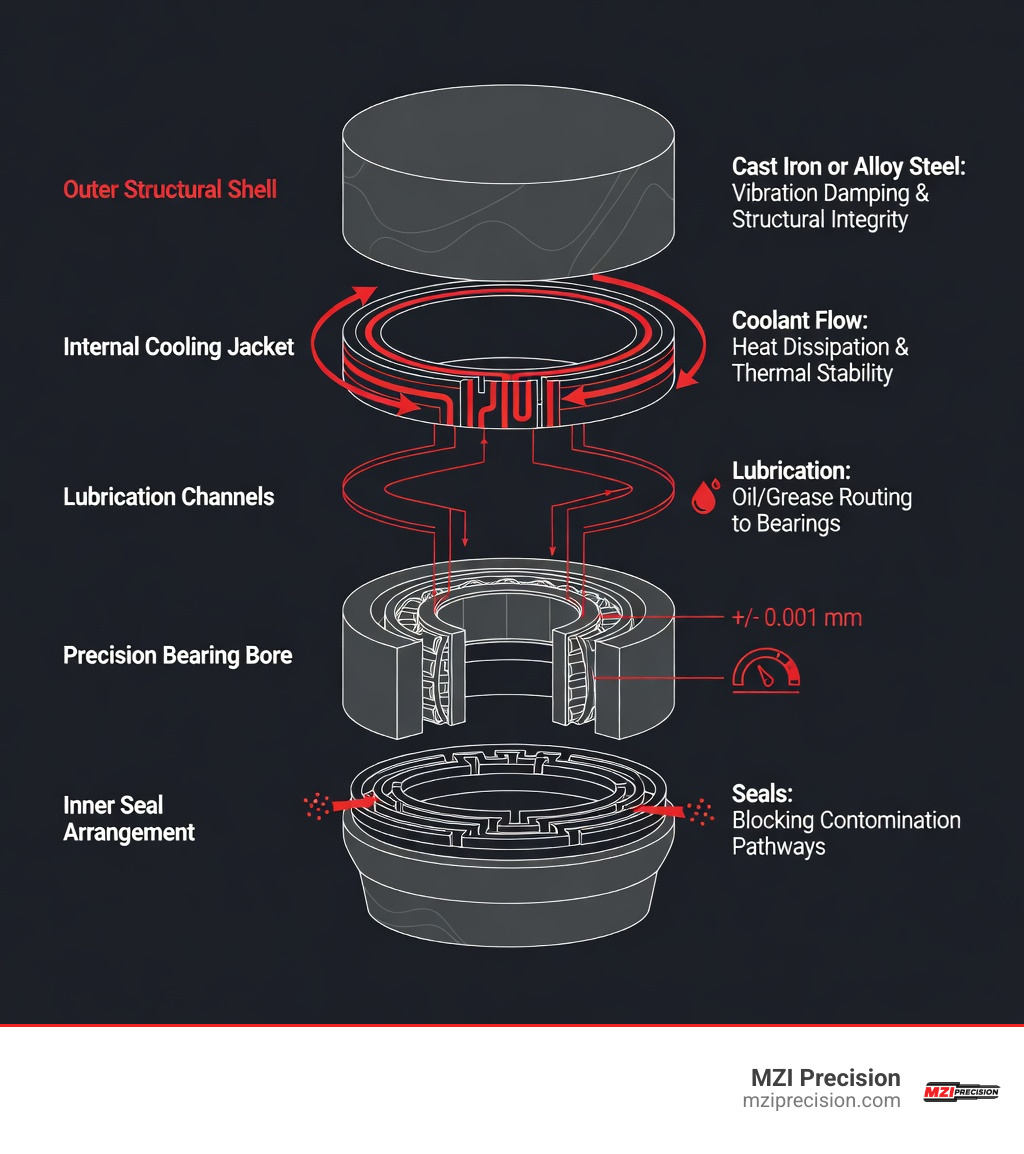
| Function | What It Does |
|---|---|
| Bearing support | Holds bearings in precise alignment to the shaft |
| Vibration damping | Absorbs machining forces to protect accuracy |
| Lubrication | Routes oil or grease to bearings via internal channels |
| Cooling | Carries coolant through jackets to manage heat |
| Contamination control | Works with seals to block chips, coolant, and debris |
For aerospace and industrial manufacturers, the spindle housing isn’t a passive part. It’s an active system — one that manages heat, pressure, lubrication, and structural load all at once.
When the housing is out of tolerance, even a perfectly rebuilt spindle will fail early. One documented case found that repeated spindle failures traced back to an out-of-tolerance machine housing — and once that was corrected, spindle life extended dramatically.
The housing is only as good as its fit, its material, and how well it’s maintained. This guide walks you through everything you need to know to select the right industrial spindle housing for your CNC application.
Spindle housing terminology:
The Critical Role of a Spindle Housing in Machine Tools
At the heart of any precision machining operation is the spindle, and the spindle housing is the “chassis” that keeps everything in line. Its primary function is to provide a rigid, stable environment for the rotating shaft and its associated spindle parts. Without a high-quality housing, the most expensive bearings in the world would be useless because they would lack the alignment necessary to hold tight tolerances.
The housing acts as the interface between the machine tool’s frame and the rotating lathe-spindle-assembly. It must be strong enough to withstand massive cutting forces while being precise enough to keep runout to a minimum.
Engineering the Perfect Spindle Housing for Precision
Modern industrial manufacturing requires more than just a metal tube. A high-performance spindle housing is a marvel of utility integration. It often features:
- Lubrication Channels: Integrated pathways that deliver oil or grease directly to the bearing-spindle-assembly to reduce friction and wear.
- Cooling Jackets: Internal cavities where coolant circulates to pull heat away from the bearings and motor, ensuring thermal stability during long production runs.
- Air Passages: These create positive internal pressure, effectively “blowing out” from the seals to prevent the ingress of fine dust and coolant.
Material Composition and Structural Integrity
We often see housings made from high-grade cast iron or alloy steels. Cast iron is favored for its natural vibration-damping properties, which help produce a smoother surface finish on machined parts. Alloy steels, such as those found in a steel spindle housing, offer superior strength-to-weight ratios and are often used in high-speed applications where rigidity is paramount. Specialized coatings may also be applied to the bores to prevent corrosion or to improve the wear resistance of the bearing seats.
Types and Designs of Industrial Spindle Housings
Not all spindle housing designs are created equal. The application dictates the form factor.
- Block Style: These are rectangular or square housings often used in milling machines. They provide large mounting surfaces for maximum rigidity.
- Flange-Mounted Cartridge: These are cylindrical housings with a mounting flange. They are common in CNC lathes because they allow for easy removal and installation during removal-and-installation procedures.
- Integral Machine Parts: In some high-end machines, the “housing” is actually bored directly into the machine’s headstock casting. While this offers the ultimate in rigidity, it makes repairs much more complex.
Selecting the Right Spindle Housing for CNC Applications
When you are looking at cnc-machine-spindle-assembly options, you must match the housing to your torque and speed requirements. A belt-driven-spindle-assembly might use a different housing design than a motorized spindle because it needs to account for the side-loading forces of the drive belt.
Understanding the decoding-spindle-assemblies-your-go-to-bearing-breakdown is also vital. The housing must be machined to accommodate specific bearing preloads and configurations, whether you’re using angular contact ball bearings for speed or roller bearings for heavy-duty milling.
Advanced Sealing and Contamination Prevention
External contamination is the leading cause of premature spindle failure. To fight this, the spindle housing works in tandem with advanced sealing systems.
- Labyrinth Seals: These are non-contact seals that use a complex “maze” path to make it nearly impossible for liquid to reach the bearings.
- Contact Seals: These use a physical lip against the shaft for low-speed applications.
In the aerospace sector, where precision is non-negotiable, the quality of these seals and the housing’s ability to maintain positive air pressure are what separate a standard rebuild from a high-performance one. You can read more about this in the article exposing the myth that all aerospace spindle rebuilds are equal.
Common Causes of Housing Failure and Wear
Even a heavy-duty spindle housing isn’t invincible. Over time, several factors can lead to failure:
- Bearing Fretting: If a bearing is not seated perfectly, it can vibrate slightly within the bore. This creates “fretting,” which eats away at the housing material and ruins the tolerance.
- Out-of-Tolerance Bores: Heat and vibration can cause the housing to warp or the bores to become egg-shaped. Once this happens, the spindle-bearing-assembly will no longer run true.
- Thermal Expansion: If the cooling system fails, the housing can expand unevenly, leading to seized bearings or permanent deformation.
Deciding whether to perform a spindle-rebuild-or-replace often comes down to the condition of the housing. If the housing is too far gone, a simple bearing swap won’t solve the problem.
Impact of Housing Quality on Machine Performance
A poor-quality or worn housing is a silent profit killer. It leads to:
- Decreased Part Accuracy: You’ll struggle to hold tight tolerances.
- Shorter Tool Life: Excessive vibration dulls cutting tools faster.
- Higher Operational Costs: Frequent downtime for repairs.
Using a spindle-restoration-guide can help you identify these issues before they lead to a catastrophic crash.
Maintenance and Restoration Strategies for Industrial Housings
When a spindle housing is worn, it doesn’t always mean it’s time for the scrap heap. Precision spindle-restoration can bring a housing back to OEM specifications. This often involves:
- Bore Grinding and Honing: Machining the bearing seats back to perfect roundness and size.
- Tolerance Restoration: Using specialized plating or sleeving techniques to rebuild worn surfaces.
For a deep dive into the technical side of these repairs, check out our spindle-assembly-repair-complete-guide.
Extending Component Life Through Proactive Care
The best way to save money is to prevent the need for a full spindle-rebuild in the first place. We recommend:
- Regular Inspection: Check for signs of leaking coolant or oil.
- Vibration Analysis: Use sensors to “listen” to the bearings. If the housing starts vibrating more than usual, something is wrong.
- Lubrication Monitoring: Ensure that the internal channels of the spindle housing aren’t clogged with old, dried grease.
Frequently Asked Questions about Spindle Housings
What are the primary functions of an industrial spindle housing?
The spindle housing provides structural rigidity, accurately supports the bearing arrangement, dampens machining vibrations, and integrates utility systems like cooling and lubrication.
How does an out-of-tolerance housing affect bearing life?
An out-of-tolerance housing causes misalignment and improper spindle-bearing-preload-complete-guide. This leads to uneven wear, excessive heat, and premature bearing failure. In one case, modifying a housing to fix a recurring tolerance issue extended spindle life from 6 months to over 3 years, saving the company $40,000!
What materials are best for high-speed CNC spindle housings?
High-grade alloy steels are excellent for high-speed applications due to their strength and thermal stability. However, cast iron remains a top choice for many industrial applications because of its superior vibration-damping properties.
Conclusion
At MZI Precision, we understand that the spindle housing is the foundation of your machine’s performance. Based in the United States with deep expertise in Southern California (including Huntington Beach and Los Angeles), we specialize in the repair and rebuilding of complex industrial spindles for the aerospace, defense, and automotive sectors.
Whether you are dealing with a crashed spindle or simply want to improve your machine’s reliability, our team is here to help. We don’t just swap parts; we restore your entire assembly to peak performance. Don’t let a worn housing compromise your precision.
Contact MZI Precision for Spindle Bearing Replacement and let us help you get back to work with a spindle you can trust.