


How the Spindle Assembly Checkpoint Prevents Cellular Chaos
Why the Spindle ASM Is the Heartbeat of Your Manufacturing Cell
TITLE: HOW THE SPINDLE ASSEMBLY CHECKPOINT PREVENTS CELLULAR CHAOS DESCRIPTION: DISCOVER HOW PRECISION SPINDLE ASM MAINTENANCE AND REPAIR PREVENT PRODUCTION DOWNTIME AND ENSURE ACCURACY IN INDUSTRIAL MANUFACTURING CELLS.

A spindle asm — short for spindle assembly — is the rotating core of a CNC machine that delivers the torque, speed, and precision needed to cut, grind, or mill a workpiece to spec.
Here’s a quick breakdown of what it does and why it matters:
- Rotates the cutting tool (or workpiece) at controlled speeds
- Transfers torque from the drive system to the point of contact
- Maintains dimensional accuracy through tight bearing tolerances
- Directly impacts part quality — any deviation shows up in your finished components
For aerospace manufacturers, a failing spindle asm doesn’t just slow production. It threatens the dimensional integrity of critical components — and that’s a risk no shop can afford.
Think of the spindle assembly as the checkpoint in your manufacturing cell. When it’s healthy, everything flows. When it starts to degrade — through wear, contamination, or bearing fatigue — the whole system begins to drift. Surface finishes suffer. Tolerances slip. Downtime climbs.
The good news is that most spindle failures don’t happen without warning. There are clear symptoms, proven diagnostic methods, and smart maintenance practices that can catch problems early — before a minor issue becomes a full production shutdown.
This guide walks you through all of it: what a spindle asm is made of, how to spot trouble early, and how to keep your manufacturing cell running with the precision your customers demand.
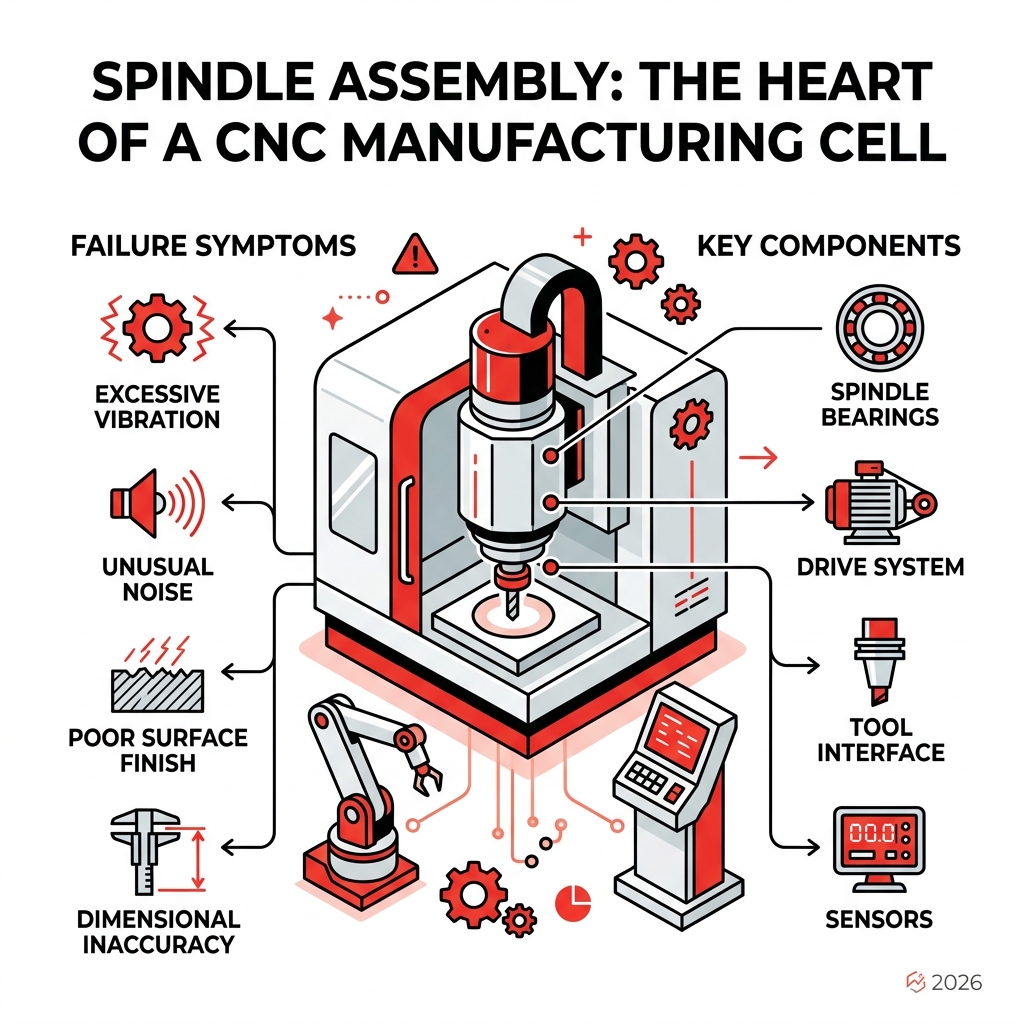
Anatomy of a High-Precision Spindle ASM
When we look inside a high-performance spindle asm, we aren’t just looking at a hunk of spinning metal. We’re looking at a finely tuned instrument where tolerances are measured in microns. The two most critical “internal organs” of this assembly are the shaft and the bearings.
The shaft is the backbone. It must be perfectly balanced and rigid enough to withstand the immense centrifugal forces of high-speed rotation. Surrounding this shaft is the bearing system, which is arguably the most sensitive part of the entire unit. In industrial manufacturing, these aren’t standard-grade bearings. We’re talking about high-precision angular contact bearings or cylindrical roller bearings designed to handle both radial and axial loads simultaneously.
To understand how these components work together to achieve accuracy, it helps to look at the precision-spindle-assembly-the-nuts-and-bolts-of-accuracy that define modern machining.
Comparing Drive Systems
The way a spindle asm receives its power dictates its performance limits. Generally, we see two main flavors in the industrial world: belt-driven and motorized (integral).
| Feature | Belt-Driven Spindle | Motorized (Integral) Spindle |
|---|---|---|
| Max RPM | Typically up to 12,000 – 15,000 | Can exceed 60,000+ |
| Torque | High (due to pulley ratios) | Variable (optimized for speed) |
| Heat Generation | Moderate (external motor) | High (internal motor requires cooling) |
| Cost | More affordable to repair | Higher initial and repair cost |
| Precision | Good | Exceptional |
Core Components of a Spindle ASM
Beyond the shaft and bearings, several other “team members” make the assembly function. The drawbar is a critical component often overlooked. It lives inside the shaft and provides the clamping force necessary to hold the tool holder securely. If the drawbar force drops, the tool can “chatter” or even pull out during a heavy cut, which is a nightmare for part accuracy.
The housing acts as the “skin” of the assembly, providing structural support and often containing the cooling jackets that keep the whole system from melting down during a long shift. For a deeper dive into these parts, you can explore the cnc-machine-spindle-assembly breakdown.
Technical Specifications for Spindle ASM
In industrial manufacturing, “fast enough” isn’t a specification. We rely on hard data. The performance of a spindle asm is defined by its torque-to-speed ratio. Modern scientific research on CNC spindle precision and speed shows that as manufacturers demand higher throughput, the “sweet spot” for spindle performance has shifted toward higher RPMs without sacrificing rigidity.
For example, a high-speed ID grinding spindle might run at 120,000 RPM but only have a lifespan of about 3 years due to the sheer intensity of the application. Conversely, a low-speed surface grinder running at 1,700 RPM can last 20 years if maintained properly.
Identifying Symptoms of a Failing Spindle Assembly
If your manufacturing cell is the body, a failing spindle asm is like a persistent cough—it might seem minor at first, but it’s usually a sign of something deeper. The most common “symptom” we hear from our clients in Huntington Beach and Los Angeles is excessive vibration.
Vibration is the enemy of precision. It leaves “chatter marks” on the surface of your parts, ruining the finish and often pushing the component out of tolerance. Another major red flag is thermal expansion. If the spindle housing feels unusually hot to the touch, or if you notice your Z-axis “drifting” as the machine warms up, your bearings might be generating excessive friction.
Monitoring these signs is part of a spindle-assembly-repair-complete-guide that every floor manager should keep handy.
Common Failure Modes
Why do these precision instruments fail? It usually comes down to a few usual suspects:
- Contamination: This is the #1 killer. Coolant, dust, or metal chips find their way past the seals and into the bearings. Once inside, they act like sandpaper, grinding away the precision surfaces.
- Fatigue: Even with perfect lubrication, metal has a limit. Over millions of cycles, the bearings will eventually develop microscopic cracks.
- Operator Error: A “crash” (where the tool hits the workpiece or table too hard) can instantly brinell the bearings, creating tiny dents in the races that lead to rapid failure.
Whether you are running a lathe-spindle-assembly or a 5-axis mill, these failure modes remain the same.
Diagnostic Tools and Techniques
We don’t just guess when a spindle is bad; we measure it. One of the most effective tests is checking for “runout.” This involves using a dial indicator to see if the shaft is spinning in a perfect circle. If the indicator wobbles more than a few microns, you have a problem.
Advanced shops also use vibration analysis and research on spindle assembly modeling to predict how an assembly will behave under load. By using Finite Element Analysis (FEA), engineers can simulate the stresses on a spindle asm before it ever hits the shop floor, allowing for more robust designs.
The Critical Role of Maintenance in Industrial Cells
We’ve seen it time and again: a $50,000 spindle fails because of a $50 lack of grease. In a high-volume manufacturing cell, maintenance isn’t a suggestion; it’s a survival strategy.
Proper lubrication is the lifeblood of the spindle asm. Whether your system uses a “grease-for-life” setup or an oil-air mist, ensuring the lubricant is clean and flowing is paramount. Cleaning is equally important. Wiping down the spindle taper and ensuring the tool holders are free of debris can prevent the “taper fretting” that leads to tool stickiness and inaccuracy.
Learning how-to-repair-spindle-assembly-bearing issues often starts with simply preventing them through cleanliness.
Proactive Inspection Schedules
Don’t wait for the machine to scream at you. We recommend a proactive schedule that includes:
- Daily: Check coolant levels and spindle temperature.
- Monthly: Inspect seals for leaks and check the air-oil lines for bubbles.
- Quarterly: Perform a vibration analysis and check the drawbar pull force.
Loss of drawbar force is a “silent killer.” If the springs inside the assembly weaken, the tool won’t be held with enough pressure, leading to subtle vibration that ruins high-end finishes. Keeping an eye on the spindle-bearing-assembly health through these checks can save you weeks of downtime.
Extending Component Lifespan
The small parts often do the heavy lifting. Seals keep the bad stuff out, while spacers maintain the exact distance between bearings to ensure proper “pre-load.” Pre-load is the amount of pressure placed on the bearings during assembly to eliminate “play.” Too little pre-load and the spindle is floppy; too much and it overheats.
Replacing these minor components during a scheduled service is much cheaper than a full rebuild. For more on how these parts interact, check out our guide on bearing-spindle-assembly maintenance.
OEM vs. Aftermarket: Quality and Precision Standards
When a spindle asm finally gives up the ghost, you face a choice: do you go back to the Original Equipment Manufacturer (OEM) or look at specialized rebuilding services?
OEM parts are built to the original specs, which is great for peace of mind. However, high-quality rebuilding services—like what we provide at MZI Precision—often use “better than OEM” components. For instance, we might replace standard steel bearings with ceramic hybrid bearings, which run cooler and can handle higher speeds.
The tolerances in these assemblies are so tight that even a fingerprint can throw off the balance. This is why a precision-ground spindle shaft must be handled in a climate-controlled environment. You can see the complexity involved in our decoding-spindle-assemblies-your-go-to-bearing-breakdown article.
Evaluating Replacement Parts
When evaluating your options, look at three things:
- Tolerances: Does the rebuilder guarantee OEM-level runout specs?
- Material Specs: Are they using high-quality ABEC-7 or ABEC-9 rated bearings?
- Lead Times: An OEM might have a 12-week lead time for a new unit, whereas a rebuild might take only two weeks.
In the markets of Southern California, we know that every day a machine is down is a day of lost revenue. Don’t let yourself dont-get-spun-out-finding-the-perfect-spindle-assembly by choosing a provider based solely on the lowest price; look for expertise and a solid warranty.
Frequently Asked Questions about Spindle Assemblies
What causes excessive heat in a spindle assembly?
Heat is usually caused by friction. This could be due to bearing wear, a lack of lubrication, or an over-tightened pre-load. If your cooling system (like a water chiller) isn’t functioning correctly, the heat will build up rapidly, causing the metal to expand and potentially seize the spindle.
How does spindle runout affect part quality?
Runout means the tool isn’t spinning perfectly on its axis. Imagine trying to draw a circle while your hand is shaking—that’s runout. In machining, this leads to “out-of-round” holes, poor surface finishes, and premature wear on your cutting tools because one side of the tool is doing more work than the other.
When is a full spindle rebuild necessary?
If you can hear a “growling” or “whining” noise, if you see smoke, or if your part finishes look rough and uneven, it’s time. Generally, once the bearings have been compromised by a crash or contamination, a simple “patch” won’t work. A full rebuild ensures that every component—from the seals to the drawbar springs—is back to factory-new condition.
Conclusion
At MZI Precision, we understand that your spindle asm is more than just a part—it’s the heart of your business. Whether you’re machining aerospace brackets in Huntington Beach or defense components in Los Angeles, you need a spindle that you can trust shift after shift.
Our expertise in OEM rebuilt spindles and our commitment to exceptional service means we don’t just fix what’s broken; we optimize it for your specific application. We’ve seen the “cellular chaos” that a failed spindle can cause, and we’re here to help you prevent it.
Ready to restore the heartbeat of your manufacturing cell? More info about spindle bearing assembly services is just a click away, or reach out to our team for a full evaluation. Let’s keep those spindles spinning!