


Spotting Bad Spindle Motor Windings Before They Vaporize
When Spindle Motor Windings Go Bad, Your Whole Line Stops
Checking spindle motor windings for how to spot bad windings in an industrial CNC machine is a critical diagnostic skill — and here’s the fast answer:
Quick Diagnosis: How to Spot Bad Spindle Motor Windings
| Test | What You Do | Bad Reading | Good Reading |
|---|---|---|---|
| Ground fault (multimeter) | Test each phase lead (T1, T2, T3) to ground | Zero or continuity | Infinite (OL) |
| Phase-to-phase (multimeter) | Test T1-T2, T2-T3, T1-T3 | 0 Ω (short) or >2 Ω (open) | ~0.8 Ω (0.3–2 Ω range) |
| Phase balance (milliohm meter) | Compare all three phase readings | >2% variance between phases | Within 1–2% of each other |
| Insulation resistance (megger) | Test each phase to motor frame | <1.2 MΩ on a 200V motor | Hundreds of MΩ or higher |
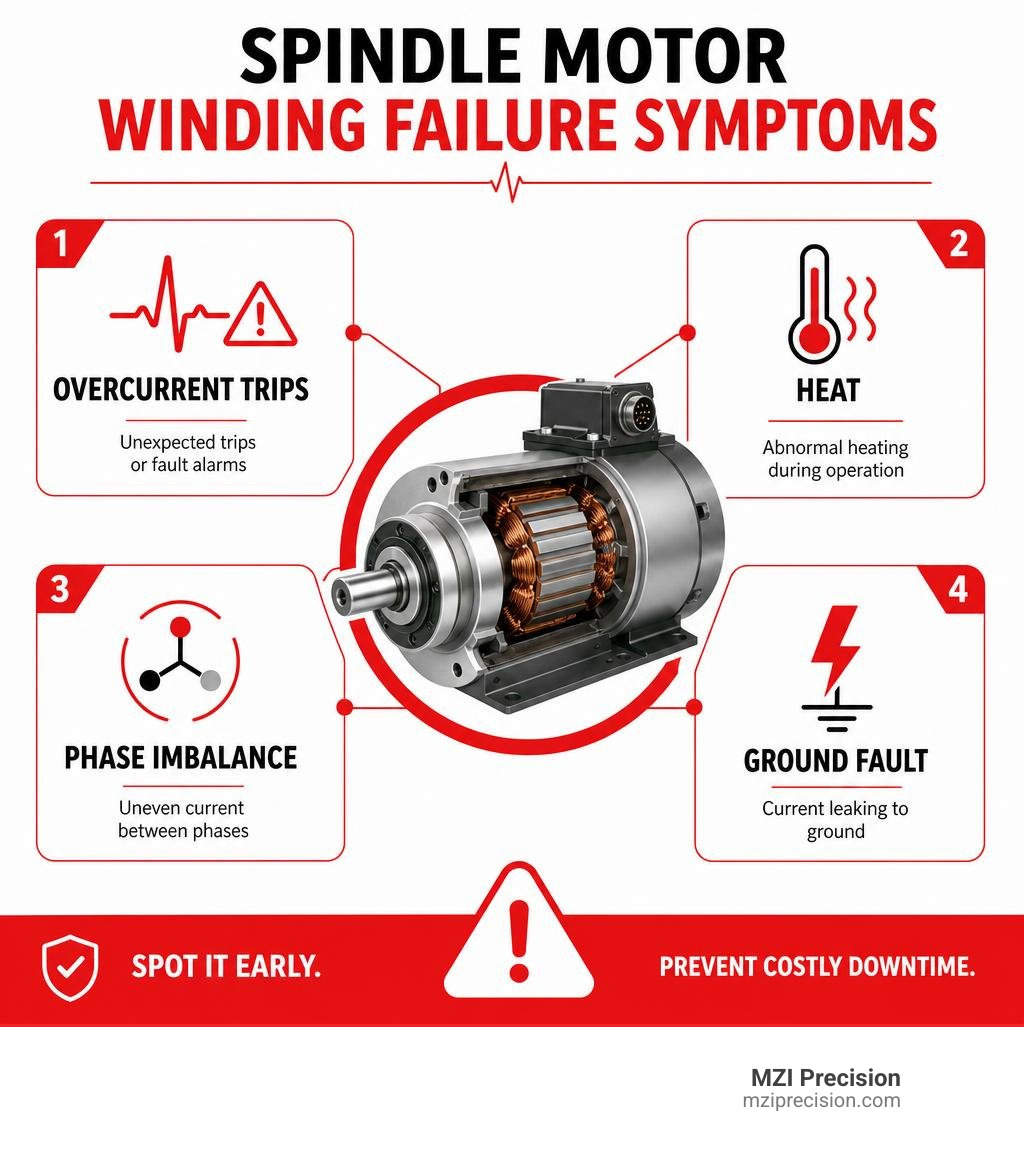
The symptoms show up first: unexpected overcurrent trips, overheating, rough surface finish on parts, or a spindle that simply won’t come up to speed. Then comes the real question — is it the windings, the cable, or something else entirely?
Winding failures don’t always announce themselves loudly. Insulation can degrade slowly from heat cycles, coolant contamination, or voltage spikes — especially in motors controlled by variable frequency drives. By the time a winding fails completely, the damage is often far more expensive than it needed to be.
For aerospace manufacturers running tight-tolerance CNC operations, an unplanned spindle failure isn’t just a repair bill. It’s scrapped parts, missed delivery windows, and a ripple effect through the production schedule.
This guide walks you through exactly how to test your spindle motor windings — from a basic multimeter check to advanced insulation testing — so you can catch problems before they become catastrophic.
Must-know checking spindle motor windings how to spot bad windings in terms:
Symptoms of Failing Industrial Spindle Motor Windings
Before you break out the diagnostic tools, the spindle itself will usually drop a few hints that something is electrically amiss. In the demanding environment of industrial manufacturing CNC machining, catching these red flags early is the difference between a simple bearing or winding refresh and a complete spindle replacement.
The most common indicators of winding distress include:
- Excessive and Unexplained Heat: If your spindle motor is running unusually hot even during light, low-feed cuts, the insulation on the windings may be degrading. As the organic polymer coating on the copper wire breaks down, it allows current to leak, creating localized hot spots.
- Frequent VFD or Drive Overcurrent Faults: Spindle drives are highly sensitive. If you are experiencing repeated “overcurrent,” “ground fault,” or “short circuit” alarms on your variable frequency drive (VFD), the drive is actively protecting itself from a failing motor winding.
- Abnormal Vibration and Noise: While mechanical wear in bearings causes a steady whine or rumble, electrical winding faults often create a distinct electromagnetic buzz or vibration that changes in pitch when power is cycled or load is applied.
- Degraded Part Surface Finish: When phase resistances are imbalanced, the spindle motor cannot deliver smooth, consistent torque. This micro-stuttering translates directly to your cutting tool, leaving chatter marks and poor surface finishes on your machined components.
In many cases, these issues are rooted in contamination. Cutting fluids, condensation, and oil mist can migrate past seals over time, settling directly on the stator windings. To understand how these physical symptoms tie back to electrical failure, you can read our comprehensive guide on Electrical Motor Troubleshooting.
Checking Spindle Motor Windings How to Spot Bad Windings In Industrial CNC Machines
When you need to perform a diagnostic check on a high-speed CNC spindle, safety must be your absolute first priority. These systems operate on high voltages and are driven by VFDs that store residual electrical energy in their capacitor banks long after the main power switch is flipped.
Crucial Safety Precautions Before Testing
- Lockout-Tagout (LOTO): Isolate the CNC machine from the main power distribution panel. Lock the breaker and tag it to ensure no one restores power while you are working in the electrical cabinet or near the spindle motor connections.
- Verify De-energization: Use a verified, working digital multimeter set to AC voltage to test all incoming lines at the spindle drive and the motor terminal box (often called the peckerhead) to confirm there is zero voltage present.
- Allow Capacitors to Discharge: Wait at least 10 to 15 minutes after disconnecting power to allow the VFD’s internal capacitors to fully bleed down to safe levels.
- Wear Appropriate PPE: Ensure you are wearing safety glasses and electrically rated gloves during the initial disconnection phase.
Once the system is safe, prepare your digital multimeter. Set the device to the lowest resistance (Ohms, $\Omega$) setting. If your meter has a manual range selection, set it to the lowest scale (usually $200\,\Omega$). Make sure to touch your meter probes together first and record the lead resistance; you will need to subtract this value from your final winding measurements to get an accurate reading.
For a deeper dive into the specific electrical patterns of three-phase motor failures, you can consult this guide on Troubleshooting the most typical winding problems of three phase … .
Checking Spindle Motor Windings How to Spot Bad Windings In Phase-to-Phase Tests
Three-phase spindle motors rely on three separate coils (or sets of coils) labeled as phases T1, T2, and T3. For the motor to run smoothly and efficiently, the electrical resistance of each phase must be virtually identical.
To perform a phase-to-phase test:
- Locate the motor terminal box on the spindle or the output terminals of the VFD inside the electrical cabinet.
- Disconnect the motor leads from the drive to isolate the spindle motor completely.
- Measure the resistance across the following pairs:
- T1 to T2
- T2 to T3
- T1 to T3
On a healthy industrial spindle motor, these readings should be very low—typically around 0.3 to 2 Ohms, with 0.8 Ohms being a common baseline for medium-sized spindles.
The key to spotting bad windings in this test is the variance between your three readings. On a precision CNC spindle motor, the phase-to-phase resistance readings should not vary by more than 2% (and most high-quality spindle motors stay within a tight 1% variance).
If you measure $0.80\,\Omega$, $0.81\,\Omega$, and $0.80\,\Omega$, your windings are perfectly balanced. However, if you measure $0.80\,\Omega$, $0.81\,\Omega$, and $0.55\,\Omega$, you have a turn-to-turn short circuit in the third phase. If any of the readings show $0\,\Omega$, there is a direct short. If the meter reads “OL” (Overload) or infinite resistance, you have an open winding, meaning the copper conductor inside has physically broken or melted.
To learn more about analyzing the balance of three-phase coils, review this resource on How to Check Your Windings on Three Phase Motors – CBM CONNECT® .
Checking Spindle Motor Windings How to Spot Bad Windings In Ground Fault Tests
A ground fault occurs when the micro-thin polymer insulation coating the copper winding wire degrades, allowing the bare copper to make physical or electrical contact with the grounded steel stator core or the spindle housing. This is the single most common cause of catastrophic spindle motor failure in CNC applications, often triggered by cutting fluid or condensation entering the motor enclosure.
To test for a short to ground using a standard multimeter:
- Set your multimeter to the highest resistance setting (Megaohms, $\text{M}\Omega$) or the continuity/diode test setting.
- Attach one probe firmly to a clean, unpainted metal ground point on the spindle chassis or the motor’s ground terminal. Verify your ground connection by testing continuity to a known ground point.
- Touch the other probe to each of the phase leads (T1, T2, and T3) one at a time.
A healthy spindle motor will show infinite resistance (often displayed as “OL” or “1” on your multimeter) to ground. If your multimeter registers any numerical resistance value or beeps on the continuity setting, you have a ground fault.
The Limitations of a Multimeter and the Value of Megger Testing
While a standard multimeter is great for finding hard shorts to ground, it only uses a tiny 9V battery to perform the test. This low voltage cannot detect insulation that is severely weakened but not yet fully touching the frame.
To find these hidden faults, we use a megohmmeter (commonly called a “megger”) to apply a high-voltage charge (typically 500V or 1000V DC) to the windings. Per the IEEE standard, a 200V motor is considered unsafe to operate if its insulation resistance falls below 1.2 M$\Omega$ (calculated as $1\,\text{M}\Omega + 1\,\text{M}\Omega$ per kV rating).
For a used winding that has been professionally cleaned and baked to remove moisture, we expect a minimum of 6,000 M$\Omega$ of resistance to ground. A brand-new or freshly rewound stator should exceed 50,000 M$\Omega$ when subjected to a 2,280V DC high-potential (hi-pot) test.
If you suspect your spindle is suffering from insulation breakdown, read more about our professional diagnostic process in our guide on Electric Motor Inspection.
Advanced Diagnostic Testing Beyond the Multimeter
While a multimeter is a fantastic tool for quick field triage, it cannot tell the whole story. A spindle motor can easily pass a basic resistance test and still trip your drive under load due to complex electrical anomalies like capacitive leakage or high-voltage arc shorts.
To paint a complete picture of motor health, industrial technicians use a combination of specialized diagnostic tools:
| Diagnostic Tool | Test Voltage | Primary Purpose | What It Detects |
|---|---|---|---|
| Digital Multimeter | ~9V DC | Basic loop continuity and phase balancing | Open circuits, direct shorts, major phase imbalances |
| Megohmmeter (Megger) | 500V to 2,500V DC | High-voltage groundwall insulation integrity | Weakened insulation, moisture ingress, contamination |
| Surge Tester | High-voltage AC pulses | Direct turn-to-turn insulation stress testing | Weaknesses between individual adjacent loops of wire |
| Motor Circuit Analysis (MCA) | Low-voltage AC signals | Comprehensive impedance, inductance, and phase-angle assessment | Early-stage winding degradation, rotor bar defects |
Understanding the Advanced Tests
- Surge Testing: This test applies rapid, high-voltage pulses to the windings, simulating the electrical spikes a motor experiences during VFD acceleration and deceleration. It detects insulation weaknesses between adjacent turns within the same coil—faults that standard DC tests miss entirely.
- Motor Circuit Analysis (MCA): Rather than relying on simple DC resistance, MCA utilizes low-voltage AC signals to measure impedance and inductance across all three phases. Because inductance is highly sensitive to the magnetic fields within the stator, MCA can pinpoint microscopic structural changes in the copper coils before they trigger an overcurrent alarm.
If your standard shop tests are inconclusive but your machine continues to drop out of production, it may be time for professional analysis. You can learn about our advanced diagnostic capabilities by visiting our page on CNC Spindle Motor Repair.
Frequently Asked Questions About Spindle Motor Windings
What are the normal resistance values for a 3-phase spindle motor?
For most industrial CNC spindle motors, normal phase-to-phase resistance values fall between 0.3 and 2 Ohms, with 0.8 Ohms serving as a common baseline. The exact number depends on the motor’s horsepower and voltage rating.
The absolute value is less critical than the balance between the phases. A healthy three-phase spindle motor should show a phase-to-phase resistance variance of less than 2% (and ideally within 1% for high-precision applications). Any variance beyond 2% indicates an internal short or connection issue. You can read more about interpreting resistance values in this guide on How to Test Motor Windings with a Multimeter .
How do I distinguish between a cable fault and a winding fault?
Often, a “ground fault” or “short circuit” alarm on your CNC control isn’t caused by the spindle motor itself, but by a damaged power cable, a contaminated connector, or a cracked cable track.
To isolate the problem:
- Disconnect the Cable: Locate the electrical junction box (peckerhead) directly on the spindle housing and disconnect the incoming power cable.
- Test the Spindle Alone: Perform your phase-to-phase and ground fault tests directly on the exposed motor terminals.
- Test the Cable Alone: Go to the electrical cabinet, disconnect the motor cable from the VFD, and test the cable leads for shorts to ground or phase-to-phase continuity.
- Inspect the Connectors: Check the spindle plugs and inserts for signs of carbon tracking, burn marks, or cutting fluid ingress.
If you need help safely opening and isolating your spindle’s electrical connections, our article on Spindle Motor Disassembly provides excellent safety and mechanical guidance.
When should a spindle motor be rewound versus replaced?
Choosing whether to rewind or replace a damaged spindle motor stator depends on three key factors:
- Core Damage: If a catastrophic winding short has melted or warped the stator’s laminated steel core, the motor must be replaced. Rewinding over a damaged core will lead to rapid failure.
- OEM Availability: For rare, high-performance, or custom-integrated spindles, finding a replacement motor can take months. Professional rewinding is often the fastest way to get your machine back in production.
- Cost-Benefit Ratio: For standard, off-the-shelf motors, replacement may be cost-effective. However, for high-precision CNC spindles, a professional rewind using premium, high-temperature insulation materials offers OEM-level performance at a fraction of the cost.
To explore how precision rewinding is performed under climate-controlled conditions, see our specialized resource on Spindle Motor Rewinding.
Conclusion
Spotting bad spindle motor windings before they suffer a catastrophic failure is the difference between a controlled, scheduled maintenance window and an incredibly expensive, unscheduled production halt. By implementing simple multimeter checks and megger testing into your preventative maintenance routine, you can identify electrical decay early.
When your diagnostic tests reveal phase imbalances, ground faults, or weakened insulation, you need a partner with the specialized equipment and experience to restore your spindle to factory specifications.
At MZI Precision, we specialize in the complete rebuilding, rewinding, and repair of high-performance industrial manufacturing spindles. Serving critical industries from aerospace to defense, our expert technicians in our state-of-the-art facilities in Southern California ensure your rebuilt spindle meets or exceeds OEM standards for vibration, balance, and electrical integrity.
Don’t wait for your spindle windings to vaporize. If you are experiencing VFD faults, excessive heat, or poor surface finishes, contact MZI Precision today to schedule a professional spindle evaluation and keep your production line running smoothly.