


The Headstock Health Check: Evaluating Your Lathe Spindle
Why Checking Lathe Spindle Health Matters for Precision Manufacturing
Checking lathe spindle condition is one of the most critical maintenance tasks in any precision manufacturing environment. A spindle that’s even slightly out of spec can mean scrapped parts, broken tooling, and unplanned downtime — all of which hurt your ability to deliver on time.
Here’s a quick overview of how to check your lathe spindle:
- Check for symptoms — unusual noise, vibration, heat, or poor surface finish
- Inspect workholding first — rule out chuck, collet, or hydraulic actuator issues before blaming the spindle
- Measure runout — use a dial indicator to check radial and axial runout at the spindle nose (target: under 0.0005″ TIR)
- Test bearing health — push the spindle by hand to check fore/aft movement (acceptable: less than 0.0005″, returning to within 0.0001″)
- Run vibration analysis — use a vibration analyzer to detect bearing damage, lubrication issues, or imbalance
- Check encoder feedback — verify signal quality to rule out orientation and vibration errors
- Review machine alarms and parameters — address any active alarm codes and verify settings like Setting 413
The consequences of ignoring spindle wear compound over time. What starts as a subtle growl at low RPM can escalate into full bearing failure, dimensional errors on every part you run, and a costly spindle rebuild — or worse, a full replacement.
As experienced machinists have noted, a lathe with deteriorating spindle bearings can sometimes still produce acceptable parts for a period — but the risk of sudden failure, inconsistent accuracy, and accelerating damage makes early detection essential, especially in high-stakes aerospace and precision manufacturing environments.
This guide walks you through every stage of a thorough industrial lathe spindle health check, from the first symptoms to advanced diagnostic tools.
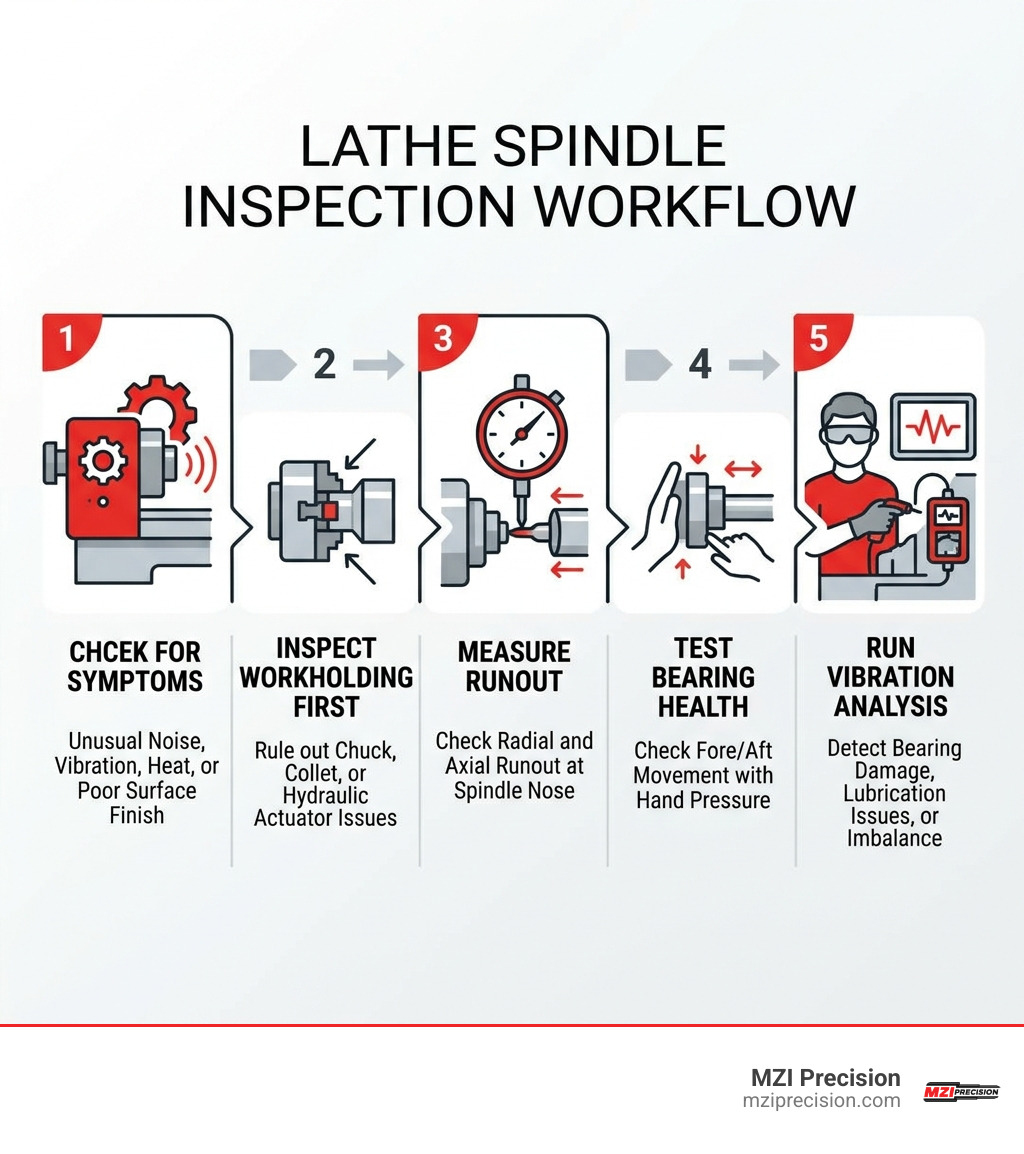
Checking lathe spindle word guide:
Identifying Symptoms of Industrial Spindle Failure

In industrial manufacturing, your spindle is the heart of the machine. When it starts to fail, it doesn’t always just stop; it usually sends out “distress signals” first. Recognizing these signs early in April 2026 can save your shop thousands in emergency repairs.
The most common symptoms of a failing industrial spindle include:
- Vibration: Unusual shaking that wasn’t there before, especially at specific RPM ranges.
- Noise: Auditory cues are often the first giveaway.
- Poor Surface Finish: If your parts are coming off the machine with chatter marks or a “cloudy” finish, the spindle’s rigidity is likely compromised.
- Heat: A spindle headstock that feels excessively hot to the touch after a 10-minute run at high speed is a major red flag.
If you are experiencing any of these, we recommend consulting a Spindle Bearing Noise Complete Guide to help differentiate between normal mechanical sounds and catastrophic bearing failure.
Common Auditory and Visual Cues
Sometimes, diagnostics are as simple as using your ears. Machinists often describe failing spindle bearings as sounding like a “box of rocks.” This clattering or grinding noise indicates that the rolling elements or races are severely pitted or damaged.
Another subtle cue is a “growling” sound at low RPM, especially after the machine has been sitting idle. Visually, you might see chatter marks on the workpiece that only appear on specific axes, or parts that are consistently out-of-spec despite perfect tool offsets. If the spindle is hard to turn by hand when isolated from the drive belt, you are likely looking at binding bearings or internal contamination.
Initial Inspection: Workholding and Drivetrain Components
Before we dive into the spindle itself, we must rule out external factors. It’s frustrating to pull a spindle for repair only to find out the vibration was caused by a dirty chuck or a loose drawtube.
| Symptom | Likely Workholding Cause | Likely Spindle Cause |
|---|---|---|
| Excessive Runout | Dirty jaws or unseated chuck | Worn bearings or bent spindle shaft |
| Vibration | Unbalanced hydraulic actuator | Bearing cage failure or imbalance |
| Part Taper | Misaligned tailstock | Spindle nose deflection |
| Chatter | Loose collet or tool stickout | Loss of bearing preload |
For a broader look at machine health, see A Comprehensive Guide On How To Inspect A Lathe.
Verifying the Hydraulic Actuator and Drawtube
In high-production CNC turning centers, the hydraulic actuator and drawtube are frequent sources of vibration. Checking lathe spindle health requires looking at these drivetrain components:
- Radial Runout: The radial runout of the hydraulic actuator rotary body must not exceed 0.0005″ Total Indicator Reading (TIR).
- Bore Accuracy: The inner diameter bore should not exceed 0.001″ TIR.
- Drawtube Misalignment: If the drawtube inner diameter shows more than 0.010″ TIR, it indicates a serious misalignment that requires re-installation.
If the spindle nose deflection is more than 0.0015″ TIR on the hydraulic actuator static body or coolant collector, it will cause excessive vibration that mimics bearing failure.
Step-by-Step Guide to Checking Lathe Spindle Runout
Measuring runout is the definitive way to quantify spindle health. Runout occurs when the spindle no longer rotates on its intended axis, leading to “wobbling” that destroys tool life and part accuracy.
Essential Tools for Checking Lathe Spindle Accuracy
To perform this check correctly, you’ll need:
- A high-quality dial test indicator (0.0001″ or 0.0005″ increments).
- A magnetic base for a rigid setup.
- A precision ground test bar or “master” rod.
Start by cleaning the spindle nose and the internal taper. Even a tiny chip can throw your readings off by several “tenths.” Mount the indicator and rotate the spindle slowly by hand. For a deep dive into fixing these issues, refer to our Spindle Runout Correction Complete Guide.
Best Practices for Checking Lathe Spindle Bearings
Healthy spindle bearings should exhibit very little play. Use the following procedure:
- Radial Check: Place the indicator on the spindle nose and push/pull the spindle by hand. It should allow less than 0.0005″ of movement and return to zero within 0.0001″.
- Axial Check: Push the spindle fore and aft. Again, movement should be minimal (under 0.0005″).
- The “Spin” Test: With the drive belts disconnected, give the spindle a firm spin by hand. A properly adjusted spindle bearing preload should allow the spindle to rotate about one full turn before stopping smoothly. If it stops instantly, the preload is too high; if it spins forever, it’s likely too loose.
For more details, see our guide on How To Check Lathe Spindle Bearings.
Advanced Diagnostics: Vibration Analysis and Laser Alignment
When manual checks aren’t enough, we turn to advanced technology. In April 2026, many industrial shops use vibration analyzers to provide a “heart monitor” for their machinery.
Utilizing Vibration Data for Predictive Maintenance
A vibration analyzer can break down the “noise” of a machine into a frequency spectrum. This allows us to identify:
- Cage Rattle: Indicative of a failing bearing cage.
- High Pre-load: Shows up as specific heat and frequency signatures.
- Lubrication Issues: High-frequency “spikes” often suggest that the spindle bearing lubrication has failed or been contaminated.
Laser alignment tools are also invaluable, especially for checking the relationship between the spindle and the tailstock over long distances (up to 65 feet). This ensures that the spindle axis is perfectly parallel to the machine’s ways. For specific alignment zones on Haas machines, you can follow the ST Lathe Alignment – Indicating Zones checklist.
Adjusting Machine Parameters and Resolving Alarms
Sometimes the issue isn’t mechanical, but electronic. Modern CNC lathes use complex parameters to manage spindle performance.
- Setting 413: This parameter often relates to spindle load and orientation. If this is misconfigured, you might experience vibration during spindle orientation or tool changes.
- Encoder Feedback: A faulty encoder can send “noisy” signals to the drive, causing the motor to “hunt” for the correct speed. This micro-vibration can look exactly like a mechanical bearing issue.
- Common Alarms: Keep an eye out for alarms like 966, 9918, 4.116S, or 174. These often point to spindle drive overloads, encoder communication errors, or overheating.
Frequently Asked Questions about Spindle Evaluation
What is the maximum allowable runout for an industrial lathe spindle?
For most high-precision industrial applications, the radial runout at the spindle nose should be less than 0.0005″ TIR. If you are measuring more than 0.001″, you will likely see a significant decrease in tool life and part quality.
How often should I perform a spindle health check?
We recommend a thorough checking lathe spindle procedure at least biannually as part of your preventative maintenance. However, if your machine runs 24/7 or handles high-speed, high-stress materials, quarterly checks are safer to prevent spindle bearing failure.
Can a bad encoder cause spindle vibration?
Yes. If the encoder provides inconsistent feedback, the spindle motor will rapidly adjust its torque to compensate, creating a high-frequency vibration. This is often mistaken for spindle bearing noise.
Conclusion
Checking lathe spindle health is the best way to ensure your shop stays productive and your parts stay within tolerance. By catching symptoms like “box of rocks” noises, excessive runout, or hydraulic actuator misalignment early, you can plan for maintenance rather than reacting to a crash.
At MZI Precision, we specialize in high-quality industrial manufacturing spindle rebuilding and repair. Whether you need a simple spindle bearing replacement or a full lathe spindle assembly overhaul, our team in Huntington Beach and Los Angeles is ready to restore your equipment to OEM standards. Don’t let a failing spindle slow you down — perform your headstock health check today.