


Spindle Motor Rewinding: 4 Steps to Precision
Why Spindle Motor Rewinding Is Critical for Manufacturing Operations
Why Spindle Motors Fail: Common Causes and Symptoms
The industrial manufacturing world relies heavily on the precision and power of spindle motors. These unsung heroes drive everything from milling machines to grinders, ensuring the intricate dance of modern production. But like any workhorse, they’re not immune to wear and tear. When a spindle motor falters, it’s not just a hiccup; it can bring an entire operation to a grinding halt. Understanding why these critical components fail and recognizing the early warning signs are the first steps in maintaining seamless production.
Common Causes of Winding Failure
The heart of any electric motor lies in its windings – the precisely coiled copper wires that generate the magnetic fields necessary for rotation. When these windings fail, the motor stops, and often, spindle motor rewinding becomes the necessary fix. Several culprits commonly lead to this breakdown:
- Overloading and Excessive Heat: Spindle motors are designed for specific loads. Pushing them beyond their limits, or operating them in high ambient temperatures, can cause the insulation around the copper wire to degrade. This “thermal deterioration” is a common enemy of motor longevity, leading to internal shorts and winding burnout. As one expert put it, “replacement really may not be your best option” if heat is the primary cause, as rewinding can address this damage. For larger motors, stators are often heated to around 700°F for about 10 hours to remove old insulation during rewinding, showing just how much heat these components can endure, and fail from.
- Contamination from Cutting Fluids and Particulates: In manufacturing environments, motors are often exposed to a cocktail of coolants, oils, dust, and metal particulates. These contaminants can seep into the motor’s housing, attacking the winding insulation and causing electrical shorts. Lubrication issues can also exacerbate this, as proper sealing and cooling are compromised.
- Voltage Spikes and Phase Imbalance: Irregularities in the electrical supply, such as sudden voltage surges or an imbalance across the three phases, can severely stress the motor’s electrical system. This can lead to rapid insulation breakdown and a “short to ground” or internal shorts within the windings.
- Insulation Degradation Over Time: Even under ideal conditions, insulation materials have a finite lifespan. Over years of continuous operation, the insulation naturally becomes brittle and less effective, making the windings vulnerable to electrical arcing and failure.
- Mechanical Stress from Bearing Failure: While seemingly unrelated, a failing bearing can induce significant mechanical stress and vibration on the motor’s rotor and stator. This can lead to friction, heat generation, and ultimately, physical damage to the delicate windings. A motor with bad bearings might run hot or improperly, putting undue strain on its electrical components.
Telltale Signs Your Spindle Motor Needs Attention
Catching winding issues early can save you significant downtime and repair costs. Keep an eye (and an ear!) out for these common symptoms that scream, “My spindle motor needs help!”:
- Increased Vibration: A well-functioning spindle motor should run smoothly. If you notice excessive vibration, it could indicate internal issues, including winding imbalances or mechanical problems stressing the windings. Most balance machines in repair shops are limited to around 600 RPM balance speeds, which might not be enough for high-speed spindles, making vibration a crucial indicator.
- Audible Humming or Grinding: Unusual noises are never a good sign. A distinct humming, grinding, or a sound “different” from its usual operation often points to electrical issues within the windings or mechanical problems like failing bearings. Sometimes, you might even “let the magic smoke out” of the drive and spindle motor, accompanied by some “nasty words,” as one forum user put it when their motor shorted.
- Reduced Cutting Accuracy: Since the spindle motor directly drives the cutting tool, any degradation in its performance – such as inconsistent RPMs or excessive runout – will directly impact the precision of your machining operations. Your parts just won’t be as good.
- Motor Overheating: This is one of the most critical indicators. If the motor casing feels unusually hot to the touch, or if your machine’s sensors report high temperatures, it’s a strong sign of internal electrical problems, likely related to winding damage causing increased resistance and heat generation.
- Unexplained Machine Alarms: Modern CNC machines are smart. They’ll often throw a PLC error code or an alarm when they detect an anomaly in the spindle motor’s operation, such as an overcurrent condition or motor fault. Don’t ignore these digital cries for help!
- Inconsistent RPMs: If your spindle motor struggles to maintain its set speed, or if you observe fluctuations in RPMs during operation, it suggests a problem with the motor’s ability to generate consistent torque, often due to compromised windings.
The Spindle Motor Rewinding Process: A Step-by-Step Guide
The process of spindle motor rewinding is far from a simple fix. It’s a highly specialized craft that requires immense precision, deep technical knowledge, and state-of-the-art equipment. Unlike general-purpose motors, industrial spindle motors operate at high speeds and demand exacting tolerances, making their rewinding a true art form. At MZI Precision, we pride ourselves on our meticulous approach to every step, ensuring your motor returns to service performing at its peak.
Step 1: Diagnosis and Data Collection
The journey begins with a thorough examination – a bit like a doctor’s visit for your ailing motor. We receive, inspect, and test the windings for problems. This initial phase is crucial for understanding the root cause of failure and collecting vital information for the rewind.
- Initial Inspection: Our technicians visually assess the motor for external damage, signs of overheating, or contamination.
- Electrical Testing: This involves a suite of precise tests:
- Megger Test: Measures insulation resistance to detect shorts to ground.
- Winding Resistance Test: Checks the resistance of each winding to identify opens or shorts between turns.
- Surge Comparison Test: Compares the insulation quality of each winding, revealing subtle weaknesses or turn-to-turn shorts.
- Nameplate Data Recording: We carefully record all original specifications from the motor’s nameplate, including voltage, current, RPM, and frequency. This data is paramount for ensuring the rewound motor matches its original performance.
- Failure Analysis: We dig into the “why” behind the failure, which informs not only the repair but also provides valuable insights for preventing future issues.
Step 2: Disassembly and Stator Preparation
Once the diagnosis is complete, the surgical process of disassembly begins. This phase requires extreme care to avoid damaging critical components.
- Meticulous Disassembly: Our skilled technicians carefully dismantle the spindle motor, marking components and taking detailed photographs to ensure proper reassembly. Every part is kept in one place so nothing gets lost.
- Stator Removal: The stator, which houses the windings, is carefully removed from the motor housing.
- Rotor Inspection: The rotor is inspected for any damage, such as rubs or signs of imbalance, that might have contributed to the winding failure.
- Burn-Off Oven: The old, damaged windings are removed. For larger motors, stators are often heated in a controlled burn-off oven to around 700°F for about 10 hours. This process incinerates the old insulation and makes it easier to strip the copper.
- Stripping Old Copper Wire: After the burn-off, the old copper wire is carefully removed from the stator slots. It’s vital to avoid damaging the stator laminations during this step.
- Stator Core Cleaning: The stator core is then thoroughly cleaned, often using methods like careful scraping, high-pressure washing, or mild abrasive blasting to remove all residue and prepare it for new insulation.
- Core Loss Testing: This critical test measures the magnetic efficiency of the stator core. If the core has sustained significant damage (e.g., from excessive heat), its magnetic properties can be compromised, making a rewind less effective or even impossible. We ensure core material loss does not exceed 2% of the core length or 10% of the number of teeth.
Step 3: The New Winding and Insulation
This is where the magic happens – the creation and installation of the new heart of your spindle motor. Precision is paramount here; even a slight deviation can affect performance.
- High-Grade Magnet Wire: We use only the highest quality magnet wire, often rated for 200°C, like Hitachi lead wire, to ensure durability and thermal resilience.
- Class H Insulation: Superior insulation materials are crucial for high-speed industrial spindle motors. We use Class H insulation, which can withstand temperatures up to 180°C, providing excellent dielectric strength. This includes:
- Slot Liners: Insulating paper inserted into the stator slots before winding.
- Phase Paper: Insulation placed between phases to prevent electrical shorts.
- Wedges: Tightly inserted into the slot openings to secure the windings and provide additional insulation.
- Lacing Cord: Used to bind the coils securely in place, preventing movement and vibration.
- Coil Forming: New coils are carefully formed to match the original winding specifications, including wire size, number of turns, and winding connections.
- Precise Coil Insertion: The newly formed coils are carefully inserted into the stator slots. This step requires skill and patience to avoid damaging the wire’s enamel coating.
- Lead Connections: All coil ends are expertly connected, soldered, and insulated, ensuring perfect electrical continuity.
- For more information about our comprehensive repair services and how we handle every detail, visit our website: More info about our repair services.
Step 4: Curing, Final Testing, and Assembly
The final stages focus on protecting the new windings, rigorous testing, and reassembling the motor to factory specifications.
- Vacuum Pressure Impregnation (VPI): This is a cornerstone of a quality rewind. The stator, with its new windings, is placed in a vacuum chamber, which removes all air and moisture. Then, a two-component epoxy resin is introduced under pressure, fully permeating and encapsulating the windings. This process ensures superior insulation, moisture resistance, and mechanical stability, safeguarding windings against vibration and thermal stress.
- Baking and Curing: After VPI, the motor is baked at around 300°F for at least four hours. This cures the epoxy resin, creating a solid, durable, and highly insulated winding assembly.
- Final Electrical Tests: Before reassembly, the windings undergo a battery of stringent tests to confirm their integrity and performance:
- Hipot Test: Applies high voltage to check insulation integrity.
- Surge Test: Detects turn-to-turn shorts and winding imbalances.
- Polarization Index (PI) Test: Measures the quality of the insulation over time.
- Megger Test: Re-confirms insulation resistance.
- Winding Resistance Test: Verifies proper resistance across all phases.
- Dynamic Balancing: For high-speed spindle motors, dynamic balancing of the rotor is absolutely critical. We balance to exacting standards, often 0.1-mil or less, ensuring smooth, vibration-free operation at high RPMs. While most repair shops have balancers limited to around 600 RPM, we ensure that the balancing is appropriate for the spindle’s operating speed to prevent resonance and premature bearing wear.
- Reassembly: The motor is carefully reassembled, paying close attention to bearing fits, air gaps, and proper component alignment.
- Replacement of Bearings as Needed: New bearings, often precision-grade, are typically installed during reassembly to ensure optimal performance and longevity.
Rewind or Replace? A Cost-Benefit Analysis
When your industrial spindle motor stops spinning, the big question looms: Do we opt for spindle motor rewinding or invest in a brand-new replacement? It’s a decision that weighs heavily on budget, downtime, and long-term performance. Let’s break down the factors to consider.
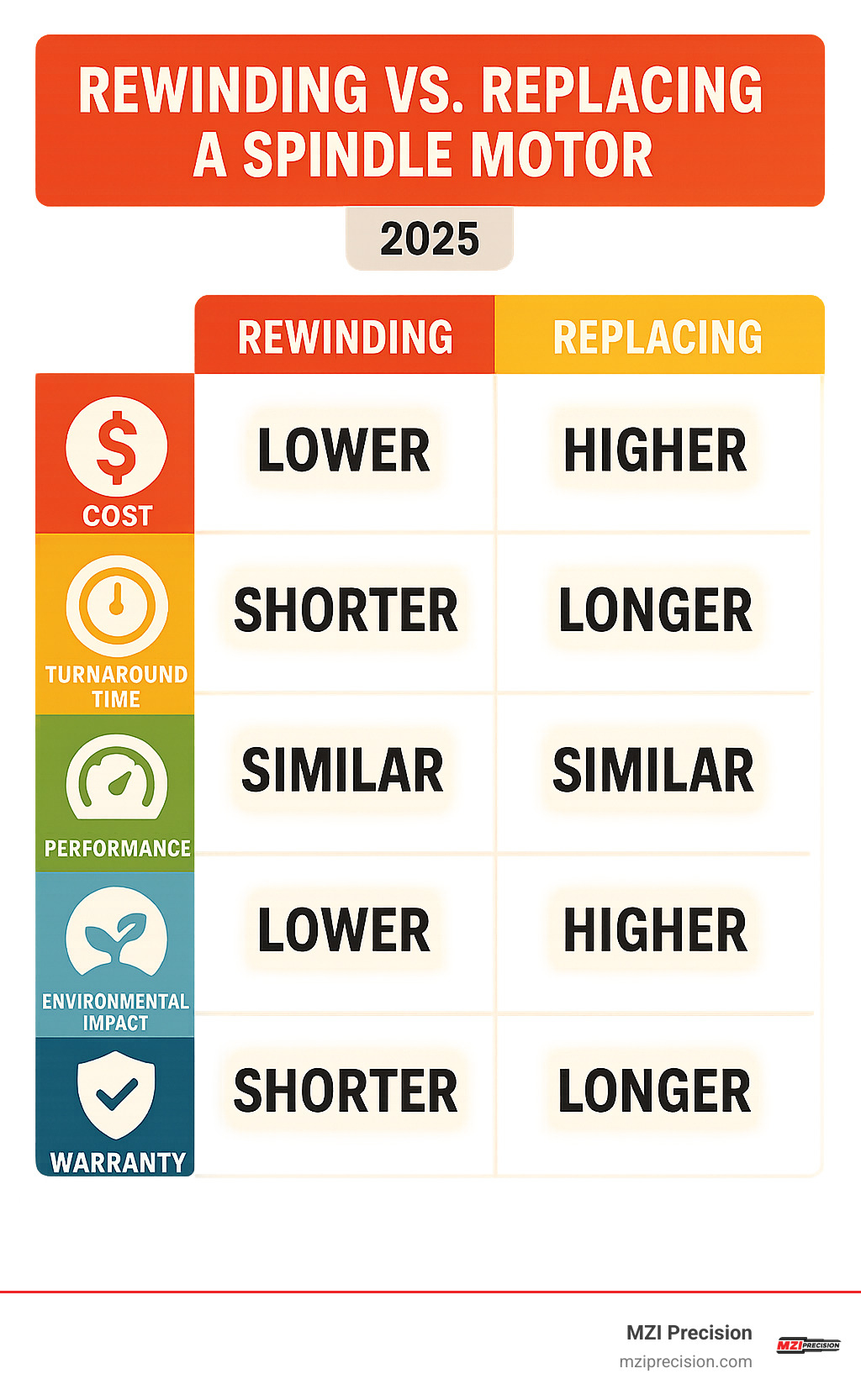
Key Benefits of Professional Spindle Motor Rewinding
Choosing to rewind your spindle motor, especially for industrial applications, offers a compelling array of advantages over outright replacement. It’s often the smartest move for your bottom line and for keeping your production humming along.
First off, let’s talk about cost-effectiveness. This is a huge win! Rewinding can typically save you a whopping 60-70% compared to buying a new motor. Imagine, for a 10HP motor, a rewind might cost you around CAD$650 (and that includes new bearings!). A brand-new one could easily hit CAD$2,700 or more, especially once you factor in shipping and import duties. That’s a massive difference that protects your budget.
Many of the industrial spindle motors we see are truly specialized motors. They might be custom-built or have unique specifications that make finding a new replacement incredibly difficult, super expensive, or involve long, frustrating lead times. Spindle motor rewinding preserves that original motor’s unique design and its perfect fit within your machine. Why replace a custom fit when you can restore it?
Then there’s the critical factor of faster turnaround. Time is precious in manufacturing. A quality rewind service can often get your motor back to you much quicker than waiting for a new, custom-built motor to arrive. We’re talking standard turnaround times of often 8-10 business days, with expedited options available if you’re really in a pinch. Getting your machine back online faster means less lost production time.
And don’t worry about performance! A high-quality rewind, when done to industry standards like EASA AR-100, can fully restore your motor’s performance. This means it will meet its original efficiency and specifications. Tests have even shown that Premium Efficiency/IE3 Motors can be rewound without losing any efficiency. It’s like getting your motor back, only better because it’s been given a new lease on life.
Finally, choosing to rewind is a wonderfully sustainable choice. It’s simply greener! You’re actively reducing waste by extending the life of existing equipment, keeping good motors out of landfills. Plus, manufacturing new motors uses a lot of energy. By rewinding, you’re conserving energy and lowering the overall environmental footprint. It’s a tangible step towards being more responsible for our planet.
When Replacement Is the Better Option
While spindle motor rewinding is often the hero of the story, there are certainly times when a new motor is the more sensible choice. We’re honest about this, because your operations deserve the best solution.
Sometimes, the damage is just too severe. If the motor’s stator core has suffered catastrophic damage – we’re talking extensive delamination, warping, or irreparable cracks – it might be beyond economical repair. Think of the stator core as the motor’s backbone; if it’s too broken, a rewind won’t fix its fundamental structure. Our stator core integrity tests will tell us if there’s significant degradation that can’t be fixed. If so, a new motor is the only way to ensure proper efficiency and long-term reliability.
Another hurdle can be obsolete parts. Occasionally, a motor might be so old or unique that critical components (other than the windings themselves) are simply unavailable. If we can’t find the necessary parts to fully rebuild it, a rewind alone won’t solve the problem. Similarly, if there’s non-repairable mechanical failure to the motor’s housing, shaft, or other key mechanical components, a rewind won’t be enough to bring it back to life.
Finally, in some rare cases, a new motor might offer significant technological advancements. If your old motor was notoriously inefficient, and there’s a new model that provides massive improvements in efficiency or performance, the availability of modern upgrades might make the investment in a new unit worthwhile. It’s all about finding the right balance for your specific needs.
Choosing a Qualified Rewinding Service for Your CNC Spindle
Entrusting your vital industrial spindle motor to a rewinding service is a big deal. The quality of the repair directly impacts your machine’s performance, uptime, and the longevity of your investment. It’s not just about replacing copper; it’s about restoring precision. So, what should you look for when vetting a service provider?
Technical Capabilities and Equipment
A truly qualified spindle motor rewinding service will back up its claims with cutting-edge equipment and a robust in-house infrastructure.
- In-House Winding: Shops that perform winding in-house, rather than outsourcing, have greater control over quality, turnaround times, and cost. This also eliminates transport risks and delays.
- VPI Systems: As discussed, Vacuum Pressure Impregnation (VPI) is non-negotiable for high-quality insulation. Ensure the service has a modern VPI system, indicating their commitment to superior winding protection.
- Advanced Electrical Testing: Look for services that conduct comprehensive electrical tests (Megger, Surge, Hipot, PI) at various stages of the process, not just at the end. This meticulous testing ensures every winding is perfect.
- Dynamic Balancing Machines: For high-speed spindle motors, precise dynamic balancing is critical. The repair shop should have specialized balancing equipment capable of achieving very low vibration tolerances, often 0.1-mil or better. While many balancers are limited to 600 RPM, a good shop understands the nuances of balancing high-speed rotors.
- Clean-Room Assembly: Especially for precision spindle motors with sensitive bearings, a clean-room environment for final assembly is crucial to prevent contamination that can lead to premature bearing failure.
- ISO Standards/Accreditation: Adherence to international quality management standards like ISO, or industry-specific accreditations such as the Electrical Apparatus Service Association’s EASA AR100 standard, signifies a commitment to best practices and consistent quality.
Experience and Quality Standards for Spindle Motor Rewinding
Beyond the machines, the human element and the commitment to quality are paramount.
- Technician Experience: Look for a service with decades of combined experience and a proven track record in restoring OEM spindle performance. At MZI Precision, our technicians specialize in OEM rebuilt spindles, ensuring your motor is in the hands of seasoned professionals.
- High-Quality Materials: A reputable service will never cut corners on materials. This includes using high-grade magnet wire (e.g., Hitachi lead wire rated for 200 °C), premium insulation materials, and robust bonding resins. A quality rewind shop should use VFD (Variable Frequency Drive) duty-rated wire for rewinds.
- Warranty: A strong warranty demonstrates confidence in the work. Look for providers that stand behind their repairs with at least a 12-month warranty on stator rewinds, giving you peace of mind.
- Industry Best Practices and Standards: A qualified service follows—or even exceeds—industry best practices. This includes meticulous documentation, adherence to original specifications, and a commitment to continuous improvement. We believe in providing exceptional service and support, ensuring every rewind meets the highest standards.
Frequently Asked Questions about Spindle Motor Rewinding
It’s natural to have questions when your critical industrial equipment needs attention. We understand you want to make the best decision for your manufacturing operations. Here are some of the most common questions we hear about spindle motor rewinding, answered with a warm, straightforward approach.
How does rewinding affect motor efficiency?
This is a really common and important question! Many folks worry that rewinding a motor might make it less efficient, leading to higher energy bills or reduced performance. But here’s the good news: when spindle motor rewinding is done right – by a qualified service like MZI Precision – using modern, high-grade materials and following strict industry standards (like EASA AR-100), your motor can be rewound without losing its efficiency.
In fact, sometimes a quality rewind, especially one that uses improved insulation materials or optimized winding patterns, can even maintain or slightly improve a motor’s original efficiency rating! This means your motor will perform exactly to the manufacturer’s original specifications, ensuring it doesn’t consume more energy than it should. Your energy bills (and your wallet) will thank you!
How long does a rewound spindle motor last?
The longevity of a rewound spindle motor truly speaks to the quality of the repair. Think of it like a new lease on life for your motor! When the rewinding is performed by a qualified service that uses premium materials, precise techniques, and crucial processes like Vacuum Pressure Impregnation (VPI), a rewound motor’s lifespan can be equal to, or sometimes even greater than, the original winding’s service life.
We’ve actually seen industrial motors that were expertly rewound continue to operate successfully for over 20 years. That’s a powerful testament to the durability and effectiveness of a quality rewind! The secret really lies in choosing a repair shop that puts quality control first and uses only the most robust materials available.
Can any industrial spindle motor be rewound?
That’s a great question, and the answer is usually yes! Most industrial spindle motors are indeed good candidates for spindle motor rewinding, making it a very versatile and valuable repair solution.
However, there’s a key factor to consider: the condition of the stator core. The feasibility and cost-effectiveness of a rewind depend heavily on this. If the stator core has suffered severe, irreparable physical damage – like extensive cracking or delamination from the original failure – then a rewind might not be possible, or it might not be the most economical choice. During our initial diagnosis, we always perform core loss testing to determine if your motor is a good candidate for rewinding. Our experts at MZI Precision are always happy to assess your specific motor and advise you on the very best course of action. You can always contact us for a spindle evaluation!
Conclusion: Restoring Precision and Extending Lifespan
In the busy world of industrial manufacturing, your spindle motors are truly the heart of your operation. They’re the silent workhorses that ensure your production runs smoothly and precisely. When one of these critical components falters, it can feel like your whole world stops. But here’s the good news: spindle motor rewinding offers a brilliant path forward.
As we’ve seen, this isn’t just a simple fix; it’s a powerful, cost-effective, and surprisingly sustainable solution. Instead of tossing out a valuable piece of equipment, rewinding breathes new life into it. You save a lot of money, get your machine back up and running faster, and even do your part for the planet by reducing waste. It’s a win-win-win!
But here’s the key: not all rewinds are created equal. To truly restore your motor’s precision and ensure it performs reliably for years to come, you need a partner with deep technical know-how, top-notch equipment, and a real commitment to quality. This isn’t a job for just anyone; it requires specialized expertise and a meticulous approach.
That’s where we, MZI Precision, come in. We understand just how vital your industrial spindles are to your success. With our strong background in OEM rebuilt spindles and our unwavering dedication to providing exceptional service and support right here in the United States, we don’t just repair your motor. We carefully restore it to its peak performance, often making it even better than before. Choosing us means you’re not just getting a repair; you’re investing in renewed precision and extending the valuable lifespan of your machinery.
Don’t let a failed spindle motor slow down your production. Let our experts help you get back to what you do best.