


Spindle Drive Troubleshooting: Don’t Let a Bad Connection Stop Your Spin
When a Spindle Drive Fails, Every Minute of Downtime Costs You
TITLE: SPINDLE DRIVE TROUBLESHOOTING AND REPAIR GUIDE METADATA DESCRIPTION: LEARN HOW TO TROUBLESHOOT AND REPAIR INDUSTRIAL CNC SPINDLE DRIVES, UNDERSTAND COMMON FAILURE SYMPTOMS, AND COMPARE THE COSTS OF REPAIR VS. REPLACEMENT.

Spindle drive repair is one of the most time-sensitive challenges in industrial manufacturing. When a spindle stops — or starts behaving erratically — production halts, schedules slip, and pressure builds fast.
Here’s a quick overview of what you need to know:
Quick Answer: Spindle Drive Repair at a Glance
| Question | Short Answer |
|---|---|
| What are the top symptoms? | Fault codes, no rotation, overheating, erratic RPM, orientation alarms |
| Can I troubleshoot before sending it in? | Yes — check power, connections, fuses, and alarm history first |
| How much does repair cost vs. new? | Typically 70% less than buying a new unit |
| How long does repair take? | Usually 3–8 business days; rush options available |
| What warranty should I expect? | 12 to 24 months on the repaired drive |
| When should I repair instead of replace? | Almost always — unless the drive has catastrophic or repeated failure |
Many spindle drive failures look catastrophic but turn out to be a bad connection, a blown fuse, or a corrupted parameter. The challenge is knowing where to look — and when to stop troubleshooting and get expert help.
This guide walks you through the full picture: from reading fault codes on the shop floor to understanding what a professional repair should include, what it costs, and how to keep it from happening again.
Important spindle drive repair terms:
COMMON SPINDLE DRIVE PROBLEMS AND FAILURE SYMPTOMS
Industrial manufacturing spindles are the workhorses of the CNC world. When the drive unit controlling them begins to fail, it rarely does so in complete silence. Instead, it drops clues. Recognizing these clues early can prevent a minor electrical hiccup from turning into a major mechanical meltdown.
Electrical Faults That Stop the Spindle
The most definitive sign of an electrical failure is a dead drive. If you open your cabinet and find no lit LEDs, or if the system refuses to power up at all, the issue lies within the incoming power path or the drive’s internal power supply.
Incoming power lines (L1, L2, L3) are the first suspects. Blown main line fuses or a tripped disconnect will stop the drive before it even receives a run command. Internally, the drive relies on a bank of DC bus capacitors to smooth out raw voltage. Over time, these capacitors dry out or leak, leading to internal power supply failures.
Another common failure point is the Insulated Gate Bipolar Transistor (IGBT) module. The IGBTs act as high-speed electronic switches that generate the variable frequency output for the motor. If an IGBT shorts out, or if its gate driver circuitry fails, the drive will immediately lock up with a major fault code to protect itself. Additionally, worn Wye/Delta transition contactors or loose terminal blocks can cause intermittent phase loss, mimicking a dead drive.
Feedback and Speed-Control Problems
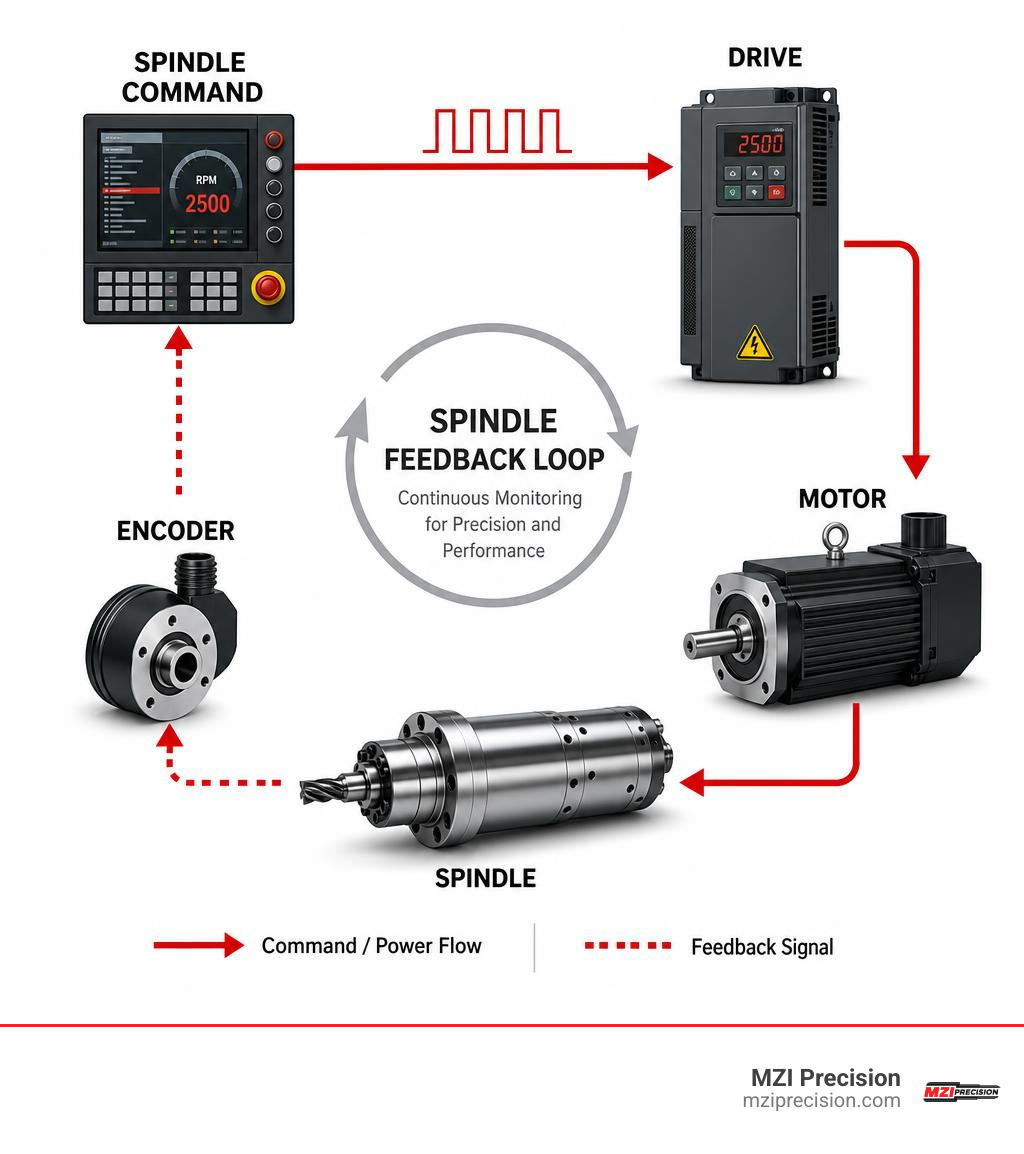
A drive is only as good as its feedback loop. To maintain exact RPM under heavy cutting loads, vector drives rely on constant data streams from encoder feedback devices, resolver signals, or tachometers.
When feedback signals degrade, you will notice “speed hunting” — where the spindle RPM visibly fluctuates or oscillates while trying to maintain a steady speed. If the actual RPM mismatch exceeds a pre-set window, the CNC controller will trigger a spindle orientation alarm or a speed deviation fault.
Sometimes, the issue isn’t the physical encoder, but parameter corruption within the drive’s memory. If a drive loses its PID tuning parameters, it can display erratic speed control, fail to orient for tool changes, or trigger nuisance alarms during acceleration.
Motor, Cable, and Connection Symptoms That Mimic Drive Failure
Before pointing the finger solely at the spindle drive, we have to look downstream. The motor leads (T1, T2, T3) and the cabling connecting the drive to the spindle motor are exposed to high thermal stress and constant movement.
A loose bolt-clamp connector inside the motor junction box can cause random short circuits or phase imbalances. Over time, motor winding insulation breaks down due to heat and age. If you run a megohm insulation test and find readings dropping below 500 megohms, the motor windings are likely shorting to ground.
Additionally, high DC bus errors during deceleration often point to a failed braking resistor or a damaged regeneration (regen) circuit rather than a faulty drive board. If the braking resistor cannot dissipate the energy generated by the stopping spindle, the drive will shut down with an overvoltage fault.
FIELD TROUBLESHOOTING BEFORE SPINDLE DRIVE REPAIR
Before you box up your drive and ship it out, there are several safe, systematic checks your operators can perform. Taking an hour to troubleshoot can save you days of unnecessary downtime if the root cause is external to the drive itself.
Always remember: Safety first. Before opening any electrical cabinet or touching terminals, perform your facility’s official lockout/tagout procedure. The DC bus capacitors inside a spindle drive can hold lethal voltages long after the main power is turned off.

Step-by-Step Operator Checks
To systematically isolate the problem, perform these basic checks:
- Analyze Alarm History: Read the exact fault codes on the drive’s display or the CNC screen. Document these codes before resetting them.
- Measure Input Voltage: Verify that the incoming voltage across L1, L2, and L3 is balanced and matches the system’s rating.
- Inspect Fuses: Check the main line fuses and the small glass control fuses behind the drive’s main board.
- Check the DC Bus Status: Use a multimeter to verify if the DC bus is charging correctly or if it is holding voltage when it shouldn’t.
- Back Up Parameters: If the drive is still partially responsive, back up its parameter records immediately.
- Inspect Fans and Filters: Ensure the cabinet cooling fans are running and the intake filters are clean. Overheating is a primary trigger for nuisance thermal trips.
- Examine Cables: Inspect the encoder cables and motor leads for physical wear, cuts, or heat damage.
For more information on general system troubleshooting, read our guide on the CNC Servo Drive.
Connection, Power, and Parameter Checks
In 230 VAC systems, the transformer input voltage must be verified. If the transformer is supplying excessive voltage, the drive will consistently fault out on DC high errors.
On machines utilizing Wye/Delta winding transitions, contactor arcing can cause random overcurrent trips. This is often solved by checking the transition dwell timing parameter. A dwell angle of approximately one second allows the contactors to fully clear before the new winding pattern is energized, preventing destructive arcing.
You should also check the speed command signal. Spindle controllers often use a 0-10 VDC analog speed signal. By testing this voltage at the drive terminals while commanding different speeds from the CNC, you can quickly determine if the issue is a dead drive or a faulty CNC control board.
If you are dealing with axis control issues alongside your spindle, you can find More info about servo drive service to help isolate the two systems.
When to Stop Troubleshooting and Send the Drive
There is a fine line between smart troubleshooting and accidental damage. If you open the drive cabinet and smell the distinct, pungent odor of burnt epoxy or see smoke, stop immediately.
Attempting to repeatedly reset a drive that has a shorted IGBT or leaking DC capacitors will only cause further damage, potentially vaporizing circuit board traces and turning a simple component replacement into a total loss. If you observe physically burnt PCBs, leaking capacitors, or if the drive immediately trips the main shop breaker upon power-up, it is time to send the unit to us for professional evaluation.
SPINDLE DRIVE REPAIR: PROFESSIONAL PROCESS, COSTS, AND TURNAROUND
When a drive arrives at our facility, it undergoes a highly structured, professional restoration process. This isn’t just about swapping a single broken part; it’s about rebuilding the unit to a state that often meets or exceeds its original factory specifications.
To learn more about our specific repair capabilities, you can read more about CNC Spindle Drive Repair.
What Professional Spindle Drive Repair Should Include
A reputable repair cannot be done with a simple soldering iron on a dirty workbench. The drive must be completely disassembled in an ESD-safe environment.
The process includes:
- Thorough Cleaning: Removing all grease, conductive carbon dust, and cutting fluid residue using specialized ultrasonic cleaning tanks.
- Component-Level Diagnostics: Individually testing high-failure-rate components, including DC bus capacitors, gate drivers, optocouplers, relays, and IGBT modules.
- Solder Trace and Board Repair: Repairing any corroded or burnt circuit board traces.
- Re-applying Protective Coatings: Applying fresh conformal coatings and sealers to protect the delicate electronics from the harsh shop environments they will return to.
Brands, Drive Families, and Common Failure Points
Over our decades of experience, we have repaired thousands of drives across all major industrial brands. Each brand has its own unique quirks:
- FANUC Drives: Known for their reliability, but commonly suffer from internal power supply failures, blown internal glass fuses, and failing cooling fans that trigger thermal alarms. For details on these units, see our Fanuc Drive repair page.
- Yaskawa & Magnetek: Frequently experience DC bus capacitor degradation and gate driver failures, particularly in high-demand 7.5kW and 15hp configurations.
- Mitsubishi & Freqrol: Popular on legacy machining centers. These legacy controllers often have parameter storage batteries that fail, causing the drive to lose its memory.
- Allen-Bradley, Indramat, Baldor, and Reliance: Common failure points include worn bypass contactors, failed encoder interface boards, and thermal sensor failures.
Testing and Quality Assurance After Repair
A repaired drive should never be shipped back to you untested. We subject every rebuilt drive to a comprehensive dynamic testing protocol.
This includes mounting the drive on a custom test stand and connecting it to a matching spindle motor in a closed-loop machine simulation. We run the drive through its entire speed range, performing rapid acceleration and deceleration cycles to test the regen circuit, monitoring current balance across all three phases, and conducting thermal scans to ensure no components are running hot.
Standard, Rush, and Complex Repair Timelines
We know that every day your machine is down is a day of lost revenue. Our standard turnaround time for a spindle drive repair is typically 3 to 5 business days, with express cases completed in 6 to 8 business days depending on part availability.
For critical situations, we offer expedited rush evaluations and repair options to get your hardware back on the shipping dock as fast as possible. Because we repair and ship nationwide, we can coordinate overnight shipping to minimize your production bottlenecks.
Warranty Coverage to Expect
A professional repair should come with a warranty that gives you peace of mind. While some shops only warranty the specific components they replaced, we stand behind our work with a comprehensive warranty covering the entire drive unit.
Standard warranties typically range from 12 months to 24 months. This warranty covers our workmanship and all replaced parts, excluding failures caused by external factors like machine crashes, severe fluid contamination, or incorrect installation wiring.
REPAIR VS. REPLACEMENT FOR INDUSTRIAL MANUFACTURING SPINDLES
When faced with a failed spindle drive, managers often ask: “Should we repair this or just buy a new one?” In almost all cases, professional repair is the superior choice.
| Factor | Professional Repair | New OEM Replacement |
|---|---|---|
| Cost | Typically 70% less than buying new | Full retail price |
| Lead Time | 3 to 8 business days (standard/rush) | Weeks or months for backordered units |
| Parameters | Retained (no reprogramming needed) | Must be completely reprogrammed |
| Sustainability | High (keeps electronics out of landfills) | Low (requires manufacturing new units) |
| Warranty | 12 to 24 months | 12 months standard |
When Spindle Drive Repair Beats Replacement
Repairing your existing drive is highly economical. Our repairs average 70% less than the cost of buying a new unit, and customers consistently save at least 20 percent compared to purchasing a replacement from the manufacturer.
Beyond cost, repair preserves your drive’s parameters. A new drive from the factory arrives completely blank. Programming a new drive to match your specific CNC controller, motor windings, and encoder feedback can require hours of specialized commissioning. With a repair, you simply slide the unit back into the cabinet, reconnect the wires, and turn the machine on.
If your spindle motor itself has suffered damage alongside the drive, check out our Spindle Motor Repair and Electric Motor Repair services to coordinate a dual rebuild.
When Replacement May Be the Better Decision
There are rare occasions when replacement makes sense. If a drive has suffered catastrophic physical damage — such as an internal electrical fire that has completely carbonized the main circuit board — a repair may not be physically possible.
Additionally, if your facility is planning a comprehensive CNC control upgrade, or if the drive is an obsolete model for which replacement semiconductors are completely unavailable globally, upgrading to a modern drive system is the logical path forward.
Total Cost Factors Beyond the Unit Price
When calculating the cost of a failure, the purchase price of the drive is only one variable. You must also calculate:
- Downtime Losses: Can exceed thousands of dollars per hour in high-volume shops.
- Commissioning Labor: The engineering cost to program and tune a new drive.
- Integration Risks: The potential for compatibility issues between a new drive model and an older CNC controller.
PREVENTIVE MAINTENANCE AND CNC MAINTENANCE INTEGRATION
The best way to handle a spindle drive failure is to prevent it from happening in the first place. Integrating your drive cabinet into your broader machine tool maintenance strategy is simple and pays massive dividends.
To keep your entire mechanical setup running flawlessly, explore our CNC Spindle Repair and Machine Tool Spindle Repair resources.
Monitoring That Reduces Drive Failures
Modern CNC maintenance relies on data. By monitoring key metrics, you can spot a failing drive weeks before it actually trips:
- Thermal Monitoring: Use infrared thermal guns to check terminal blocks and heat sinks for hot spots.
- Amperage Draw: Track the idle current draw of your spindle motor. A gradual increase in idle current often indicates failing spindle bearings, which overload the drive.
- DC Bus Trends: Monitor the DC bus voltage level during acceleration and deceleration to check capacitor health.
- Fan Hours: Replace internal cooling fans proactively based on their rated operating hours.
Maintenance Actions for Drives, Motors, and Spindles
Keep your electrical cabinets sealed and clean. Coolant mist and fine metallic dust are conductive; if they settle on a drive’s circuit board, they will cause a catastrophic short circuit.
Clean or replace cabinet air filters monthly. Check the torque on all high-current terminal connections annually, as thermal cycling can cause screw terminals to back out over time. Finally, coordinate your drive maintenance with regular spindle inspections.
If you suspect mechanical wear is putting extra stress on your drive, consider scheduling a professional Spindle Rebuild to restore mechanical efficiency.
How Drive Repair Fits the Broader Machine Tool Strategy
A healthy drive and a healthy spindle are two sides of the same coin. An electrically unstable drive can cause micro-stuttering in the spindle motor, which destroys surface finishes and ruins expensive cutting tools.
Conversely, a mechanical spindle crash can send a massive electrical spike back up the motor cables, instantly blowing the drive’s IGBT modules. By treating the drive, motor, and spindle as a single integrated system, you can build a highly reliable production environment.
If you are located in the Western United States, we invite you to learn more about our local regional support on our Spindle Repair California page.
FREQUENTLY ASKED QUESTIONS ABOUT INDUSTRIAL SPINDLE DRIVES
How do I know whether the drive or motor is the problem?
To isolate the issue, perform a megohm insulation test on the motor windings (T1, T2, T3 to Ground) with the motor leads disconnected from the drive. If the motor passes the insulation test, check the drive’s output voltage phase balance. If the drive output is unbalanced or non-existent while receiving a valid speed command, the drive is the problem.
How much does repair cost compared with buying new?
Professional repair typically costs only 30% of the price of a new OEM drive, representing an average savings of 70%. Furthermore, because the repaired drive retains your original parameters, you save significantly on installation and engineering commissioning costs.
How long does a typical repair take and what warranty is standard?
A standard professional repair takes between 3 to 5 business days, with express turnaround options available for urgent situations. Reputable repair services provide a comprehensive 12-month to 24-month warranty that covers the entire drive unit, not just the components that were replaced.
CONCLUSION
Maximizing your CNC uptime requires a smart, repair-first strategy. When a spindle drive stops, don’t panic and immediately order an expensive, long-lead-time replacement from the manufacturer. Most failures are highly repairable at a fraction of the cost.
At MZI Precision, we specialize in industrial manufacturing spindle rebuilding and OEM rebuilt spindle drive support. From our state-of-the-art facility in Huntington Beach, California, we repair and ship nationwide, providing rapid turnaround times, detailed repair support, and dependable service for industrial manufacturing spindle systems.
Don’t let a bad connection keep your production line from spinning. Get CNC spindle drive repair support from our expert team today, or check out our physical location by visiting our View facility listing.