

Spindle tool holder: Complete Guide 2025
WHY SPINDLE TOOL HOLDERS MATTER IN PRECISION MANUFACTURING
A spindle tool holder is the critical interface between your machine spindle and cutting tool, responsible for transmitting rotary motion, ensuring accurate positioning, and providing secure clamping during machining operations. In CNC machining, the tool holder connects the cutting tool to the machine spindle via a precisely engineered taper.
Quick Overview: What You Need to Know
| Component | Function |
|---|---|
| Taper Section | Fits into the spindle nose, transmits rotary motion |
| Tool-Holding Section | Grips and secures the cutting tool |
| Gage Line | Divides taper and tool-holding sections, aligns with spindle face |
| Retention System | Keeps holder locked in spindle during operation |
Common Taper Types:
- 7:24 taper – Used in CAT, BT, and NMTB holders
- 1:10 taper – Used in HSK holders
Here’s something most shops overlook: your tool holder is precision equipment, not just an accessory. Most machine tool spindles have a taper of Class AT2 or better, while most toolholders are Class AT3 or better. These tolerance classes directly impact your connection stiffness, damping, accuracy, and repeatability.
The right tool holder setup affects everything downstream. Poor runout accuracy leads to premature tool wear, inconsistent surface finishes, and scrapped parts. Conversely, a properly selected and maintained tool holder system improves cutting-tool life, spindle-bearing life, and overall machine productivity.
Whether you’re running a turn-mill center at 50,000 RPM or performing heavy milling operations, understanding tool holder fundamentals helps you maximize throughput, reduce setup time, and improve part quality.
Handy Spindle tool holder terms:
FUNDAMENTALS: COMPONENTS, TAPERS, AND CORE STANDARDS
At its heart, a spindle tool holder is a precision device designed to bridge the gap between your CNC machine’s powerful spindle and the delicate, yet robust, cutting tool. This connection must be rigid, repeatable, and capable of transmitting significant forces and speeds.
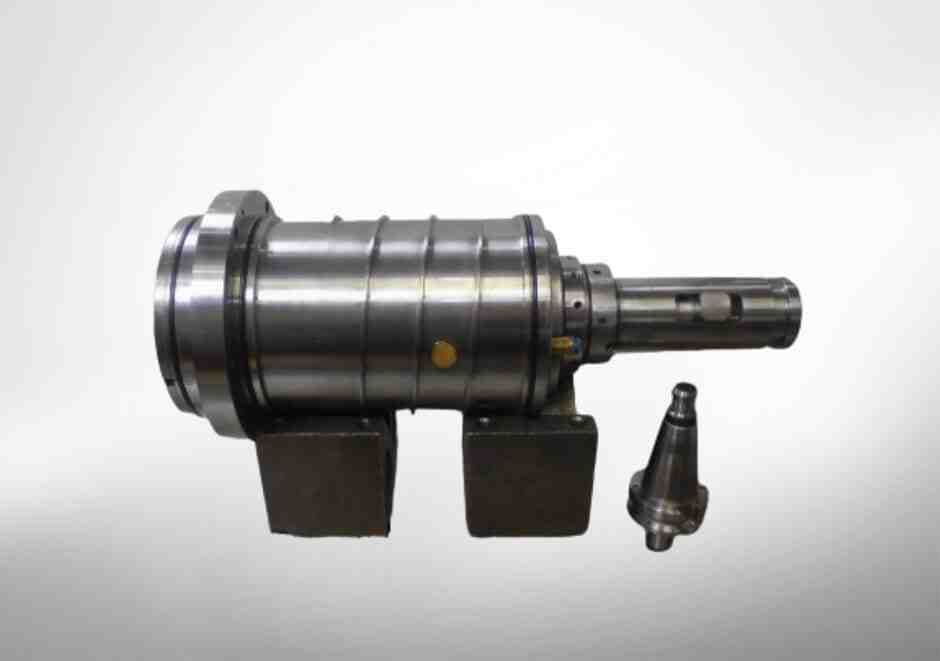
Every CNC tool holder consists of two primary parts: the taper section and the tool-holding section. The taper section is precisely machined to fit into the machine’s spindle bore, creating a tapered connection that ensures accurate tool location and transmits rotary motion. An imaginary line called the “gage line” aligns with the bottom edge of the spindle face, effectively dividing the taper and tool-holding sections. This gage line is crucial for defining the tool’s position relative to the spindle.
Beyond the taper, a retention knob (or pull stud) is threaded into the top of the holder, allowing the machine’s drawbar to pull the holder securely into the spindle. The flange, located near the top of the taper, provides a surface for automatic tool changers to grip and maneuver the tool holder. The entire assembly relies on a self-centering geometry inherent in the cone shape, which helps to correct slight misalignments when the holder is pulled into the spindle. This ensures that even if the tool holder is inserted with a slight deviation, the contact forces will naturally straighten and center it for optimal performance. For a deeper dive into these mechanical marvels, we find insights from sources like Understanding tapered spindle connections | Cutting Tool Engineering invaluable.
SPINDLE TAPER DESIGNS AND TOLERANCES
When we talk about spindle tapers, we’re primarily discussing two main design philosophies that dictate how the tool holder fits into the spindle.
The most common is the 7:24 taper (also expressed as 3.5:12, or 3.5 inches of taper per 12 inches of axial length, or 7 inches of taper per 24 inches of axial length). This “steep taper” design is widely used in CAT, BT, and NMTB holders. These are considered “free-releasing” holders, meaning they don’t self-lock into the spindle and can be easily removed, which is a significant advantage for automatic tool changers found in modern CNC machines. Historically, self-locking holders, like the Morse taper, required a special tool (a drift) for removal, which became cumbersome with the advent of automatic tool changing.
The other prominent design is the 1:10 taper, exclusively used in HSK (Hohl Schaft Kegel or “hollow-taper shank”) holders. Unlike the 7:24 taper, HSK designs are dual-contact, engaging both the taper and the face of the spindle, which we’ll discuss more later.
The precision of these tapered connections is paramount. Standards like ANSI/ASME B5.50-1994 and ISO 1947 define “tolerance classes” from AT1 to AT11. AT1 represents the tightest tolerance, indicating the smallest allowable error in the machined taper. In our experience, most industrial manufacturing machine tool spindles are manufactured to a taper of Class AT2 or better, while the tool holders themselves typically meet Class AT3 or better. This precise fit is critical for maintaining the stiffness, damping characteristics, accuracy, and repeatability of the spindle-tool holder connection.
A common pitfall we observe is the overtightening of retention knobs on these tight-tolerance holders. This seemingly minor action can cause the tail end of the holder to swell, altering the class of fit. This shifts the contact point in the spindle from the crucial nose area to the tail, dramatically reducing the connection’s stiffness and potentially damaging both the holder and the spindle. Always use a torque wrench and follow manufacturer specifications when tightening retention knobs.
COMPARING SPINDLE TOOL HOLDER STANDARDS
The world of spindle tool holders is governed by several international standards, each with unique characteristics that make them suitable for different applications and machine types. Understanding these differences is key to optimizing your machining processes.
Here’s a comparison of the most common standards:
| Standard | Taper Ratio | Flange Design | Pull Stud | Key Features & Applications |
|---|---|---|---|---|
| CAT (Caterpillar) | 7:24 | Imperial, V-flange | Imperial thread | Common in North America, single-contact, good for general machining. |
| BT (Bottle Top) | 7:24 | Metric, V-flange | Metric thread | Popular in Asia, similar to CAT but with metric dimensions, single-contact. |
| ISO (International Standards Org.) | 7:24 | Metric, V-flange | Metric thread | Global standard, similar to BT, single-contact. |
| HSK (Hohl Schaft Kegel) | 1:10 | Hollow, face contact | Internal clamping | High-speed machining, dual-contact (face and taper), excellent rigidity, common in European machines and high-performance applications. |
CAT, BT, and ISO holders all use the 7:24 steep taper and are generally considered “single-flange” systems. While they share the same basic taper angle, their flange dimensions, pull stud threads, and sometimes the V-groove for tool changers differ, making them generally non-interchangeable without adapters.
HSK, on the other hand, stands apart. Its name, “Hohl Schaft Kegel,” translates to “hollow-taper shank,” highlighting its unique design. HSK holders feature a 1:10 taper and are “dual-contact” systems. This means they engage both the taper and the face of the machine spindle simultaneously. This dual engagement dramatically increases rigidity, improves positional accuracy, and reduces tool pull-out at high speeds. HSK holders are becoming increasingly prevalent in high-speed machining, live tooling, and multitasking machines where precision and dynamic performance are critical.
A GUIDE TO COMMON TOOL HOLDER CATEGORIES
Choosing the right spindle tool holder is as crucial as selecting the right cutting tool. The optimal choice depends heavily on the specific machining operation, the material being cut, desired surface finish, and the spindle’s capabilities. Let’s explore the common categories we encounter in industrial manufacturing.
COLLET CHUCKS
Collet chucks are workhorses in many shops, prized for their versatility and ability to hold a wide range of tool shank diameters with a single holder body, simply by changing the collet. ER collets are the most common type, offering excellent gripping power and good runout accuracy for many applications.
For high-speed applications, we recommend collet chucks balanced to 25,000 RPM at G2.5, achieving a maximum TIR of 0.0001”. Some advanced collet systems, like those featuring “Dead Nuts Accurate” (DNA) collets, further improve precision. Collet chucks are ideal for drilling, reaming, and light to medium milling operations where tool changes are frequent and flexibility is desired. Their primary advantage lies in their adaptability, allowing us to use various tool sizes efficiently.
END MILL HOLDERS
End mill holders, especially those designed for Weldon shanks, are perhaps the most traditional type of tool holder. They use a set screw to clamp onto a flat on the tool shank, providing a very positive drive, which is excellent for heavy cutting operations where torque transmission is critical. They are essentially side-lock arbors.
However, the set screw design can introduce runout and radial displacement if not perfectly aligned or if the tool is not precisely ground. For better performance and reduced runout, we look for end mill holders with an H5 bore tolerance. This tighter tolerance significantly reduces the space between the tool shank and the holder bore, leading to improved cutting performance and extended tool life. While Weldon shank holders are robust, modern alternatives often offer superior accuracy for precision work.
SHRINK-FIT HOLDERS
Shrink-FIT holders represent a leap in precision and gripping power. These holders work on the principle of thermal expansion: the holder’s bore is heated, causing it to expand. The tool shank is then inserted, and as the holder cools, it shrinks tightly around the tool, creating an incredibly strong and concentric grip.
When properly applied, shrink-FIT holders offer best-in-class runout accuracy and gripping strength, making them the first choice for demanding applications, especially with carbide shank drills and end mills (they are not recommended for steel shanks due to material differences). They have no moving parts, which contributes to their high balanceability and rigidity. Many high-performance shrink-FIT holders are made from H13 steel for improved durability and feature options like CoolBLAST coolant ports or DIN-B coolant delivery for optimal chip evacuation and tool cooling. Their superior runout and balance make them indispensable for high-speed and high-precision machining where surface finish and tool life are paramount.
HYDRAULIC AND MILLING CHUCKS
Hydraulic holders and mechanical milling chucks offer a compelling balance of gripping force, accuracy, and vibration damping.
Hydraulic holders use hydraulic fluid to generate uniform pressure around the tool shank, providing exceptionally high clamping pressure and repeatable accuracy of less than 0.0001”. This uniform pressure also helps to dampen vibrations, leading to improved surface finish, extended tool life, and quieter machining. They are excellent for high-performance drilling, reaming, and precision milling, especially when repeatability is a top priority.
Mechanical milling chucks, often featuring a cam-operated mechanism or a series of rollers, provide significant clamping force that rivals shrink-fit in many aspects. They are more accurate than traditional Weldon shank end mill holders and can be highly versatile. Many milling chucks can use reduction sleeves, allowing them to hold various shank sizes with a single holder, enhancing their flexibility in the shop. Both hydraulic and milling chucks offer substantial improvements over basic side-lock holders, particularly in terms of accuracy and rigidity for demanding industrial manufacturing operations.
MAXIMIZING PERFORMANCE AND LONGEVITY
In the competitive landscape of industrial manufacturing, every component plays a role in overall machine productivity, part quality, tool life, and ultimately, cost-effectiveness. The spindle tool holder is no exception; in fact, its impact is often underestimated. Optimizing your tool holding strategy can open up significant gains. More info about our expert services can help you identify areas for improvement in your spindle systems.
THE CRITICAL ROLE OF ACCURACY AND BALANCING
Accuracy in tool holding primarily refers to Total Indicator Runout (TIR). TIR is a measurement of how much the cutting edge deviates from the true center of rotation. Even a small amount of runout can lead to uneven chip loads, premature tool wear on one side of the cutting edge, poor surface finish, and reduced part accuracy. For critical applications, we strive for TIR values of less than 0.0002”. Mechanical milling chucks and hydraulic tool holders, for instance, are significantly more accurate than Weldon shank end mill holders in minimizing radial displacement. Shrink-fit holders, when properly used, offer best-in-class runout.
Balancing is equally critical, especially in high-speed machining (HSM) environments where spindle speeds can reach tens of thousands of RPM. An unbalanced tool assembly creates centrifugal forces that cause vibration. This vibration not only degrades surface finish and part quality but also severely impacts tool life and, more importantly, the lifespan of your machine’s spindle bearings. We emphasize that balancing is not just for ultra-high speeds; any rotary tool benefits from proper balancing to improve process predictability and reduce wear.
The key insight here is that the entire tool assembly must be balanced, not just the spindle tool holder itself. This includes the holder, retention knob, cutter, inserts, and screws. Assemblies balanced to G2.5 or better greatly improve cutting-tool and spindle-bearing life. Ignoring balancing is akin to driving a car with unbalanced tires – it leads to a bumpy ride and premature wear on critical components.
SELECTING THE RIGHT SPINDLE TOOL HOLDER
Selecting the right spindle tool holder is a thoughtful process, not a one-size-fits-all decision. It involves carefully matching the holder’s capabilities to the demands of the machining application.
Here are the key considerations we evaluate:
- Machining Application: Is it heavy roughing, precision finishing, drilling, reaming, or tapping? Each requires different levels of rigidity, clamping force, and runout accuracy. For instance, heavy milling might benefit from a robust end mill holder or milling chuck, while precision finishing at high speeds demands the low runout of a shrink-fit or hydraulic holder.
- Material Being Cut: Harder materials often require more rigid tool holding to prevent vibration and deflection, which can lead to tool breakage and poor surface quality.
- Spindle Speed: As discussed, high-speed machining necessitates balanced tool holders with excellent runout characteristics to protect both the tool and the spindle.
- Rigidity Requirements: If deflection is a concern, a more robust holder design (like dual-contact HSK or a milling chuck) will be preferred over a standard collet chuck.
- Coolant Delivery: For deep-hole drilling or machining tough materials, through-tool coolant or specialized coolant delivery systems (like CoolBLAST or DIN-B options on shrink-fit holders) can be crucial for chip evacuation and tool cooling.
- Tool Type and Shank: The type of cutting tool (e.g., carbide end mill, HSS drill, indexable insert tool) and its shank design will dictate the compatible tool holder. For carbide shanks, shrink-fit is often ideal.
A careful analysis of these factors ensures that we select a tool holder that not only fits the machine but also optimizes the entire machining process.
ADVANCED DESIGNS AND MAINTENANCE PRACTICES
The evolution of spindle tool holder technology continues to push the boundaries of productivity and accuracy in industrial manufacturing. Advanced designs like dual-contact holders and polygon tapers (e.g., HSK) significantly improve rigidity and reduce deflection by engaging both the taper and the face of the spindle. Polygon-style tapers are particularly prevalent in live tooling and multitasking machines, offering superior performance where both turning and milling operations occur.
Quick-change tool holding systems are another game-changer. These systems, combined with offline presetting, can dramatically reduce machine downtime. Instead of setting up tools directly on the machine, tools are pre-set and measured offline while the machine is running, then quickly swapped in when needed. This can reduce setup time from minutes to mere seconds, greatly enhancing overall machine productivity.
However, even the most advanced tool holders require diligent maintenance to ensure their longevity and performance. We recommend the following practices:
- Routine Cleaning: Regularly clean both the tool holder’s taper and the machine spindle’s taper. Contaminants like chips, dust, or dried coolant can interfere with the precise metal-to-metal contact, leading to poor fit, increased runout, and accelerated wear.
- Wear Inspection: Periodically inspect tool holders and spindle connections for signs of wear, scoring, or damage. Even minor imperfections can compromise the connection’s integrity. Replace worn or damaged holders promptly.
- Drawbar Force Check: The machine’s drawbar is responsible for pulling and holding the tool holder in the spindle. We regularly check the drawbar force with an appropriate instrument to ensure it meets manufacturer specifications. Insufficient drawbar force can lead to tool pull-out, chatter, and spindle damage.
- Proper Storage: Store tool holders in a clean, organized manner, ideally in dedicated cabinets or racks, to protect their precision-ground surfaces from damage, rust, or contamination.
By implementing these advanced designs and maintenance practices, industrial manufacturing operations can achieve higher levels of precision, extend tool and spindle life, and significantly boost productivity.
FREQUENTLY ASKED QUESTIONS ABOUT SPINDLE TOOL HOLDERS
We often get questions about spindle tool holders from shops looking to optimize their processes. Here are some of the most common inquiries we address.
HOW DOES TOOL HOLDER RUN-OUT AFFECT MY MACHINING PROCESS?
Tool holder run-out, which is the deviation of the cutting tool’s centerline from the spindle’s true axis of rotation, has a profound impact on your machining process. Even a small amount of run-out can lead to:
- Reduced Tool Life: Uneven load distribution on the cutting edges causes premature wear on certain flutes, leading to faster degradation and frequent tool changes. This is a significant cost factor in industrial manufacturing.
- Poor Surface Finish Quality: The oscillating motion caused by run-out results in chatter marks, scallops, and an inconsistent surface finish, often requiring secondary operations to meet specifications.
- Compromised Part Accuracy: The tool’s actual cutting path deviates from the programmed path, leading to dimensional inaccuracies and potential scrap. For precision components, this is simply unacceptable.
- Increased Vibration and Noise: Run-out generates unwanted vibrations, which can damage the machine spindle, increase noise levels, and negatively affect the overall machining environment.
Excessive run-out costs time, money, and quality. Investing in high-precision holders like shrink-fit or hydraulic chucks can mitigate these issues.
WHAT IS THE DIFFERENCE BETWEEN CAT AND BT TOOL HOLDERS?
While both CAT and BT spindle tool holders use the 7:24 steep taper, making them visually similar, there are critical differences that prevent direct interchangeability:
- Flange Design: The most significant difference lies in the flange. CAT (Caterpillar) holders have an imperial-dimensioned V-flange, while BT (Bottle Top) holders have a metric-dimensioned V-flange. This difference affects how they are gripped by automatic tool changers.
- Pull Stud (Retention Knob): CAT holders typically use imperial threaded pull studs, whereas BT holders use metric threaded pull studs. This means you cannot use a CAT pull stud in a BT holder, and vice-versa, as they will not engage properly with the machine’s drawbar.
- Tool Changer Compatibility: Due to the flange and pull stud differences, a tool changer designed for CAT holders will generally not work with BT holders, and vice versa. Trying to force compatibility can lead to damage to both the tool changer and the tool holder.
While they share the same fundamental taper angle, their specific dimensions and retention mechanisms are designed for different regional standards and are not interchangeable.
WHY IS TOOL HOLDER BALANCING IMPORTANT EVEN AT LOWER RPMS?
While the detrimental effects of an unbalanced spindle tool holder are most dramatic and visible at very high RPMs (e.g., 20,000 RPM and above), balancing is crucial for all rotary tools, even at lower speeds. Here’s why:
- Improved Process Predictability: A balanced assembly ensures consistent cutting forces and predictable tool behavior, leading to more reliable and repeatable machining processes.
- Reduced Vibration and Chatter: Even at lower RPMs, imbalances can introduce vibrations that manifest as chatter. This chatter negatively impacts surface finish, tool life, and can cause micro-fractures in the workpiece.
- Extended Spindle and Tool Life: Continuous vibration, regardless of speed, puts undue stress on the machine’s spindle bearings and the cutting tool itself. Proper balancing (to G2.5 or better for the entire assembly) significantly reduces this stress, extending the lifespan of both expensive components.
- Improved Part Quality: Less vibration means better surface finishes, tighter tolerances, and fewer defects, ultimately contributing to higher quality parts.
So, while the catastrophic failure might be reserved for high-speed scenarios, the subtle but persistent degradation caused by imbalance at any speed makes balancing a best practice for all industrial manufacturing operations.
CONCLUSION
The spindle tool holder is far more than a simple adapter; it is a critical precision component that directly influences the performance, accuracy, and efficiency of your entire CNC machining operation. We’ve explored its fundamental components, the nuances of taper designs and standards, and the diverse categories available, each with its unique advantages. From the versatile collet chucks to the unyielding grip of shrink-fit holders, the choice you make reverberates through every cut, every surface finish, and every part produced.
Understanding the critical role of accuracy and balancing, especially in high-speed machining, and diligently adhering to maintenance practices are not just recommendations—they are essential strategies for maximizing tool life, preserving spindle integrity, and achieving optimal machine productivity. By treating your tool holders as the precision equipment they are, you invest in the overall system rigidity and open up the full potential of your industrial manufacturing capabilities.
At MZI Precision, we understand the intricate relationship between a high-performing spindle and the tool holders it connects with. Our expertise in industrial manufacturing spindle repair and rebuilding, particularly for OEMs, ensures that your machines in California, including Huntington Beach and Los Angeles, operate at their peak. We are committed to providing the exceptional service and support needed to keep your operations running smoothly and efficiently.
Contact us for spindle replacement and repair needs today, and let us help you optimize your spindle systems. To dig deeper into maintaining your machine’s core, learn more about spindle replacement.