


How to Rebuild Machine Spindles Like a Pro
The Critical Role of Spindles in Manufacturing
Industrial machine tool spindle repair is one of the most important maintenance decisions a manufacturing facility will ever make — and getting it wrong means costly downtime, scrapped parts, and lost production.
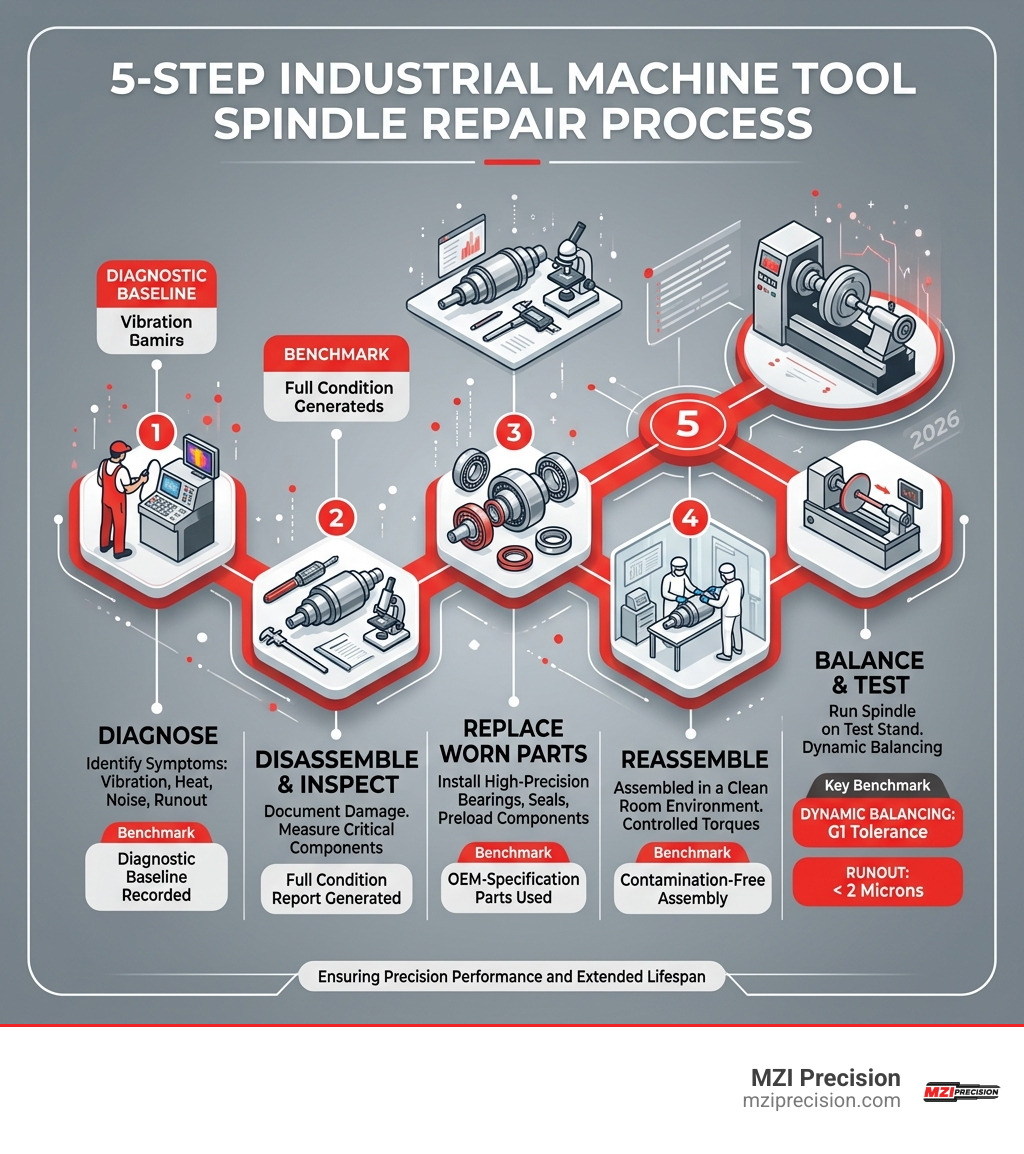
Here’s a quick overview of what the process involves:
- Diagnose — Identify symptoms like vibration, runout, noise, or heat
- Disassemble and inspect — Document damage and measure all critical components
- Replace worn parts — Bearings, seals, preload collars, and drawbar components
- Reassemble — In a clean room, to OEM specifications
- Balance and test — Dynamic balancing to G1 tolerances, runout under 2 microns
- Document and return — With warranty and full inspection report
The spindle is the heart of any CNC machining, grinding, milling, or drilling operation. It holds and rotates the cutting tool at extreme precision — often at tens of thousands of RPM. When it fails, everything stops.
Spindle failures don’t just cost repair fees. They cost production time. For aerospace manufacturers and other precision industries, even a few hours of unplanned downtime can ripple into missed deadlines and serious financial losses.
The good news: most spindle failures are repairable. And a professionally rebuilt spindle can perform just like new — often at a fraction of the cost of replacement.
This guide walks you through the entire process, from recognizing early warning signs to selecting the right rebuild partner.
Identifying Signs of industrial machine tool spindle repair Needs
As we move into April 2026, the demand for precision in manufacturing has never been higher. To keep up with these demands, you have to be a bit of a “spindle whisperer.” Your machine is constantly talking to you; the trick is knowing how to listen before a small whisper turns into a catastrophic scream (and a very expensive repair bill).
When a spindle begins to fail, it typically shows its hand through measurable physical changes. The most common technical indicators are radial and axial runout. Radial runout refers to the deviation of the spindle’s axis of rotation as it spins, while axial runout refers to the “end-play” or back-and-forth movement. In high-precision environments, we look for radial runout of less than 2 microns and axial runout of less than 1 micron to ensure the part meets specifications.
To truly master Diagnose This Unlocking The Secrets Of Machine Tool Health, we utilize vibration analysis. By measuring the frequency and amplitude of vibrations, we can pinpoint exactly which bearing is failing or if the spindle has lost its dynamic balance.

Common Symptoms Requiring industrial machine tool spindle repair
If you aren’t using sensors yet, you can still catch a failing spindle using your basic senses. Here is what to look out for:
- The Squeal of Sorrow: Unusual noises like grinding, clicking, or high-pitched squealing usually indicate that the bearing races are pitted or the lubrication has failed.
- The Heat Wave: If the spindle housing feels excessively hot to the touch, or if your thermal sensors are tripping, you likely have internal friction issues or a failing cooling jacket.
- The “Orange Peel” Finish: If your parts suddenly have a poor surface finish—chatter marks, waves, or inconsistent dimensions—your spindle is likely losing its rigidity.
Understanding these signs is the first step in Extending The Service Life Of Your Machine Tool Spindle. Ignoring them can lead to a spindle “crash,” which can damage the machine’s casting and drive system.
Advanced Diagnostics for Industrial Manufacturing Spindles
In our Huntington Beach and Los Angeles facilities, we see a wide variety of complex failures. To get to the bottom of them, we use advanced tools like VibeAid analysis. This type of in-line health monitoring can actually prevent a crash before it happens. Research shows that one prevented spindle crash will pay for the cost of advanced analysis many times over.
When you contact us for Industrial Machine Tool Spindle Repair Services, we don’t just look at the broken part. We look at the “why.” Was it a lubrication failure? A contamination issue from coolant mist? Or perhaps an improper tool-changing cycle? Identifying the root cause is what separates a “patch job” from a professional rebuild.
The Step-by-Step Spindle Rebuild Process
A professional machine tool spindle rebuilding is a surgical procedure. It requires a controlled environment, specialized tools, and a lot of patience. Here is how we handle the journey from a broken hunk of metal back to a high-precision instrument.
Step 1: Intake and Pre-Testing Before we turn a single wrench, we perform a pre-test. We document the incoming vibration levels and runout. This gives us a baseline to compare against once the repair is finished.
Step 2: Disassembly and “Forensic” Inspection We carefully disassemble the unit, documenting every step with photos. This is critical for Precision Spindle Remanufacturing. We look for “fretting” on the bearing journals, wear on the taper, and any signs of electrical discharge (common in motorized spindles).
Step 3: Ultrasonic Cleaning Every part is cleaned using ultrasonic tanks to remove microscopic debris, old grease, and dried coolant. You cannot rebuild a spindle in a dirty shop; even a single speck of dust can ruin a high-speed bearing.
Component Evaluation and Replacement
During the rebuild, we focus on the “Big Three”: bearings, seals, and the drawbar.
- Bearings: We almost exclusively use ABEC 7 or higher precision bearings. These are the gold standard for industrial manufacturing spindles.
- Seals: We replace all O-rings and specialized seals to prevent coolant from entering the delicate internal motor or bearing areas.
- Drawbar Force: Many people forget the drawbar! We use force gauges to ensure the tool-holding power meets OEM specs. If the drawbar is weak, the tool will vibrate, even if the bearings are brand new.
Understanding Machine Tool Spindle Design allows us to sometimes even improve on the original manufacturer’s specs. For example, we might use ceramic hybrid bearings to handle higher speeds and reduce heat.
Precision Reassembly and Balancing
Reassembly happens in our climate-controlled clean room. We use precision-ground spacers to set the exact “preload” on the bearings. If the preload is too tight, the spindle will overheat; too loose, and it will vibrate.
Once assembled, we perform dynamic balancing to G1 tolerances. This is a level of balance so precise it minimizes vibration to nearly zero, which significantly extends the life of the new bearings.
| Feature | Professional Repair | Buying New Spindle |
|---|---|---|
| Cost | 40% – 60% of New | 100% |
| Turnaround | 2-3 Weeks (Standard) | 8-16 Weeks (OEM Lead Time) |
| Performance | Meets/Exceeds OEM | Meets OEM |
| Warranty | 12-24 Months | 12 Months |
As shown in our Machine Tool Spindle Rebuild comparison, repairing is almost always the smarter financial move for California manufacturers looking to maximize their ROI.
Advanced Testing and Quality Standards
A spindle isn’t “done” just because it’s put back together. The final testing phase is where the “pro” status is earned. We subject every unit to a rigorous “run-in” procedure. This involves starting the spindle at low speeds and gradually increasing to the maximum RPM, all while monitoring temperature and vibration levels.
We guarantee our work to the highest industry standards. For most repairs, this means a radial runout of less than 2 microns and an axial runout of 1 micron. We use calibrated test bars and air gauges to verify the taper interface is perfect.
Choosing a Partner for industrial machine tool spindle repair
Not all repair shops are created equal. When you are looking for Machine Tool Rebuilds Finding The Right Partner For Your Equipments Revival, you should look for specific certifications.
- ISO Certification: Ensures the shop follows a strict quality management system, such as ISO 9001.
- BIG-PLUS® Authorization: If you run BIG-PLUS tooling, you need a shop with authorized gauges to grind the taper correctly.
- In-House Grinding: A shop that has to send parts out for “grind-plate-grind” work will take much longer. We prefer to keep everything in-house for better quality control.
Post-Repair Documentation and Warranty
When we ship a spindle back to a client in California, it comes with a “birth certificate.” This document includes all final test results, vibration plots, and runout measurements.
We stand behind our Machine Tool Spindle Repair California with industry-leading warranties. While some offer only six months, reputable services provide a one-year or even a 24-month warranty on repairs. This gives you peace of mind that your production line will stay up and running.
Frequently Asked Questions about Spindle Rebuilding
How long does a standard spindle rebuild take?
Most professional spindle rebuilds are completed in 2 to 3 weeks after the customer approves the quote. However, for production-critical emergencies, some specialized shops can offer a “redline” service that gets the job done in as little as 3 to 5 days.
What is the typical warranty on a professional spindle repair?
The industry standard is a one-year warranty on the rebuild. However, some premium providers offer up to a 24-month warranty if they also perform the installation and vibration analysis.
Can high-speed air-bearing spindles be repaired?
Yes! While they are much more delicate than mechanical spindles, air-bearing spindles used in semiconductor dicing or high-precision grinding can be repaired. This usually involves repairing corroded coolant jackets or cleaning the microscopic air ports to restore the “air film” that supports the shaft.
Conclusion
At MZI Precision, we understand that your spindles are the lifeblood of your business. Whether you are in the aerospace, defense, or medical sector, your success depends on the precision of your machine tools.
We specialize in industrial machine tool spindle repair for a massive range of brands, including Mazak, Mori Seiki, Okuma, Haas, and many more. By combining decades of experience with a commitment to OEM-quality standards, we help California manufacturers minimize downtime and maximize precision.
If your machine is starting to make noise, or if your part quality is slipping, don’t wait for a crash. Contact us today at (714) 379-6505 for a machine tool spindle repair evaluation and let’s keep your production line moving at peak performance.