


Machine Tool Diagnostics: Top 5 Secrets
Understanding Machine Tool Diagnostics: The Foundation of Manufacturing Reliability
Machine tool diagnostics is the systematic process of using performance data, advanced sensors, and technical expertise to assess equipment health, identify faults, and determine root causes before they result in catastrophic failures. For manufacturers in aerospace and other precision industries, understanding diagnostics is essential for maintaining the accuracy and reliability of industrial spindles and other critical components.
Quick Answer: What You Need to Know About Machine Tool Diagnostics
Machine tool diagnostics encompasses three core approaches:
- Reactive Diagnostics – Post-failure analysis to identify root causes after damage occurs
- Proactive Diagnostics – Early fault detection through regular monitoring to prevent failures
- Predictive Diagnostics – AI-powered forecasting of future faults using historical data patterns
Key diagnostic methods include:
- Vibration analysis using accelerometers and displacement sensors
- Acoustic emission monitoring for bearing and spindle health
- Geometric accuracy assessment across 21 degrees of freedom
- Real-time data collection from control systems (speed, current, temperature)
Modern manufacturing faces a critical challenge: all machine tools degrade during operation, yet traditional manual inspection methods are time-consuming and often detect problems too late. A typical 3-axis machine tool has 21 degrees of freedom—each representing a potential deviation that affects positioning accuracy and part quality.
The evolution from reactive maintenance to predictive diagnostics represents a fundamental shift in manufacturing strategy. With vibration analysis being the single most useful parameter for diagnosing mechanical faults in rotating machinery, manufacturers can now detect issues like bearing wear, spindle imbalance, and geometric deviations before they cause expensive downtime or scrapped parts.
Advanced diagnostic systems can complete automated health checks in less than a minute, while deep learning models have achieved fault detection accuracy rates of up to 99%. This combination of speed and precision enables manufacturers to schedule maintenance during planned downtime rather than responding to emergency failures.
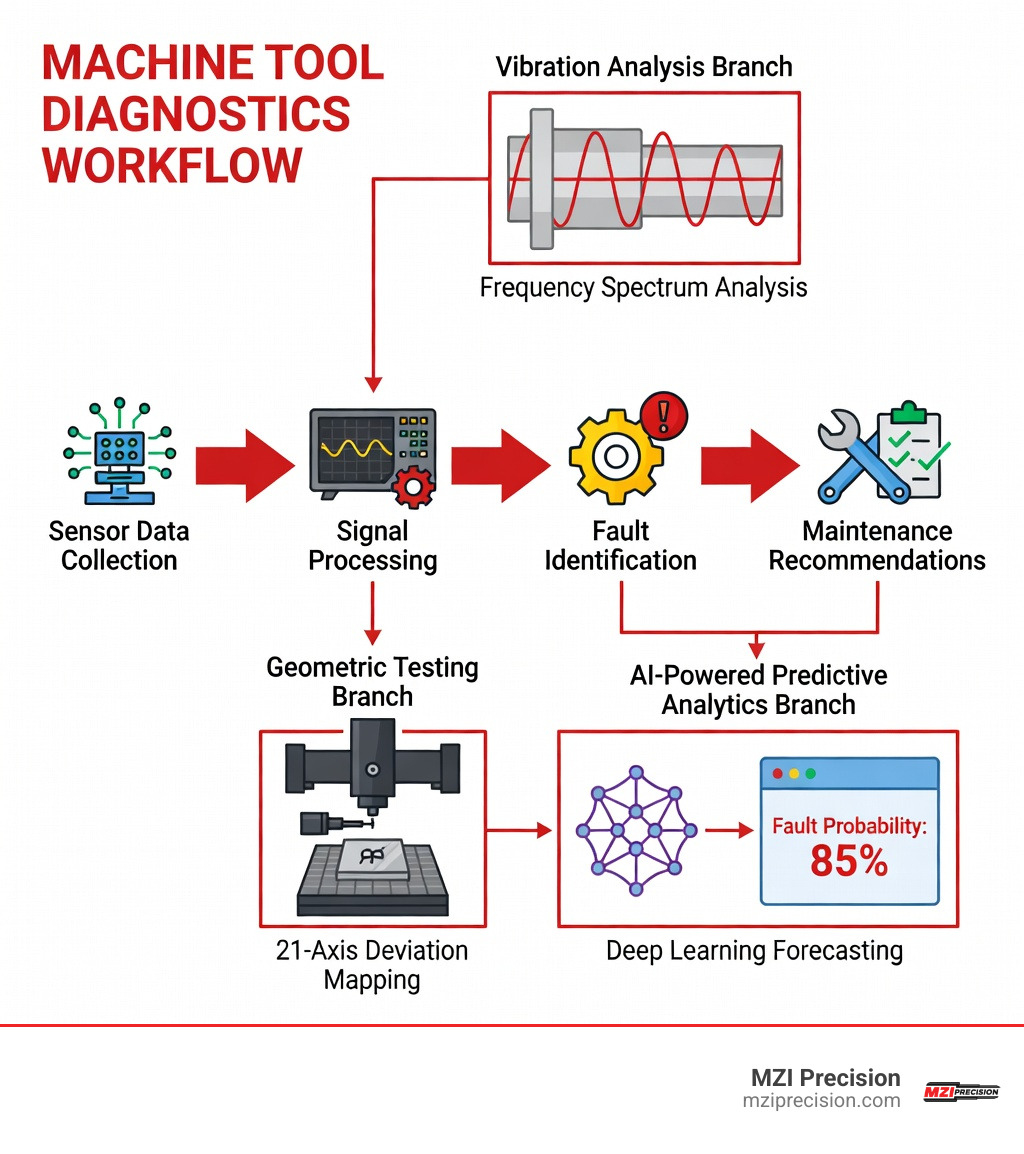
Machine tool diagnostics basics:
The Fundamentals of Machine Tool Diagnostics
At its heart, machine tool diagnostics is about listening to what your machinery is trying to tell you. In the high-stakes world of industrial manufacturing—whether you’re in Huntington Beach or Los Angeles—a spindle isn’t just a rotating shaft; it’s the heart of your production line. When that heart skips a beat, your entire operation can grind to a halt.
Diagnostics involves more than just seeing if a machine is “on” or “off.” It requires a deep dive into the physics of motion. Every machine tool is subject to degradation. As components move, they wear. As they wear, their geometry changes. According to scientific research on linear axis diagnostics, detecting this degradation has traditionally been a manual, grueling process. Modern diagnostics changes the game by using “sensor boxes” equipped with inclinometers and accelerometers to identify errors without disrupting production.
Reactive vs. Proactive Machine Tool Diagnostics
We often see shops operating in a “reactive” mode. This is essentially damage control. You wait for the spindle to seize or the part finish to look like a plowed field before calling for help. While reactive diagnostics can find the root cause of a failure, it’s a “passive defense” that usually comes with a hefty price tag in lost productivity and emergency repair costs.
On the flip side, proactive diagnostics is about early interdiction. By performing regular check-ups, we can catch a bearing that is starting to pit or a seal that is beginning to fail. This stage of machine tool diagnostics focuses on spindle failure analysis to understand the “why” behind wear patterns, allowing us to fix the issue before the machine actually breaks down. It’s the difference between a routine oil change and replacing a blown engine.
The Evolution of Predictive Machine Tool Diagnostics
The real “magic” happening in factories today is predictive diagnostics. This moves beyond simple schedules and into the realm of the Industrial Internet of Things (IIoT) and Machine-to-Machine (M2M) communication.
By using Wi-Fi or cellular-connected sensors, machines can upload their “vitals” to cloud-based smart algorithms. These systems don’t just look at where the machine is now; they look at where it’s headed. Predictive diagnostics can tell you, with startling accuracy, that a spindle motor is likely to fail in three weeks based on subtle changes in its electrical current and vibration signature. This allows for advanced predictive maintenance where repairs are scheduled during natural production lulls, ensuring maximum facility efficiency.
Advanced Sensor Technologies for Industrial Spindles
To get high-quality data, you need high-quality “ears.” Modern machine tool diagnostics relies on a suite of advanced sensors that monitor every aspect of a spindle’s life.
- Accelerometers: These are the workhorses of vibration analysis, measuring the forces of acceleration to detect imbalances.
- Acoustic Emission (AE) Sensors: These “hear” high-frequency stress waves. They are incredibly sensitive and can differentiate between the continuous sound of normal tool wear and the transient “pop” of a tool breakage.
- Inclinometers and Rate Gyroscopes: Often used in “sensor boxes,” these measure the angular and straightness errors of a machine’s linear axes.
Research on tool condition monitoring shows that “indirect” methods—monitoring things like vibration and current rather than looking at the tool itself—are the future. They allow for real-time monitoring without stopping the machine, which is a win-win for any shop floor.
Vibration Analysis and Signal Processing
Vibration is perhaps the most telling parameter in all of machine tool diagnostics. Every mechanical fault—from a loose bolt to a failing bearing—leaves a unique “fingerprint” in the vibration data. To make sense of this, we use signal processing techniques like the Fast Fourier Transform (FFT). This takes a messy time-waveform signal and breaks it down into individual frequencies, much like how a prism breaks white light into a rainbow.
When we perform spindle vibration analysis, we look at three main measures:
| Measure | Best For… | Typical Sensor |
|---|---|---|
| Displacement | Low-frequency issues, shaft motion | Proximity Probes |
| Velocity | Mid-range frequencies, general machine health | Velometers |
| Acceleration | High-frequency issues, bearing/gear faults | Accelerometers |
By analyzing these, we can detect if a spindle is vibrating because it’s out of balance (usually a 1X rotational speed spike) or because a bearing race is damaged (higher frequency “noise”).
High-Resolution Data Acquisition
It’s not just about vibration anymore. Modern diagnostic tools combine sensor data with “control data” pulled directly from the machine’s brain. This includes real-time speed values and current draw from the spindle motor.
For instance, if a spindle is drawing more current than usual to maintain a specific RPM, it might be a sign of internal “jamming” or increased friction from a failing bearing. We also use these high-resolution tools to perform spindle runout checks to ensure the tool is rotating perfectly on its axis. Even a tiny amount of runout can lead to poor surface finishes and premature tool wear.
Identifying Faults: From Bearing Wear to Geometric Deviations
A typical 3-axis machine tool is a complex beast. It is subject to 21 degrees of freedom—these are the 21 different ways the machine can deviate from “perfect.” This includes linear positioning errors, pitch, yaw, roll, and squareness between axes. If any of these are off, your “precision” parts won’t be so precise.
One of the most common culprits in machine failure is spindle bearing failure. Bearings are the front-line soldiers of the spindle, absorbing massive forces. When they begin to fail, they don’t just stop; they send out warning signals that we can catch if we’re looking.
Detecting Bearing Damage and Oil Whip
In high-speed spindles using fluid-film bearings, we have to watch out for specialized issues like “oil whip” and “oil whirl.” These occur when the lubricating oil film becomes unstable, causing the shaft to vibrate violently. A classic sign of this in machine tool diagnostics is a vibration spike at approximately 0.47X (or 47%) of the machine’s operating speed.
For standard rolling-element bearings, the signs are different. We often listen for specific bearing noises—grinding, clicking, or high-pitched squealing—which indicate that the internal races or balls are damaged. Using envelope analysis, we can “zoom in” on these low-energy impacts even when they are buried under the noise of the rest of the machine.
Analyzing Imbalance and Misalignment
If your spindle feels like a washing machine on the spin cycle, you likely have an imbalance or misalignment issue.
- Imbalance: This happens when the mass of the spindle isn’t perfectly distributed around its center of rotation. It shows up as a massive vibration peak at the rotational frequency (1X).
- Misalignment: This occurs when the spindle motor and the spindle itself aren’t perfectly lined up. This often creates vibration at 1X and 2X frequencies.
By using phase measurement—comparing the timing of the vibration to a fixed point on the shaft—we can differentiate between the two. This is a critical part of CNC spindle troubleshooting because the fix for an imbalance (adding weights) is very different from the fix for misalignment (re-shimming the motor).
The Impact of AI and Deep Learning on Diagnostic Accuracy
We are entering a “Golden Age” of machine tool diagnostics thanks to Artificial Intelligence. In the past, a technician had to manually pore over graphs to find a fault. Today, Deep Learning models can do the heavy lifting.
These models are “trained” on thousands of hours of machine data. They learn what “healthy” sounds like and can automatically extract features from raw sensor data that a human might miss. According to a comprehensive review on data-driven machinery fault diagnosis, these AI systems are solving the “Big Data” problem in manufacturing, where the sheer volume of sensor information is too much for traditional analysis.
Deep Learning Models for Rotating Machinery
Two types of neural networks are leading the charge:
- Convolutional Neural Networks (CNNs): These are great at “looking” at vibration spectrograms (visual maps of frequency over time) to classify faults like bearing wear or gear defects.
- Long Short-Term Memory (LSTM) Networks: These are designed to analyze sequences of data over time, making them perfect for predicting the “Remaining Useful Life” (RUL) of a spindle.
These models have achieved staggering accuracy—up to 99% in some studies. This level of precision is why gearbox condition monitoring has become so much more reliable in recent years.
Real-Time Monitoring and Sentiment Analysis
It sounds strange, but the same technology used for “sentiment analysis” (figuring out if a customer review is happy or sad) is being used in spindles. Bi-LSTM (Bidirectional Long Short-Term Memory) models have shown 94% accuracy in complex data analysis. In a manufacturing context, this “sentiment” is the machine’s health status.
This allows for adaptive control. Imagine a machine that senses a “chatter” vibration starting during a heavy cut and automatically adjusts the spindle speed or feed rate to stop it. This kind of electric motor inspection and real-time adjustment keeps the machine safe and the parts perfect.
Strategic Benefits of Implementing Advanced Diagnostic Systems
Why invest in all this tech? For a manufacturer in Huntington Beach or Orange County, the ROI is clear:
- Reduced Scrap: When you know your spindle is healthy, you don’t have to worry about “mystery” surface finish issues that result in wasted material.
- Increased Uptime: By scheduling repairs during planned maintenance, you avoid the “catastrophic Friday afternoon breakdown” that ruins your production schedule.
- Lower Inspection Costs: Automated health checks, like the ones that take less than a minute, reduce the need for manual, labor-intensive inspections.
- Extended Lifespan: Catching a lubrication issue early can save a $20,000 spindle from being turned into a paperweight.
Keeping a close eye on spindle health ensures your business stays competitive and profitable.
Frequently Asked Questions about Machine Tool Diagnostics
What is the most effective parameter for diagnosing mechanical faults?
Vibration analysis is widely considered the most effective and versatile parameter. It can detect the broadest range of mechanical issues, from simple imbalances to complex bearing race degradation, often weeks or months before a failure occurs.
How long does an automated machine health check take?
With modern diagnostic tools, a basic automated health check can be completed in less than a minute. More comprehensive geometric and axis checks can still be performed relatively quickly, often in under 10-20 minutes, depending on the complexity of the machine.
Can deep learning identify faults with limited data?
Yes. Techniques like “data augmentation” allow deep learning models to achieve high accuracy (up to 99%) even when the initial set of “faulty” data is limited. This is crucial because, thankfully, we don’t have “failure” data happening every day!
Conclusion
At MZI Precision, we understand that your spindles are the lifeblood of your operation. We specialize in the repair and rebuilding of industrial manufacturing spindles, bringing OEM-level expertise to every project. Whether you are in aerospace, defense, or automotive manufacturing, our commitment is to provide the exceptional service and support you need to keep your machines running at peak performance.
Don’t wait for a breakdown to start thinking about your machine’s health. By embracing modern machine tool diagnostics, you’re not just fixing problems—you’re unlocking the full potential of your manufacturing facility.
Ready to ensure your spindles are in top shape? Learn more about our industrial spindle services and how we can help you maintain a stable, accurate, and profitable production line.