


Don’t Lose Your Bearings with These Spindle Rebuild Tips
When a Spindle Fails, Everything Stops – Here’s What to Know
CNC spindle rebuild experts are specialized engineers and technicians who restore industrial manufacturing spindles to OEM performance standards through precision diagnostics, component replacement, dynamic balancing, and rigorous testing.
Quick answer – what CNC spindle rebuild experts do:
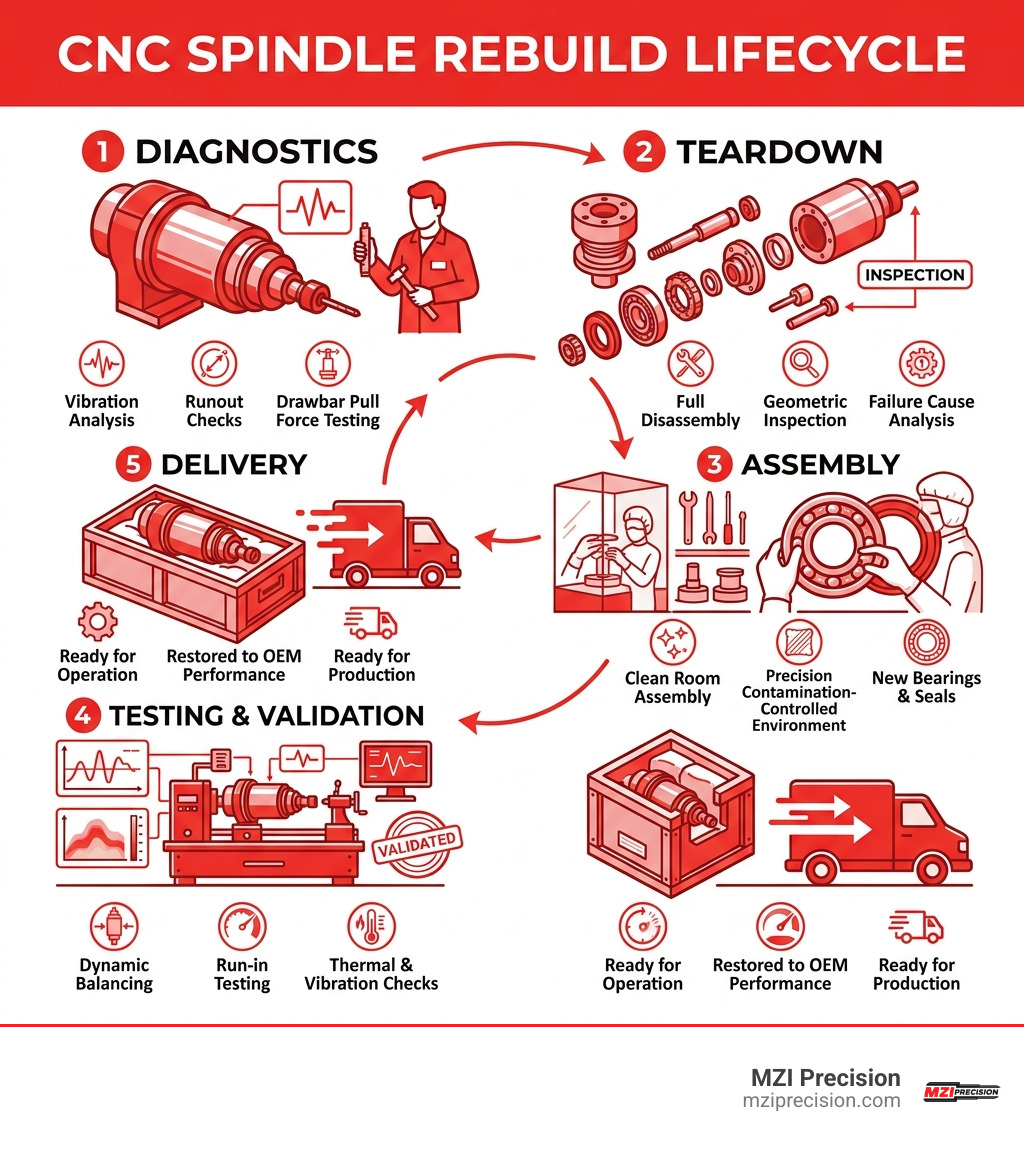
| Step | What Happens |
|---|---|
| Diagnostics | Vibration analysis, runout checks, drawbar pull force testing |
| Teardown | Full disassembly, geometric inspection, failure cause analysis |
| Component Replacement | Bearings (ABEC 7 or better), seals, preload collars |
| Clean Room Assembly | Contamination-controlled environment prevents premature failure |
| Testing & Validation | Dynamic balancing, run-in testing, thermal and vibration checks |
| Turnaround | Typically 2-3 weeks; as fast as 3 days for critical production needs |
In industrial manufacturing, a spindle is the heart of any CNC machine. It drives rotary motion, controls cutting force, and determines the precision of every part your facility produces.
When it fails, production halts. Deadlines slip. Costs mount by the hour.
The good news? A professional rebuild by qualified experts can restore your spindle to – or beyond – its original performance specs. In many cases, it’s faster and more cost-effective than buying a new unit outright.
With normal use, spindles can last 10 to 15 years or longer. But heavy duty cycles, contamination, and deferred maintenance can cut that lifespan short. Knowing when to call in experts – and which process to expect – is critical for any aerospace or precision manufacturing operation.
Why CNC Spindle Rebuild Experts Prioritize Precision
Precision isn’t just a buzzword in our world; it’s the difference between a machine that runs for another decade and one that fails in six months. At MZI Precision, we know that industrial manufacturing spindles must maintain incredible tolerances to produce high-quality parts for sectors like aerospace, defense, and solar energy.
A spindle provides the necessary rotary motion for cutting tools or workpieces. The design of that spindle determines the speed and cutting force available to the machine. If the internal components are even slightly out of alignment, the entire system suffers. This is why CNC Spindle Repair focuses on more than just “fixing what’s broken” – it’s about restoring the mechanical integrity of the entire assembly. For more details on how we handle these complex systems, you can explore our Expert Spindle Services.
How CNC spindle rebuild experts ensure OEM quality
To achieve OEM-level performance, we don’t settle for “good enough” parts. We utilize ABEC 7 or better rolling element bearings, which are the industry standard for high-precision industrial spindles. These bearings are designed to handle high RPMs with minimal heat generation and vibration.
When we perform a Precision Spindle Rebuild, we measure accuracy down to the micron. We inspect housing bores, shaft journals, and shoulders to ensure they meet or exceed the original manufacturer’s specifications. If a shaft is worn, we don’t just slap new bearings on it; we restore the surface through precision grinding to ensure a perfect fit.
Why CNC spindle rebuild experts use clean room assembly
One of the biggest “silent killers” of a CNC spindle is microscopic contamination. A single speck of dust or a flake of skin inside a high-speed bearing can cause a catastrophic failure at 15,000 RPM. This is why reputable Spindle Rebuild Specialists perform their assembly in climate-controlled clean rooms.
We utilize Class 10,000 HEPA-filtered clean rooms to ensure that the environment is free of airborne particles. By controlling the temperature and air quality, we prevent thermal expansion of components during the assembly phase and keep contaminants out of the lubricants and bearings. It’s this level of care that ensures your rebuilt spindle stays in your machine and off our workbench for a long, long time.
The Professional Industrial Spindle Rebuild Process
A professional rebuild is a journey, not a quick fix. It’s a documented, eight-step process designed to eliminate guesswork. We treat every spindle as a project that requires a “forensic” approach to understand why it failed in the first place.
Before we even take a bolt out, we perform pre-test diagnostics. This includes vibration analysis to identify bearing frequencies, checking the drawbar pull force to ensure the tool-holding mechanism is safe, and measuring runout. This baseline data helps us confirm the symptoms you reported. You can learn more about the scope of these projects on our Spindle Rebuild page.
Comprehensive diagnostics and teardown
Once the initial tests are done, the real work begins. We disassemble the spindle and perform a geometric inspection. This involves chemically cleaning every part and checking for hidden flaws like cracks or metal fatigue.
A critical part of an OEM Spindle Rebuild is the root-cause failure analysis. We don’t just want to replace the bearings; we want to know why they failed. Was it a lack of lubrication? A “slight” machine crash that knocked the taper out of alignment? Or perhaps an out-of-tolerance housing? By identifying the root cause, we can often suggest upgrades—like enhanced sealing or different bearing preloads—to prevent the same issue from happening again.
Reassembly and performance validation
After all components are cleaned, repaired, or replaced, the spindle is reassembled in our clean room. But we aren’t done yet. The reassembled unit undergoes dynamic balancing to stringent tolerances (often 0.1 mil or less). This ensures that at maximum operating speed, the spindle runs smooth and cool.
Every CNC Spindle Rebuild concludes with a rigorous run-in test. We run the spindle on a test stand for a minimum of eight hours, slowly ramping up the speed while monitoring temperature and vibration. We provide a final report with all verified dimensions and performance characteristics, so you have proof that your spindle is ready for the production floor.
Recognizing Signs of Spindle Failure in Manufacturing
Waiting for a spindle to seize up is a recipe for disaster. Early intervention can save you thousands of dollars in secondary damage. If you catch a bearing failure early, you might only need a simple rebuild. If you wait until the spindle crashes, you could be looking at a ruined shaft or housing.
Manufacturers should keep a close eye on tolerance drift. If your parts are starting to show poor surface finishes or if you’re struggling to hold dimensions that used to be easy, your spindle might be experiencing “play” or runout. These are classic signs that a Machine Tool Spindle Rebuild is in your near future.
Common symptoms of mechanical wear
The most common warning signs include:
- Vibration: If the machine feels “rougher” than usual, the balance is likely off.
- Noise: High-pitched whining or grinding sounds are the screams of failing bearings.
- Overheating: If the spindle housing is too hot to touch after a standard run, the bearings are creating excessive friction.
- Power Loss: If the spindle is struggling to maintain RPM under load, the motor or bearings may be dragging.
If you notice these, it’s time to talk to Spindle Rebuilders who can diagnose the issue before it leads to a total production halt.
Impact of downtime on production
In industrial manufacturing, downtime is the ultimate enemy. When a critical spindle goes down, it’s not just one machine that stops—it can halt an entire workflow in an automated facility. Cash flow is directly impacted as parts aren’t being shipped, and deadlines begin to slip.
For a deeper look at how to manage these risks, check out Restore Your Machine: The Essential Guide to Spindle Rebuilds. We’ve seen cases where a single failed spindle cost a shop more in lost production in one week than the entire cost of the rebuild.
Maximizing ROI: Rebuild vs. Replacement
The big question every manager asks: “Should I just buy a new one?” While a new spindle sounds great, it’s often not the most efficient choice for your bottom line or your schedule.
| Feature | Professional Rebuild | New OEM Spindle |
|---|---|---|
| Cost | 40% – 60% of new | 100% |
| Lead Time | 2–3 weeks (or 3 days expedited) | Often months (if backordered) |
| Integration | Drops right back in | May require software/wiring tweaks |
| Performance | Meets or exceeds OEM | Meets OEM |
| Upgrades | Possible during rebuild | Not available |
By choosing to rebuild, you gain a “forensic” look at your machine’s health. You can find more insights in our Spindle Rebuild Companies Ultimate Guide.
Financial advantages of remanufacturing
The financial benefits go beyond the initial price tag. Because a rebuild uses your existing housing and shaft (assuming they are in good condition), you avoid the high costs of raw materials and manufacturing a brand-new assembly. Furthermore, there is no “re-integration” period. A rebuilt spindle is the exact same model that came out of your machine, meaning all your offsets and programs remain valid.
If you’re looking for the best in the business, our Best Spindle Rebuilders Guide can help you navigate the selection process.
Turnaround times and expedited services
Standard turnaround for a comprehensive rebuild is typically 2 to 3 weeks. This allows time for proper disassembly, parts sourcing, and the mandatory 8-hour run-in test. However, we understand that some spindles are “production-critical.” In those cases, we can often expedite the process to as little as 3 days.
High-speed applications require even more care. For those running at the edge of performance, see The Fast and the Flawless: A Guide to High-Speed Spindle Rebuilding.
Frequently Asked Questions about CNC Spindle Rebuild Experts
How long does a typical industrial spindle rebuild take?
Most professional rebuilds are completed in 2 to 3 weeks after the customer approves the quote. For emergency situations where every hour counts, production-critical spindles can sometimes be repaired in as little as 3 days.
What is the difference between a repair and a full rebuild?
A “repair” usually focuses on fixing a specific failed component (like a broken seal or a single noisy bearing). A “full rebuild” involves a complete overhaul: replacing all bearings, seals, and O-rings, restoring all surfaces to OEM specs, and performing a full dynamic balance and run-in test. A rebuild offers much higher long-term reliability.
What warranties are standard for rebuilt motorized spindles?
While it varies by the type of spindle, reputable services typically offer a 6-month to 1-year warranty on workmanship and parts. At MZI Precision, we stand behind our work because we know our clean room processes and high-grade bearings are built to last.
Conclusion
Don’t let a failing spindle derail your production schedule. Whether you are in aerospace, defense, or solar energy, maintaining your CNC equipment is vital to your success. By partnering with CNC spindle rebuild experts, you aren’t just getting a repair—you’re getting an engineering partner dedicated to keeping your machines running at peak performance.
At MZI Precision, we pride ourselves on our ability to restore spindles from over 30 OEM brands, ensuring that your equipment returns to you better than ever. Ready to get your machine back in the game? More info about our services is just a click away. Let us help you keep your bearings!