


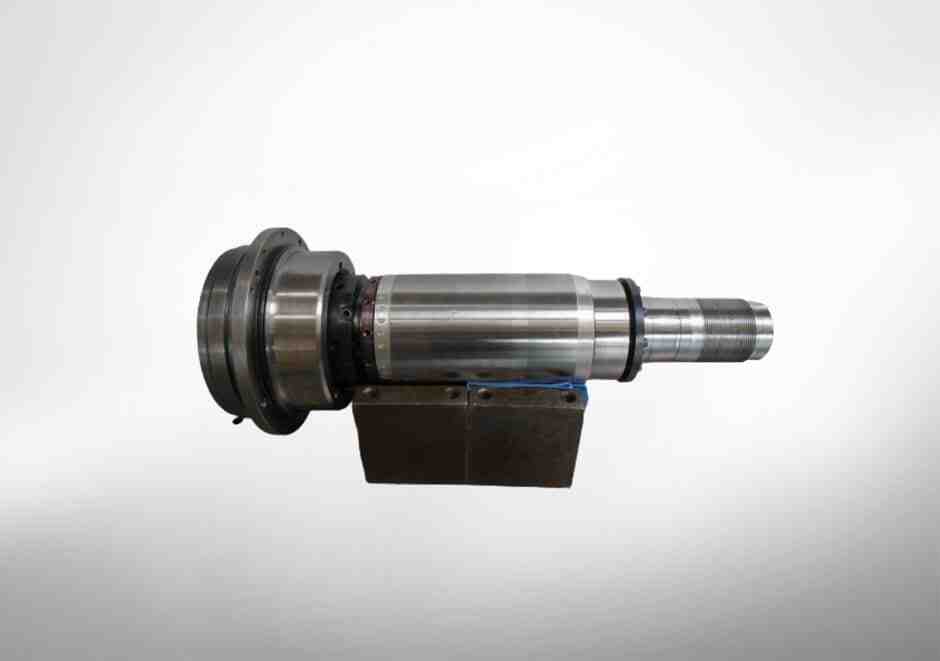
Why Your Industrial Spindle Motor Needs a Speed Boost
The CNC Lathe Spindle: What It Is and Why It Matters for Industrial Performance
METADATA: TITLE: WHY YOUR INDUSTRIAL SPINDLE MOTOR NEEDS A SPEED BOOST DESCRIPTION: AN EXTENSIVE GUIDE TO CNC LATHE SPINDLE TECHNOLOGY, PERFORMANCE SPECIFICATIONS, AND MAINTENANCE BEST PRACTICES FOR INDUSTRIAL MANUFACTURING.

A CNC lathe spindle is the rotating core of a CNC lathe machine — it holds and spins the workpiece while a stationary cutting tool removes material to create precise parts.
Quick answer: What does a CNC lathe spindle do?
- Rotates the workpiece at controlled speeds (RPM) for turning, boring, and drilling
- Transmits torque from the drive system to the material being cut
- Maintains positional accuracy through precision bearings and tight runout tolerances
- Holds tooling and workholding devices like chucks and collets via the spindle nose
- Enables automated control through encoder feedback systems in modern CNC machines
For aerospace manufacturers and other precision-driven industries, the spindle isn’t just a component — it’s the heartbeat of the entire machining operation.
When it underperforms, everything suffers: surface finish quality drops, tolerances drift, cycle times grow, and costly downtime follows.
The most common spindle problems — vibration, bearing noise, and poor surface finish — often trace back to one of a few root causes: worn bearings, inadequate lubrication, drivetrain misalignment, or running at the wrong speed range for the application.
Understanding how your spindle works, what the right specifications look like, and when to act on early warning signs is what separates shops that stay productive from those that lose hours to unplanned repairs.
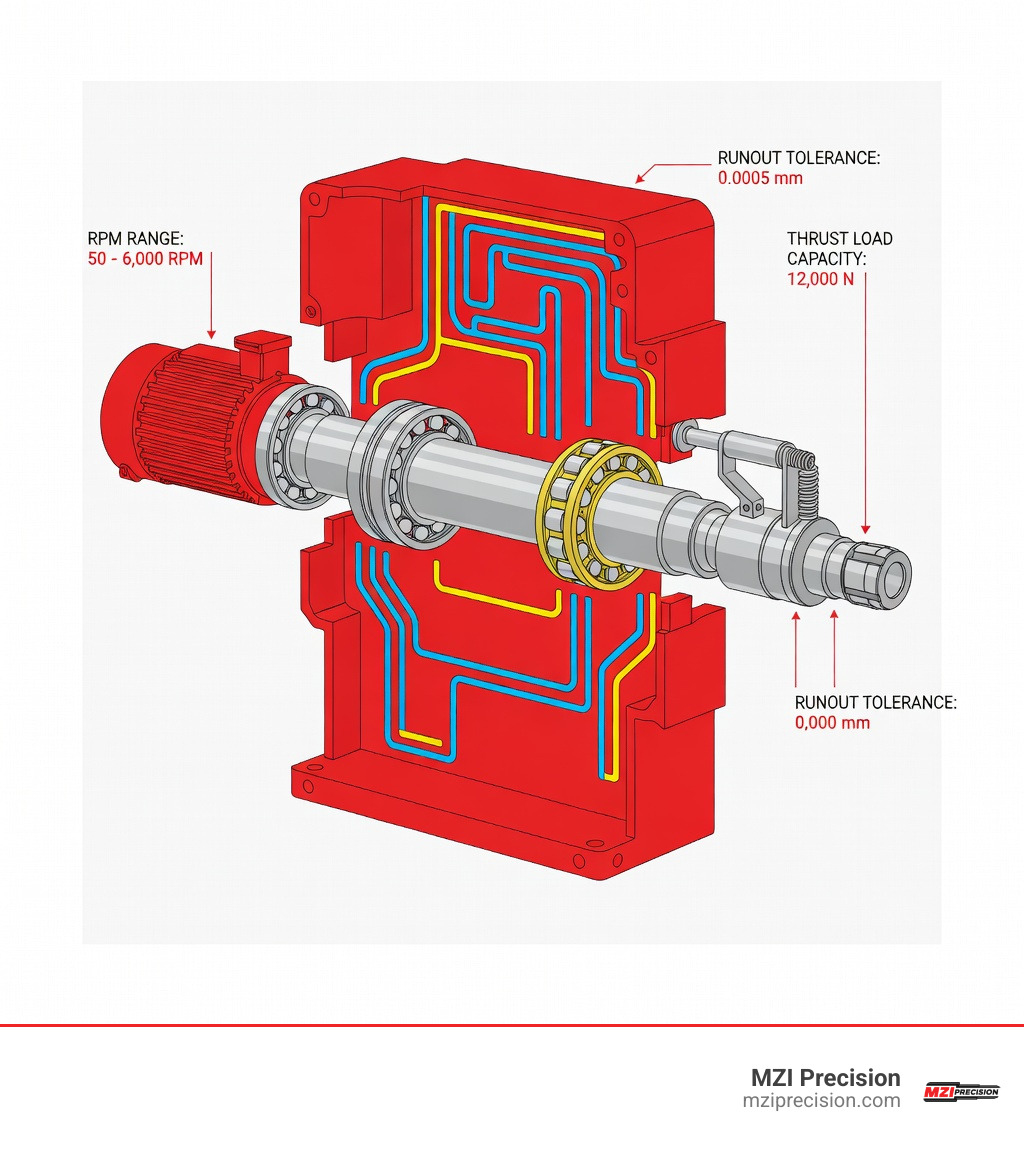
Know your CNC lathe spindle terms:
Anatomy and Function of the CNC Lathe Spindle
To understand why a CNC lathe spindle might need a “speed boost” or a rebuild, we first have to look at what is happening inside that heavy metal housing. At its simplest, the spindle is the bridge between the machine’s motor and the workpiece. However, the internal physics are anything but simple.
The development of modern tools focuses on speed and precision, and the way a lathe spindle assembly is put together determines whether you can hold a tolerance of 0.0001″ or if you’ll end up with a scrap pile.
The spindle functions by applying torque and rotational speed to the workpiece. Unlike a milling machine, where the tool rotates, the lathe rotates the material itself. This requires a robust design that can handle significant radial forces (from the cutting tool pushing against the side of the part) and axial forces (from drilling or pushing against the face).
Primary Components of the Spindle
Every high-performance CNC lathe spindle relies on a specific set of “innards” to get the job done:
- The Spindle Shaft: This is the rotating heart. It is usually hollow to allow long bar stock to pass through the machine. The accuracy of this shaft—how straight it is and how well it’s balanced—is the foundation of your part quality.
- Bearing System: Most spindles use a combination of double-row cylindrical roller bearings (for high radial stiffness) and angular contact ball bearings (to handle axial thrust). High-end bearings from brands like NSK or SKF are standard in the precision world to ensure longevity.
- Drive System: This is how the power gets to the shaft. It could be a belt-and-pulley system, a gear drive, or an “integral” motor where the motor is actually built around the shaft itself.
- Labyrinth Seals: These are non-contact seals that use a complex “maze” path to keep coolant and metal chips (swarf) out of the bearings. Contamination is the leading cause of spindle failure, so these seals are your first line of defense.
- Drawbar Mechanism: Located inside the hollow shaft, this system uses a spring stack and hydraulic or pneumatic actuation to pull the collet or chuck tight, securing the workpiece.
Drive System Evolution: Belt-Driven vs. Integral Motors
In the old days of machining, most lathes used belts. While they are still very common and effective, the industry is moving toward “built-in” or electric spindles.
When we talk about a “speed boost,” we are often looking at the transition from mechanical drive chains to “zero drive” systems. An electric built-in spindle eliminates the need for belts, gears, or couplings. By integrating the motor’s rotor directly onto the spindle shaft, you remove transmission losses and significantly reduce vibration.
| Feature | Belt-Driven Spindle | Integral (Electric) Motor Spindle |
|---|---|---|
| Max Speed | Typically up to 12,000 – 15,000 RPM | Up to 60,000+ RPM |
| Torque | High (better for heavy roughing) | Moderate to High (speed-dependent) |
| Vibration | Higher due to belt resonance | Extremely low |
| Complexity | Simple, easy to change belts | High, requires specialized repair |
| Response Time | Slower acceleration/deceleration | Near-instant “Zero Drive” response |
For shops in Southern California, from Huntington Beach to Los Angeles, choosing between these depends on your specific output. If you are doing heavy-duty turning of large steel billets, a belt-driven system provides the “grunt” you need. However, if you are machining small, intricate aerospace components, a precision lathe spindle with an integral motor is the gold standard.
Advantages of Electric Built-in Spindles
The “Zero Drive” concept is a game-changer for productivity. Because there are no belts to slip or gears to mesh, the dynamic accuracy is much higher. These spindles are also more compact, which allows for modular machine designs and dual-spindle setups where two spindles face each other to pass parts back and forth.
Furthermore, electric spindles are often liquid-cooled. We use aluminum water jackets to circulate coolant around the motor, preventing the heat from the high-speed rotation from expanding the metal and throwing off your tolerances.
Optimizing Performance and Specifications
When selecting or evaluating a CNC lathe spindle, you can’t just look at the horsepower. You need to dive into the technical specs that actually dictate part quality. If you find your machine isn’t hitting the marks it used to, it might be time for a professional lathe spindle repair.
Critical Specifications for a CNC Lathe Spindle
- Total Indicated Runout (TIR): This measures how much the spindle “wobbles” as it rotates. For high-precision work, you want a TIR of 0.0005” or better at the spindle nose. Some elite systems, like Royal Live Centers, are guaranteed accurate to ±0.00005” TIR.
- RPM Range: Speed is life for small-diameter parts. While a standard Haas lathe might max out at 4,500 RPM, specialized air turbine spindles can reach 25,000 to 90,000 RPM for fine finishing.
- Thrust Load Capacity: This is the amount of force the spindle can handle in a “pushing” direction. Heavy-duty spindles can handle upwards of 4,050 lbs of thrust.
- Encoder Feedback: Modern spindles use non-contact encoders to tell the CNC control exactly where the spindle is at all times. This is vital for “C-axis” operations where the spindle must stop at a precise degree for milling or cross-drilling.
Integration with Live Centers and Tailstocks
In many turning operations, the main CNC lathe spindle doesn’t work alone. For long parts, you need a tailstock equipped with a “live center.” A heavy-duty live center supports the other end of the workpiece, preventing it from bending under cutting pressure.
The best live centers use an extended point design, which provides extra tool clearance—essential for CNC applications where the turret needs to get close to the end of the part. We often see issues where the main spindle is perfect, but a worn-out tailstock bearing is causing chatter and vibration.
Troubleshooting and Maintenance Strategies
Vibration is the enemy of every machinist. It ruins surface finishes, breaks carbide tools, and eventually destroys your bearings. If your machine sounds like a bag of marbles or you’re seeing “chatter” marks on your parts, it’s time to investigate.
One of the first things we do is how to check lathe spindle bearings. We look for “brinelling” (dents in the bearing races) or signs of overheating.
Common Issues with a CNC Lathe Spindle
- Resonant Frequencies: Every spindle has a “natural frequency” where it likes to vibrate. If you run your machine at that exact RPM, it will shake. A quick fix is often to adjust your speed by 10% to move out of that resonance zone.
- Mechanical Looseness: This often happens at the spindle nose or the workholding. If the chuck isn’t balanced or the jaws weren’t bored correctly, the resulting imbalance will mimic a bearing failure.
- Contamination: If your seals are failing, coolant will wash away the bearing grease. This leads to “clicking” noises and eventual lockup.
- Encoder Issues: Sometimes the vibration isn’t mechanical at all—it’s electrical. If the encoder feedback is “noisy,” the motor will hunt for the correct position, causing a micro-vibration. A simple test is to cut the power while the spindle is spinning; if the vibration stops immediately while it coasts, the problem is likely in the electronics.
Essential Maintenance Practices
To keep your CNC lathe spindle running for years, you need a proactive plan. This is especially true for our customers needing CNC lathe repair California services, where high-volume production is the norm.
- Vibration Analysis: Use an analyzer to check the health of your bearings across the entire RPM range. This can catch a failing bearing months before it actually breaks.
- The “Bottle Test”: Verify that your lubrication system is actually delivering oil. We check the lines to ensure there are no air bubbles or clogs.
- Spindle Balancing: Much like the tires on your car, a spindle can become unbalanced over time due to wear or small crashes. Using set screws on a union adapter, we can balance the system to “G1” or better standards.
- Cooling System Check: Ensure your chillers are running at the right temperature. If a spindle runs too hot, the shaft will grow (thermal expansion), which changes your Z-axis offset and ruins your part lengths.
Frequently Asked Questions
What causes vibration in a CNC lathe spindle?
Vibration is usually caused by one of three things: imbalance in the workpiece/chuck, worn-out bearings, or drivetrain misalignment (like a loose belt). In some cases, it can also be “chatter,” which is a self-excited vibration caused by taking too heavy of a cut or having too much tool overhang.
How often should spindle bearings be lubricated?
This depends entirely on your spindle type. Many modern precision bearings are “greased for life” and sealed. However, high-speed spindles often use an “oil-air” mist system that requires constant monitoring. Always check your manufacturer’s manual, but a daily check of the lubrication reservoir is a best practice for any shop.
What is the difference between a lathe spindle and a mill spindle?
The primary difference is what rotates. On a lathe, the spindle rotates the workpiece. On a mill, the spindle rotates the cutting tool. Because of this, lathe spindles are designed to handle larger workholding devices like 10-inch chucks and must have a hollow bore for bar stock, whereas mill spindles are optimized for quick tool changes and high-speed tool rotation.
Conclusion
In industrial manufacturing, your CNC lathe spindle is the ultimate indicator of your shop’s health. Whether you are machining titanium for aerospace or precision components for the automotive sector, the speed and accuracy of your spindle dictate your bottom line.
A “speed boost” isn’t just about turning the dial up to 11; it’s about optimizing your drive system, ensuring your bearings are in peak condition, and maintaining the rigid OEM standards that the machine was designed for. At MZI Precision, we specialize in the complex world of spindle rebuilding and repair. Based right here in the United States with a strong presence in California (including Los Angeles and Huntington Beach), we understand the unique demands of high-output industrial environments.
Don’t let a noisy bearing or a “fuzzy” surface finish slow down your production. By staying proactive with your maintenance and understanding the anatomy of your machine, you can ensure your spindles stay fast, accurate, and reliable for years to come.
Contact MZI Precision for expert spindle services today to see how we can help your operations reach their full potential.