


The Ultimate Guide to Spindle Vibration Analysis and Maintenance
Why Spindle Vibration Analysis Is Critical for CNC Machining
Spindle vibration analysis is the process of measuring, recording, and interpreting vibration signals from a CNC spindle to assess its health, detect early-stage faults, and prevent unexpected failures.
Quick answer — what you need to know:
- What it measures: Displacement (in MIL), velocity (in/s), and acceleration signals from the rotating spindle
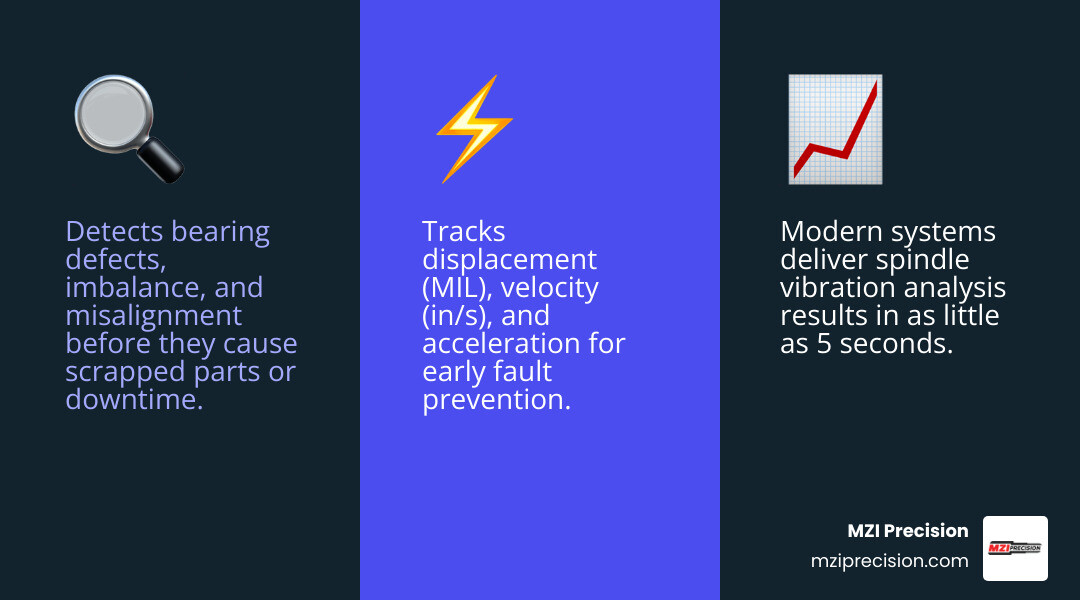
- Why it matters: Detects bearing defects, imbalance, and misalignment before they cause scrapped parts or unplanned downtime
- Key tools: Accelerometers, FFT spectrum analyzers, and integrated CNC monitoring software
- How fast: Modern systems can deliver results in as little as 5 seconds
- Who needs it: Any operation running precision CNC milling, grinding, or aerospace-grade machining
Many operators wait until they hear something wrong with a spindle. That’s a costly mistake.
Vibration problems develop long before they become audible. By the time a spindle sounds bad, bearing damage or misalignment may already be severe enough to require a full rebuild — or worse, cause a crash that damages the machine and scraps a high-value part.
In precision manufacturing environments like aerospace, even slight vibration pushing a tool beyond tolerance can mean a rejected part. The stakes are high, and the margin for error is razor thin.
The good news: spindle vibration analysis gives you an early warning system. With the right sensors and software, you can track spindle health over time, catch problems in their earliest stages, and schedule maintenance on your terms — not in response to an emergency.
Spindle vibration analysis terms simplified:
Fundamentals of Spindle Vibration Analysis
At its core, Spindle vibration analysis is about understanding how a spindle moves when it shouldn’t. In an ideal world, a spindle would rotate perfectly around its center axis with zero deviation. In the real world of industrial manufacturing, every spindle has a “signature” of motion. Our job is to ensure that signature stays within safe limits.
To do this, we look at three primary metrics:
- Displacement: This measures the actual distance the spindle shaft moves from its center, usually measured in “mils” (one-thousandth of an inch). High displacement often indicates an unbalanced tool or a bent shaft.
- Velocity: This measures how fast the spindle is vibrating. It is the best indicator of overall “severity” and is typically measured in inches per second (in/s). It helps us find issues like misalignment or looseness in the assembly.
- Acceleration: This measures the rate of change in velocity. It is incredibly sensitive to high-frequency vibrations, making it the “go-to” metric for spotting early-stage bearing defects before they become visible to the naked eye.
Understanding these fundamentals is the first step toward effective Spindle Vibration Analysis. As noted in Scientific research on spindle dynamics, these dynamics—mass, stiffness, and damping—fundamentally govern how a CNC mill performs under load. If these dynamics shift, your part quality will follow suit.
Interpreting Data in Spindle Vibration Analysis
When we collect data, we don’t just look at a single number. We use a Fast Fourier Transform (FFT) spectrum. Think of an FFT as a “prism” for vibration; it takes a complex, messy vibration signal and breaks it down into individual frequencies.
In April 2026, modern analyzers allow us to look at specific CPM (Cycles Per Minute) ranges. For example:
- 1x RPM: A large spike at the exact speed the spindle is turning almost always points to an imbalance.
- High-Frequency Ranges: Spikes in the 30k to 210k CPM range often indicate bearing race damage or ball defects.
- MIL and in/s Limits: We use these to set “traffic light” systems. If your displacement exceeds a certain MIL limit, it’s time to stop the machine.
The Role of Software in Spindle Vibration Analysis
Gone are the days of manually holding a probe against a housing and guessing. Today, Cnc Spindle Vibration Analysis is largely driven by integrated software. These systems can be triggered directly from a CNC part program, performing a health check in the middle of a production run.
This software provides real-time HMI (Human-Machine Interface) feedback. Using simple color-coded indicators—green for healthy, yellow for caution, and red for “shut it down”—operators in Huntington Beach or Los Angeles can make data-driven decisions without needing a PhD in physics. This “Condition-Based Maintenance” (CBM) is the gold standard for modern shops.
Official Vibration Tolerances and Displacement Limits
To keep your machines running smoothly, you need to know what “good” looks like. Tolerances vary significantly depending on the size and speed of your spindle. A massive 50-taper spindle has very different limits than a high-speed 30-taper unit screaming at 40,000 RPM.
The following table outlines the general industry standards for acceptable vibration levels:
| Spindle Type | Max Speed (RPM) | Displacement Limit (MIL) | Velocity Spike Limit (in/s) |
|---|---|---|---|
| 30T, 40T, 50T (Standard) | Up to 20,000 | 0.100 MIL | Max (3) spikes < 0.005 |
| 20T, 30T (High-Speed) | 30,000 – 50,000 | 0.040 MIL | < 0.060 @ 75k CPM |
According to Research on vibration monitoring technology, reaching these tolerances is critical because vibration intensity growth isn’t linear. It often accelerates rapidly after passing certain RPM thresholds (like 5,000 RPM), making early detection vital.
High-Speed Spindle Specifications
For high-speed spindles (20T and 30T) operating between 30,000 and 50,000 RPM, the margin for error is incredibly small. Because these spindles rotate so fast, even a microscopic imbalance creates massive centrifugal forces.
- Displacement: Must not exceed 0.040 MIL at maximum speed.
- Velocity: Spikes should not exceed 0.060 in/s at 75,000 CPM. If you are running these types of spindles in a high-precision aerospace application, staying within these limits is the difference between a perfect finish and a scrapped workpiece.
Standard Spindle Specifications
Standard 30T, 40T, and 50T spindles usually top out around 20,000 RPM. While they are more robust, they still require strict monitoring.
- Displacement: Should stay under 0.100 MIL at max speed.
- Velocity: You should see no more than three velocity spikes between 30,000 and 210,000 CPM that exceed 0.005 in/s. Exceeding these limits often points to “looseness” in the spindle drawbar or wear in the bearing journals.
Identifying Causes of Excessive Spindle Vibration
When a spindle starts vibrating, we categorize the cause into two main groups: Force Vibration and Self-Excited Vibration.
Understanding the root cause is the only way to perform a proper Diagnostic methods for machine tool spindles. If you just treat the symptom (the vibration) without fixing the cause (the bearing defect), the problem will return in weeks.
Common Mechanical Faults
Most “Force Vibrations” come from internal mechanical issues. These are predictable and usually stay constant regardless of what you are cutting.
- Imbalance: The most common culprit. This happens when the center of mass doesn’t align with the center of rotation. It could be a dirty tool holder or a chipped spindle shaft.
- Misalignment: This occurs when the spindle motor and the shaft aren’t perfectly “square.” This puts uneven loads on the bearings, leading to rapid heat buildup.
- Low Preload: Bearings need a specific amount of “squeeze” (preload) to function. If the springs or spacers wear out, the bearings become “loose,” causing the shaft to wobble.
- Resonance: Every spindle has a “natural frequency.” If you run the spindle at a speed that matches this frequency, the vibrations will amplify wildly, even if the machine is otherwise healthy.
Self-Excited Vibration and Chatter
This is the “ghost in the machine.” Self-excited vibration, often called chatter, isn’t caused by the spindle itself, but by the interaction between the tool and the material.
- Tool-Material Interaction: This often happens when grinding hard materials like Inconel or titanium. The tool “bounces” off the material, creating a harmonic loop.
- Intricate Machining: High material removal rates can trigger chatter if the setup isn’t rigid enough. While this isn’t a “spindle fault” per se, constant chatter will eventually destroy your spindle bearings. Spindle vibration analysis helps you identify the exact RPM where chatter starts, allowing you to program around it.
Frequently Asked Questions about Spindle Health
What are the consequences of excessive spindle vibration?
The consequences are expensive. First, you’ll see poor surface finishes—the “orange peel” or “zebra stripe” patterns on your parts. This leads to part rejection. Second, excessive vibration acts like a hammer on your cutting tools, causing premature tool wear. Finally, if left unchecked, the vibration will cause a catastrophic bearing failure, leading to weeks of unplanned downtime and a repair bill that could have been avoided with a simple sensor check.
How do you perform a spindle vibration test?
In a modern shop, you can perform a test via the RS-232 or Ethernet interface on your CNC control. You can actually write a small “maintenance” block in your G-code that spins the spindle to specific RPM increments while a sensor records the data. Modern software can deliver a full health report in under 5 seconds, comparing your current data against the factory baseline.
What is the difference between displacement and velocity in vibration analysis?
Think of displacement (MIL) as “how far” it’s moving—it’s great for finding balance issues. Think of velocity (in/s) as “how much energy” is in the vibration—it’s the best measure of how much damage is being done to the machine. Displacement tells you a tool is unbalanced; velocity tells you the bearings are about to fail.
Conclusion
At MZI Precision, we know that your spindles are the heart of your production line. Whether you are in aerospace, defense, or automotive manufacturing in Southern California, you can’t afford to ignore the warning signs of vibration.
We specialize in high-precision Spindle vibration analysis and OEM-quality spindle rebuilding. By catching these issues early—using the displacement and velocity limits we’ve discussed—we help our customers extend equipment life and maintain the tight tolerances their industries demand.
If your spindle is showing signs of “fever” through high vibration readings, don’t wait for it to fail. Our US-based team in Huntington Beach is ready to help you get back to peak productivity.
Contact us for spindle services today to schedule a health check or discuss your rebuilding needs. Let’s keep those spindles turning smoothly.