

How to Hit 30000 RPM Without Breaking a Sweat
Why the 30 000 RPM Spindle Belt Drive Is a Game-Changer for High-Speed Machining
A 30 000 rpm spindle belt drive is a high-speed machining system that uses a belt-driven mechanism — rather than a direct gear or motor coupling — to spin a BT30-taper spindle at up to 30,000 RPM for precision milling, 3D profiling, and fine-detail cutting operations.
Here’s a quick summary of what you need to know:
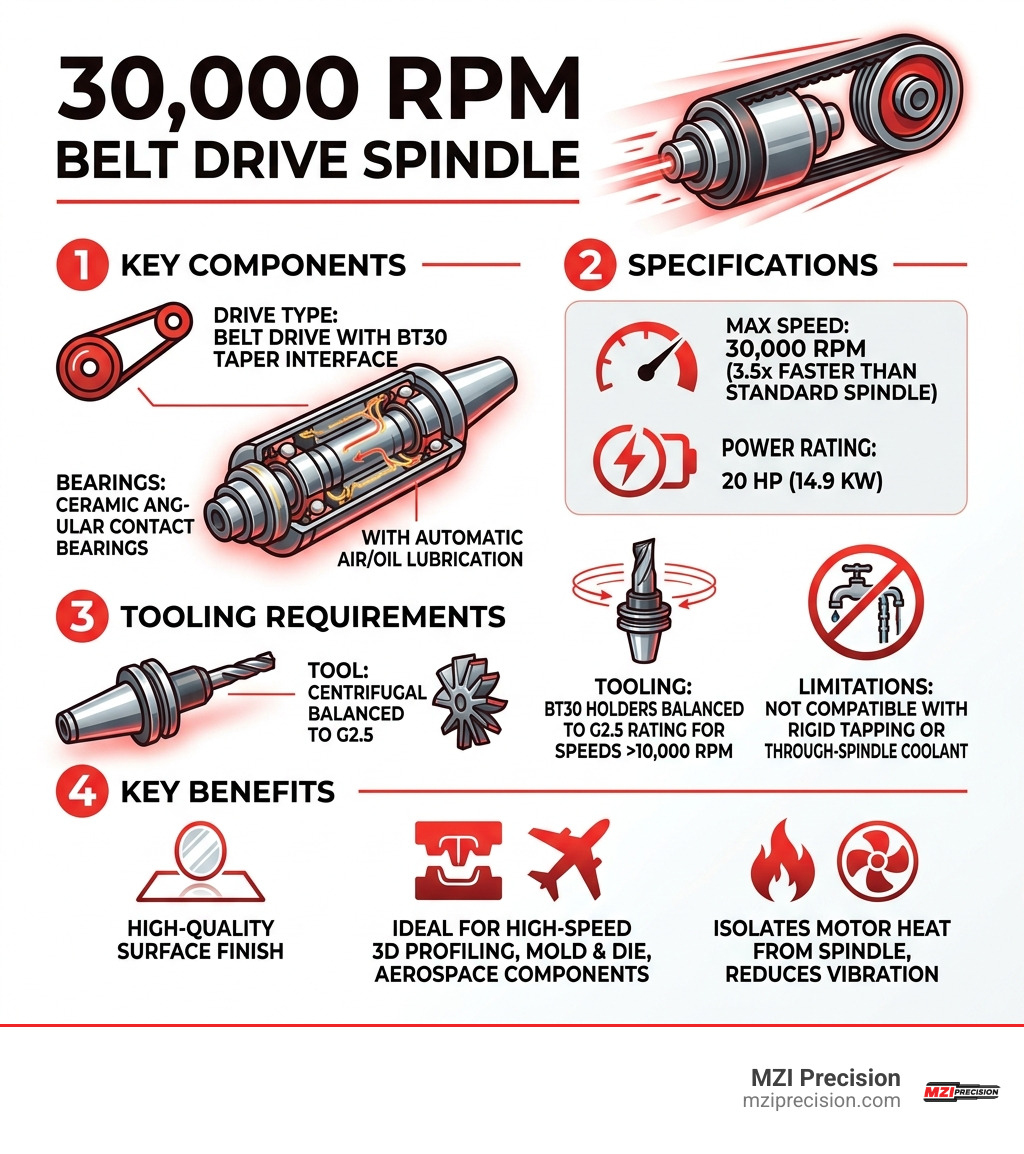
- Drive type: Belt drive with BT30 taper interface
- Max speed: 30,000 RPM (roughly 3.5x faster than a standard 8,100 RPM inline spindle)
- Power rating: 20 hp (14.9 kW)
- Bearings: Back-to-back ceramic angular contact bearings with automatic air/oil lubrication
- Tooling requirement: BT30 holders balanced to G2.5 rating for speeds above 10,000 RPM
- Key limitation: Not compatible with rigid tapping or through-spindle coolant
- Best for: High-speed 3D profiling, fine surface finishing, mold and die work, aerospace component machining
For aerospace manufacturers and precision machining shops, hitting 30,000 RPM consistently — without vibration, heat buildup, or premature bearing failure — is not a nice-to-have. It’s a competitive necessity.
The belt drive design plays a bigger role in that than most people realize. It isolates motor heat from the spindle, reduces vibration transmission, and allows the spindle bearings to run longer and more reliably than many direct-drive alternatives at equivalent speeds.
But getting the most out of a 30K belt-driven spindle means understanding the specs, the tooling rules, the maintenance intervals, and the operational limits. Miss any of those, and you’re not running at peak — you’re burning through bearings and toolholders.
This guide covers all of it.
Handy 30 000 rpm spindle belt drive terms:
Technical Specs of the 30 000 RPM Spindle Belt Drive
When we talk about a 30 000 rpm spindle belt drive, we are looking at a specialized piece of industrial equipment designed for high-velocity material removal. In April 2026, these systems are more relevant than ever as industries push for faster cycle times and superior surface finishes.
The heart of the system is typically a 20 hp (14.9 kW) motor. While 20 hp might sound standard, the way that power is delivered to a BT30 taper at 30,000 RPM is anything but ordinary. This speed is roughly 3.5 times faster than a conventional 8,100 RPM inline spindle, which means the centrifugal forces and heat generation are significantly higher.
To handle these forces, the belt driven spindle design utilizes back-to-back ceramic angular contact bearings. Ceramic balls are lighter and harder than steel, which reduces friction and allows for these extreme rotational speeds without the bearings seizing up. Furthermore, the system relies on a mid-point automatic air/oil lubrication system. This ensures that a precise mist of oil is delivered directly to the bearings, providing both cooling and lubrication simultaneously.
Precision Tooling for a 30 000 RPM Spindle Belt Drive
You can’t just throw any old toolholder into a 30K spindle and hope for the best. At these speeds, even a microscopic imbalance becomes a violent vibration that can ruin your surface finish or, worse, shatter your spindle bearings.
The strict requirement for a 30 000 rpm spindle belt drive is the use of BT30 toolholders balanced to a G2.5 rating. This rating must be maintained for any speed exceeding 10,000 RPM. Additionally, these spindles often require BT30 holders without drive slots. Because the spindle is belt-driven and designed for high-speed finishing rather than heavy-duty hogging, the drive slots are removed to improve the inherent balance of the rotating mass.
Proper high speed spindle balancing is the difference between a spindle that lasts five years and one that fails in five months. We always emphasize to our clients in California that tooling is an extension of the spindle itself; if the tool is out of balance, the spindle is out of balance.
Operational Constraints of the 30 000 RPM Spindle Belt Drive
Every high-performance machine has its trade-offs. The 30 000 rpm spindle belt drive is optimized for speed and finish, which means it sacrifices some traditional “utility” features.
- No Rigid Tapping: Because of the belt drive’s inherent nature and the high-speed optimization of the motor, rigid tapping is generally not supported. If your part requires hundreds of tapped holes, this spindle isn’t the primary tool for that job.
- No Through-Spindle Coolant (TSC): The complex air/oil lubrication requirements and the high rotational speeds make integrated TSC difficult to implement without risking contamination of the precision bearings.
- Torque Curves: At 30,000 RPM, you aren’t looking for massive torque. These spindles are designed for high-speed, light-cut applications. However, they are robust; peak power is typically available for 3 minutes at a 200% spindle load, or 10 minutes at 150% load. For continuous operation, you should stay at or below 100% load.
Advantages of Belt-Driven Systems in High-Speed Milling
Why choose a belt drive over a direct-drive system for 30,000 RPM? It comes down to thermal isolation and vibration dampening.
In a direct-drive setup, the motor is coupled directly to the spindle shaft. This means every bit of heat generated by the motor transfers straight into the spindle, causing thermal expansion that can throw off your tolerances. In a 30 000 rpm spindle belt drive, the belt acts as a thermal break. The motor sits off to the side, and its heat stays away from the precision-machined spindle housing.
Furthermore, belts are excellent at absorbing high-frequency vibrations. When you are performing 3D profiling on a mold or an aerospace wing section, you want the smoothest possible rotation. The belt dampens motor harmonics, leading to a “cleaner” cut.
| Feature | Belt-Driven (30K) | Direct Drive (Standard) |
|---|---|---|
| Max Speed | 30,000 RPM | 10,000 – 15,000 RPM |
| Thermal Isolation | Excellent (Motor is offset) | Poor (Motor is coupled) |
| Vibration Dampening | High (Belt absorbs harmonics) | Moderate |
| Maintenance | Requires belt/isolator checks | Generally sealed |
| Primary Use | Finishing/Profiling | General Milling |
For a deeper dive into these differences, check out our belt vs direct drive CNC guide.
Maintenance and Repair for Ultra-High-Speed Spindles
Maintaining a 30 000 rpm spindle belt drive is a proactive game. You don’t wait for it to break; you monitor it constantly. Because the belt is the primary wear item, it requires regular inspection.
One of the most common issues we see at our Huntington Beach and Los Angeles facilities is the degradation of the spindle motor belt and the isolators. The isolators are critical because they manage the tension and alignment of the drive system. If an isolator wears out, the belt may begin to vibrate or slip, leading to belt driven spindle noise that signals impending failure.
Key maintenance steps include:
- Belt Tensioning: Ensuring the belt is tight enough to prevent slip but not so tight that it side-loads the bearings.
- Vibration Analysis: Using sensors to check for deviations in the G2.5 balance.
- Temperature Monitoring: Keeping an eye on the ceramic bearings. If they start running hot, it usually means the air/oil lubrication system is failing.
If you do encounter a failure, high speed spindle repair is a task for experts. Rebuilding a 30K spindle involves clean-room assembly and precision balancing that simply cannot be done in a standard shop environment.
Frequently Asked Questions about High-Speed Spindles
What lubrication is best for 30,000 RPM?
For a 30 000 rpm spindle belt drive, air/oil lubrication is the industry standard. Unlike grease, which can “churn” and generate heat at high speeds, an air/oil system injects a tiny, controlled amount of oil into a constant stream of compressed air. This air not only carries the lubricant but also creates a positive pressure inside the spindle housing, which keeps dust and coolant out. This is vital for the longevity of the high speed spindle motor.
Can I use standard BT30 holders at 30,000 RPM?
The short answer is no. Standard BT30 holders are often balanced for 8,000 to 12,000 RPM. Using them at 30,000 RPM is dangerous. You must use holders specifically rated for G2.5 at 30,000 RPM. Many 30K spindles also require holders without drive slots to ensure the mass is perfectly symmetrical around the centerline of rotation.
How often should spindle belts be replaced?
This depends on your duty cycle, but generally, belts and isolators should be inspected every 2,000 to 3,000 hours of operation. If you notice a change in the finish of your parts or hear a new high-pitched whine, it’s time to check the belt. Ignoring these signs can lead to a snapped belt or, worse, damaged pulleys.
Conclusion
The 30 000 rpm spindle belt drive represents the pinnacle of high-speed milling technology for 2026. Whether you are machining complex 3D profiles for the aerospace industry, creating intricate molds, or producing components for solar energy systems, the 30K spindle offers a level of precision that slower spindles simply cannot match.
At MZI Precision, we specialize in the repair and rebuilding of these high-performance systems. Our expertise in belt driven spindle assembly ensures that when your spindle comes to us, it is returned to OEM specifications (or better). We understand the unique requirements of defense manufacturing and automotive mold-making, and we are committed to keeping your machines running at their absolute peak.
If your high-speed spindle isn’t hitting its marks, or if you’re hearing unusual vibrations, don’t wait for a total breakdown. Contact us at our California locations to discuss your spindle rebuilding needs and let us help you hit 30,000 RPM without breaking a sweat.