

Why Your CNC Machine Craves Certified OEM Spindle Repair
When a Spindle Fails, Every Minute Costs You
Certified OEM spindle repair is the process of rebuilding an industrial CNC machine spindle to the exact factory specifications set by the original equipment manufacturer — using genuine OEM parts, proprietary assembly techniques, and rigorous testing standards like ISO 9001 and QS-9000.
Here’s what sets it apart from generic rebuilds:
| Feature | Certified OEM Repair | Generic/Aftermarket Repair |
|---|---|---|
| Parts used | Genuine OEM components | Aftermarket substitutes |
| Assembly method | Factory-spec techniques | General best practices |
| Testing standards | ISO G1.0 balancing, run-out certification | Varies widely |
| Warranty | Up to 1 year, parts and labor | Limited or none |
| Turnaround | As fast as 3–8 days | Unpredictable |
| Documentation | Full traceability and test reports | Often minimal |
For aerospace and precision manufacturing operations, a spindle failure doesn’t just slow things down — it stops everything. Production halts, deadlines slip, and costs mount fast.
The stakes are high. Industrial CNC spindles run at extreme speeds, hold tolerances measured in microns, and carry the precision demands of some of the world’s most critical manufactured parts. When they fail, the way you repair them determines whether you get like-new performance or set yourself up for the next failure.
That’s exactly why the repair path you choose matters so much.
What Defines a Certified OEM Spindle Repair?
In industrial manufacturing, the word “repair” can be a bit of a wildcard. You might find a shop that replaces a few bearings and calls it a day. However, a certified OEM spindle repair is a completely different animal. It is an engineering-driven process designed to restore a spindle to its original “birth” state.
When we talk about certification, we are talking about a commitment to factory specifications. This means every dimension, every preload, and every balance weight is returned to the exact numbers recorded when the machine first left the factory floor. This level of OEM Spindle Rebuild ensures that your machine tool doesn’t just “work,” but performs with the same structural integrity it had on day one.
Our Spindle Repair Services focus on maintaining these proprietary engineering standards. By using calibrated and certified test equipment, we can verify that every component meets the original design intent.
The Difference Between OEM and Aftermarket Rebuilds
The biggest difference lies in the “DNA” of the parts. Generic rebuilders often use aftermarket bearings or seals that look the same but have different internal clearances or material properties. A certified OEM spindle repair uses only genuine components.
Why does this matter? Consider the assembly techniques. OEM-certified processes often involve specific thermal fitting methods or proprietary lubricants that generic shops simply don’t have access to. When you choose OEMs Rebuilt services, you are ensuring that the tolerance matching between the shaft and the bearings is perfect, preventing the premature wear that often plagues “budget” repairs.
Rigorous Standards for Certified OEM Spindle Repair
Quality isn’t an accident; it’s the result of strict adherence to international standards. Certified providers follow ISO 9001 and often QS-9000 guidelines, which are the gold standards for continuous improvement and quality management.
As Spindle Rebuild Specialists, we rely on factory-trained technicians who have spent decades–sometimes over 15 to 40 years–working specifically on high-precision spindles. These experts understand the nuances of different brands and models, allowing them to spot microscopic issues that a generalist might miss.
Why OEM Certification is Critical for Machine Performance
If your spindle isn’t performing at its peak, your entire production line is compromised. A certified repair focuses on three pillars: vibration analysis, thermal stability, and tool life. If any of these are off, you’ll see it in your scrap rates and your bottom line.
Maintaining Factory Warranties with Certified OEM Spindle Repair
One of the most practical reasons to stick with certified repairs is warranty protection. Many high-end machine tool manufacturers will void your machine’s overall warranty if they discover non-certified work was performed on the spindle. By opting for a [certified oem spindle repair**, you stay in compliance with machine tool specifications.
For example, when we handle OEMs Rebuilt / Fanuc units, we ensure that every sensor and motor component is handled according to factory protocols. This keeps your machine’s digital and mechanical ecosystem in perfect harmony.
Addressing Common Failure Causes
Most spindles don’t die of old age; they die from “environmental” factors. Our Spindle Repair process involves a deep-dive root-cause analysis to figure out why the spindle failed in the first place. Common culprits include:
- Bearing Damage: Often caused by crashes or improper preload.
- Contamination: Coolant or dust breaching the seals.
- Overheating: Failed cooling jackets or lubrication starvation.
- Vibration: Imbalance that leads to “fretting” and rapid component degradation.
By identifying these causes, we can often recommend upgrades to prevent the same issue from happening again.
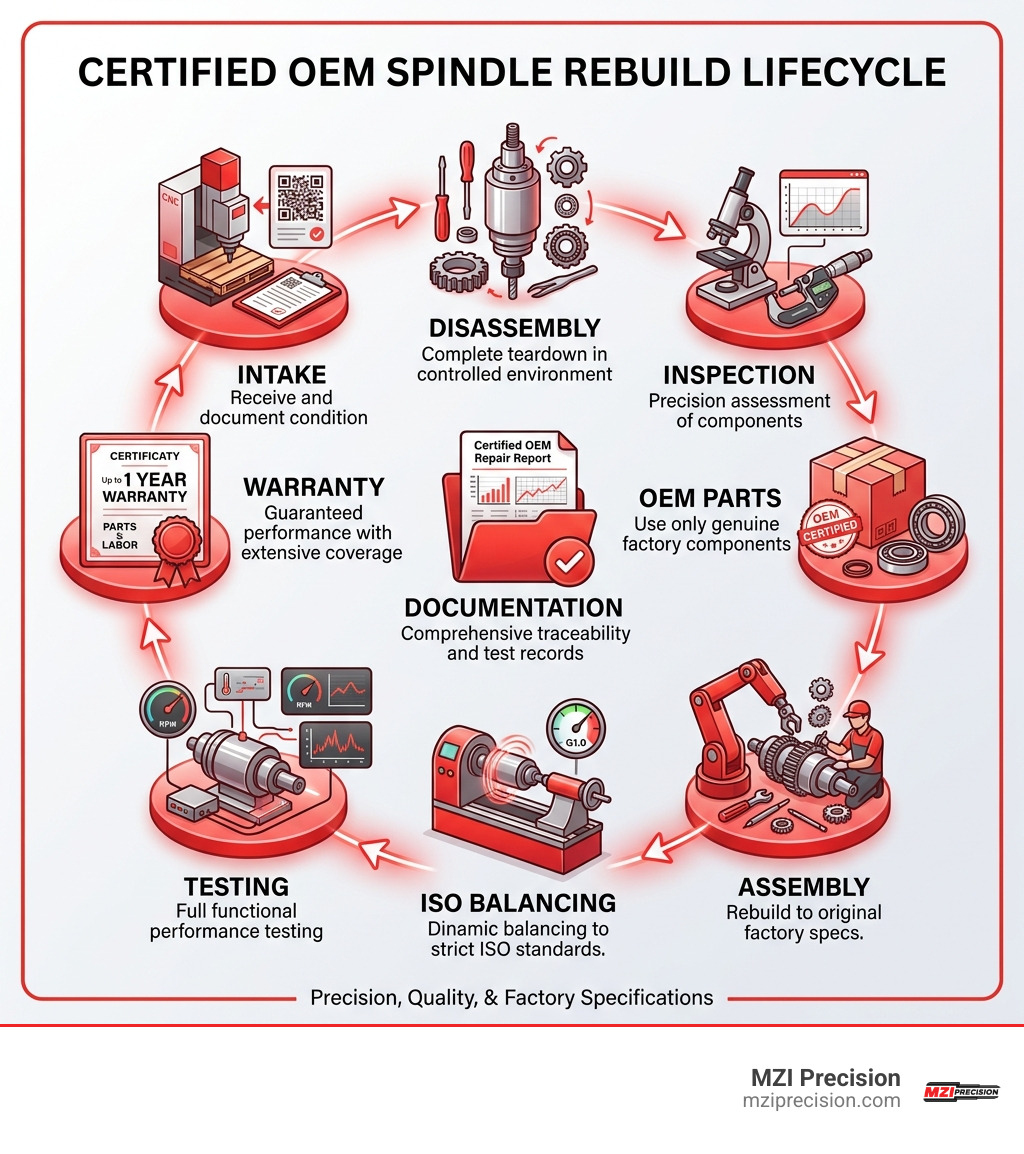
The Rigorous Process of a Certified Spindle Rebuild
When you send a spindle for Spindle Rebuilding California, it undergoes a transformation. Here is how the certified process stacks up against a generic “patch job”:
| Step | Generic Process | Certified OEM Process |
|---|---|---|
| Intake | Visual check | Full documentation & photos |
| Cleaning | Surface wipe | Ultrasonic/Deep cleaning |
| Inspection | Basic measurements | Micron-level dimensional analysis |
| Balancing | Single-plane | Two-plane ISO G1.0 balancing |
| Parts | “Equivalent” parts | Genuine OEM components |
| Final Test | Spin test | Full thermal & vibration run-in |
Advanced Testing Standards for Certified OEM Spindle Repair
Every Spindle Rebuild we perform must pass a gauntlet of tests. We don’t just hope it works; we prove it. This includes dynamic balancing to ISO G1.0 or better–essentially ensuring that the rotating assembly is as close to perfectly balanced as physics allows. We also provide run-out certification, confirming that the spindle shaft rotates with less than two microns of deviation.
Handling Specialized Air-Bearing and High-Speed Models
High-speed spindles (some reaching up to 128,000 RPM) and air-bearing models require a specialized touch. These units are often assembled in climate-controlled cleanrooms to prevent even a single speck of dust from ruining the bearings. As Spindle Rebuild Specialists, we use specialized coatings and high-speed testing rigs to ensure these complex models can handle the heat and pressure of 24/7 industrial production.
Key Advantages: Turnaround Time, Parts, and Support
In April 2026, the global supply chain can still be tricky. Certified providers have a massive advantage here because they maintain extensive inventories of OEM parts.
Access to Proprietary Parts and Engineering Support
Generic shops often struggle to find the right spacers or the exact ABEC 7 (or better) bearings required for high-precision work. A certified provider often has thousands of OEM bearings in stock. For brands like OEMs Rebuilt / Doosan, having the right parts on the shelf can mean the difference between a 3-day repair and a 3-week wait.
Furthermore, we perform drawbar force testing to ensure your tool retention system is pulling with the exact poundage required. This is critical for brands like OEMs Rebuilt / Hardinge, where tool slippage can ruin expensive aerospace workpieces.
Documentation and Traceability
When your spindle returns to you, it shouldn’t come alone. It should come with a “birth certificate” of its repair. This includes detailed test reports, acceptance results, and quality certifications. If you are following our Haas Spindle Rebuild Complete Guide, you know that documentation is the key to long-term maintenance tracking and ISO compliance for your own shop.
Frequently Asked Questions about Certified Spindle Services
When should I choose repair over replacement?
This is the age-old question. Generally, we recommend a certified oem spindle repair when the cost of the rebuild is 50-60% or less than the cost of a new unit. Other factors include:
- Spindle Age: If the casting is still sound, a rebuild is usually better.
- Complexity: Highly integrated motor spindles are often much cheaper to rebuild than replace.
- Availability: If a new spindle has a 20-week lead time, a 1-week repair is the obvious winner. Check out our OEMs Rebuilt / Niigata page for more on specialized brand analysis.
What is the typical turnaround for complex integrated motor spindles?
While simple cartridge spindles can sometimes be handled in 3 days for production-critical emergencies, complex integrated motor spindles usually take an average of 6 to 8 days. This allows for proper motor testing, winding insulation checks, and the essential 24-hour “run-in” period where we monitor temperatures and vibration. For specialized brands like OEMs Rebuilt / Proth, we always aim for the fastest possible return to service without cutting corners.
What exclusive benefits do certified providers offer?
Beyond the parts and the warranty, you get engineering support. This means if your spindle keeps failing due to a specific environmental factor, we can offer upgrades—like enhanced sealing or better bearing materials—that the original design might have lacked. This is the core of our Spindle Repair Services.
Conclusion
Your CNC machine is the heart of your production floor, and the spindle is its soul. Settling for anything less than a certified oem spindle repair is a gamble with your machine’s precision, your tool life, and your company’s reputation.
At MZI Precision, we bring decades of expertise to every rebuild, serving critical industries from aerospace and defense to automotive and solar energy. Based right here in the United States, with deep roots in Southern California, we are committed to providing the reliability your industrial operations demand.
Don’t let a spindle failure keep your business at a standstill. Choose the precision, speed, and quality that only a certified specialist can provide.