


Mastering Spindle Maintenance Training for Better Shop Performance
Why Spindle Maintenance Training Is Critical for Industrial Manufacturing
Spindle maintenance training is a structured program that teaches technicians how to inspect, service, and repair industrial machine tool spindles to prevent failure and extend equipment life. According to industry standards maintained by the International Organization for Standardization (ISO), precision in manufacturing relies on the consistent application of technical maintenance protocols.
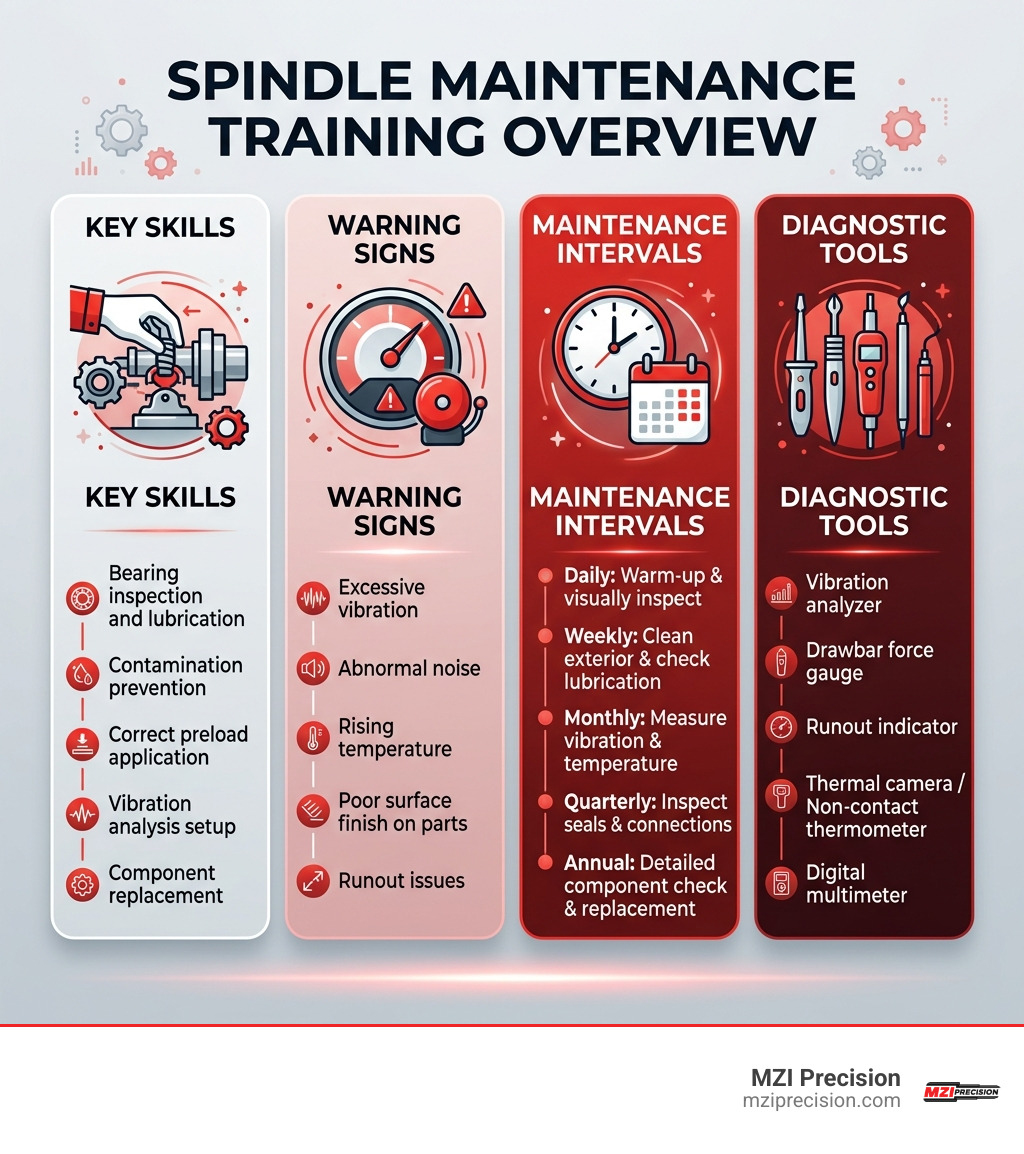
Here is what effective spindle maintenance training covers:
- Bearing inspection and lubrication – identifying wear, applying correct lubricants, and understanding preload
- Contamination prevention – keeping coolant, debris, and moisture away from spindle bearings
- Vibration analysis – collecting baseline data and spotting early warning signs
- Warm-up and cool-down procedures – protecting bearings from thermal shock and grease starvation
- Component replacement schedules – knowing when to replace collets, tool holders, and seals before failure
- Diagnostic tools – using precision instruments to measure runout, drawbar force, and temperature
For manufacturing operations in precision industries like aerospace, a spindle failure is never just a mechanical problem. It is a production problem. Unplanned downtime can cost tens of thousands of dollars in labor, scrapped parts, and emergency repairs.
The frustrating reality is that most spindle failures are preventable. For years, many maintenance teams only acted when a spindle seized completely — by which point secondary damage had already spread to other components. A well-trained technician catches the warning signs long before that point.
That is exactly what spindle maintenance training is designed to fix: turning reactive habits into a proactive, systematic approach to machine health.
The Core Pillars of Spindle Maintenance Training
At MZI Precision, we have seen that the most successful shops are those that treat their spindles like the high-precision instruments they are. The core pillars of any robust training program must move beyond “fixing what is broken” and focus on the science of precision rotation.
A comprehensive CNC Spindle Maintenance program begins with understanding the delicate balance of the spindle’s internal ecosystem. This includes the interaction between the shaft, the bearings, the lubrication system, and the motor. When we train technicians, we emphasize that a spindle isn’t just a spinning hunk of metal; it’s a high-speed assembly where a deviation of just a few microns can lead to catastrophic failure.
Technical Skills Taught in Spindle Maintenance Training
Effective training must get into the “nitty-gritty” of spindle anatomy. One of the first things a technician learns is bearing nomenclature. Not all bearings are created equal, and using the wrong precision class or contact angle can ruin a high-speed spindle in minutes.
Furthermore, Proper spindle bearing lubrication is perhaps the most vital skill. Technicians must learn the difference between grease-pack and oil-air systems. In grease-lubricated spindles, for instance, adding too much grease can actually cause more harm than too little, as the internal friction leads to rapid overheating. Training also covers seal installation—ensuring that labyrinths and air purges are functioning to keep out the “spindle killers” like metal chips and coolant. Finally, we teach drawbar force testing; if the springs holding the tool aren’t pulling with enough force, you’ll face vibration and poor surface finishes.
Certification and Standards in Spindle Maintenance Training
Quality isn’t an accident; it’s a process. In industrial manufacturing, following ISO 9001:2015 standards ensures that maintenance routines are consistent and documented. Training programs often align with these standards to ensure that every repair or check meets OEM specifications.
Part of the Care and maintenance of your spindle involves rigorous quality assurance. This means that after a technician performs maintenance, the spindle must be tested against a benchmark. We believe that a technician’s job isn’t done until the spindle has been “rung out” on a test stand, proving it can handle the speeds and loads it was designed for without excessive heat or vibration.
Identifying and Preventing Common Spindle Failure Modes
If you want to master spindle maintenance training, you have to become a bit of a “spindle detective.” You need to be able to look at a failed component and work backward to find the culprit. Research shows that most failures stem from a handful of repeat offenders: contamination, improper lubrication, and overheating.
When asking yourself, “Are my spindle bearings bad?“, you are usually looking at the result of a long-term issue. Contamination prevention is the first line of defense. Whether it’s stone dust, metal fines, or composite particulates, these abrasives act like sandpaper inside your precision bearings. Training helps staff identify where these particles are entering—often through worn seals or improper air purge pressure.
Root Causes of Industrial Spindle Failure
The “Big Three” of spindle failure are:
- Improper Lubrication: This is the leading cause of bearing failure. Our Greasing spindle bearings ultimate guide highlights that using the wrong grease or failing to follow a run-in procedure can lead to “skidding” or “smearing” of the rolling elements.
- Tool Imbalance: At high RPMs, even a tiny imbalance in a tool holder creates massive centrifugal forces. This puts an uneven load on the bearings, leading to premature fatigue and “spalling” (where the metal surface flakes away).
- Coolant Ingress: Coolant is great for the part, but deadly for the spindle. If coolant gets past the seals, it washes away the bearing grease, leading to metal-on-metal contact.
To Keep your CNC running smoothly, technicians must be trained to spot these root causes before they lead to a complete seizure.
Warning Signs and Sensory Inspections
We often tell our clients that their machines are “talking” to them. You just have to know how to listen. Abnormal noise is usually the first sign of trouble—a high-pitched whine or a low-frequency growl often points to bearing damage.
Spindle health monitoring also involves the sense of touch. If a spindle housing feels hot to the touch (usually over 140°F), it’s a red flag. Finally, look at the parts you’re making. If the surface finish starts to degrade or you see “chatter” marks, the spindle is likely losing its rigidity or suffering from excessive runout.
Advanced Predictive Maintenance and Diagnostic Skills
Reactive maintenance—waiting for the spindle to die—is a recipe for financial disaster. Industry statistics show that reactive repairs can cost tens of thousands of dollars more than predictive ones. That’s why spindle maintenance training now focuses heavily on advanced diagnostics.
Predictive maintenance uses data to tell you exactly when a spindle needs help. By taking baseline measurements when a spindle is new or freshly rebuilt, we create a “fingerprint” of its healthy state. When future readings deviate from that baseline, we know trouble is brewing.
| Feature | Reactive Maintenance | Predictive Maintenance |
|---|---|---|
| Timing | After failure occurs | Before failure occurs |
| Cost | High (emergency shipping, lost production) | Lower (scheduled downtime) |
| Safety | Risk of catastrophic component failure | High (controlled environment) |
| Equipment Life | Shortened due to secondary damage | Maximized through timely care |
Precision Measurement and Runout Checks
Learning How to check spindle runout is a fundamental skill for any maintenance engineer. We’re talking about micron-level accuracy here. Using a precision test bar and a dial indicator, technicians measure the “wobble” of the spindle. If the runout is too high, it doesn’t matter how sharp your tools are—your parts will be out of tolerance.
If you’re wondering, “What is the best way to check spindles?“, the answer is a combination of static checks (measuring the taper) and dynamic checks (running the spindle at speed). A 12-hour test-stand runoff is the gold standard for ensuring a spindle is ready for the rigors of the shop floor.
Utilizing Vibration Analysis Technology
Modern training often incorporates iPad-based analyzers and frequency tracking. These tools allow technicians to see vibrations that are invisible to the naked eye. By analyzing the “frequency peaks,” we can distinguish between a bearing issue, a belt problem, or an unbalanced tool.
This technology is also vital for Electric motor predictive maintenance. Since the motor is often integrated directly into the spindle (motor-spindles), monitoring the electrical and mechanical vibrations of the motor helps prevent a double-failure where a bad bearing ruins the motor windings.
Implementing a Systematic Spindle Maintenance Routine
Consistency is the secret sauce of spindle longevity. You can’t just do maintenance “when you have time.” You need a schedule. A systematic routine ensures that small tasks—like cleaning the taper—don’t fall through the cracks.
A proper Spindle runout check should be part of your periodic inspection, but the work starts much earlier than that. It starts with the daily warm-up. Running a cold spindle at 10,000 RPM immediately is like sprinting a marathon without stretching; the bearings haven’t had time to channel the lubricant, and the sudden heat can cause immediate failure.
Daily and Weekly Maintenance Protocols
Your daily checklist should be simple but non-negotiable:
- Warm-up: Gradually increase RPMs over 15-20 minutes to distribute grease.
- Taper Cleaning: Use a dedicated taper wiper (never compressed air!) to remove debris.
- Air Purge: Ensure the air seal is active and the air is dry.
- Visual Check: Look for leaks or debris around the spindle nose.
On a weekly basis, you should perform Servo motor preventive maintenance checks and verify that lubrication levels are topped off with the correct OEM-specified fluids. These small steps prevent the “creeping” failures that happen when a spindle is neglected for weeks at a time.
Long-Term Component Replacement Schedules
Some parts of your machine are “consumables,” even if they don’t look like it. For example, tool holder collets should be replaced every 3 to 6 months. Why? Because they lose their elasticity and start to “slip,” which causes vibration.
A proper Gearbox maintenance schedule is also critical if your spindle is gear-driven. Furthermore, the Belleville springs in your drawbar lose tension over time. If you don’t check their tension annually, you might find your tools “walking” out of the spindle during a heavy cut.
Frequently Asked Questions about Spindle Maintenance Training
What are the primary benefits of spindle maintenance training?
The biggest benefit is reduced downtime. When your team knows how to maintain a spindle, you stop having “surprise” breakdowns on Friday afternoon. This leads to massive cost savings, as you aren’t paying for rush shipping or emergency rebuilds. It also improves safety; a spindle that fails at 20,000 RPM can be incredibly dangerous. Finally, it enhances efficiency—a well-maintained spindle produces better parts, faster.
How often should technicians undergo updated training?
We recommend annual refreshers. Technology in the industrial world moves fast. New sensor technologies, improved Electric motor maintenance tips, and advancements in synthetic lubricants mean that what was “best practice” five years ago might be outdated today. Whenever you integrate new equipment into your shop, that is also a perfect time for a training update.
What tools are required for effective spindle training?
You don’t need a lab, but you do need precision. Essential tools include vibration sensors, drawbar force gauges, and high-accuracy dial indicators. Having the right Check spindle tools allows your team to move from “guessing” to “knowing.” We also recommend having a dedicated clean area for inspections to prevent introducing more contamination during the check-up.
Conclusion
Mastering spindle maintenance training is one of the most impactful investments an industrial shop can make. By empowering your technicians with the skills to identify early warning signs, perform precision measurements, and maintain a systematic routine, you transform your maintenance department from a “cost center” into a “productivity engine.”
At MZI Precision, we understand that your spindles are the heart of your operation. We specialize in OEM rebuild standards and are committed to helping you achieve maximum uptime through expert repair services and support. Whether you are in aerospace, defense, or general manufacturing, we are here to ensure your spindles run with the precision and reliability your business demands.
Contact us for professional spindle repair services to learn how we can help you optimize your shop’s performance and extend the life of your critical machinery.