

Ball Bearing Spindle: Top 5 Precision Secrets
The Heart of Precision Machining
A ball bearing spindle is a rotating axis assembly using ball bearings for the high-speed, high-precision rotation required in machine tools like CNC mills, lathes, and grinders. It comprises a shaft, bearing system, housing, and drive mechanism that work together to hold cutting tools or workpieces, transmit torque, and maintain exceptional accuracy.
Key characteristics of ball bearing spindles:
- Primary function: Rotate cutting tools or workpieces at precise speeds (up to 12,000+ RPM)
- Bearing types: Angular contact, deep groove radial, or cylindrical roller bearings
- Precision level: Can achieve ABEC9 tolerances with run-out as low as 0.00015 inches
- Materials: Steel bearings (standard) or ceramic hybrid bearings (50% lighter, up to 5x longer lifespan)
- Applications: Aerospace manufacturing, medical device production, semiconductor fabrication
As one industry expert noted: “Spindles are the heart of each and every machine tool, from the aerospace industry to automotive and medical equipment manufacturing. Inside each spindle is a set of bearings that must hold very tight tolerances, withstand extreme conditions, and last for many years.”
Ball bearing spindles are critical to manufacturing, directly impacting accuracy, surface finish, and efficiency. Failure can halt production, making proper selection, maintenance, and expert repair essential.
External contamination is the leading cause of premature spindle failure, making a deep understanding of these components crucial for engineers and maintenance teams.
What is a Ball Bearing Spindle and How Does It Work?
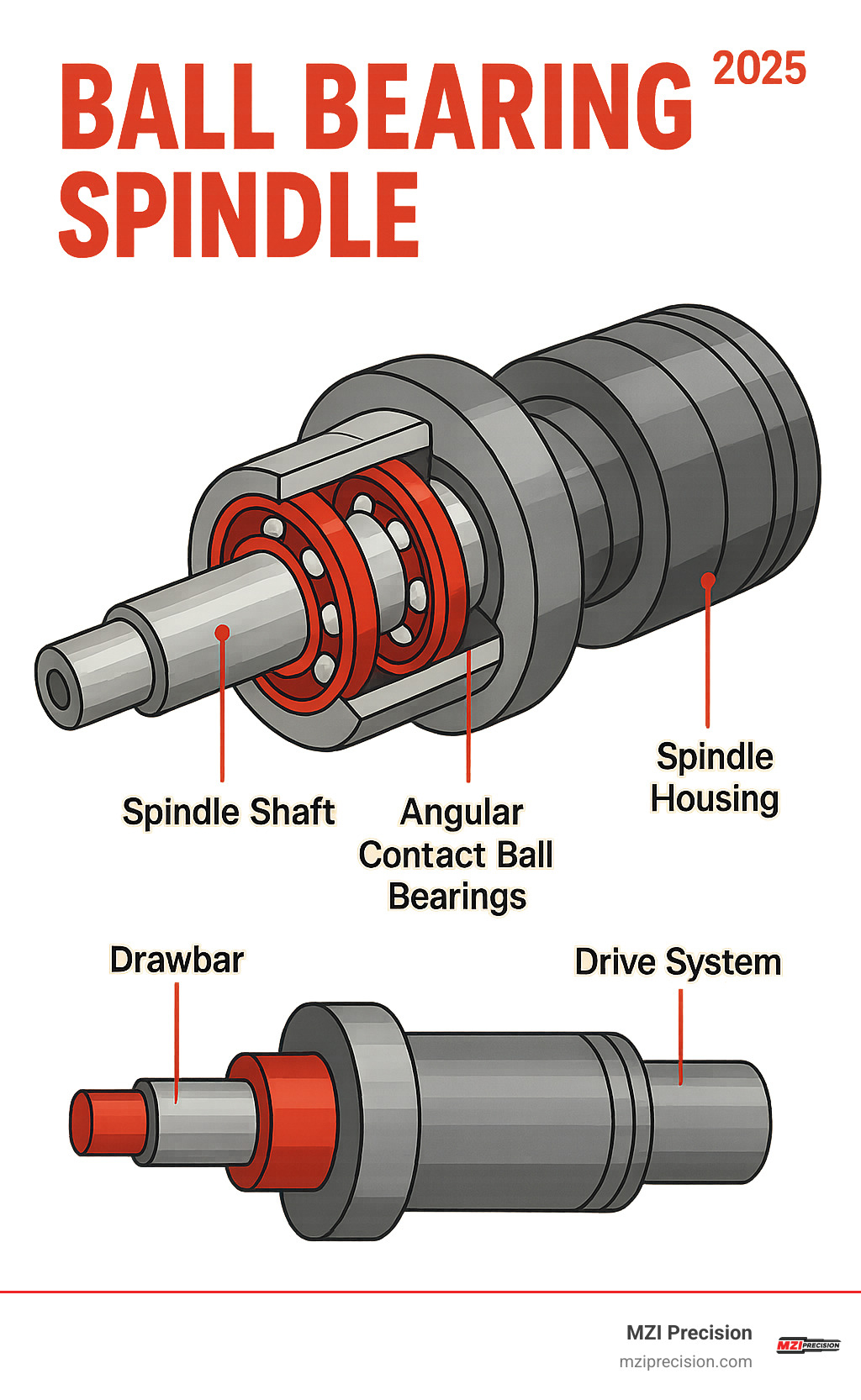
The ball bearing spindle is the heart of a precision machine tool. This assembly is a rotating powerhouse that holds cutting tools or workpieces, spinning them at high speeds with extreme precision. As the rotating axis of the machine, the complete spindle assembly—shaft, bearings, housing, and drive—spins as one unit.
It transmits torque from the drive system to the cutting tool while supporting heavy loads and maintaining accuracy measured in microns. Whether cutting, drilling, or grinding, the ball bearing spindle ensures every operation meets the demands of modern manufacturing. These spindles are built to withstand continuous operation under heavy loads while delivering the surface finishes and dimensional accuracy required for high-quality production.

Core Components of a Spindle Assembly
Each component of a ball bearing spindle plays a crucial role in its overall performance.
- Spindle Shaft: This central rotating element transmits torque from the drive system to the tool or workpiece. It’s often hollow or tapered to securely grip tools.
- Spindle Housing: This structure protects and encapsulates the bearings, dampens vibration, and includes passages for lubrication and cooling to maintain optimal operating temperatures.
- Bearing System: The bearings support the spindle shaft, enabling smooth rotation while handling both radial (sideways) and axial (along the shaft) loads. Bearing selection is critical to spindle performance.
- Drive System: This can be a belt-driven system for high torque or an integral motor built directly into the spindle for high-speed applications.
- Drawbar Mechanism: This system precisely clamps and unclamps tools using springs, cylinders, and grippers for secure, reliable tool holding.
- Sealing System: Seals protect precision components from coolant, chips, and dust. This is crucial, as contamination is the leading cause of premature spindle failure.
The Fundamental Role of the Ball Bearing Spindle
A ball bearing spindle must rotate incredibly fast while maintaining incredible precision. Its core functions include:
- High-Speed Rotation: Modern spindles achieve very high speeds, enabling rapid material removal and shorter cycle times, which boosts productivity.
- High-Precision Accuracy: The bearing system minimizes run-out (deviation from the ideal rotation path). An assembled spindle’s run-out should not exceed 0.00015 inches, a key factor for superior machining.
- Radial and Axial Load Support: Bearings provide support against both sideways (radial) and lengthwise (axial) forces. This maintains the stiffness required to prevent deflection and ensure accuracy.
- Tool and Workpiece Holding: The spindle offers a stable, rigid platform for holding tools or workpieces, which is essential for consistent, accurate machining.
- Run-Out Control and Vibration Dampening: Quality spindles are carefully balanced (Grade 0.3 or better) to minimize vibration (ideally 0.1G per 10,000 RPM). This ensures smooth operation, extending spindle and tool life.
A Guide to Spindle Bearing Types and Materials
For ball bearing spindles, bearing choice is critical. The bearing’s performance characteristics, load capacity, and speed rating directly impact everything from surface finish quality to repair frequency. Choosing the wrong bearings can lead to premature failures and costly downtime, while the right selection can transform a spindle into a precision powerhouse.

At MZI Precision, we work with several bearing types, each designed for specific industrial manufacturing challenges.
Common Types of Spindle Bearings
- Angular Contact Ball Bearings: These are the workhorses for spindles, handling high speeds and mixed (radial and axial) loads. Their contact angle (typically 12°-25°) allows them to manage both force types. They are often arranged in sets (duplex, triplex, quad) and require special retainers for stability at high speeds.
- Deep Groove Radial Ball Bearings: A versatile choice for applications with primarily radial loads and some axial support, where precision is still important.
- Cylindrical Roller Bearings: With a larger contact area, these bearings offer exceptional radial load capacity and high-speed capability. They are used in single or double-row configurations where rigidity is critical for heavy-duty machining.
- Thrust Bearings: These specialize in handling heavy axial loads (along the shaft’s axis) and are typically used in lower-speed applications.
For those interested in exploring bearing types further, there’s excellent additional information available about bearing types and usage that covers the broader spectrum of bearing applications.
Steel vs. Ceramic: Choosing the Right Bearing Material
The choice of bearing material can dramatically impact spindle performance. We primarily work with two options:
All-Steel Bearings are the traditional choice, crafted from high-grade bearing steel. They are robust, cost-effective, and proven across countless standard machining operations.
Hybrid Ceramic Bearings represent a significant technological step, using ceramic balls (typically silicon nitride, Si3N4) with steel races. They offer transformative results for high-performance applications. Ceramic balls are 50% lighter than steel, reducing centrifugal forces and allowing spindles to increase running speeds by up to 25%. They also run 2-7 times smoother, which improves surface finishes and extends tool life.
Longevity is a key advantage, as ceramic bearings can last up to 5 times longer than steel bearings, reducing rebuilds and downtime. The higher modulus of elasticity in ceramic also creates greater bearing stiffness and rigidity, while lower friction leads to cooler operation.
Here’s how the two materials stack up:
| Metric | Steel Bearings | Hybrid Ceramic Bearings |
|---|---|---|
| Weight | Standard | 50% lighter (balls) |
| Max Speed | Standard | Up to 25% increase |
| Lifespan | Standard | Up to 5 times longer |
| Vibration | Standard | 2-7 times lower |
| Rigidity | Standard | Higher (due to higher modulus of elasticity) |
| Heat | Higher friction, more heat | Lower friction, cooler operation |
While ceramic balls can create higher contact stresses in some designs, the overall benefits for high-speed, high-precision applications typically make them a worthwhile investment in performance and reliability.
Performance and Precision: Key Selection and Repair Factors
Optimal ball bearing spindle performance comes from balancing precision, speed, and durability for your specific application, not just buying expensive bearings. Achieving this balance requires careful attention to every detail, from initial bearing selection to final mounting.
Understanding Bearing Tolerances and Precision (ABEC Rating)
The ABEC (Annular Bearing Engineers’ Committee) rating defines bearing precision: a higher number means tighter tolerances. For machine tool spindles, high-precision bearings up to ABEC9 (or RBEC9 for roller bearings) are common. The higher the classification number, the tighter the tolerances.
Higher ABEC ratings deliver measurable improvements:
- Decreased run-out: Less wobble for tighter dimensional tolerances and superior surface finishes.
- Improved machining accuracy: Tighter bearing tolerances contribute to more precise and consistent cuts.
- Reduced vibration: Smoother operation leads to extended tool life.
For applications where precision is non-negotiable, such as in aerospace or medical device manufacturing, specifying the correct ABEC rating is critical.
Critical Factors for Spindle Bearing Selection and Repair
A thorough evaluation of operating conditions is the first step in any ball bearing spindle repair or selection to avoid future problems. Key factors include:
- Cutting Loads: The anticipated forces determine the required bearing load capacity and stiffness.
- Operating Speed: High speeds (cartridge spindles typically don’t exceed 12,000 RPM) demand bearings designed for low friction and heat dissipation, often favoring ceramic balls.
- Required Stiffness and Rigidity: The assembly must resist deflection, requiring bearings with high stiffness achieved through proper preloading.
- Operating Temperature: Heat must be managed through proper bearing selection and thermal design to protect the bearing and lubricant.
- Environmental Contamination: As the leading cause of premature failure, contamination influences the choice of seals and protection.
- Mounting and Fit Requirements: The interface between the bearing, shaft, and housing is critical for performance.
- Preload Application: Applying the correct axial force to angular contact bearings is essential to eliminate internal clearance and maximize stiffness.
The Importance of Proper Fit and Mounting
Even the best bearing will fail if not mounted correctly. Proper installation is critical to prevent premature failure and damage.
- Interference Fit: A tight (interference) fit is generally preferred over a loose one to prevent the bearing from rotating on its seat, which causes wear and precision loss.
- Preloading: Applying a controlled axial force to angular contact bearings eliminates internal clearance. This increases stiffness, improves rotational accuracy, and prevents balls from skidding at high speeds.
- Component Alignment: Precision machining of the shaft and housing is required for proper alignment. Misalignment causes uneven load distribution, increased friction, and premature failure.
- Thermal Expansion Management: Bearing mounts must accommodate shaft expansion due to temperature changes, preventing damaging axial loads from building up.
Applications and Advanced Considerations
The ball bearing spindle is the backbone of modern manufacturing, providing the precision needed for everything from aerospace components to consumer electronics. The technology’s adaptability allows it to be customized to meet the unique demands of various industries.
Industrial Applications of the Ball Bearing Spindle
Across industries, the commonality of these applications is the need for rapid and flexible capabilities.
- Aerospace Manufacturing: Machines critical components like turbine blades from exotic materials, requiring spindles that handle immense forces while maintaining tight tolerances.
- Medical Device Production: Requires extreme precision for surgical instruments and implants, where flawless surface finishes and exact dimensions are non-negotiable.
- Semiconductor Fabrication: Powers equipment for processing silicon wafers, demanding exceptional precision and contamination control.
- High-Precision Grinding: Pushes spindles to their limits to create perfect curvatures on optical lenses or achieve ultra-fine finishes on machine tool components.
- 3C Parts Machining: Involves high-volume production of small, intricate parts for computers, communication devices, and consumer electronics, requiring spindles that run fast and consistently.
Beyond these fields, ball bearing spindles are fundamental to nearly every CNC machining center, lathe, mill, and grinder.
Can Standard Bearings Be Modified for Spindles?
Yes, standard bearings can be modified for ball bearing spindle applications. This is often a practical solution to address premature failures, long lead times for specialty parts, or unique application requirements. At MZI Precision, we regularly modify standard bearings to create custom solutions.
This process is about problem-solving and performance optimization. Common modifications include:
- Custom Preloads: Fine-tuning the bearing’s internal forces for specific loads and speeds.
- Lubrication Grooves: Ensuring lubricant reaches critical areas.
- ID/OD Grinding: Achieving perfect fits not available in standard sizes.
- Advanced Modifications: Adding anti-rotation slots, O-ring grooves for better sealing, or even converting roller bearings to ball bearings.
We can also integrate advanced materials like Silicon Nitride bearing components into modified designs, increasing rigidity and maximum operating speeds to give an older spindle modern performance capabilities.
Frequently Asked Questions about Spindle Bearings
As spindle repair experts, we frequently answer the same questions from manufacturing engineers. Here are some of the most common.
What are the signs of a failing spindle bearing?
A failing ball bearing spindle typically provides several warning signs before a complete breakdown. Look for:
- Increased Vibration: A healthy spindle runs smoothly. New or increased vibration is a primary red flag of bearing wear.
- Unusual Noise: Grinding, whining, or clicking sounds often indicate contamination, wear, or internal bearing damage.
- Excessive Heat Generation: If a spindle runs hotter than normal, it can signal lubrication issues, improper preload, or internal friction from failing bearings.
- Poor Part Quality: A sudden decline in part surface finish or a loss of machining accuracy is often a direct result of bearing instability.
How often should spindle bearings be replaced?
There is no fixed replacement schedule for spindle bearings. Lifespan depends on several factors:
- Usage and Intensity: Spindles running 24/7 under heavy loads will wear out faster than those used for light, intermittent work.
- Lubrication: The quality, type, and delivery of lubricant are critical to bearing life.
- Operating Environment: External contamination from coolant, chips, and dust is the leading cause of premature spindle failure.
The best approach is condition-based maintenance. Monitor your spindle’s vibration, temperature, and performance, and plan for a rebuild when signs of wear appear. This is far more cost-effective than reacting to a catastrophic failure.
What is spindle bearing preload and why is it important?
Spindle bearing preload is a controlled axial force applied to angular contact ball bearings during installation. It is important because it:
- Eliminates Internal Clearance: Removes the microscopic play within the bearing.
- Increases Spindle Stiffness: Creates a rigid assembly that resists deflection under cutting loads, improving accuracy.
- Improves Rotational Accuracy: Ensures the spindle spins true with minimal run-out for consistent part quality.
- Prevents Ball Skidding: At high speeds, preload ensures balls roll smoothly instead of sliding, which prevents heat buildup and wear.
Achieving the correct preload is a precision process. Too little preload negates the benefits, while too much creates excessive heat and friction, leading to rapid failure.
Conclusion: Ensuring Longevity and Performance of Your Spindle
This guide has explored ball bearing spindles, the rotating heart of precision machine tools. From their core components to advanced materials, these assemblies are the backbone of modern manufacturing, enabling the high-speed, high-precision operations that define industries from aerospace to medical.
We’ve seen that reliable, long-lasting spindle performance is built on a foundation of key factors: managing cutting loads and operating speeds, preventing environmental contamination, and ensuring precision mounting. As external contamination is the leading cause of premature failure, proactive maintenance and proper sealing are critical.
Material choice, such as using hybrid ceramic bearings with their longer lifespan and performance benefits, can transform a machine tool’s capabilities. When combined with precision mounting and correct preload application, these advancements maximize productivity.
At MZI Precision, our expertise lies in understanding these complex factors to optimize your machine tool’s performance. We apply this knowledge to everything from diagnosing subtle issues to performing complete spindle rebuilds.
Investing in proper spindle care through expert selection, precision installation, and professional repair services pays dividends in reduced downtime, improved part quality, and extended equipment life.
Learn more about our expert spindle repair and rebuilding services and find how MZI Precision can help you achieve peak spindle performance for your critical manufacturing operations.