

Precision Spindle Repair for the Modern Defense Industry
When a Spindle Fails in Defense Manufacturing, Everything Stops
METADATA: TITLE: PRECISION SPINDLE REPAIR FOR THE MODERN DEFENSE INDUSTRY DESCRIPTION: DISCOVER THE CRITICAL ROLE OF DEFENSE PRECISION SPINDLE REPAIR IN MAINTAINING AEROSPACE AND MILITARY MANUFACTURING STANDARDS. LEARN ABOUT REBUILD CAPABILITIES, FAILURE MODES, AND COST-EFFECTIVE OEM REBUILDS. KEYWORD: DEFENSE PRECISION SPINDLE REPAIR

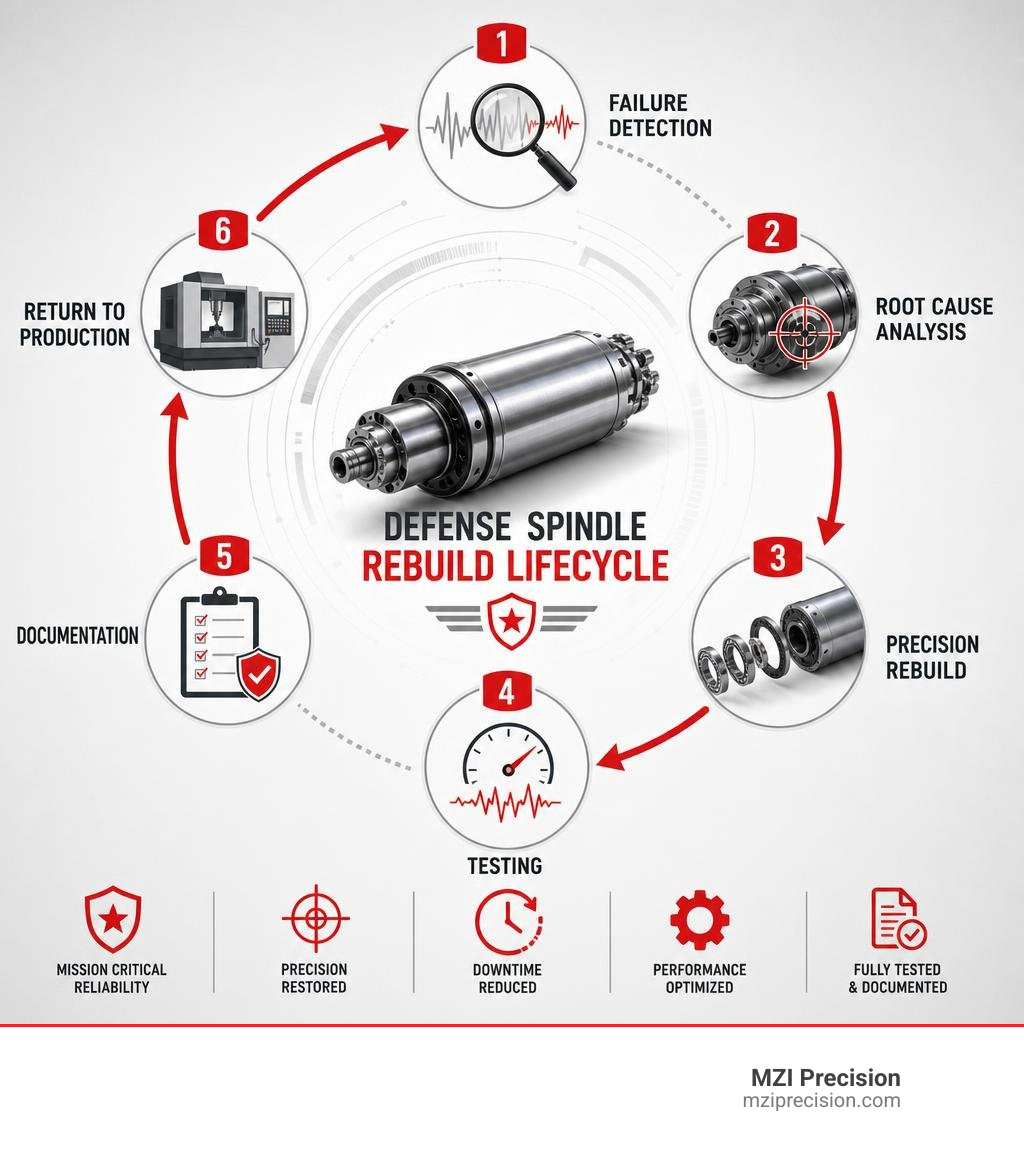
Defense precision spindle repair is a specialized service that restores — and often improves — the spindles used in military and aerospace manufacturing to meet the extreme accuracy and reliability standards these environments demand.
If you need a quick answer on what this involves, here’s the short version:
What defense precision spindle repair includes:
- Root-cause failure analysis — identifying exactly why the spindle failed before any work begins
- Precision bearing replacement — using high-grade or ceramic hybrid bearings matched to duty cycle
- Dynamic balancing — typically to G2.5 or better across the full operating speed range
- Taper restoration — returning the spindle interface to proper concentricity and toolholder contact
- Cleanroom reassembly — eliminating contamination that can shorten spindle life
- Full documentation and testing — run-in reports, vibration signatures, and thermal validation for audit compliance
Why it matters: A spindle failure in a defense or aerospace shop doesn’t just mean a machine is down. It means production halts, deadlines slip, and the cost of inaction mounts by the hour — on parts that often have no margin for error.
Aerospace and defense machining operates at the extreme end of what manufacturing demands. Tight tolerances, exotic materials like titanium and Inconel, long cycle times, and zero room for surface finish variation all put enormous stress on spindles. Standard industrial repair approaches aren’t built for these conditions.
The good news: a properly executed precision rebuild — done by engineers who understand these environments — can return a spindle to full specification, and in many cases exceed original OEM performance, in a fraction of the time and cost of a full replacement.
Defense precision spindle repair terms to know:
What Sets Defense Precision Spindle Repair Apart?
Standard industrial spindle repair is often treated as a simple parts-replacement job. A technician swaps out some bearings, replaces the seals, gives it a quick spin, and ships it back. But in the high-stakes world of defense manufacturing, that basic approach is a recipe for catastrophic failure.
Defense manufacturing involves machining exotic materials like titanium, Inconel, cobalt-chrome, hardened steels, and carbon-fiber composites. These materials are incredibly tough on cutting tools and the machine tool spindles driving them. The spindle must withstand massive cutting forces, sustained high speeds, and long cycle times – all while maintaining sub-micron accuracy.
Because we are dealing with critical components for military hardware, defense machining demands extreme accuracy, repeatability, and reliability. There is absolutely zero margin for spindle vibration, thermal drift, or runout. If a spindle experiences even minor deviations under load, it can ruin a workpiece worth tens of thousands of dollars, delay a defense contract, and compromise component integrity.
To understand the specialized nature of these services, you can explore More info about aerospace spindle services.
The Critical Role of Defense Precision Spindle Repair in Aerospace Machining
In aerospace machining, spindles are pushed to their absolute physical limits. Whether milling structural bulkheads for military aircraft, machining landing gear components, or carving intricate turbine blades, the spindle is the heart of the operation.
These components require extremely tight tolerances and flawless surface finishes. A single microscopic imperfection on a turbine blade can lead to stress fractures under operational loads, which is simply unacceptable in defense aviation. High spindle speeds coupled with heavy cutting forces create a punishing thermal environment. Without specialized engineering during the rebuild process, standard spindles will quickly succumb to thermal expansion, bearing fatigue, and premature failure.
To keep these critical lines moving, manufacturers rely on dedicated Aerospace spindle repair solutions designed to handle the unique duty cycles of aerospace machining centers.
Why Defense Precision Spindle Repair Demands Strict Traceability
In defense manufacturing, “good enough” does not exist. Every single component that goes into a military vehicle, aircraft, or satellite must have a documented pedigree. This requirement extends directly to the machine tools and spindles used to make them.
When we perform a defense precision spindle repair, we don’t just fix the hardware; we build a comprehensive audit trail. This process requires strict compliance with quality management systems, rigorous testing protocols, and complete traceability of all replacement parts, such as certified super-precision bearings. For general background on quality management frameworks, ISO provides an overview of ISO 9001 quality management.
From initial failure analysis to final dynamic balancing and thermal testing, every step must be meticulously documented. This level of traceability helps support defense contractor quality requirements and ISO-aligned audit expectations, giving manufacturers the verification they need for strict compliance programs.
To learn more about the engineering standards required for these high-stakes rebuilds, read about High precision spindle engineering.
Common Failure Modes in Defense-Grade Spindles
High-speed machining of hardened alloys and composites creates a perfect storm for spindle wear. In our experience servicing defense manufacturing facilities in California—including Los Angeles and Huntington Beach—we regularly see several primary failure modes:
- Bearing Fatigue: The sustained radial and axial loads required to cut titanium and Inconel cause microscopic cracks in bearing raceways, eventually leading to pitting, severe vibration, and complete spindle seizure.
- Thermal Instability: Long production runs generate intense friction. If the spindle’s cooling jackets or lubrication systems are partially clogged or improperly calibrated, thermal expansion will quickly destroy bearing preloads.
- Vibration Issues: Unbalanced tooling, minor crashes, or natural bearing wear can introduce vibration that degrades workpiece surface finishes and accelerates wear on the machine’s guideways.
- Taper Wear and Fretting: Constant tool changes and high clamping forces wear down the spindle taper, causing toolholder slippage, excessive runout, and poor tool life.
- Coolant Ingress: High-pressure coolant systems are essential for machining exotic materials, but if the spindle’s labyrinth seals or air-purge systems fail, coolant will wash away the bearing grease, leading to rapid failure.

Understanding these failures is the first step toward prevention. For a deeper dive into diagnosing these issues, check out our Spindle failure analysis guide.
Warning Signs of Impending Spindle Failure
Spindles rarely fail completely without warning. For defense manufacturers, catching these signs early can save hundreds of thousands of dollars in secondary damage to the spindle shaft, motor windings, and housing.
Watch out for these common warning signs:
- Audible Noise: Any high-pitched whining, grinding, or clicking sounds coming from the spindle head indicate bearing cage damage or raceway pitting.
- Temperature Spikes: If the spindle housing feels unusually hot to the touch or if your machine’s PLC sensors trigger thermal limit codes, the bearings are likely failing or running dry.
- Surface Finish Degradation: If you notice chatter marks, poor surface roughness, or dimensional drift on finished parts, the spindle’s structural stiffness has been compromised.
- Runout Drift: Increased tool wear or difficulty holding tight tolerances often points to wear inside the spindle taper.
To proactively monitor these conditions before they cause catastrophic failures, defense shops utilize advanced diagnostic techniques. Learn more about Spindle vibration analysis techniques.
Specialized Rebuild Capabilities for Military and Aerospace Applications
Rebuilding a spindle to defense-grade standards requires highly specialized equipment, controlled environments, and advanced engineering capabilities. It is not a job for a general machine shop.
To meet these demanding standards, we utilize a multi-step, engineering-driven process:
- Class 10,000 Cleanroom Assembly: Even a single speck of dust inside a high-speed spindle bearing can cause localized friction, leading to premature failure. All critical assemblies must be completed in a certified cleanroom environment.
- Taper Restoration: We restore worn or damaged tapers (including CAT, HSK, and BIG-PLUS systems) to less than two microns of runout, ensuring perfect concentricity and maximum toolholder contact.
- Thermal Optimization: We evaluate and optimize internal cooling passages and lubrication systems to ensure stable operating temperatures during extended duty cycles.
Selecting the right components during this process is critical. You can read about how we choose components in our guide on Precision spindle bearings selection.
Precision Bearing Replacement and Upgrades
The bearings are the most critical component of any spindle. For defense and aerospace applications, we don’t just replace like-for-like; we look for opportunities to upgrade performance.
We frequently upgrade standard steel bearings to ceramic hybrid bearings (silicon nitride balls with steel rings). Ceramic balls are 60% lighter than steel, significantly harder, and generate much less thermal expansion at high speeds. This upgrade reduces operating temperatures, increases spindle stiffness, and extends bearing life up to three times compared to standard steel alternatives. Additionally, we precisely match and optimize bearing preloads to ensure the spindle can handle both high-speed finishing and heavy-duty roughing cuts.
For more details on our bearing replacement protocols, see our Spindle bearing replacement services.
Dynamic Balancing and Runout Correction
At high operating speeds (often exceeding 20,000 RPM), even a microscopic weight imbalance can generate massive centrifugal forces. This imbalance causes severe vibration, ruins surface finishes, and rapidly destroys spindle bearings.
We dynamically balance the entire rotating assembly—including the drawbar and internal components—to ISO G2.5 standards or better (often achieving tolerances of 0.1 mil or less). This precise balancing eliminates harmful vibrations across the spindle’s entire operating speed range, maximizing tool life and protecting your machine tool investment.
To understand how we correct runout and restore perfect concentricity, read our Spindle runout correction complete guide.
Rebuild vs. OEM Replacement: Cost, Lead Time, and Performance
When a critical defense spindle fails, managers face a choice: buy a brand-new spindle from the original equipment manufacturer (OEM) or invest in a professional precision rebuild.
In 2026, global supply chain disruptions continue to make OEM replacements a logistical headache. Lead times for new OEM spindles regularly stretch from 8 to 24 weeks or longer. In contrast, a professional rebuild can typically be completed in 1 to 3 weeks, keeping your production lines moving.
Furthermore, a precision rebuild is incredibly cost-effective, typically costing only 30% to 60% of the price of a new OEM spindle. Because we can engineer performance upgrades (like ceramic bearings, enhanced sealing, and custom preloads) directly into the rebuild, the finished spindle often outperforms the original factory specifications.
| Feature | Professional Spindle Rebuild | Full OEM Replacement |
|---|---|---|
| Average Cost | 30% – 60% of new spindle cost | 100% retail price |
| Typical Lead Time | 1 – 3 weeks (Expedited available) | 8 – 24+ weeks |
| Performance | Often exceeds OEM (with upgrades) | Standard factory specifications |
| Warranty | Up to 12–24 months | Standard factory warranty |
| Traceability | Full documentation & test reports | Standard factory compliance |
To explore your rebuild options further, read about our High speed spindle repair options.
Minimizing Downtime in Mission-Critical Environments
In defense manufacturing, downtime isn’t just measured in lost dollars—it can impact national security timelines and defense contract compliance.
By choosing an independent, high-precision rebuilder located right here in California, you can dramatically cut shipping transit times and eliminate customs delays. We serve manufacturing hubs across Southern California, including Los Angeles and Huntington Beach, providing rapid turnaround times and direct engineering support to keep your shop floor operational.
If you are operating in California, you can leverage California spindle repair services to minimize shipping times and ensure rapid turnaround.
Frequently Asked Questions about Precision Spindle Rebuilds
Can defense spindles be upgraded beyond original OEM specifications during a rebuild?
Yes, absolutely. Standard OEM spindles are designed for general-purpose use to keep manufacturing costs down. When we rebuild a spindle for a specific defense application, we can customize it to your exact operating conditions.
This customization includes upgrading to ceramic hybrid bearings, optimizing bearing preloads for titanium or composite machining, applying advanced coating technologies to the spindle shaft, and improving the labyrinth sealing systems to prevent coolant ingress. These engineering-driven upgrades frequently result in a spindle that lasts longer and runs faster than it did brand new from the factory.
For a comprehensive overview of our repair capabilities, see our Precision spindle repair overview.
What documentation and testing certifications are provided after a rebuild?
Every defense-grade spindle we rebuild undergoes a rigorous testing and validation process before it leaves our facility. We provide a complete documentation package that includes:
- Detailed root-cause failure analysis reports
- Dimensional inspection logs showing shaft and taper runout (standard is less than two microns)
- Dynamic balancing certificates showing compliance with G2.5 standards
- Thermal stability run-in logs monitoring bearing temperatures over several hours
- Vibration signature analysis reports at maximum operating RPM
To learn more about our quality control and testing processes, explore our CNC spindle repair and rebuild services page.
How does dynamic balancing improve the lifespan of high-speed defense spindles?
Dynamic balancing removes the centrifugal forces that cause spindle vibration. When a spindle is out of balance, it creates uneven loads on the precision bearings, leading to localized friction, heat, and rapid bearing failure.
By balancing the rotating assembly to sub-micron tolerances, we eliminate these forces. This result produces a flawless surface finish on machined parts, extends the life of your expensive cutting tools, and protects the spindle bearings from premature wear.
For more information on high-speed balancing, check out High-speed spindle repair and balancing.
Conclusion
In the defense and aerospace industries, precision is non-negotiable. When a spindle fails, you need a partner who can restore your equipment to OEM-or-better standards quickly, reliably, and with complete traceability.
At MZI Precision, we specialize in high-precision, engineering-driven spindle rebuilds. Operating from our state-of-the-art facilities in Southern California—serving Los Angeles, Huntington Beach, and beyond—we bring decades of experience to every rebuild. We don’t just replace parts; we analyze the failure, optimize the design, and deliver a certified, high-performance spindle backed by an industry-leading warranty.
Let us help you eliminate downtime, improve your machining accuracy, and keep your critical defense contracts on schedule.
Ready to restore your machine’s edge? Schedule a defense spindle repair consultation today.