


How to Measure Spindle Runout Accurately Fast
Why Spindle Runout Is the First Thing to Check When Tool Life Drops
METADATA: TITLE: HOW TO MEASURE SPINDLE RUNOUT ACCURATELY FAST DESCRIPTION: LEARN HOW TO MEASURE, TOLERANCE, AND CORRECT SPINDLE RUNOUT ON INDUSTRIAL CNC MACHINES TO EXTEND TOOL LIFE AND IMPROVE MACHINING ACCURACY.

Spindle runout is one of the most common — and most costly — sources of machining inaccuracy in industrial CNC operations. In simple terms, it means your spindle is no longer rotating exactly on its intended axis. Instead of spinning perfectly true, it wobbles slightly. That tiny wobble has big consequences.
Quick answer: What is spindle runout?
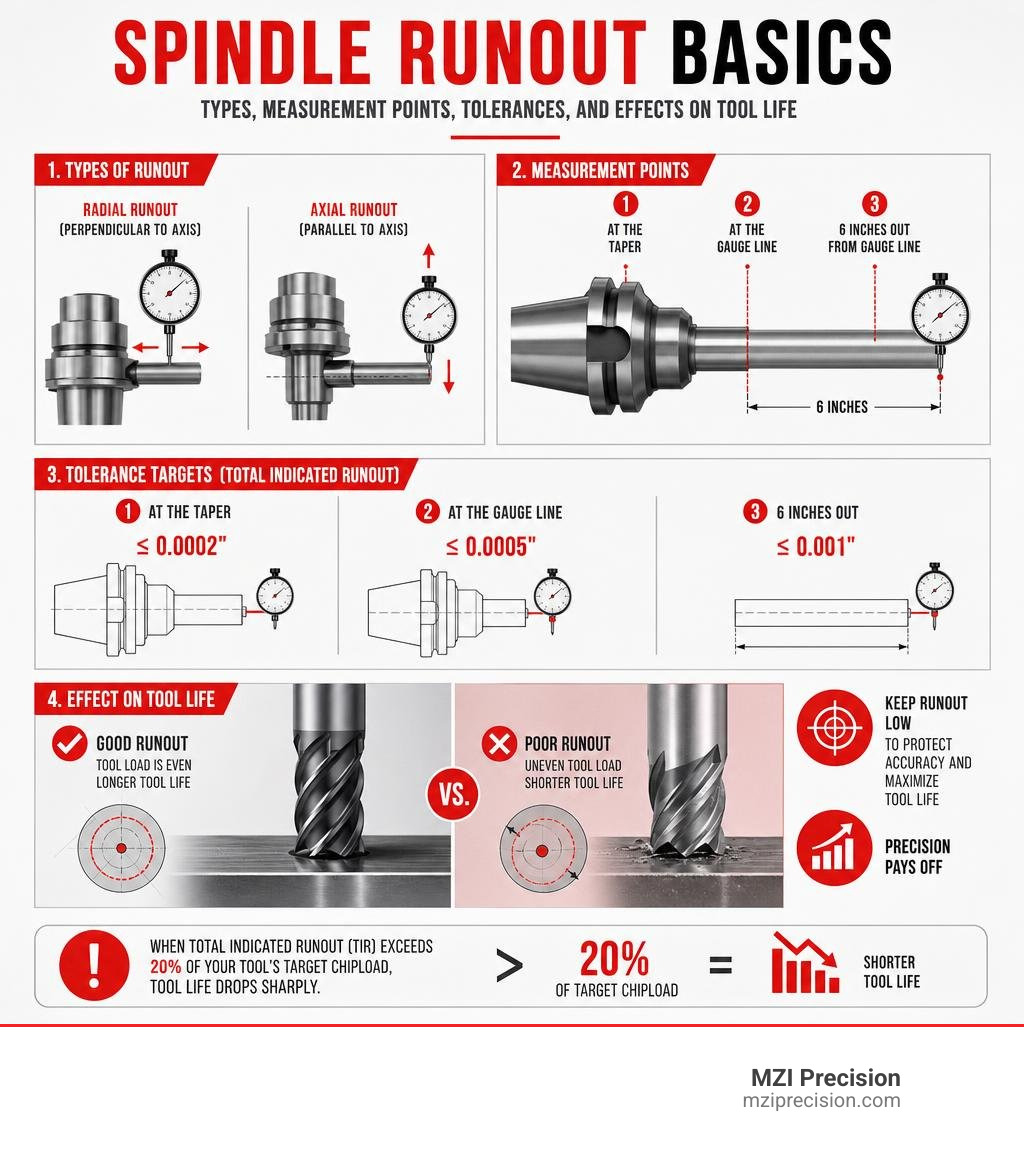
- Definition: The deviation of a rotating spindle from its true axis of rotation, measured as Total Indicated Runout (TIR)
- Types: Radial runout (error perpendicular to the axis) and axial runout (error parallel to the axis)
- How it’s measured: Dial test indicator or non-contact sensor against a precision test bar, at the taper, gauge line, and 6 inches out
- Acceptable limits: No more than 0.0002″ at the taper, 0.0005″ at the gauge line, and 0.001″ at 6 inches from the gauge line
- Why it matters: When TIR exceeds 20% of your tool’s target chipload, tool life drops sharply — reducing runout on carbide drills from 0.0006″ to 0.00008″ has been shown to deliver a 3x improvement in tool life
Even a few ten-thousandths of an inch of runout can mean the difference between a tool that lasts a full shift and one that breaks in the first hour. For small-diameter tools — say, a 1/8″ end mill — even 0.0008″ of runout can exceed 100% of the intended chipload, leading to near-immediate breakage.
This article walks you through exactly how to measure spindle runout accurately, what tolerances to target, and what to do when your numbers are out of spec.
Understanding Spindle Runout and Its Impact on Machining
When we talk about high-precision manufacturing in industries like aerospace, medical, and defense, we are often chasing tolerances measured in microns. At this level of precision, any deviation in the rotation of the industrial manufacturing spindle is magnified.
If your spindle has even a tiny wobble, your cutting tools will not engage the material evenly. Instead of a smooth, continuous cut, the tool experiences a rapid hammering effect. This is why understanding and managing rotational deviation is essential to preventing premature spindle failure analysis and keeping your shop running efficiently.
For a deeper dive into how these errors manifest dynamically under laboratory conditions, you can read the Scientific research on spindle error movements.
What is Spindle Runout and Why Does It Matter?
At its core, spindle runout is the deviation of the spindle’s actual rotational axis from its theoretical, perfect axis of rotation. When a spindle is in perfect health, the center point of the tool rotates in a perfect circle. When runout is present, that circle becomes eccentric or wobbles.
This matters immensely for several reasons:
- Machining Accuracy: Runout makes it impossible to hold tight tolerances. Holes will be bored oversize, pockets will be cut too wide, and 3D surfaces will have dimensional errors.
- Tool Chatter and Surface Finish: The eccentric rotation causes the cutting edges to hit the material with uneven force. This induces tool chatter, leaving unsightly scallops and rough surface finishes on your parts.
- Tool Life Degradation: Solid carbide drills and end mills are incredibly rigid but highly sensitive to shock. When a tool wobbles, one flute takes a much larger bite of material (chip load) than the others. This uneven chip load causes rapid edge chipping and catastrophic tool breakage.
How dramatic is this tool life killer? Industry tests show that reducing runout on carbide drills from 0.0006″ to 0.00008″ results in an incredible 3x tool life improvement. If you are tired of throwing money into the carbide recycling bin, managing your runout is the single best place to start.
Types of Spindle Runout: Axial vs. Radial
To diagnose and fix runout, we must first understand the different ways a spindle can wobble. The ASME B89.3.4-2010 standard defines these error motions precisely:
- Radial Runout: This is deviation perpendicular to the spindle’s axis of rotation. If you place an indicator on the outside diameter of the spindle shaft or toolholder and rotate it, any movement of the needle represents radial runout. This is the primary culprit behind oversized holes, poor side-wall surface finishes, and uneven chip loads.
- Axial Runout: This is deviation parallel to the spindle’s axis of rotation (up and down). It is measured on the flat face of the spindle nose or the bottom of a toolholder. Axial runout causes depth inaccuracies, uneven wear on the bottom face of end mills, and poor finishes during face milling operations.
- Circular Runout vs. Total Runout: In GD&T (Geometric Dimensioning and Tolerancing) terms, circular runout limits the error at a single circular slice along a cylinder. Total runout controls the entire surface of the cylinder simultaneously, accounting for taper, straightness, and angular misalignment.
Understanding these distinctions helps us isolate whether an issue lies in the spindle bearings, the taper itself, or the toolholder assembly.
How to Measure Spindle Deviation on a VMC
To get an accurate picture of your machine’s health, you need to know how to check spindle runout using the right equipment and procedures. Relying on guesswork or using worn-out tools will only lead to frustrating, inconsistent readings.
Before you begin, you must decide whether to perform static or dynamic testing. Static testing is done with the spindle turned off, rotating it slowly by hand. It is simple, highly accessible, and excellent for checking physical wear on the taper.
Dynamic testing, on the other hand, measures the spindle while it is running at operating speeds. This captures the effects of heat, centrifugal forces, and bearing vibration, though it requires specialized non-contact sensors.
For a comprehensive look at how these testing methods impact your machining environment, check out this Guide on measuring spindle runout.
Step-by-Step Dial Indicator Measurement Procedure
For most machine shops, the dial test indicator (DTI) and a precision ground test bar (often called a spindle runout arbor) are the gold standards for quick, accurate static verification. Here is our recommended procedure to get reliable measurements:
- Preheat the Spindle: Always run the spindle at moderate speed for 15 to 20 minutes to reach its normal operating temperature. Thermal expansion can significantly alter your readings.
- Clean the Taper Thoroughly: Any tiny speck of dust, dried coolant, or carbon buildup inside the spindle taper will throw off your measurements. Clean the taper using a dedicated taper wiper and a residue-free solvent.
- Inspect and Clean the Test Bar: Ensure your precision test bar is free of nicks or scratches. Wipe its mating taper clean.
- Mount the Test Bar: Insert the test bar into the spindle taper. If your machine uses a drawbar, clamp it with standard retention force.
- Set Up the Indicator: Mount a high-resolution dial test indicator (preferably with 0.0001″ or 0.00005″ increments) on a rigid magnetic base secured to the machine table or column. Avoid flimsy magnetic bases that can flex.
- Measure at the Taper Mouth: Place the indicator stylus just inside the mouth of the spindle taper. Rotate the spindle slowly by hand and record the Total Indicated Runout (TIR) — the difference between the highest and lowest points on the dial.
- Measure at the Gauge Line: Move the indicator stylus to the test bar’s gauge line (just below the spindle nose). Rotate the spindle slowly and record the TIR.
- Measure at 6 Inches Out: Finally, position the indicator stylus on the test bar exactly 6.0 inches (150 mm) away from the gauge line. Rotate the spindle slowly and record this final reading. This measurement is crucial because any angular error inside the taper is amplified the further you get from the spindle nose.
Advanced Dynamic Testing and Error Separation
While hand-rotating a spindle tells you a lot about mechanical alignment, it does not show how the spindle behaves at 10,000 or 20,000 RPM. Under dynamic conditions, centrifugal forces can cause the spindle shaft to grow, and bearing preloads can shift.
Advanced diagnostic systems use non-contact eddy-current sensors to measure spindle runout dynamically. These sensors sit close to a high-precision cylindrical target without touching it, measuring distance changes down to the sub-micron level.
By using multiple probes arranged at 90-degree angles, these systems can measure five-degrees-of-freedom error motions, separating the geometric form errors of the test target from the actual spindle error.
This advanced approach allows engineers to isolate:
- Synchronous Error: Errors that repeat at the exact same angular position with every revolution (often caused by out-of-round shafts or damaged tapers).
- Asynchronous Error: Non-repeating errors that occur randomly (usually indicating worn, pitted, or under-lubricated spindle bearings).
To learn more about the mathematics and sensor setups behind this precision methodology, consult the Research on multi-probe error separation.
Acceptable Runout Tolerances and Maintenance Standards
Once you have recorded your runout measurements, you need to compare them to industry-standard tolerances. If your machine is cutting general-tolerance parts, you might tolerate slightly higher values than a medical mold-making shop. However, exceeding maximum limits will quickly destroy your tools and spindle bearings.
To keep your machine running smoothly, we recommend performing a formal spindle runout check at least once a month, or immediately following any tool crash.
The table below outlines the industry-accepted maximum TIR limits across different machine classes:
| Measurement Location | Standard CNC VMC (CAT/BT40) | Precision / Micro-Milling VMC | High-Speed Spindle (HSK) |
|---|---|---|---|
| Inside Spindle Taper | 0.0002″ (0.005 mm) | 0.0001″ (0.0025 mm) | 0.00005″ (0.0012 mm) |
| At the Gauge Line | 0.0005″ (0.013 mm) | 0.0002″ (0.005 mm) | 0.0001″ (0.0025 mm) |
| 6.0″ (150mm) from Gauge Line | 0.0010″ (0.025 mm) | 0.0004″ (0.010 mm) | 0.0002″ (0.005 mm) |
For more details on verifying these numbers against original equipment manufacturer specs, see this guide on Spindle runout specifications.
In addition to measuring runout with an indicator, two other factors are critical for a healthy spindle interface:
- Drawbar Force Verification: A spindle taper relies on massive clamping force to hold the toolholder securely. If your drawbar springs are fatigued, the toolholder will fretted, vibrate, and exhibit massive runout under load. A CAT40 spindle typically requires 1,200 to 1,500 kgf (2,650 to 3,300 lbf) of pull force, while HSK-A63 requires 1,000 to 1,200 kgf.
- Prussian Blue Taper Inspection: To check the physical contact between your spindle taper and toolholders, apply a thin layer of high-spot blue (Prussian blue) paste to a clean, high-quality toolholder taper. Clamp it into the spindle, unclamp it, and inspect the contact pattern. The fit into the taper is correct when at least 75% of high-spot paste has been rubbed off evenly, concentrated near the large end. If you see a “bell-mouthed” pattern where only the very front makes contact, your taper is worn and needs professional attention.
How to Reduce and Correct Spindle Deviation
If your runout measurements are higher than the acceptable limits listed above, do not panic. Before you assume you need a complete spindle rebuild, there are several on-machine adjustments and maintenance steps you can take to isolate and reduce the error.
Often, what looks like a damaged spindle is actually a dirty taper, a worn collet, or a cheap toolholder. By systematically checking each component, you can save your shop thousands of dollars in unnecessary repairs. For a deep dive into these correction techniques, read our spindle runout correction complete guide.
The Role of Toolholders, Collets, and Pull Studs
Runout is an additive problem. This is known as runout stacking. If your spindle taper has 0.0001″ of runout, your toolholder has 0.0002″, and your collet has 0.0003″, your total runout at the tool tip could easily reach 0.0006″ or more.
To minimize runout stacking, pay close attention to your tooling components:
- Toolholder Quality: Not all toolholders are created equal. Worn side-lock (Weldon flat) holders inherently push the tool to one side, introducing runout. High-quality ER collet chucks typically deliver between 0.0004″ and 0.0008″ of runout. For ultra-precision work, hydraulic holders (0.0002″ to 0.0004″ runout) or shrink-fit holders (less than 0.0001″ runout) are highly recommended.
- Collet Wear: Collets are consumable items! Over time, they lose their elasticity, accumulate micro-debris, and sustain minor damage from broken tools. If you are breaking small end mills, swap out your collets regularly.
- Pull Studs (Retention Knobs): A damaged, dirty, or poorly machined pull stud can pull the toolholder into the spindle at a slight angle. Ensure your pull studs are torqued to the manufacturer’s exact specifications.
- “Clocking” Your Toolholders: This is a fantastic trick for reducing runout on the machine. If you measure runout at the tool tip, mark the high spot. Unclamp the holder, rotate it 180 degrees in the spindle taper, and clamp it again. If the runout decreases, you have successfully used the toolholder’s runout to partially cancel out the spindle’s runout.
Step-by-Step Spindle Taper Maintenance
Keeping your spindle taper clean is the easiest way to prevent runout and extend the life of your machine. Here is a simple maintenance routine you should perform weekly (or daily in high-production environments):
- Step 1: Solvent Cleaning: Spray a lint-free cloth with a residue-free solvent or light degreaser. Wipe the inside of the spindle taper thoroughly to remove dried coolant, oil, and small chips.
- Step 2: Use a Taper Wiper: Insert a clean taper-cleaning tool (matching your spindle taper size, e.g., CAT40, HSK63) and rotate it to sweep out any remaining micro-particles.
- Step 3: High-Spot Paste Verification: Periodically use Prussian blue paste on a master test bar to verify that your taper has at least 75% contact coverage. If you notice uneven contact or heavy wear lines, the taper may need to be professionally ground.
- Step 4: Stress Relief on Helical Nuts: On some high-speed spindles, stress can build up over time in the helical threads of the retaining nut on the back of the spindle shaft. In specialized maintenance scenarios, technicians can use a spring punch to gently relieve stress in the helical nut threads, helping to dial back unacceptable runout on the shaft.
Frequently Asked Questions about Spindle Deviation
What is the acceptable tolerance for a CNC VMC?
For a standard industrial CNC Vertical Machining Center (VMC) using CAT40 or BT40 tooling, the general acceptance criteria are:
- At the spindle taper: Max TIR of 0.0002 inches (0.005 mm).
- At the gauge line: Max TIR of 0.0005 inches (0.013 mm).
- At 6.0 inches from the gauge line: Max TIR of 0.001 inches (0.025 mm).
If you are running high-speed HSK spindles or performing micro-machining, these tolerances are cut in half, requiring less than 0.00005″ at the taper.
How does rotational error affect tool life?
Rotational error (runout) is incredibly destructive because it causes uneven chip load. As a general rule of thumb, tool life drops dramatically when TIR exceeds 20% of the cutter’s targeted chipload.
For example, if you are running a 1/8″ carbide end mill with a target chipload of 0.0006″ per tooth, a runout of 0.0008″ represents over 130% of your chipload! This means one tooth is doing all the work and taking a massive shock load, leading to rapid chipping and immediate tool breakage. Conversely, reducing your runout on carbide drills can yield a 3x tool life improvement.
When should you consider professional spindle repair or rebuild?
While cleaning and switching to high-quality toolholders can resolve minor runout issues, some problems require professional intervention. You should consider contacting a professional rebuild specialist if you experience:
- Spindle Bearing Failure: If you hear abnormal spindle bearing noise (such as grinding, whistling, or roaring) or notice excessive heat buildup near the spindle nose, your bearings are failing. This can be verified through spindle vibration analysis.
- Severe Crash Damage: If the machine suffered a major crash, the spindle shaft may be bent or the taper deformed.
- Loss of Drawbar Force: If your drawbar pull-force drops below 70% of its rated specification, your tools will slip and vibrate, causing massive runout under load.
- Deep Taper Scoring: If a toolholder has spun inside the taper, it will leave deep grooves and galling that cannot be cleaned off.
For more information on diagnosing these issues, read our guide on spindle bearing failure.
Conclusion
Measuring and managing spindle runout is one of the most effective ways to protect your tools, improve your surface finishes, and keep your shop profitable. By implementing regular taper maintenance, using high-quality toolholders, and performing monthly dial-indicator checks, you can catch wear before it leads to catastrophic tool breakage or part rejection.
However, when spindle bearings begin to fail or tapers become bell-mouthed, on-machine adjustments are no longer enough. That is where we come in.
At MZI Precision, we are experts in industrial manufacturing spindle rebuilding and repair. Based in the United States, we serve high-precision industries across the country — including aerospace, defense, medical manufacturing, and other industrial production environments. Our core expertise lies in rebuilding spindles to original OEM specifications, backed by state-of-the-art diagnostic equipment and exceptional customer support.
If your spindle is making noise, running hot, or showing unacceptable runout, do not wait for it to crash. Contact us today for our professional spindle repair services, and let us get your machine running with the precision your business deserves.