


How to keep your horizontal machining center spindle spinning perfectly
Why Spindle Maintenance Determines the Quality of Every Part You Machine
Spindle maintenance is the set of inspection, cleaning, lubrication, and monitoring practices that keep your CNC spindle running accurately — and it directly controls whether your parts pass or fail tolerance.
Quick answer for busy shops:
- Clean the spindle taper before every tool change
- Inspect for runout monthly (TIR must stay within 0.0002″ at the taper)
- Verify drawbar clamping force with a calibrated tool
- Watch for early warning signs: vibration, unusual noise, or surface finish changes
- Perform deeper inspections more often when cutting abrasive materials like graphite or cast iron
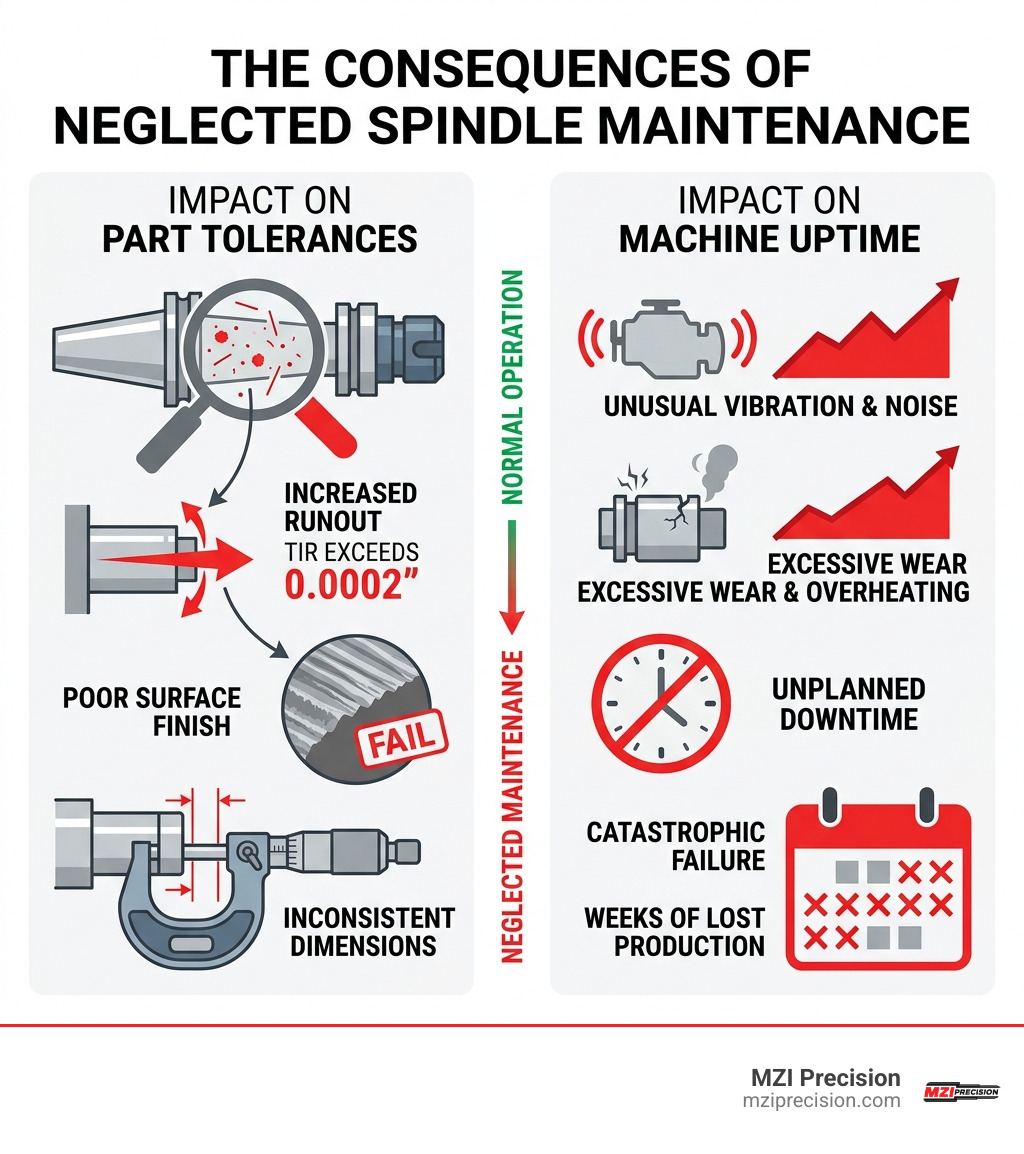
Think of your spindle as the single point where everything — bearings, toolholder, cutting force, and part accuracy — converges. When it’s healthy, your machine holds tight tolerances and delivers clean surface finishes shift after shift. When it’s neglected, even small irregularities inside the taper or at the face show up directly on your finished parts.
For aerospace manufacturers and other high-precision shops, that’s not a minor inconvenience. It’s scrapped parts, missed deliveries, and unplanned downtime that can stretch into weeks.
The good news? Most spindle problems don’t appear without warning. They announce themselves early — through vibration, noise, heat, or subtle changes in part quality — long before catastrophic failure. Knowing what to look for, and when, is what separates shops that run smoothly from those that are constantly reacting to the next crisis.
This guide walks you through exactly how to keep your horizontal machining center spindle spinning perfectly.
The Core Pillars of Effective Spindle Maintenance

To keep a horizontal machining center (HMC) or vertical machining center (VMC) performing at peak capacity in April 2026, we must focus on three core pillars: taper protection, consistent lubrication, and contamination prevention.
Spindle Maintenance isn’t just a box to tick on a Friday afternoon; it is a rigorous discipline. The spindle taper is the interface between the machine’s power and the cutting tool. If this interface is compromised by even a microscopic layer of dust or dried coolant, the toolholder won’t seat correctly. This leads to “runout,” which causes uneven tooth loading on your cutters and poor surface finishes.
Care Maintenance Of Your Spindle requires a “clean as you go” mentality. Every time a tool is changed, the taper should be free of debris. Furthermore, we must address the “invisible” enemies: moisture and oil in the air supply. Many modern spindles use an air-purge system to create a positive pressure barrier, keeping contaminants out of the bearings. If your shop air is wet or dirty, you are essentially pumping sandpaper and rust into your high-precision bearings.
Effective Maintenance for CNC Spindle also involves managing the “thermal growth” of the machine. A proper warm-up routine—running at 10-15% of maximum RPM for 10 to 15 minutes—allows the grease to distribute evenly and the metal components to expand uniformly before you start hitting high-speed cycles.
Essential Tools for Spindle Maintenance
You wouldn’t perform surgery with a butter knife, and you shouldn’t maintain a $50,000 spindle with hardware-store tools. To get professional results, we recommend a specialized kit:
- Dyna Contact: This gauge is used with high-spot blue dye to verify the “contact percentage” between the toolholder and the spindle taper.
- Dyna Force: A digital retention force gauge that measures exactly how hard the drawbar is pulling the tool into the spindle.
- Dial Indicator (0.0001″ resolution): Essential for measuring runout.
- Precision Test Bar: A calibrated, hardened steel bar used as a “perfect” reference tool to check for spindle alignment and runout.
Using these tools as part of your Tips for Spindle Maintenance, Repair and Rebuild routine ensures that you are making decisions based on data, not guesswork.
Implementing a Spindle Maintenance Schedule
Consistency is the secret sauce. A spindle that is cleaned religiously but never checked for drawbar force is still a liability. We suggest the following cadence:
- Daily: Clean the taper and toolholders. Perform a 15-minute warm-up. Listen for “new” noises.
- Monthly: Perform a runout check using a test bar. Inspect the air filters and lubrication levels.
- Quarterly/Annually: Conduct a full retention force test and vibration analysis.
If you are machining abrasive materials like cast iron or graphite, your Cnc Spindle Maintenance schedule should be even more aggressive, as these fine particles can bypass seals more easily than standard aluminum or steel chips.
Precision Inspection: Measuring Runout and Taper Integrity
When we talk about spindle health, “Runout” is the metric that matters most. Total Indicated Runout (TIR) measures the deviation of the spindle’s axis of rotation from a perfect circle.
For high-precision industrial work, the TIR at the spindle taper must not exceed 0.0002″ (0.005 mm). As you move further away from the spindle face, the tolerance naturally increases, but it must stay within strict limits to prevent tool chatter.
[TABLE] Acceptable TIR Tolerances (Industrial Standards)
| Measurement Location | Maximum Acceptable TIR |
|---|---|
| Inside Spindle Taper | 0.0002″ (0.005 mm) |
| At the Gauge Line | 0.0005″ (0.013 mm) |
| 6.0″ (150 mm) from Gauge Line | 0.0010″ (0.025 mm) |
If you find that your Spindle Runout Check exceeds these numbers, it’s a sign that your bearings are wearing out or your taper has been damaged by “fretting” (micro-vibrations that weld tiny particles of metal between the holder and the taper).
Verifying Taper Fit with High-Spot Paste
A spindle taper can look shiny and clean to the naked eye while being “bellmouthing”—meaning the opening is wider than the interior. To verify the fit, we use the high-spot paste test.
Apply a thin, even layer of blue dye to a Dyna Contact gauge or a known-good toolholder. Insert it into the spindle and give it a slight turn. When you remove it, the dye should be rubbed off on at least 75% of the surface. If you only see contact at the very front or the very back, your Spindle Health is at risk, and you likely have a taper geometry issue that requires professional grinding.
Measuring Drawbar Retention Force
The drawbar is the “unsung hero” of the spindle. It uses a stack of Belleville washers to pull the toolholder into the taper with thousands of pounds of force. Over time, these washers can fatigue or crack, leading to a loss of clamping pressure.
A reduction in retention force leads to chatter, poor tool life, and—in extreme cases—the tool being pulled out of the spindle during a heavy cut. Using a tool like the Dyna Force allows us to see reductions in force in increments as small as 0.1kN. If your force has dropped by 10-20% from the OEM spec, it is time for a drawbar rebuild. This is a critical step in How To Check Spindle Runout and overall system rigidity.
Advanced Strategies: Preventive vs. Predictive Care
In industrial manufacturing, there are three ways to handle maintenance:
- Reactive Maintenance: You run the spindle until it screams, smokes, or seizes. This is the most expensive method, as it leads to unplanned downtime and often destroys internal components that could have been saved.
- Preventive Maintenance: You perform service based on a calendar or “hours used” (e.g., checking the drawbar every 2,000 hours). This is much safer than reactive care, but you might occasionally replace parts that still had life in them.
- Predictive Maintenance: This is the gold standard for 2026. By using IoT sensors, Electric Motor Predictive Maintenance tools, and thermography, we can monitor the “pulse” of the spindle in real-time.
Spindle Vibration Analysis is a key part of predictive care. By using an accelerometer to measure the frequency of vibrations, we can identify exactly which bearing is failing long before it produces a sound audible to the human ear. If you can hear the spindle growling, it’s already in the “late stage” of failure. Predictive tools catch it in the “early stage,” allowing you to schedule a repair during a planned weekend shutdown rather than a Tuesday morning production rush.
Troubleshooting Common Industrial Spindle Failures
Even with the best Spindle Maintenance, parts eventually wear out. Knowing why they fail helps us prevent the next occurrence.
- Bearing Fatigue: This is the most common “natural” death. High speeds and heavy loads eventually cause the metal to flake (spalling).
- Contamination: If coolant or chips get past the seals, they wash away the grease or act as an abrasive. This often happens if the air-purge system fails or if operators spray high-pressure compressed air directly at the spindle nose.
- Imbalance: Running unbalanced toolholders at high RPM is like driving a car with a missing lug nut. The vibration hammers the bearings, leading to premature failure. We recommend balancing toolholders for any operation exceeding 8,000 to 10,000 RPM.
If you are asking yourself, “Are My Spindle Bearings Bad?”, listen for a high-pitched screech or a low-frequency rumble. You can also check the temperature; a healthy spindle should run warm, but never so hot that you cannot comfortably keep your hand on the housing. For a deeper dive into these auditory cues, see our Spindle Bearing Noise Complete Guide.
As noted in A Dake Guide to Spindle Maintenance, the cost of a professional rebuild is significantly lower than the cost of a new spindle, but only if you catch the failure before the internal shaft or housing is damaged beyond repair.
Frequently Asked Questions about Spindle Care
How often should I clean my VMC or HMC spindle taper?
Clean the taper every single time you change a tool manually. For automated tool changes, ensure the “air blast” feature is functioning correctly to blow chips off the taper. A deep manual cleaning with a specialized taper wiper should be done at the end of every shift.
What are the early warning signs of bearing failure?
The “Big Three” are noise, heat, and finish. If the spindle sounds like it’s “grinding,” if the housing is too hot to touch, or if you see “ghosting” or “ripples” on your part surface that weren’t there yesterday, your bearings are likely failing.
Why should I remove toolholders when the machine is idle?
This is a pro tip many shops miss. If you leave a toolholder in the spindle overnight, the coolant can “bond” the holder to the taper through a process called fretting or electrolysis. Furthermore, the weight of a heavy toolholder sitting in a horizontal spindle for days can theoretically put uneven pressure on the bearings. Always end your shift with an empty, clean spindle.
Conclusion
At MZI Precision, we’ve seen how a little bit of proactive care can save a shop tens of thousands of dollars. Whether you are in aerospace, defense, or automotive manufacturing, your spindle is the heart of your operation.
We specialize in OEM-quality spindle rebuilding and repair, serving the United States from our Huntington Beach, California, and Los Angeles area locations. Our team understands the rigorous standards required for high-precision industrial manufacturing, and we are committed to getting your machine back in the “green” with minimal downtime.
Don’t wait for the screech of a seized bearing to take action. Implement a predictive maintenance plan today to keep your production line moving. More info about professional spindle repair services is just a click away, or you can contact us to discuss a custom maintenance strategy for your shop.