


Precision Spindle Assembly: The Nuts and Bolts of Accuracy
Why Precision Spindle Assembly Matters for Manufacturing Excellence
Precision spindle assembly is the process of carefully selecting, mounting, and configuring the rotating components at the heart of your machine tool—the shaft, bearings, housing, seals, and drive system that deliver accurate rotational motion to transform raw materials into finished parts. When these components work together with tolerances measured in microns, your spindle achieves the accuracy and speed your manufacturing operation depends on.
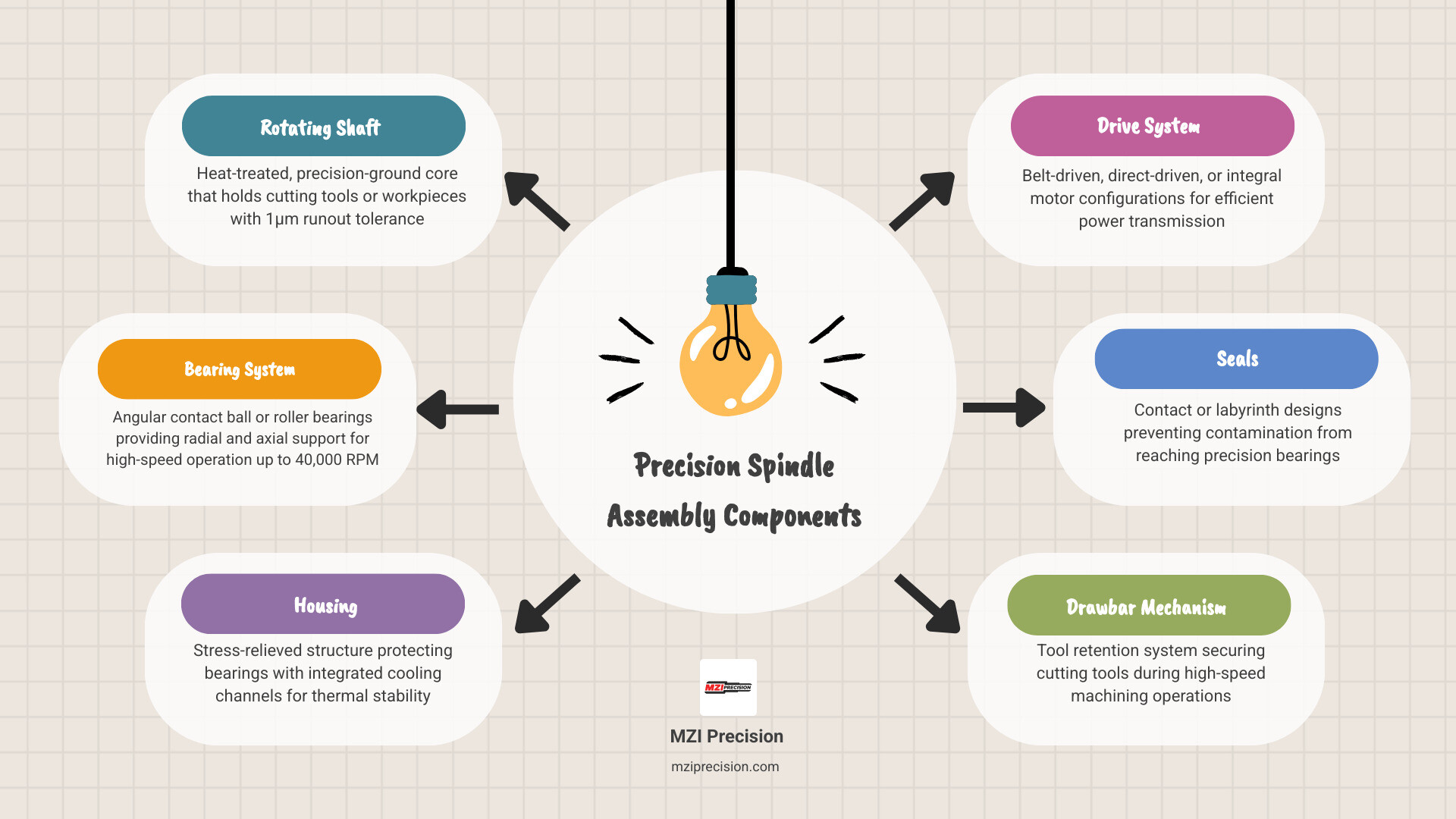
Key Components of Precision Spindle Assembly:
- Rotating Shaft – Heat-treated, precision-ground core that holds cutting tools or workpieces
- Bearing System – Angular contact ball bearings or roller bearings providing radial and axial support
- Housing – Stress-relieved structure that protects bearings and provides cooling channels
- Drive System – Belt-driven, direct-driven, or motorized configurations for power transmission
- Seals – Contact or labyrinth designs that prevent contamination from reaching bearings
- Drawbar Mechanism – Tool retention system that secures cutting tools during operation
Think of a spindle as the beating heart of your machine tool. When your spindle fails, everything stops. But unlike a simple motor, precision spindles must maintain accuracy within 1 micron while spinning at speeds up to 40,000 RPM. That’s why assembly isn’t just about putting parts together—it’s about achieving dimensional and geometrical accuracies measured in sub-microns.
The difference between a spindle that delivers years of reliable service and one that fails prematurely often comes down to assembly details. Contamination from a single fingerprint (15 microns) can damage bearings ground to tolerances of 2 microns or less. A bearing heated 10 degrees too hot during shrink fit can compromise its precision forever. Even the amount of grease matters—15% of bearing free volume for angular contact bearings, 10% for cylindrical roller bearings.
For manufacturing companies in aerospace and other precision industries, these details directly impact production quality and uptime. Every precision bearing receives 100% inspection during manufacturing, but proper assembly techniques are what transform individual components into a system capable of maintaining accuracy over thousands of hours of operation.
Important precision spindle assembly terms:
Core Components of a Precision Spindle Assembly
At its core, a precision spindle assembly is a masterpiece of engineering where several critical parts must interact with absolute harmony. We often think of the housing as a “protective fortress.” Usually made of stress-relieved cast iron, the housing provides a stable environment for the internal components, featuring intricate utility channels for lubrication and cooling.
The rotating shaft is the “muscle” of the unit. These shafts are typically manufactured from heat-treated alloy steel and precision ground to ensure that runout is kept to a minimum. Most modern shafts are hollow and tapered to accommodate a drawbar mechanism. This drawbar is the tool retention system that uses hydraulic or pneumatic actuation to pull the tool holder into the spindle taper with immense force, ensuring it doesn’t budge during heavy cuts.
For a deeper dive into these individual elements, you can explore our Precision Machine Spindle Complete Guide or check out A Comprehensive Guide to Spindle Parts.
Bearing Systems in Precision Spindle Assembly
The bearing system is the unsung hero of the precision spindle assembly. It must support the shaft while allowing it to rotate at high speeds with almost zero friction. We generally use two main types:
- Angular Contact Ball Bearings: These are the gold standard for high-speed spindles. They handle both radial and axial loads and are designed to run with specific preloads to eliminate any internal play.
- Cylindrical Roller Bearings: When your application requires massive radial stiffness and load capacity (like in heavy-duty grinding), roller bearings are the go-to choice.
Choosing the right bearing is a balancing act between speed and rigidity. If you are wondering if Are Angular Contact Bearings Good for High Speed Precision Spindles?, the answer is usually a resounding yes, provided the contact angle and preload are matched to the job. You can also find more info about bearing types to see how different geometries affect performance.
Drive Systems and Labyrinth Seals
How we get the spindle spinning depends on the application’s speed and torque requirements.
- Belt-Driven Spindles: These use an external motor and belts. They are great for high-torque, lower-speed work (typically up to 12,000–15,000 RPM), but belt tension can put extra radial stress on the bearings.
- Integral (Motorized) Spindles: Here, the motor is built directly into the housing. This allows for speeds exceeding 40,000 RPM and eliminates the vibration associated with belts.
To protect these high-tech internals, we use advanced sealing. Labyrinth seals are non-contact designs that use a “maze” path to stop liquids and dust. When combined with air overpressure—where we pump clean, dry air into the spindle to create a positive internal pressure—it becomes nearly impossible for contaminants to enter. Since external contamination is the leading cause of premature failure, this “air curtain” is vital for longevity.
Engineering the Perfect Fit: Bearing Selection and Preload
In precision spindle assembly, “close enough” is never good enough. We use precision grades to define how accurate a bearing is.
| Precision Grade | Description | Typical Application |
|---|---|---|
| P4 / ABEC 7 | Standard high precision | General CNC milling and turning |
| P3 | P4 external / P2 internal | Cost-effective high accuracy |
| P2 / ABEC 9 | Ultra-high precision | High-speed grinding and micro-machining |
The contact angle is another critical choice. An 18-degree angle has become a standard for high-speed products because it offers excellent bending stiffness. However, for applications requiring high axial thrust (like drilling), a 25-degree angle might be preferred. For more technical details, you can read this scientific research on bearing tolerances or our guide on Decoding Spindle Assemblies: Your Go-To Bearing Breakdown.
Preload Methods for Precision Spindle Assembly
Preload is the “squeeze” we put on bearings during assembly to remove all internal clearance. This increases rigidity and prevents the balls from skidding at high speeds.
- Back-to-Back (DB): This is the most common arrangement. It provides high moment stiffness, meaning the spindle resists “tilting” or bending under load.
- Tandem (DT): Used when you need to share a heavy axial load across two bearings.
- Face-to-Face (DF): Less common in spindles, as it is less resistant to moment loads.
Applying the correct preload is a delicate science. If it’s too light, the spindle will vibrate; if it’s too heavy, the bearings will overheat and fail. You can learn more about the specifics of Spindle Bearing Assembly and how these configurations impact your machine’s performance.
Radial Internal Clearance in Roller Bearings
For spindles using cylindrical roller bearings, we don’t just “drop them in.” These often have a tapered bore. As we drive the bearing up the tapered shaft, the inner ring expands, reducing the radial internal clearance.
- Target Preload: For tool-side bearings, we often aim for a 2µm preload.
- Target Clearance: For rear-side bearings, a 5µm clearance is typical to allow for thermal expansion of the shaft.
For every 12µm you move the bearing up the taper, the internal clearance is reduced by roughly 1µm. This level of control is what separates a standard rebuild from a true precision spindle assembly.
The Assembly Process: Cleanliness and Mounting Techniques
If there is one rule in our shop, it’s this: Cleanliness is everything. We treat the assembly area like a surgery suite.
- Filtration: Any washing solutions used must be filtered to at least 5µm.
- Handling: We use lint-free gloves because the acids in a single fingerprint can cause microscopic corrosion.
- Grease Quantity: More is not better! For angular contact bearings, we use exactly 15% of the free volume. For roller bearings, it’s 10%. Over-greasing causes “churning,” which leads to rapid heat buildup.
Our Spindle Assembly Repair Complete Guide covers these protocols in even greater detail.
Shaft and Housing Metrology
Before a single bearing is pressed, we perform exhaustive metrology. We check the shaft and housing for any flaws, burrs, or size deviations.
- Parallelism: Spacers must be parallel within 3 microns. If they aren’t, the bearing will sit “cocked,” leading to noise and heat.
- Runout: If a shaft has 2µm of runout, we can often orient the bearing’s “high point” opposite the shaft’s “high point” to cancel the error out, bringing the final runout close to zero.
This meticulous checking is a core part of Precision Spindle Metrology.
Fitting Procedures: Press vs Shrink Fit
How we get the bearing onto the shaft depends on the size.
- Press Fit: Usually reserved for smaller bearings (under 30mm bore).
- Shrink Fit: For larger bearings, we heat the inner ring using an induction heater. Crucially, we never exceed 120°C. Heating a bearing too much can change the metallurgy of the steel.
Once the bearing is seated, we apply the correct locknut torque and check the radial runout. Our goal for a high-speed spindle is a final runout of less than 2µm. For more on this process, see the Spindle Bearing Replacement Complete Guide.
Troubleshooting and Performance Upgrades
Even the best-built spindles can run into trouble. Most issues manifest as either heat or noise. High temperatures are often caused by incorrect preload or lubricant “churning,” while noise usually points to contamination or a damaged raceway.
One of our favorite upgrades is the use of hybrid ceramic bearings. These use steel rings but ceramic (silicon nitride) balls. Because ceramic balls are 60% less dense than steel, they generate less centrifugal force at high speeds, allowing for 30% higher RPMs and significantly lower operating temperatures.
If you’re experiencing issues, our Precision Spindle Repair services can help diagnose the root cause.
Post-Mounting Checks and Run-in Procedures
Once the precision spindle assembly is complete, the work isn’t over. We perform a “run-in” procedure. This involves starting the spindle at low speeds and gradually increasing them while monitoring the temperature. If the temperature exceeds 70°C at the bearings, we shut it down and let it cool. This process “channels” the grease, pushing the excess out of the way of the balls so the spindle can run cool at high speeds.
We also perform dynamic balancing. For high-speed spindles, we aim for a G1.0 balance grade or better to ensure there is no vibration that could mar your surface finish. Learn more about this in The Balancing Game: Achieving Precision with High Speed Spindles.
Frequently Asked Questions about Spindle Assembly
Q: What is the most common cause of spindle failure? A: Contamination. Even smoke particles (6µm) or dust (25µm) are massive compared to the 1–2µm oil film that bearings ride on.
Q: How much grease should be used? A: For most precision spindle assembly work, 15% of the bearing’s free volume is the target for angular contact bearings.
Q: Can I use P4 bearings instead of P2? A: It depends on your speed and accuracy requirements. P2 tolerances are roughly half of P4. For ultra-precision grinding, P2 is non-negotiable.
Q: Why is my spindle getting hot during the first hour of use? A: This is often normal “grease churning.” A proper intermittent run-in procedure helps the grease settle without damaging the bearings.
Conclusion
At MZI Precision, we understand that a precision spindle assembly is more than just a collection of parts—it is the heart of your manufacturing capability. Based in the United States, we specialize in OEM rebuilt spindles, ensuring that your equipment returns to service with the same (or better) accuracy and reliability it had when it was brand new. Whether you are in aerospace, defense, or automotive manufacturing, our commitment to 1-micron accuracy and exceptional support ensures your operations keep spinning smoothly.
If you need expert assistance with your machine tools, explore more info about precision spindle services or contact us today to see how we can optimize your spindle performance.