


Everything You Need to Know About CNC Spindle Repair Shops
Why CNC Spindle Repair Matters for Industrial Manufacturing
CNC spindle repair is the process of restoring a damaged or worn industrial machine tool spindle to full working condition — replacing worn bearings, correcting balance, repairing tapers, and validating performance to OEM specifications.
Quick answer — what to know before you read on:
- Most spindles can be repaired, not replaced — saving significant cost and lead time
- Typical turnaround: 10–14 business days (expedited options as fast as 3 days)
- Spindle lifespan: 10–15 years with proper maintenance
- Repair covers: bearing replacement, taper repair, dynamic balancing, drawbar repair, run-in testing
- When to replace instead: only if the spindle is beyond economic repair or has suffered irreparable structural damage
In industrial manufacturing — especially in demanding sectors like aerospace and defense — a spindle is the heart of any CNC machine. It controls rotary motion, cutting speed, and surface finish. When it fails, everything stops.
The problem is that spindle issues rarely announce themselves loudly at first. They creep in — a slight increase in vibration here, a subtle drop in surface quality there. Left unchecked, what could have been a straightforward bearing replacement turns into a catastrophic failure and weeks of unplanned downtime.
The good news? The vast majority of spindle damage is fixable. Working with the right CNC spindle repair shop means you can get your machine back to full precision — often faster and at a fraction of the cost of a new spindle.
This guide walks you through everything: how to spot failure early, what the repair process actually involves, how to decide between repair and replacement, and what to look for in a qualified repair partner.
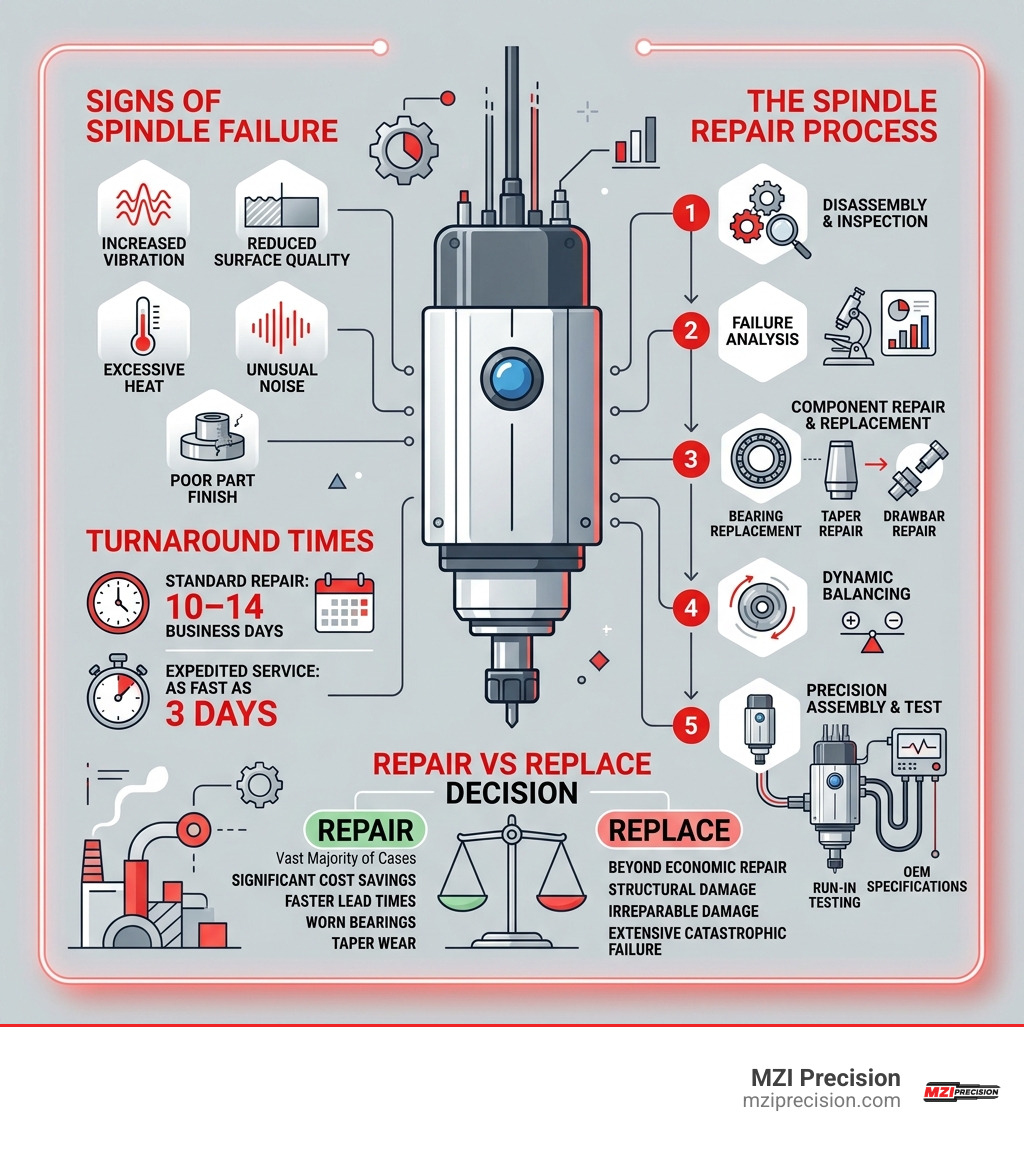
Identifying Common Signs of CNC Spindle Failure
Recognizing the early warning signs of failure is the difference between a scheduled maintenance event and an emergency shutdown. In industrial manufacturing, what is a spindle in a CNC machine is essentially the primary source of rotary motion. Because it operates at high speeds and under heavy loads, it is subject to immense physical stress.
The most common signs of trouble include:
- Excessive Vibration: This is often the first indicator. If your machine’s vibration levels increase, it usually points to worn bearings or an imbalanced tool.
- Unusual Noise: Grinding, screeching, or high-pitched whining sounds are red flags. These noises typically suggest that the internal lubrication has failed or the bearings are beginning to pit and gall.
- Poor Surface Finish: If your parts are showing “chatter” marks or inconsistent finishes that weren’t there before, your spindle might be experiencing runout or loss of rigidity.
- Thermal Expansion: While spindles get warm during operation, excessive heat—especially near the nose or motor housing—indicates friction issues that need immediate attention.
- Loss of Drawbar Force: If the tool holder isn’t being held with the correct tension, accuracy will plummet. This is often caused by fatigued springs or damaged drawbar components.
- Runout Issues: When the spindle taper is no longer perfectly concentric, the tool will “wobble,” leading to premature tool wear and out-of-tolerance parts.
For more detailed strategies on keeping your equipment running smoothly, you can find more info about spindle maintenance on our dedicated resource page.
Troubleshooting Common Spindle Repair CNC Issues
Before you ship your unit to a professional shop for spindle repair cnc, there are a few basic troubleshooting steps you can perform in-house:
- Vibration Analysis: Use a handheld vibration meter to check for spikes in velocity or acceleration. This helps distinguish between a spindle issue and a problem with the machine’s axes.
- Power Draw Monitoring: Check your CNC controller for unusual spikes in spindle load during standard cuts. Increased power draw often means the motor is working harder to overcome internal friction.
- Tool Chatter Checks: Ensure the chatter isn’t caused by the cutting tool itself or the workholding. Swap out the tool holder to see if the vibration persists.
- Lubrication Checks: Verify that the oil-air or grease injection system is functioning correctly. A dry spindle is a failing spindle.
If these basic checks don’t resolve the issue, it’s time to look into a professional spindle rebuild and replacement to prevent further damage to the shaft or housing.
The Professional Spindle Repair CNC Process
When a spindle arrives at a high-quality repair facility, it undergoes a rigorous, multi-step restoration. This isn’t just a “cleaning and greasing” job; it is a precision engineering project.
- Disassembly and Documentation: The unit is fully torn down. Every component is logged, and photos are taken to document the “as-found” condition. This helps identify the root cause of failure—whether it was contamination, a crash, or simple wear and tear.
- Chemical Cleaning: Parts are cleaned using ultrasonic tanks or specialized chemicals to remove every trace of old grease, coolant, and metal shavings.
- Geometric Inspection: We measure components down to the micron. This includes checking housing bores, shaft journals, and taper runout. If a taper is damaged, it may require a regrind to restore the proper interface.
- Dynamic Balancing: This is perhaps the most critical step. We balance the rotor shaft and the entire rotating assembly to G1 tolerance levels (or better). Even a few milligrams of imbalance at 20,000 RPM can destroy new bearings in hours.
- Reassembly in a Clean Room: To prevent contamination, spindles are reassembled in a controlled environment. This is where spindle bearing replacement happens, using high-precision ceramic or steel bearings.
- Run-in Testing: The spindle isn’t just turned on and shipped back. It undergoes a “run-in” period, gradually increasing RPM over several hours while we monitor temperature and vibration.
Our spindle rebuilding & repair services in California are designed to meet or exceed OEM specifications, ensuring that your CNC spindle rebuild provides the same longevity as a brand-new unit.
Advanced Testing and Validation
Validation is what separates a “repair” from a “restoration.” A reputable shop uses advanced tools to ensure the unit is ready for the production floor:
- Vibration Sensors: We use spectrum analysis to ensure there are no resonant frequencies that could cause issues at specific speeds.
- Thermal Monitoring: We track the temperature of the bearings throughout the run-in to ensure the lubrication and pre-load are perfect.
- Encoder Testing: For motorized spindles, we test the feedback systems and encoders to ensure the machine controller can accurately track speed and position.
- Final Balancing: A final trim balance is often performed on the completed assembly to ensure absolute smoothness.
This level of spindle repair ensures that when the unit is reinstalled, it is ready to make chips immediately.
Repair vs. Replace: Making the Right Decision
One of the most frequent questions we hear in April 2026 is whether it’s better to fix an old unit or buy a new one. In the vast majority of cases, spindle repair cnc is the superior choice.
| Feature | Professional Repair | New OEM Replacement |
|---|---|---|
| Cost | 30% – 60% of New | 100% Retail Price |
| Lead Time | 10 – 14 Days | 4 – 12 Weeks (or more) |
| Performance | Meets/Exceeds OEM | OEM Standard |
| Warranty | 6 – 24 Months | 12 Months |
| Legacy Support | Excellent for old models | Often Discontinued |
Choosing CNC spindle repair allows you to address the root cause of failure. An OEM replacement simply gives you the same design that failed in the first place. Through repair, we can often perform component upgrades—such as better seals or higher-grade bearings—that actually extend the life of the spindle beyond its original design.
However, if the main shaft is snapped or the housing is cracked beyond the point of safe machining, a replacement may be the only economically viable path. For most CNC machine spindle repair scenarios, rebuilding is the smartest move for your budget.
Cost-Benefit Analysis of Spindle Repair CNC
Beyond the invoice price, you have to consider the cost of downtime. A new spindle from a manufacturer might have a lead time of several months. Meanwhile, a professional repair shop can often have you back in production in under two weeks.
If you are running a Haas spindle repair, for example, the availability of parts and the standardized design make repairs incredibly efficient. When you factor in the performance restoration and the warranty protection provided by a specialist, the “cost per hour” of a repaired spindle is significantly lower than a new one.
Preventing Premature Failure in Industrial Spindles
Once your spindle is back in the machine, the goal is to keep it there for the next 10 to 15 years. Prevention is always cheaper than a cure.
- Contamination Prevention: Most failures are caused by “crap” getting where it shouldn’t. Ensure your seals are in good condition and that your air-purge system (if equipped) is always pressurized.
- Strict Lubrication Schedules: Whether it’s grease or oil-air, never skip a lubrication interval. Use only the specific lubricants recommended by the spindle rebuilders.
- Load Management: Avoid “crashing” the machine, but also avoid consistent overloading. Running a spindle at 100% load for 24 hours a day will drastically shorten the bearing life.
- Regular Calibration: Periodically check the runout and drawbar force. Catching a drop in retention force early can prevent a tool from spinning in the taper and causing major damage.
- Vibration Monitoring: Implementing a permanent vibration monitoring system in your CNC spindle California facility can alert you to bearing wear months before it becomes audible.
Frequently Asked Questions about Spindle Repair CNC
What is the average turnaround time for a spindle rebuild?
For a standard industrial spindle, the average turnaround time is between 10 and 14 days. This includes the time for disassembly, part sourcing, machining, and the mandatory 8-hour run-in test. Some shops offer expedited “emergency” services that can shrink this to as little as 3 to 5 days if parts are in stock.
How much can I save by repairing instead of replacing?
On average, a professional repair costs about 40% to 60% less than buying a brand-new unit from the OEM. These savings are even more dramatic for high-end motorized or large-format grinding spindles, where a new unit can cost upwards of $50,000.
What types of industrial spindles can be repaired?
Almost all industrial manufacturing spindles are candidates for repair, including:
- High-speed motorized spindles (used in aerospace)
- Belt-driven milling spindles
- Grinding spindles (external, internal, and centerless)
- Lathe and turning center spindles
- Gearbox and multi-axis head assemblies
Conclusion
At MZI Precision, we understand that your spindles are the lifeline of your production. We bring years of industrial manufacturing expertise to every project, adhering to the strict standards required by the aerospace, defense, and medical sectors. Whether you are dealing with a simple bearing failure or a complex motorized rebuild, our team is dedicated to providing “like-new” performance with a faster turnaround than any OEM.
If you are looking for CNC spindle repair near me or need a trusted partner for spindle repair California, we are here to help. Don’t let a failing spindle derail your production schedule.
Request a quote for professional CNC spindle repair today and let us get your machines back to work.