


Big Power for Big Projects: A Guide to Large CNC Spindle Servo Motors
The Real Power Behind Precision Turning: What You Need to Know About CNC Lathe Spindle Servo Motors
A CNC lathe spindle servo motor is the high-performance heart of modern industrial turning — and choosing the right one can be the difference between tight tolerances and scrapped parts.
Quick answer: What is a CNC lathe spindle servo motor?
- A closed-loop AC motor that drives the spindle of a CNC lathe with precise speed, position, and torque control
- Unlike a standard induction motor on a VFD, it uses encoder feedback to hold exact spindle position at any speed
- Enables advanced functions like C-axis interpolation, rigid tapping, and spindle orientation
- Common power range: 7.5 kW to 15 kW+ for industrial lathes, with torque up to 95 Nm at rated speed
- Used wherever a lathe needs to do more than just spin — threading, live-tool coordination, and precision indexing all depend on it
For aerospace and industrial manufacturers, the spindle motor is not a commodity component. It defines what the machine can do — and how reliably it can do it, shift after shift.
Large CNC lathes handling heavy cuts or complex multi-operation parts put enormous demands on the spindle drive system. A servo motor meets those demands in ways a basic VFD-driven induction motor simply cannot. The torque is higher at low speeds, the speed range is wider, and the position accuracy opens up an entirely different class of operations.
This guide covers everything you need to select, size, integrate, and maintain a spindle servo motor for large industrial CNC lathe applications.
Explore more about cnc lathe spindle servo motor:
What Is a CNC Lathe Spindle Servo Motor?
At its core, a cnc lathe spindle servo motor is a specialized AC motor designed for high-performance motion control. While a standard motor just “spins,” a servo motor “positions.” In industrial manufacturing spindles, these motors are typically permanent magnet synchronous motors or high-performance asynchronous (induction) motors equipped with high-resolution feedback devices.
The “servo” designation means the motor operates in a closed-loop system. The drive constantly monitors a spindle encoder to ensure the actual speed and position match the commanded values. This level of speed regulation is vital for maintaining surface finish during heavy cuts and is mandatory for any operation requiring the spindle to act as a rotary axis.
For a general technical reference on CNC machine architecture, the computer numerical control overview is a useful external resource alongside application-specific guidance.

How a cnc lathe spindle servo motor differs from a standard spindle motor
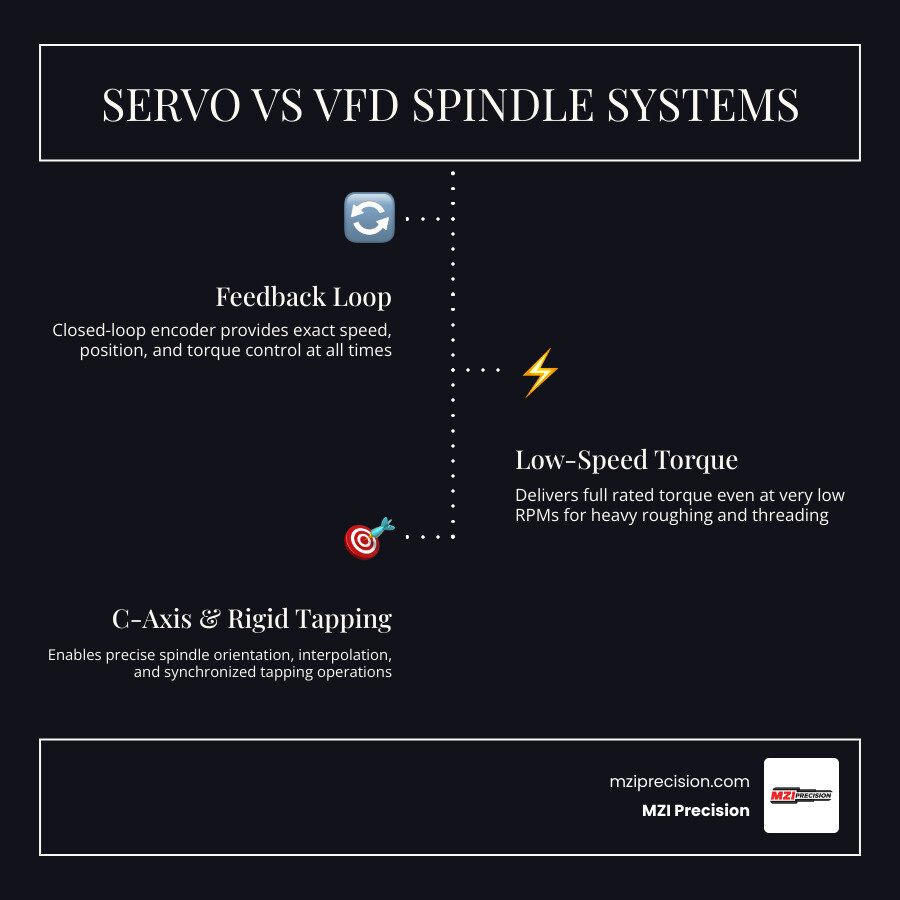
The primary difference lies in the feedback loop. A standard spindle motor driven by a Variable Frequency Drive (VFD) often operates in “open loop.” You tell it to run at 1,000 RPM, and it gets close, but as the tool hits the workpiece, the load causes the motor to slip and slow down.
In contrast, a cnc lathe spindle servo motor offers:
- Closed-Loop Precision: The drive adjusts current in milliseconds to maintain exact RPM regardless of load.
- Low-Speed Torque: Servos can produce full rated torque at very low speeds, even near zero RPM, which is where standard induction motors often struggle.
- Spindle Orientation: A servo can stop at a specific angular position (e.g., 45.00 degrees) repeatedly, allowing for automatic tool changes or part loading.
- Axis Coordination: It allows the spindle to be “interpolated” with the X and Z axes, effectively turning the spindle into a “C-axis.”
| Feature | Servo Spindle Motor | VFD-Driven Induction Motor |
|---|---|---|
| Control Type | Closed-Loop | Often Open-Loop (or simple closed-loop) |
| Position Control | Full (±1 pulse accuracy) | None to Limited |
| Low-Speed Torque | Excellent / Constant | Poor without heavy derating |
| Rigid Tapping | Standard Capability | Difficult / Requires special VFD |
| Speed Holding | High Precision | Subject to load slip |
Where servo spindle systems fit in industrial manufacturing spindles
These systems are the gold standard for large lathes and multi-tasking machines. When you are performing heavy-duty roughing on a 15-inch chuck or need to accelerate a heavy workpiece to 3,000 RPM in under two seconds, the power density of a servo is unmatched. They are also the foundational component for machines equipped with live tooling, where the spindle must lock in place or move in sync with a milling head. To learn more about the technical specifications of these units, check out our page on the CNC Spindle Servo Motor.
Why Use a CNC Lathe Spindle Servo Motor on a Large Lathe?
Upgrading to a servo spindle isn’t just about speed; it’s about process flexibility. In industrial manufacturing, time is money, and a servo motor’s ability to reach speed faster (acceleration) and stop on a dime (deceleration) can shave seconds off every cycle.
Torque, speed range, and constant power benefits
Large industrial lathes require a wide “constant power” band. You need high torque at low speeds for large-diameter turning and high RPMs for finishing small diameters. A high-quality cnc lathe spindle servo motor provides a much broader performance envelope than a standard motor. For example, a 15 kW model can deliver a massive 95 Nm of torque at 1,500 RPM, maintaining stable power even as you push into higher speed ranges through field weakening. This allows for heavy-duty cuts that would stall a lesser motor.
How a cnc lathe spindle servo motor enables C-axis and rigid tapping
If you’ve ever tried to tap a hole on a manual lathe, you know the struggle. On a CNC, “rigid tapping” requires the spindle’s rotation to be perfectly synchronized with the Z-axis feed. Because the servo knows its exact position via the encoder, the controller can sync the two axes down to the micro-degree.
Furthermore, the servo motor spindle allows for C-axis functionality. This means the spindle can stop, lock, and then rotate at a controlled feed rate. This enables cross-drilling, bolt-hole patterns, and even milling hexes or slots on the face of a part without moving it to a separate milling machine. This “one-and-done” capability is why many shops choose a servo motor for their CNC machine.
When a servo spindle is the better choice than a VFD spindle
A VFD spindle is perfectly fine for basic “spin and cut” operations. However, a servo spindle is the clear winner when your work involves:
- Complex Threading: Especially large-diameter or multi-start threads.
- Oriented Stops: Necessary for many automatic tool changers.
- Live Tooling: If you have a turret with powered tools, you need a servo spindle to index the part.
- High-Volume Production: Faster acceleration and deceleration cycles significantly reduce “air time” between cuts.
Power, Torque, and Speed: Matching Specs to the Work
Sizing a cnc lathe spindle servo motor is a balancing act. If the motor is too small, you’ll lack the torque for heavy roughing; if it’s too large, you’re paying for electricity and footprint you don’t need.
Typical power and torque ranges for large CNC lathe spindle motors
In the industrial sector, we usually see motors categorized by their continuous power output:
- 7.5 kW (10 hp): Common for mid-sized lathes, offering roughly 50 Nm of torque at 1,460 RPM.
- 11 kW (15 hp): A workhorse for larger lathes, providing around 70 Nm of torque.
- 15 kW (20 hp): Heavy-duty territory, capable of 95 Nm at 1,500 RPM.
While these motors often have a “rated speed” (base speed) around 1,500 RPM, they can typically be driven up to 6,000 or even 10,000 RPM depending on the model and the drive’s voltage capacity.
How machine size and part type affect motor selection
The mass of your chuck and your workpiece (spindle inertia) plays a huge role in motor selection. A 24-inch chuck has massive inertia; a small motor will take forever to get it up to speed and might overheat trying to stop it. Interrupted cuts—like turning a square block into a cylinder—also create shock loads that require a motor with high peak torque (often 200% of rated torque) to maintain speed.
Reading motor datasheets without over- or under-sizing
When looking at a datasheet for something like an Indramat or Fanuc motor, pay attention to the Torque Constant (Nm/A). This tells you how much “push” you get for every amp of current. A motor like the MAD100D might offer a 2.62 Nm/A constant, which is excellent for heavy-duty applications.
Must-Check Spindle Motor Specs:
- Continuous Torque (S1 Duty): What the motor can do all day long.
- Peak Torque: What the motor can do for short bursts (accel/decel).
- Rotor Inertia: Must be compatible with your spindle load for stable tuning.
- Encoder Line Count: Higher resolution (e.g., 2048 pulses/rev) equals better C-axis accuracy.
How to Select the Right Spindle Servo Motor and Drive
Selection involves more than just power; you have to consider how the motor physically fits and stays cool.
Mechanical selection criteria: frame, shaft, mount, and brake
Most industrial motors use a flange mount for direct attachment to the headstock or a foot mount for belt-driven setups. You also need to decide if you need a holding brake. While the servo drive can hold the spindle in position (active holding), a mechanical brake is often safer for heavy milling operations on the C-axis to prevent the spindle from “creeping” under the force of the milling cutter.
Cooling methods and what they mean for performance
Heat is the enemy of motor life. There are three common ways to keep a cnc lathe spindle servo motor cool:
- Axial Fan (Forced Air): Most common. A fan is mounted to the back of the motor and runs constantly. It’s simple and reliable but can be noisy.
- Liquid Cooling: Used for very high-power motors (60 kW+) or where thermal growth must be strictly controlled (aerospace). It allows for a much smaller motor footprint for the same power but requires a chiller.
- Self-Cooled: Rare in large spindles; these rely on the motor’s surface area.
Encoder options and why resolution matters
The encoder is the “eyes” of the motor.
- Incremental Encoders: Common and cost-effective, but the machine must “home” the spindle every time it powers up.
- Absolute Encoders (like EnDat 2.1): These remember exactly where the spindle is, even after the power is turned off. This is a huge time-saver for complex setups.
- Resolution: For basic turning, 1,024 pulses per revolution is fine. For high-precision C-axis milling, you’ll want 2,048 pulses or higher to ensure the “steps” between positions are invisible to the cutting tool.
Matching the motor and drive as a system
We always recommend buying a matched motor and drive set. Mixing a Fanuc motor with a Delta drive is a recipe for a tuning nightmare. The drive must be sized to handle the motor’s peak current—not just its continuous current. If the drive is undersized, you’ll get nuisance trips during fast acceleration. For more on high-performance pairings, see our guide on AC servo motors for CNC machines.
Retrofitting, Integration, and Long-Term Reliability
Retrofitting an older lathe with a new cnc lathe spindle servo motor is one of the best ways to modernize a shop without spending $200k on a new machine.
Installation and integration considerations for a retrofit
When installing a new motor, alignment is everything. If the motor shaft isn’t perfectly aligned with the spindle (in a direct-drive setup) or if the belt tension is too high, you’ll destroy the bearings in months. You’ll also need to ensure your CNC controller can handle the feedback signals. Modern drives like the Veichi SD500 offer dual-encoder interfaces, which allow the drive to “talk” to both the motor encoder and a separate encoder mounted directly on the spindle for maximum precision.
Commissioning steps for C-axis, threading, and rigid tapping
Once the motor is bolted in, the real work begins: tuning.
- Velocity Loop Tuning: Ensure the spindle doesn’t “hunt” or vibrate at high speeds.
- Orientation Setup: Tell the controller exactly where “Zero” is.
- Rigid Tapping Test: Start with a plastic part and a small tap to ensure the Z-axis and spindle are perfectly synced.
- Acceleration Limits: Set these to the fastest the motor can handle without triggering an “Overcurrent” alarm.
Cost, support, and lifecycle factors before you buy
A cheap, unbranded servo might save you $2,000 upfront, but if it breaks and the manual is only available in a language you don’t speak, your machine is a very expensive paperweight. Stick with reputable brands that have local support in the United States.
At MZI Precision, we’ve seen many “bargain” spindles end up on our bench for repair much sooner than they should. Whether you need spindle motor repair services or are looking for spindle repair in California, always consider the total cost of ownership, including the availability of spare parts and expert spindle motor repair.
Frequently Asked Questions About CNC Lathe Spindle Servo Motor Selection
What encoder resolution is enough for threading and C-axis work?
For standard threading, a 1,024-line encoder is usually sufficient. However, for C-axis work—especially if you are milling features far from the center of the part—you should aim for at least 2,048 pulses per revolution. This prevents “stair-stepping” on the finished surface.
Is liquid cooling better than fan cooling for a large spindle servo motor?
Liquid cooling is superior for thermal stability, which is critical for high-precision aerospace parts where even a few microns of thermal expansion can scrap a part. However, for 90% of industrial manufacturing, a high-quality axial fan is more cost-effective and much easier to maintain.
What is the most common sizing mistake with a spindle servo retrofit?
Ignoring inertia matching. People often buy a motor based on kW alone. If you put a small, high-speed motor on a spindle with a massive 20-inch chuck, the motor will struggle to control that mass. It’s like trying to stop a freight train with bicycle brakes. Always check the rotor inertia vs. the load inertia.
Conclusion
The cnc lathe spindle servo motor is the ultimate upgrade for any industrial turning center. It transforms a machine from a simple lathe into a multi-tasking powerhouse capable of C-axis milling, rigid tapping, and high-precision threading. By matching the right torque, power, and cooling to your specific application, you ensure your machine stays productive for years to come.
If your spindle motor is sounding rough or failing to hold position, don’t wait for a catastrophic failure. We specialize in keeping your machines running at peak performance. For expert assistance, check out our CNC lathe repair services in California, learn more about our spindle repair process, or contact us today to discuss your project. At MZI Precision, we provide the big power and expert support your big projects deserve.