

Spindle Bearing Replacement: Essential 2025 Guide
Why Precision Matters: Understanding Industrial Spindle Bearing Replacement
Spindle bearing replacement is a critical maintenance procedure that restores precision to industrial equipment. When spindle bearings fail, your machine loses accuracy, vibrates excessively, and can experience catastrophic downtime, costing thousands in lost production.
The Spindle Bearing Replacement Process in Brief:
- Preparation: Enforce LOTO, drain fluids, and prepare a clean workspace.
- Disassembly: Document and mark all component positions before removing the spindle.
- Removal & Cleaning: Use bearing pullers to extract old bearings, then thoroughly clean and inspect all parts.
- Installation: Press new bearings with precise alignment, applying force only to the correct race.
- Reassembly & Testing: Reassemble in reverse order, torque to spec, and verify runout is below 1-3 microns during a gradual run-in.
At their core, rolling-element bearings minimize friction to ensure smooth, accurate rotation under extreme loads and speeds. When they wear, the spindle can no longer maintain the micron-level precision required for quality manufacturing.
The replacement process demands meticulous attention to detail. A single error during installation—misalignment, contamination, or improper force—can cause premature failure. This guide will walk you through each critical step, helping you decide whether to perform the replacement in-house or engage a professional spindle repair service for more complex rebuilds.
PREPARATION: BEFORE YOU BEGIN THE REPLACEMENT

Successful spindle bearing replacement begins with thorough preparation. A clean, organized environment is not optional; it is essential for a precise and lasting repair.
COMMON SIGNS YOUR SPINDLE BEARINGS NEED REPLACEMENT
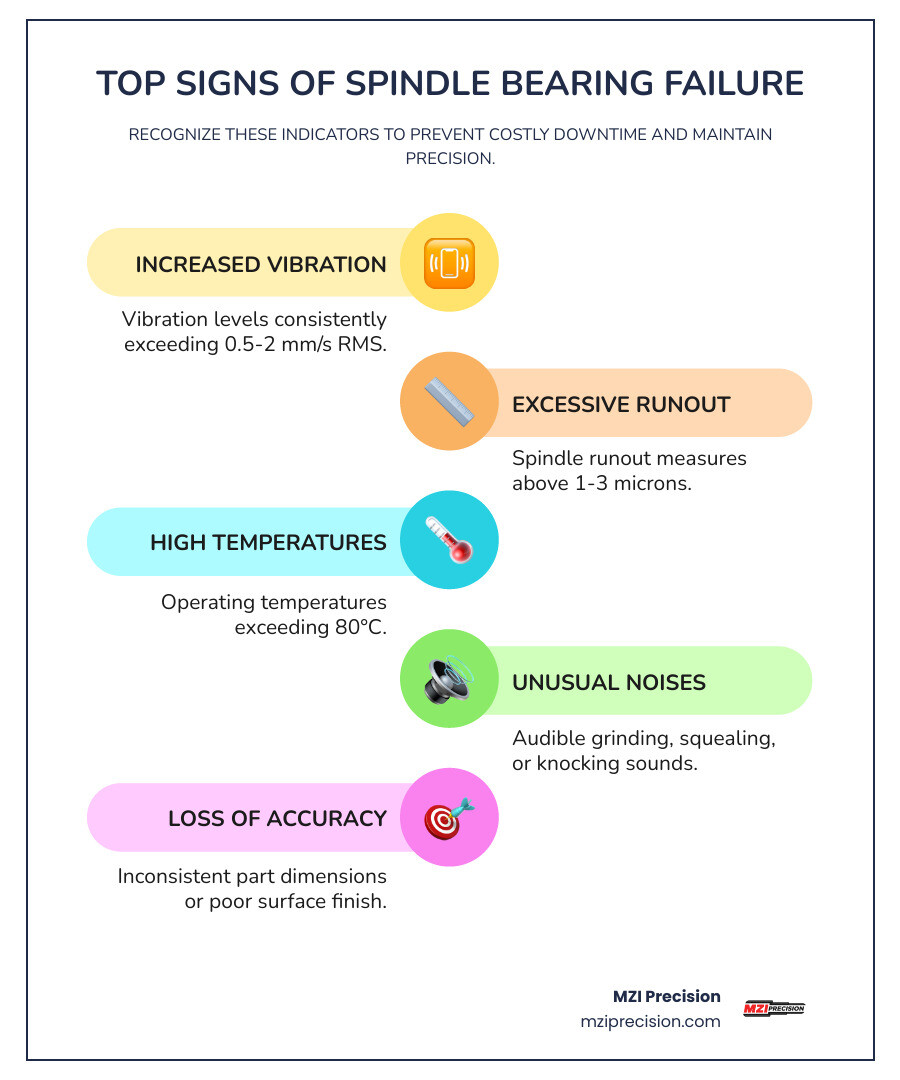
Catching bearing problems early can prevent catastrophic breakdowns. Watch for these key indicators:
- Increased Vibration: A healthy spindle runs smoothly. Vibration levels exceeding 0.5–2 mm/s RMS for precision spindles indicate a problem.
- Loss of Precision: If machined parts fail to meet tolerances or surface finish degrades, worn bearings are a likely cause. Runout exceeding 1–3 microns is a clear red flag.
- Liftd Temperatures: Consistent spindle housing temperatures above 80°C suggest lubrication breakdown or internal damage. The ideal range is 40–60°C.
- Audible Noise: Squealing, grinding, or howling sounds are cries for help, often indicating contamination, poor lubrication, or physical bearing damage.
- Lubrication Contamination: Discolored lubricant, strange odors, or visible particles signal trouble. Oil analysis can provide early warnings by detecting microscopic wear particles.
For a deeper dive into spindle health, see A Simple Guide to Spindle Repair – MZI Precision Resource.
SAFETY AND WORKSPACE PREPARATION
Safety is paramount. Before starting, implement these non-negotiable steps:
- Lockout/Tagout (LOTO): Disconnect and lock all power sources (electrical, hydraulic, pneumatic) to prevent accidental startup.
- Drain Fluids: Fully drain all coolants and lubricants to maintain a clean, safe workspace.
- Create a Clean Environment: Spindle bearings are extremely sensitive to contamination. Work in a controlled, dust-free area. Even a single speck of dust can drastically shorten bearing life.
- Organize Tools: Lay out all clean, calibrated tools to ensure an efficient and contamination-free workflow.
ESSENTIAL TOOLS AND MATERIALS FOR SPINDLE BEARING REPLACEMENT
Using the right tools is critical for a successful repair. Precision work demands precision tools.
- Bearing Pullers/Extractors: For removing old bearings without damaging the shaft or housing.
- Hydraulic or Mechanical Press: Essential for seating new bearings squarely and evenly. Never use a hammer.
- Calibrated Torque Wrenches: To tighten fasteners to exact manufacturer specifications.
- Precision Measuring Instruments: Micrometers, dial indicators (0.0001″ precision), and bore gauges are required for checking dimensions and runout.
- Induction Heater: To safely heat inner bearing races for easier installation.
- Cleaning Supplies: Non-abrasive solvents and lint-free cloths for thorough cleaning.
- Personal Protective Equipment: Clean, lint-free gloves are mandatory to prevent contamination from skin oils.
- Other Essentials: Manufacturer-recommended lubricant, specialized spanner wrenches, a camera for documentation, and parts bins for organization.
THE STEP-BY-STEP SPINDLE BEARING REPLACEMENT PROCESS
This is where preparation meets precision. The actual spindle bearing replacement requires following manufacturer guidelines without deviation. Every step is critical, and cutting corners will lead to future failures.
SPINDLE DISASSEMBLY: ACCESSING THE BEARINGS
Disassembly is a methodical process. Always start with the manufacturer’s manual for your specific spindle model.
- Document Everything: Photograph each step from multiple angles. These images are invaluable during reassembly.
- Mark Components: Use marriage marks on balanced rotating components to ensure they are reassembled in the exact same orientation, preserving balance. Precisely mark sensor positions.
- Handle with Care: Carefully remove seals, retaining rings, and locking mechanisms. The drawbar assembly is often under high spring tension and requires extreme caution; follow specific safety procedures for its removal.
- Stay Organized: Keep all components, especially bearing spacers, in labeled bins to maintain their original order and orientation. Spacers can differ by mere microns. For more guidance, see How to Replace a Spindle – MZI Precision Resource.
- Warning on Hydraulic Components: Many motorized spindles use hydraulic nuts and rotors with heavy interference fits. These require specialized high-pressure equipment (up to 10,000 PSI) for removal. If you encounter a non-threaded component, stop. Attempting to press it off without the correct tools can cause severe, irreparable damage to the shaft and rotor.
CLEANING AND INSPECTING COMPONENTS
This phase is tedious but crucial for identifying hidden problems.
- Thorough Cleaning: Use non-abrasive solvents and lint-free cloths to clean every component. All old grease, coolant, and particulate must be removed. Use filtered, dry compressed air for drying.
- Detailed Inspection: Examine the spindle shaft, housing, and all parts for wear, scoring, corrosion, or galling. Pay close attention to bearing journals and shoulders.
- Precision Measurement: Use micrometers and bore gauges to measure all shaft and housing journals for concentricity and dimensional accuracy. Differences in bearing race bores exceeding 0.005 inches must be addressed. Polish any rough surfaces or burrs.
- Replace All Seals: Always replace all seals and O-rings. Their cost is negligible compared to the cost of a failure caused by contamination.
INSTALLING THE NEW SPINDLE BEARINGS

Correct installation determines bearing longevity. Handle new bearings only with clean, lint-free gloves to prevent contamination.
- Pre-lubricate: Apply the manufacturer-recommended grease or oil before installation to reduce friction during the initial run-in.
- Ensure Perfect Alignment: The new bearing must be perfectly parallel to its mating surface before applying any force.
- Use a Press: A hydraulic or mechanical press provides the even, consistent force needed. Follow this golden rule: apply force only to the inner race when installing on a shaft, and only to the outer race when installing in a housing. Applying force incorrectly will damage the bearing.
- Use Temperature Differentials: Gently heating inner races to around 150°F (66°C)—never exceeding 180°F (82°C)—causes them to expand for easier installation. Freezing outer races can help them drop into housings with minimal force.
- Verify Seating: After installation, use precision tools to confirm the bearing is fully and squarely seated. An improperly seated bearing will fail quickly.
POST-INSTALLATION: CALIBRATION, TESTING, AND PREVENTION

The spindle bearing replacement is not finished until the spindle is reassembled, calibrated, and tested. This phase ensures the repair was successful and prevents future issues.
REASSEMBLY AND CRITICAL TORQUE SPECIFICATIONS
Reassemble the spindle in the reverse order of disassembly, using your photos and notes as a guide. Ensure all marked components are aligned correctly.
- Replace All Seals: It is critical to replace all seals and O-rings with new ones to prevent contamination.
- Use a Calibrated Torque Wrench: Every fastener must be tightened to the manufacturer’s exact specifications. This is crucial for proper bearing preload and structural integrity. Spindle nuts may require high torque values, such as 85 to 110 ft-lb (115 to 140 Nm) or more, applied in increments. Never guess at torque values.
For more on the processes that ensure peak performance, explore our services at MZI Precision.
CALIBRATION AND RUN-IN PROCEDURE
Do not immediately run the spindle at full speed. A careful run-in procedure is essential.
- Low-Speed Initial Run: Start the spindle at a low speed, listening for unusual noises and feeling for vibration or heat.
- Gradual Speed Increase: Increase the spindle speed in stages, monitoring performance at each level. Vibration analysis tools are invaluable here.
- Measure Runout: Use a precision dial indicator to check radial and axial runout. It must be within specification, ideally below 1 micron for precision spindles. Runout exceeding 1–3 microns indicates a problem.
- Check Rolling Torque: Verify the rolling torque is within the expected range (e.g., 45 to 55 in-lbs) to confirm proper seating and preload.
- Perform a Machining Test: The final verification is a real-world test. Check the dimensional accuracy and surface finish of a machined part to confirm the spindle bearing replacement was successful.
UNDERSTANDING AND PREVENTING PREMATURE BEARING FAILURE
To avoid repeating the repair, address the root causes of failure:
- Improper Lubrication: The #1 cause of failure. Use the correct type and amount of lubricant and prevent contamination. Regular oil analysis can detect wear particles early.
- Contamination: Dust, moisture, or debris entering the bearing will destroy it. Ensure seals are effective and the operating environment is clean.
- Spindle Crashes: Even a minor crash can cause latent damage that leads to later failure.
- Overloading: Operating a spindle beyond its rated speed or load capacities accelerates wear.
- Improper Installation: Misalignment, incorrect pressing techniques, or contamination during installation will doom a new bearing.
Most of these are preventable with a regular maintenance schedule that includes vibration analysis, temperature monitoring, and lubrication checks.
PROFESSIONAL SPINDLE REPAIR: WHEN TO CALL AN EXPERT
While this guide empowers in-house teams, some spindle bearing replacement jobs demand a level of expertise and equipment that is impractical for most facilities. Knowing when to call a professional is a smart business decision that protects your investment.
ASSESSING THE COMPLEXITY AND RISKS
Not all spindle repairs are equal. Consider these factors before attempting a complex replacement in-house:
- Specialized Equipment: Do you have high-pressure hydraulic equipment (up to 10,000 PSI) for nut removal, advanced bearing pullers, and precision balancing machines? These are significant investments.
- Measurement Precision: Can you accurately measure journals and shoulders to within a single micron? Most general-purpose tools cannot achieve this level of precision.
- Risk of Additional Damage: A single misstep can turn a bearing replacement into a full rebuild, scoring a shaft or cracking a housing. The risk is especially high with hydraulic rotors.
- Cost of Downtime: For high-volume operations, downtime can cost thousands per day. A failed in-house repair attempt can extend this downtime from days to weeks, compounding the financial impact. The fastest, most certain path to production is often the most cost-effective.
THE CONSEQUENCES OF IMPROPER INSTALLATION
An incorrect installation has severe consequences beyond just redoing the work:
- Reduced Bearing Life: Misalignment or incorrect preload causes uneven stress, leading to failure in a fraction of the expected service life.
- Excessive Vibration and Noise: These symptoms indicate damage has already occurred, compromising part quality and accelerating wear on the entire machine.
- Loss of Machine Accuracy: The very problem you sought to fix—poor tolerances and surface finish—will persist or worsen.
- Catastrophic Failure: A poorly seated bearing can disintegrate at speed, destroying the spindle and creating a safety hazard.
- Voided Warranties: Unauthorized repairs can void existing machine or spindle warranties.
Learn more about how we avoid these pitfalls at More info about spindle motor repair.
BENEFITS OF A PROFESSIONAL SPINDLE REBUILD
Partnering with a professional spindle repair service like MZI Precision provides access to resources and guarantees peace of mind.
- Cleanroom Environments & Specialized Equipment: Our controlled facility prevents contamination, and we use advanced balancing machines, calibrated presses, and induction heaters to ensure a perfect rebuild.
- Advanced Diagnostics: We use sophisticated vibration analysis and thermography to identify the root cause of failure, not just the symptoms, preventing repeat issues.
- OEM-Level Expertise: We rebuild spindles to meet or exceed OEM standards, restoring them to ‘like-new’ performance. Our team has deep experience across demanding industries like aerospace, automotive, and defense.
- Comprehensive Warranties: We stand behind our work with warranties that provide assurance and accountability.
- Long-Term Cost-Effectiveness: A professional rebuild extends spindle life, minimizes downtime, and reduces the total cost of ownership, making it a sound investment.
For a full overview of our capabilities, visit Spindle Repair Services by MZI Precision. We work efficiently to get your critical equipment back into production, because we know every hour counts.
FREQUENTLY ASKED QUESTIONS ABOUT SPINDLE BEARING REPLACEMENT
HOW DOES LUBRICATION AFFECT BEARING LONGEVITY?
Lubrication is the lifeblood of spindle bearings. It creates a protective film that reduces friction and heat, protects against corrosion, and helps flush out contaminants. However, using the wrong type or amount of lubricant is a primary cause of failure. Too little lubricant causes metal-on-metal contact and overheating, while too much can cause churning and temperature spikes.
Regular oil analysis is a key part of preventative maintenance, as it can detect microscopic wear particles long before performance issues become apparent. For more on this topic, see A Simple Guide to Spindle Repair – MZI Precision Resource.
WHAT IS SPINDLE RUNOUT AND WHY IS IT CRITICAL?
Spindle runout is any deviation from the spindle’s ideal, perfectly straight axis of rotation, measured in microns. There are two types: axial runout (in-and-out motion) and radial runout (side-to-side wobble). Both directly impact part tolerance and surface finish.
High-precision spindles require runout below 1 micron. When runout exceeds 1–3 microns, you will see dimensional inaccuracies, poor surface finishes, and increased tool wear. This is why we measure runout carefully after every spindle bearing replacement—it is the ultimate test of a successful repair.
CAN I REUSE SPINDLE SEALS AND O-RINGS?
No. You should never reuse seals and O-rings. Over time, they degrade from exposure to heat, chemicals, and mechanical stress. Once removed, they lose the elasticity needed to create an effective seal, creating a significant risk of contamination that can quickly destroy your new bearings.
The cost of new seals is minimal compared to the cost of another bearing failure and the associated downtime. Always include new seals and O-rings in your replacement kit. It’s a simple, inexpensive practice that protects your investment.
CONCLUSION
Replacing spindle bearings is a precision operation where meticulous attention to detail is paramount. From identifying the first signs of failure to performing the final runout tests, every step is critical. A single mistake—contamination, misalignment, or improper torque—can lead to premature failure, undoing hours of work and causing costly downtime.
While some simpler spindle bearing replacement tasks can be handled in-house, many industrial spindles require the specialized tools, cleanroom environments, and diagnostic expertise that only a professional repair facility can offer.
At MZI Precision, our California-based team specializes in industrial manufacturing spindle repair for the most demanding industries, including aerospace, automotive, and defense. We don’t just replace parts; we restore spindles to meet or exceed OEM specifications, backing our work with a comprehensive warranty.
If you are facing spindle issues, let our experts help you maintain the heart of your manufacturing operations. When your spindles run right, everything else falls into place.