

Precision spindle bearings: 2025’s Vital Edge
WHY PRECISION SPINDLE BEARINGS ARE ESSENTIAL FOR MANUFACTURING
Precision spindle bearings are the critical components that enable machine tools to achieve high-speed rotation with exceptional accuracy. These specialized bearings support the spindle—the rotating shaft that holds cutting tools or workpieces—while maintaining tight tolerances measured in microns or even nanometers.
What makes a spindle bearing “precision”:
- Tight tolerances – Manufactured to ABEC9/RBEC9, P4, P2, or even higher precision classes
- High-speed capability – Designed for speeds up to 30,000 RPM and beyond
- Minimal runout – Rotational accuracy under 0.5 μm for ultra-precise machining
- Advanced materials – High-purity steel, hybrid ceramic balls, and specialized alloys like SV30
- Rigorous manufacturing – Often assembled in class 7 clean rooms with noise testing
Unlike standard bearings, precision spindle bearings combine ultra-accurate geometry with advanced materials to deliver the rigidity, speed, and thermal stability required for CNC machining, grinding, and other high-precision manufacturing operations. Machine tool spindle bearings can achieve precision up to ABEC9/RBEC9, with some specialized bearings offering rotational runout under 0.5 μm.
For aerospace and industrial manufacturing companies, the difference between standard and super-precision bearings directly impacts part quality, production speed, and machine uptime. A bearing with just a few microns of additional runout can mean the difference between meeting tight aerospace tolerances and producing scrap parts.
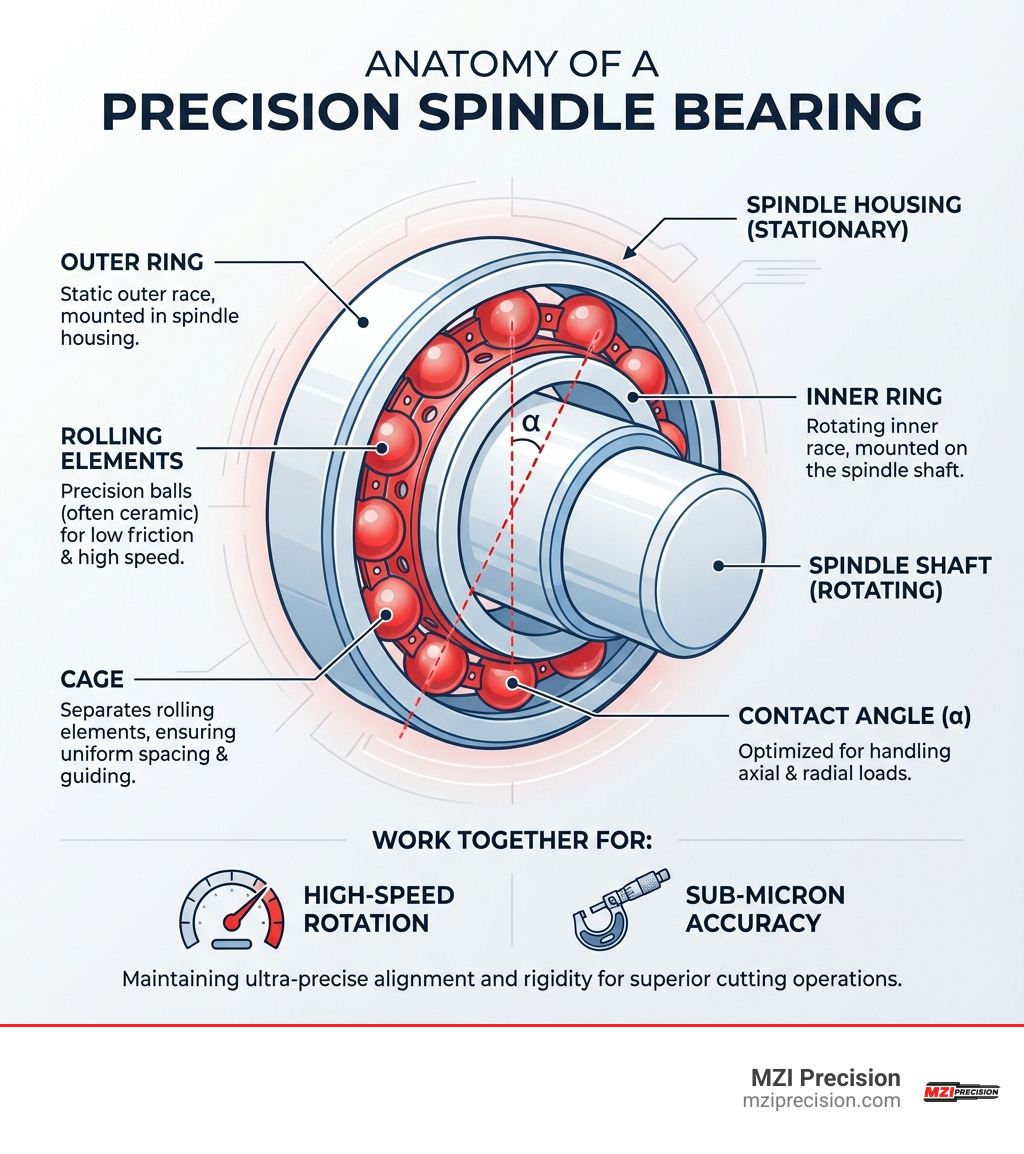
Precision spindle bearings terminology:
THE CORE OF MACHINING: WHAT ARE PRECISION SPINDLE BEARINGS?
At the heart of every high-performance industrial machine tool lies its spindle, and within that spindle are the unsung heroes: precision spindle bearings. These aren’t just any bearings; they are carefully engineered components designed to withstand extreme conditions while maintaining microscopic accuracy. Their primary function is to support the rotating spindle, allowing it to turn at incredibly high speeds with unparalleled precision.
Imagine a high-speed machining process where even the slightest wobble could ruin a workpiece. That’s where these bearings come into play. They ensure the spindle remains perfectly stable, resisting forces from all directions. This stability translates directly into the quality of the finished product.
The primary functions of precision spindle bearings include:
- Supporting Radial and Axial Loads: Whether the cutting tool is pushing sideways (radial) or plunging into the material (axial), the bearings must absorb and distribute these forces without deforming.
- Enabling High-Speed Rotation: Many industrial processes demand thousands, even tens of thousands, of revolutions per minute. Precision bearings are designed to operate smoothly and reliably at these blistering speeds.
- Maintaining High Rotational Accuracy: This is perhaps their most critical function. Any deviation, however small, from a perfectly concentric rotation can compromise the precision of the machining operation. Spindle bearings are manufactured to ensure minimal runout, sometimes less than 0.5 μm.
- Providing High Rigidity: Rigidity refers to the bearing’s resistance to deflection under load. A rigid bearing setup prevents the spindle from flexing, which is crucial for maintaining tight tolerances during cutting.
- Minimizing Friction and Heat Generation: High speeds naturally generate heat. Precision bearings are designed with optimized geometries and materials to reduce friction, controlling heat buildup, which can negatively impact accuracy and longevity.
- Facilitating Heat Dissipation: Even with reduced friction, some heat is inevitable. The bearing design, lubrication, and surrounding spindle structure work together to manage and dissipate this heat effectively.
For a general technical overview of how rolling-element bearings perform these roles in rotating machinery, you can also refer to the background information on ROLLING-ELEMENT BEARINGS.
Precision spindle bearings are the backbone of modern industrial manufacturing, enabling the creation of components with the tight tolerances and flawless finishes that our industries demand.
KEY CHARACTERISTICS OF A SUPER-PRECISION BEARING
What truly sets a super-precision bearing apart from its conventional cousins? It’s a combination of demanding characteristics that push the boundaries of engineering and material science. When we talk about super-precision, we’re talking about components engineered to perform flawlessly under conditions that would quickly degrade standard bearings.
- High-Speed Capability: Industrial spindles often spin at phenomenal speeds. This capability is often quantified by the “dmn value,” a metric that combines the bearing’s mean diameter (d) with its rotational speed (n). The higher the dmn value a bearing can handle, the faster it can spin. For instance, some specialized air-bearing spindles can achieve 0–30,000 RPM (+).
- Rotational Runout and Non-Repetitive Runout (NRRO): This is a measurement of how much the rotating shaft deviates from its ideal axis of rotation. For precision spindle bearings, this deviation is incredibly small, often measured in sub-microns. Some high-precision angular contact ball bearings, for example, achieve a rotational runout under 0.5 μm. Non-Repetitive Runout (NRRO) is an even more stringent measure, capturing the variation in runout over multiple rotations, which is critical for ultra-precise finishing operations. High-quality mechanical bearing spindles can boast an impressive error motion of less than ±20.0 μ” (±0.50 micron).
- Thermal Stability: As bearings operate at high speeds, they generate heat. Maintaining thermal stability means the bearing’s performance characteristics (like internal clearances and preload) remain consistent despite temperature fluctuations. This is vital for consistent machining accuracy.
- Load Capacity: While high speed and precision are paramount, the bearings must also support the substantial radial and axial loads imposed by cutting forces without excessive deflection or premature wear.
- Service Life: The longevity of these bearings is crucial for machine uptime. Super-precision bearings are designed for extended service life, even under demanding conditions, minimizing maintenance interruptions and overall operational costs.
These characteristics are not just theoretical; they are carefully engineered and tested into every precision spindle bearing, ensuring that the heart of your machine tool beats with unwavering accuracy and reliability.
KEY TYPES AND CONFIGURATIONS OF PRECISION SPINDLE BEARINGS
Just as a master chef selects the perfect knife for each culinary task, we select the ideal precision spindle bearings for specific industrial applications. The choice of bearing type and configuration depends heavily on the demands of the machine tool, including the types of loads encountered, desired speeds, and required rigidity. Understanding these distinctions is fundamental to achieving optimal spindle performance.
COMMON ROLLING ELEMENT BEARING DESIGNS
The world of precision spindle bearings features a few dominant designs, each with unique strengths:
- Angular Contact Ball Bearings (ACBBs): These are the workhorses of many industrial spindle applications. ACBBs are exceptionally versatile, designed to handle both radial and thrust (axial) loads simultaneously. Their ability to manage combined loads at high speeds makes them ideal for various machining operations. A critical feature of ACBBs is their “contact angle,” typically 15° or 25°. A smaller contact angle (like 15°) is better for higher speeds and predominantly radial loads, while a larger contact angle (like 25°) offers greater axial load capacity and stiffness, though with a slight reduction in speed capability.
- Cylindrical Roller Bearings: When an application demands very high radial load capacity and exceptional rigidity, cylindrical roller bearings step up. Unlike ball bearings, their rolling elements are cylinders, providing a larger contact area with the raceways. This design makes them particularly robust against heavy radial forces, though they typically have limited or no axial load capacity on their own. They are crucial for spindle designs that require significant radial support and stiffness.
- Tapered Roller Bearings: These bearings feature tapered inner and outer ring raceways and tapered rollers. This geometry allows them to handle very heavy combined radial and thrust loads. While often found in industrial gearboxes, they are also used in smaller spindle designs requiring substantial thrust load capabilities, offering robust performance in demanding applications.
ADVANCED BEARING SYSTEMS AND ARRANGEMENTS
Beyond individual bearing types, how these bearings are arranged and the system they operate within also defines their precision and performance.
- Mechanical vs. Air-Bearing Spindles: Traditional mechanical bearing spindles, using the rolling element bearings described above, are incredibly precise. High-quality mechanical bearing spindles, for example, offer error motion less than ±20.0 µ” (±0.50 micron). However, for the absolute pinnacle of precision and speed, air-bearing spindles enter the scene. These use a thin film of pressurized air instead of rolling elements to support the spindle, virtually eliminating friction and mechanical contact. This allows for unparalleled “nanometer-level precision” and incredibly high speeds, with some air-bearing spindles offering 0–30,000 RPM (+). While mechanical bearings are suitable for many demanding applications, air bearings are chosen when even the slightest mechanical imperfection cannot be tolerated.
- Bearing Sets and Configurations: To meet specific load and rigidity requirements, precision spindle bearings are rarely used alone. Instead, they are often paired or grouped into “sets.”
- Duplex, Triplex, and Quad Configurations: These refer to sets of two, three, or four bearings matched and ground together to achieve a specific preload and load distribution. This improves the overall rigidity and load-carrying capacity of the spindle.
- Back-to-Back (O), Face-to-Face (X), and Tandem Arrangements: These are common ways to mount angular contact ball bearings in sets:
- Back-to-Back (O Arrangement): The contact lines of the bearings diverge towards the outside. This arrangement provides high rigidity against overturning moments and is generally preferred for high-precision, high-speed applications.
- Face-to-Face (X Arrangement): The contact lines converge towards the outside. This arrangement also offers good rigidity against overturning moments, though typically less than the O-arrangement, and is often used where space is a constraint.
- Tandem Arrangement: Bearings are arranged so their contact lines are parallel. This configuration significantly increases the axial load capacity in one direction and is often combined with an O or X arrangement to handle bidirectional axial loads.
These intricate designs and arrangements allow us to tailor spindle performance to the exacting demands of modern industrial manufacturing, ensuring every machine operates at its peak potential.
THE SCIENCE OF SUPER-PRECISION: MATERIALS AND TOLERANCES
The journey from raw material to a super-precision bearing is a testament to advanced material science and meticulous manufacturing. It’s not just about shaping metal; it’s about controlling its very molecular structure and ensuring tolerances so tight they defy common perception. This scientific rigor is what allows precision spindle bearings to perform with such extraordinary accuracy and longevity.
UNDERSTANDING MATERIALS FOR PRECISION SPINDLE BEARINGS
The choice of materials is paramount, directly influencing a bearing’s speed, load capacity, rigidity, and resistance to wear and corrosion.
- High-Purity Steel (52100): This is the traditional workhorse for bearing components, a chromium steel known for its hardness and wear resistance. However, for super-precision applications, the steel must be of exceptionally high purity, with minimal inclusions that could compromise its integrity under stress.
- Advanced Stainless Steels: For applications requiring superior corrosion resistance or improved wear properties, specialized stainless steels are employed. For instance, some manufacturers use advanced materials like SV30 (X30CrMoN15-1) stainless steel as a standard for their spindle bearings, offering extreme wear and corrosion resistance.
- Hybrid Ceramic Bearings: This is a significant leap in bearing technology. Hybrid bearings combine steel rings with rolling elements made from advanced ceramics, primarily Silicon Nitride (Si3N4). The benefits are substantial:
- Lighter Weight: Ceramic balls are approximately 60% lighter than steel balls. This reduced mass lowers centrifugal forces at high speeds, allowing for even faster rotation.
- Higher Speed: The lower density and superior hardness of ceramic balls enable significantly higher operating speeds compared to all-steel bearings.
- Lower Heat Generation: Ceramic has a lower coefficient of friction and better thermal properties, leading to less heat buildup during operation. This contributes to greater thermal stability and longer lubricant life.
- Increased Rigidity: Silicon Nitride has a Young’s Modulus 50% higher than steel, making ceramic balls stiffer. This translates to increased bearing rigidity, which is crucial for maintaining machining accuracy.
- Electrical Insulation: Ceramic balls are non-conductive, preventing electrical current from passing through the bearing, which can cause damage (fluting) in electric motor spindles.
- Proprietary Steels: Leading manufacturers continually innovate with their own proprietary steel alloys. Some of these materials can offer significantly longer fatigue life and higher speed capabilities than conventional bearing steels, making them ideal for ultra-high-speed applications.
These material advancements are critical for pushing the boundaries of spindle performance, allowing for faster, more precise, and more reliable machining.
DECODING PRECISION CLASSES AND ADVANCED QUALITY
The “precision” in precision spindle bearings isn’t just a marketing term; it’s a quantifiable standard defined by stringent international classifications. These classes dictate the manufacturing tolerances for dimensions, geometry, and running accuracy.
- ABEC/RBEC Ratings (Annular Bearing Engineering Committee / Roller Bearing Engineering Committee): These are North American standards, with higher numbers indicating greater precision. For spindle bearings, we often see ratings up to ABEC9/RBEC9, signifying exceptionally tight tolerances.
- ISO/DIN Precision Classes (e.g., P4, P4S, P2): European and international standards use designations like P4, P2 (and sometimes intermediate classes like P4S). Similar to ABEC, a lower number (P2 being the highest) indicates superior precision. These classes signify tighter tolerances on internal clearances, radial and axial runout, bore, and outer diameter accuracy.
- P4 and P4S: These are common high-precision classes for many industrial spindle applications, offering excellent balance between performance and cost.
- P2: This is the highest precision class, reserved for the most demanding applications where extreme accuracy is paramount.
- Significance of Tighter Tolerances: Tighter tolerances mean less deviation from the ideal geometric form. This directly translates to:
- Improved Rotational Accuracy: The spindle runs truer, reducing runout and enabling finer surface finishes and tighter dimensional control on machined parts.
- Improved Rigidity: Precisely manufactured components fit together more accurately, reducing play and increasing the overall stiffness of the bearing arrangement.
- Reduced Vibration and Noise: Smoother running surfaces and more accurate geometry lead to quieter operation and less vibration, which can also impact machining quality.
- Advancements in Quality: Beyond the standard precision classes, manufacturers are continuously refining their processes and designs. Some advanced quality bearings, for instance, feature improved raceway geometry and optimized surfaces. This leads to a significant increase in their fatigue limit load, allowing them to achieve up to 50% higher values in expanded adjusted service life calculations. Many top-tier super precision ball bearings are manufactured to surpass standard criteria, emphasizing a commitment to superior quality.
The combination of advanced materials and meticulous adherence to the highest precision classes ensures that precision spindle bearings are not merely components, but critical enablers of cutting-edge manufacturing capabilities.
OPTIMIZING PERFORMANCE AND LONGEVITY
Even the most precisely manufactured precision spindle bearings won’t deliver their full potential without careful attention to their operating environment, particularly lubrication, sealing, mounting, and ongoing maintenance. These factors are not afterthoughts but integral parts of the spindle’s design and operational lifecycle, directly impacting performance, accuracy, and longevity.
THE CRITICAL ROLE OF LUBRICATION AND SEALING
Lubrication is the lifeblood of any bearing, but for precision spindle bearings, it’s an exact science. Its primary roles are to reduce friction, dissipate heat, and prevent wear.
- Types of Lubrication:
- Grease Lubrication: Often used for its simplicity and sealing properties. Precision bearings require specific, high-performance greases that can withstand high speeds and temperatures. Ultra-filtered greases are often used for super-precision applications to avoid contamination.
- Oil-Air Lubrication: This method delivers a continuous, controlled mist of oil and air directly to the bearing. It’s excellent for high-speed applications as it provides superior cooling and ensures a constant supply of fresh lubricant, flushing away contaminants and heat.
- Oil-Mist Lubrication: Similar to oil-air but typically delivers a finer mist. It’s also suitable for high-speed applications where precise lubricant delivery and cooling are crucial.
- Heat Removal: Lubrication plays a vital role in carrying away heat generated by friction, preventing thermal expansion that could alter bearing clearances and reduce accuracy.
- Contamination Prevention: Lubricant forms a protective barrier against external contaminants like dust, coolant, and machining debris, which are highly detrimental to precision surfaces.
- Sealing: Effective sealing is critical to keep the lubricant in and contaminants out.
- Non-Contact Seals: For high-speed applications, non-contact seals are preferred as they introduce minimal friction and heat. These seals create a labyrinth or gap that impedes the entry of debris without physically touching the rotating shaft.
- FKM Material: Seals made from materials like fluororubber (FKM) offer excellent chemical resistance and temperature stability, making them ideal for demanding industrial environments. Some manufacturers, for example, offer non-contact seals made from FKM for almost all their bearing types.
Choosing the right lubricant and ensuring robust sealing are fundamental steps in extending the life and maintaining the precision of your spindle bearings.
MOUNTING AND MAINTENANCE FOR PRECISION SPINDLE BEARINGS
The moment a precision spindle bearing is installed, its fate can be sealed. Improper mounting can negate all the careful engineering and manufacturing that went into it. That’s why we emphasize meticulous procedures:
- Clean Room Assembly: Precision bearings are so sensitive to contamination that many manufacturers perform assembly, greasing, sealing, and noise testing in controlled environments, often a Class 7 clean room. This minimizes the introduction of microscopic particles that could cause premature wear.
- Preload Application: Bearings often require a specific “preload”—an initial axial force applied during mounting. This preload eliminates internal clearance, increases rigidity, and ensures proper load distribution. The correct preload is critical; too little leads to wobble, too much generates excessive heat and reduces lifespan. We carefully calculate and apply preload, often using specialized tools and techniques to ensure optimal performance.
- Shaft and Housing Fits: The fit between the bearing and the spindle shaft, and between the bearing and the housing, is crucial. These fits are typically interference (press) fits, ensuring a rigid connection. The dimensions must be incredibly accurate to avoid distorting the bearing rings, which would compromise accuracy.
- Run-in Procedures: After mounting, new spindle bearings require a “run-in” period. This involves gradually increasing the spindle speed in stages, allowing the bearing components to settle, the lubricant to distribute evenly, and any initial high spots to wear in gently. Monitoring temperature during run-in is vital, as excessive heat can indicate improper mounting or lubrication.
- Temperature Monitoring: During both run-in and normal operation, continuous temperature monitoring helps detect potential issues early. An abnormal rise in bearing temperature can signal inadequate lubrication, excessive preload, contamination, or impending failure.
At MZI Precision, our expertise extends beyond repair to the precise integration of these bearings into your machine tool designs. We understand that a spindle is only as good as its bearings and their installation. For a deeper dive into how we handle these critical processes, you can find more information about our SPINDLE ASSEMBLY SERVICES.
FUTURE INNOVATIONS IN SPINDLE BEARING TECHNOLOGY
The world of industrial manufacturing is constantly evolving, and with it, the demands on precision spindle bearings continue to intensify. As we look to the future, innovation isn’t slowing down; it’s accelerating, driven by the need for even higher speeds, greater accuracy, increased efficiency, and predictive maintenance capabilities.
WHAT’S NEXT FOR PRECISION SPINDLE BEARINGS?
The trends point towards bearings that are not only mechanically superior but also “smarter” and more integrated into the overall manufacturing ecosystem.
- Integrated Sensors (Smart Bearings): Imagine a bearing that can tell you its own temperature, vibration levels, and even lubrication condition in real-time. The integration of miniature sensors directly into bearing components is a burgeoning field. These “smart bearings” will feed data directly into machine monitoring systems, enabling truly predictive maintenance, optimizing performance, and preventing catastrophic failures before they occur. This aligns perfectly with the broader industry trend towards IoT (Internet of Things) and AI integration in manufacturing.
- Self-Lubricating Systems: While current lubrication methods are highly effective, continuous research aims to develop more advanced self-lubricating materials or encapsulated lubrication systems. These could extend maintenance intervals, reduce the risk of lubrication-related failures, and potentially simplify spindle designs.
- New Material Composites: The quest for lighter, stronger, and more thermally stable materials continues. We can expect to see further advancements in ceramic composites, novel steel alloys, and perhaps entirely new material combinations that push the boundaries of speed, load capacity, and wear resistance even further. The use of Silicone Nitride bearing components, already advanced, will likely continue to evolve.
- Higher dmn Values: As machining processes demand ever-increasing speeds, bearing manufacturers will continue to engineer designs and materials capable of achieving even higher dmn values, enabling faster material removal rates and shorter cycle times without compromising precision.
- Improved Energy Efficiency: With a global focus on sustainability, future precision spindle bearings will also aim for even lower friction and greater energy efficiency. Every watt saved in spindle operation contributes to a greener and more cost-effective manufacturing process.
These innovations promise to redefine what’s possible in industrial manufacturing, allowing for the creation of even more complex, precise, and sophisticated components. We at MZI Precision remain at the forefront of these advancements, ensuring that our expertise and services evolve to meet the future demands of your industrial spindles.
CONCLUSION
We’ve journeyed deep into the intricate world of precision spindle bearings, uncovering what makes these components so critical to modern industrial manufacturing. From their fundamental role in supporting high-speed, accurate rotation to the advanced materials and meticulous manufacturing processes that define their super-precision status, it’s clear that these bearings are far more than just simple parts.
We’ve explored the diverse types, such as angular contact ball bearings, cylindrical roller bearings, and tapered roller bearings, each custom for specific load conditions. We’ve digd into the science behind their construction, from high-purity steels and advanced ceramics like Silicon Nitride to the stringent precision classes (P4, P2) that guarantee microscopic accuracy. And we’ve emphasized the non-negotiable importance of proper lubrication, sealing, and meticulous mounting procedures for ensuring optimal performance and longevity.
Precision in a spindle is not a single feature; it’s a symphony of perfectly engineered components, expertly assembled and maintained. The performance of your industrial manufacturing spindles, and by extension, the quality of your finished products, hinges directly on the integrity and precision of these vital bearings.
At MZI Precision, we understand this intricate relationship. Our expertise in spindle repair and rebuilding is built on a deep knowledge of these complex components and the demanding applications they serve. We are committed to ensuring your industrial spindles operate at their peak, delivering the precision and reliability your operations demand.
For expert insights, unparalleled service, and solutions custom to your industrial manufacturing needs, don’t hesitate to reach out to us. We’re here to keep your operations running smoothly and precisely.
CONTACT US FOR EXPERT SPINDLE SERVICES
EXPLORE OUR FULL RANGE OF SERVICES