

Spindle Precision: Achieve Peak Performance 2025
The Core of Modern Manufacturing
Spindle Precision is the foundation of quality manufacturing. It’s the difference between producing parts that meet exact specifications and scrapping expensive materials.
What is Spindle Precision?
- Rotational accuracy – How true a spindle runs without wobbling
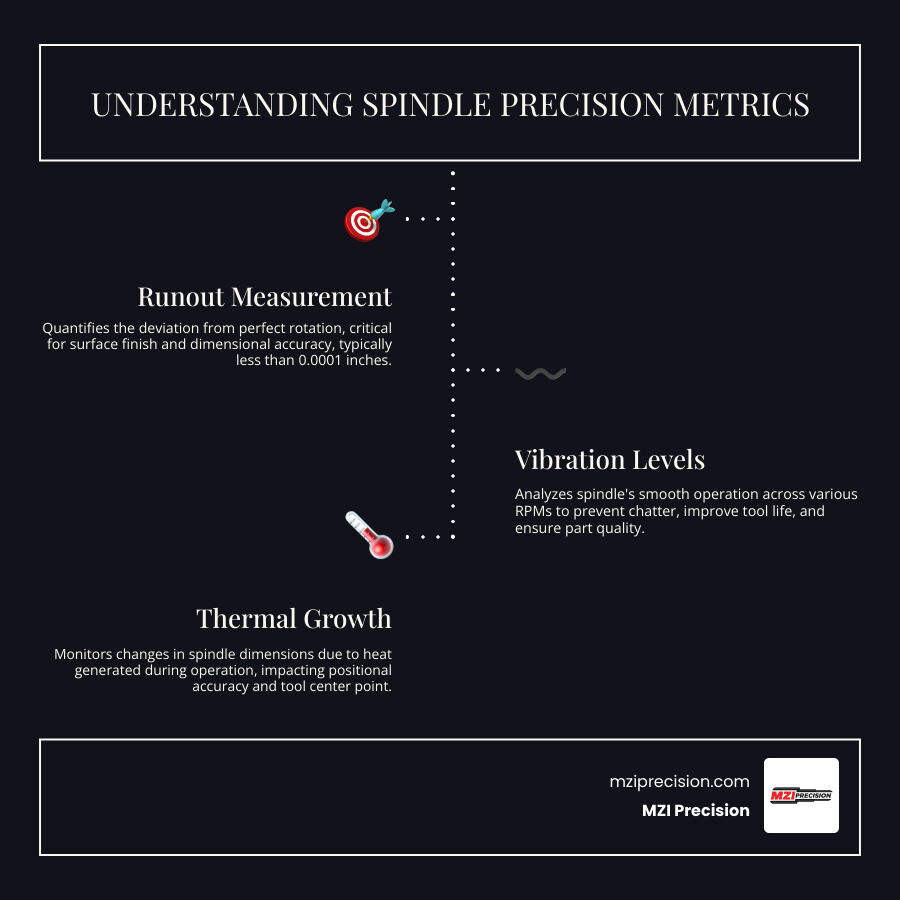
- Minimal runout – Less than 0.0001″ deviation in most precision applications
- Thermal stability – Maintaining accuracy as temperatures change
- Vibration control – Smooth operation at all speeds
Industrial manufacturing spindles are the rotating heart of CNC machines, machining centers, and grinding equipment. When they run true, your parts come out perfect. When they don’t, you get scrap.
The numbers tell the story. Industry data shows spindle failures account for up to 40% of unplanned machine downtime in precision manufacturing facilities. The sheer volume of repairs performed industry-wide highlights just how critical proper spindle maintenance is.
Why does spindle precision matter so much? Every manufacturing operation depends on the spindle’s ability to hold and rotate cutting tools or workpieces with extreme accuracy. Even tiny deviations, measured in microns, can ruin surface finishes, throw off dimensional tolerances, and turn expensive raw materials into costly scrap.
In aerospace, medical device manufacturing, and mold making, there’s simply no room for error. Parts must meet specifications the first time, every time.
The High Cost of Imprecision: Common Spindle Problems
When your CNC machine suddenly produces faulty parts with rough surface finishes and incorrect dimensions, you’ve entered the costly world of lost Spindle Precision. When industrial manufacturing spindles lose accuracy, the financial impact is immediate. Imperfect parts mean wasted material, lost machine time, missed deadlines, and damaged customer relationships.
The real pain, however, comes from unplanned downtime. A failing spindle can trigger alarms, break tools, or cause catastrophic damage, halting your production line. This isn’t just lost production; it’s lost revenue.
These precision problems rarely fix themselves. Instead, they gradually reduce your machine’s lifespan, forcing premature replacement of expensive equipment.
So what causes a spindle to lose its edge? Here are the usual suspects:
Bearing failure is a top precision killer. These critical components enable smooth, high-speed rotation. Over time, bearings can wear, develop pitting, or seize. Bad bearings lead to increased vibration, runout, and heat—all enemies of Spindle Precision.
Contamination from tiny particles of debris or degraded coolant can wreak havoc. Contaminants act like sandpaper on delicate bearing surfaces, accelerating wear and destroying rotational accuracy.
Machine crashes and operator errors can instantly damage a spindle. Minor impacts can bend shafts, damage bearing races, or misalign internal components, causing weeks of downtime.
Improper lubrication is a major cause of failure. Too little lubricant causes friction and heat, while too much creates pressure problems. The wrong type is also detrimental. Your spindle needs the right lubricant, in the right amount, at the right time.
Excessive vibration signals a problem long before catastrophic failure. Caused by worn bearings, unbalanced tools, or a bent shaft, high vibration levels ruin surface finishes and accelerate wear.
Drawbar malfunctions are also precision killers. If the drawbar can’t clamp toolholders properly, you get tool pull-out, chatter, and inconsistent cuts, making quality parts impossible.
Understanding these common problems is the first step toward preventing them and maintaining the Spindle Precision your operation demands.
The Path to Peak Performance: Achieving and Maintaining Spindle Precision
Think of Spindle Precision as a two-part strategy. One part involves proactive measures to prevent problems. The other involves reactive solutions to restore industrial manufacturing spindles when things go wrong. Smart manufacturers master both.
At MZI Precision, we’ve seen how this balanced approach transforms operations. Companies that accept both preventive care and expert restoration avoid costly surprises and consistently deliver quality.
Understanding precision machining as a system helps put spindle performance in context. For more insights, explore our Precision Machining services.
When restoration is needed, the process requires specialized expertise that brings a damaged spindle back to peak performance.
Proactive Maintenance for Lasting Spindle Precision
Prevention is the difference between profitable operations and costly shutdowns. A solid proactive maintenance strategy keeps your industrial manufacturing spindles running true, extends their lifespan, and maintains the critical Spindle Precision your operations depend on.
Preventive maintenance schedules are the backbone of any successful spindle care program. These are carefully timed inspections based on operating hours and manufacturer guidelines, which are crucial for preventing unexpected failures.
Lubrication management is critical, as many problems start here. Using the right lubricant in the right amount at the right time requires precision. High-speed spindles need specialized greases or oil-air systems to handle intense heat and friction.
Your coolant system plays a major role. Regular checks of lines, filters, and concentration levels keep your spindle cool. Clean coolant also prevents contamination that can damage precision bearings.
Filtration effectiveness is key. Maintaining clean work environments and efficient filtration systems keeps abrasive contaminants away from sensitive spindle components.
Operator training protocols turn your team into your first line of defense. Trained operators know proper tool changing techniques, understand load limits, and can spot early warning signs like unusual noises or vibrations.
Routine performance checks provide data for informed decisions. Simple runout measurements, temperature monitoring, and listening for abnormal sounds can reveal developing issues before they cause catastrophic failures.
Restorative Techniques for Damaged Spindles
When things go wrong, restorative techniques are your lifeline, bringing damaged industrial manufacturing spindles back to their original Spindle Precision—or even better.
The journey back to peak performance starts with a thorough spindle repair process. This involves complete disassembly, careful inspection of every component, and identifying the root cause. Sometimes a simple fix, like replacing worn seals or springs, is all that’s needed.
Spindle rebuilding is more comprehensive. This approach replaces all wear components, especially bearings, with new high-grade parts. The spindle shaft and housing are cleaned, inspected, and often re-machined to restore original tolerances, with the goal of bringing your spindle to a “better than new” condition.
Spindle remanufacturing is the ultimate restoration. This process may involve re-engineering or upgrades to improve performance beyond original specifications, bringing older spindles up to current standards.
Specialized techniques require skill and precision. Precision grinding restores critical surfaces like bearing journals and taper bores to perfect concentricity. Taper grinding focuses on the tool interface, the most critical area for toolholding accuracy and minimizing runout.
Replacement of critical components means installing new high-precision bearings (often ceramic hybrid), seals, springs, encoders, and drawbar components. High-grade bearings made from advanced materials like silicone nitride offer increased speed capabilities, better rigidity, and longer life.
The Role of Advanced Diagnostics in Spindle Precision
Modern manufacturing demands microscopic accuracy, making advanced diagnostics essential for maintaining Spindle Precision. These tools provide hard data to pinpoint problems, validate repairs, and predict future issues.
Vibration analysis measures the amplitude and frequency of vibrations. Changes in vibration patterns reveal bearing wear, imbalance, or misalignment before they cause major damage.
Thermal imaging uses infrared cameras to detect heat signatures. Hot spots indicate excessive friction from failing bearings or insufficient lubrication. Catching these thermal problems early prevents critical damage.
Runout testing measures both axial and radial deviation from perfect rotation. These measurements, taken with sensitive indicators or laser systems, provide fundamental data about spindle condition.
Drawbar pull-force measurement ensures the drawbar exerts consistent clamping force. This test confirms toolholders are seated properly, preventing chatter and ensuring consistent results.
Balancing procedures are critical for high-RPM spindles. Dynamic balancing ensures the rotating assembly runs smoothly, minimizing vibration and extending bearing life while improving overall Spindle Precision.
These diagnostic methods provide a complete picture of spindle health, enabling informed decisions about maintenance, repairs, and optimal operating conditions.
Innovations in Spindle Technology and Services
The manufacturing world never stands still, and neither does spindle technology. We’re living through some pretty exciting times when it comes to Spindle Precision innovations. The push for faster production, better quality, and smarter manufacturing is driving incredible advances in how industrial manufacturing spindles work and how we maintain them.
The biggest game-changer we’re seeing is predictive maintenance powered by real-time health monitoring. Think of it like having a fitness tracker for your spindle. Instead of waiting for something to break or just guessing when maintenance is due, sensors built right into the spindle constantly watch things like temperature, vibration, and power usage.
This smart monitoring approach means your spindle can actually tell you when it’s starting to feel unwell – long before it breaks down completely. The data gets analyzed by sophisticated software that can spot patterns and predict problems weeks or even months ahead of time. It’s like having a crystal ball for your maintenance schedule.
Modern manufacturing demands are pushing spindle speeds to incredible heights. High-speed spindles and high-frequency spindles now routinely operate above 30,000 RPM, with some reaching much higher speeds. These lightning-fast rotations enable faster material removal and create those mirror-like surface finishes that precision industries demand.
But here’s the catch – spinning that fast puts enormous stress on every component. That’s where advanced bearing materials come into play. We’re seeing more ceramic hybrid bearings (steel races with ceramic balls) and even full ceramic bearings in high-performance applications. These materials are incredibly hard, create less friction, and handle heat much better than traditional steel bearings. The result? Better Spindle Precision that lasts longer, even under extreme conditions.
The concept of smart spindles is moving from science fiction to factory floors. These aren’t just mechanical components anymore – they’re intelligent systems that can think for themselves. Built-in sensors, processing power, and communication capabilities let these spindles diagnose their own health, report their status to central control systems, and even adjust their performance based on what’s happening right now.
This intelligence is a cornerstone of Industry 4.0 integration, where everything in the factory talks to everything else. Your spindle can now communicate with your production planning system, automatically schedule its own maintenance, and optimize its performance for each specific job.
At MZI Precision, we stay on top of these technological advances because they directly impact how we rebuild and repair industrial manufacturing spindles. These innovations aren’t just making spindles faster or stronger – they’re making manufacturing smarter, more efficient, and more reliable than ever before.
Choosing the Right Spindle Service Partner
When your industrial manufacturing spindle needs attention, the partner you choose can make or break your operation. It’s not just about fixing a broken part – it’s about getting back to producing quality components that meet your exact specifications. At MZI Precision, we’ve seen how the right repair can transform a struggling machine back into a precision powerhouse.
Finding the right service partner starts with understanding what truly matters for restoring Spindle Precision. You need more than just someone who can take apart and reassemble components – you need experts who understand the intricate relationship between every bearing, seal, and surface that affects your spindle’s performance.
Technical expertise forms the foundation of quality spindle service. Your partner should have deep knowledge of diverse spindle types and brands, understanding the intricate mechanics, electronics, and hydraulics that make each design unique. This isn’t something you learn overnight – it takes years of hands-on experience with different manufacturers and failure modes.
Years of experience translate directly into better outcomes for your equipment. Seasoned technicians have seen it all – from simple bearing replacements to complex rebuilds after catastrophic failures. They know which problems tend to recur, how to prevent future issues, and when a repair makes more sense than a complete rebuild.
The quality of OEM-specification parts can’t be compromised. High-grade bearings, precision-machined seals, and components that meet or exceed original specifications are essential for restoring true Spindle Precision. Cutting corners on parts quality might save money upfront, but it usually leads to premature failures and more downtime later.
Advanced diagnostic equipment separates professional service providers from basic repair shops. State-of-the-art vibration analysis, precision balancing equipment, runout gauges, and thermal imaging tools allow technicians to accurately diagnose problems and verify that repairs meet performance standards. For more information on how precision affects the broader manufacturing process, learn more about CNC Machining.
In-house testing capabilities provide the final assurance that your repaired spindle is ready for production. Comprehensive testing under various operating conditions – including different speeds, loads, and temperatures – ensures the spindle will perform reliably when it returns to your shop floor.
A comprehensive warranty demonstrates confidence in the repair work. Look for partners who stand behind their work with substantial warranty periods, showing they’re committed to long-term performance rather than just getting your spindle out the door.
Turnaround time and emergency services matter because every hour of downtime costs money. While quality shouldn’t be sacrificed for speed, efficient processes and emergency repair capabilities can minimize the impact on your production schedule.
At MZI Precision, we bring together all these elements to serve industries from aerospace to defense, agriculture to solar energy. Our expertise in OEM rebuilt spindles means we understand exactly what it takes to restore your industrial manufacturing spindle to peak performance. We’re not just a repair shop – we’re your partner in maintaining the precision that keeps your operation running smoothly.
Frequently Asked Questions about Spindle Repair
When your operation depends on precision, questions about spindle repair are critical. At MZI Precision, we’ve helped countless manufacturers with these decisions. Here are the most common questions regarding Spindle Precision.
How do I know if my spindle needs a repair or a full rebuild?
This is a vital question. Understanding the difference can save you time and money.
A repair addresses a specific, isolated issue. For industrial manufacturing spindles, this might mean replacing a faulty sensor, fixing a drawbar component, or addressing a leaking seal. The main rotating parts, like bearings and the shaft, are still in good condition.
A rebuild is a complete overhaul. The entire spindle is disassembled, every component is inspected, and all wear parts are replaced. This always includes new bearings, seals, O-rings, and often other critical internal components. The spindle shaft and housing are precision ground to restore the tight geometric tolerances required for Spindle Precision.
The goal of a rebuild is to restore your spindle to “better than new” condition, meeting or exceeding original OEM specifications. This maximizes precision and extends the spindle’s life.
The decision comes down to a thorough diagnostic evaluation. We use vibration analysis, thermal imaging, runout testing, and visual inspection to assess wear. If bearings show significant wear or multiple components are compromised, a rebuild is the smarter long-term choice.
What is a typical turnaround time for spindle repair?
Turnaround times depend on several factors. Standard times typically range from one to three weeks, depending on the damage and parts availability. High-precision bearings, in particular, can have longer lead times.
We understand that downtime is expensive. That’s why many service providers, including MZI Precision, offer expedited or emergency repair services. These services prioritize your spindle to get you back up and running as quickly as possible.
Expedited services cost more, but the investment is often justified by avoiding extended production delays. Communicating your urgency upfront helps us plan and provide realistic expectations.
What industries rely most on high-precision spindles?
Some industries cannot compromise on precision. When tolerances are measured in microns, Spindle Precision is critical.
Aerospace manufacturing is a prime example. Components for aircraft and spacecraft demand zero tolerance for error, as a slight imperfection could be catastrophic.
Medical device production is equally demanding. Surgical implants and precision instruments require complex geometries and biocompatible surface finishes that only precise machining can achieve.
Mold making is another precision-critical industry. Imperfections in a mold are replicated in every part produced, so mold makers demand the highest levels of spindle accuracy.
Defense and military applications share similar requirements with aerospace; components must perform reliably under extreme conditions.
Semiconductor manufacturing takes precision to the nanoscale, where microscopic vibrations can ruin a product. The tolerances are so tight that specialized air bearing spindles are often used.
These industries show how diverse the applications for high-precision industrial manufacturing spindles are. In each case, Spindle Precision is essential for success and safety.
Conclusion: Your Partner in Precision Manufacturing
One thing is clear: in modern manufacturing, Spindle Precision is essential. When your industrial manufacturing spindles run true, your operation is efficient. When they don’t, the costs add up fast, from scrapped parts to unplanned downtime and soaring operational costs.
Fortunately, maintaining spindle precision is achievable. The path forward combines proactive maintenance with expert restorative techniques. Regular lubrication, coolant monitoring, and operator training are your first line of defense. When problems arise, precision grinding, rebuilding, and remanufacturing can restore your spindles.
Advanced diagnostics like vibration analysis and thermal imaging have revolutionized spindle health management, providing hard data for informed decisions. The future is even brighter, with innovations like real-time health monitoring making Spindle Precision more predictable than ever.
Choosing the right service partner is critical. You need technical expertise, experience, OEM-specification parts, and comprehensive warranties. Most importantly, you need a partner invested in your success.
At MZI Precision, we’ve built our reputation on that principle. Our expertise in OEM rebuilt spindles is a commitment to keeping your operations running smoothly. We serve the aerospace, defense, solar energy, and many other industries because we know how critical Spindle Precision is across all manufacturing sectors.
Your spindles are the heart of your operation. They deserve expert care from a team that understands their importance. We provide that care, ensuring your industrial manufacturing spindles deliver the precision your business demands.
Explore our expert spindle services and find how MZI Precision can become your trusted partner in achieving manufacturing excellence.