


On Site Spindle Repairs: Top 5 Powerful Benefits 2025
Why On Site Spindle Repairs Are Game-Changers for Manufacturing
On site spindle repairs bring expert technicians and precision equipment directly to your manufacturing floor, eliminating the need to remove spindles from your CNC machines. This approach can restore your industrial manufacturing spindles to OEM specifications in just 2-8 hours instead of the weeks required for traditional off-site rebuilds.
Quick Answer for Manufacturing Managers:
- Service Time: 2-3 hours for taper grinding, 5-8 hours for bearing replacement
- Downtime Reduction: 85-95% less than off-site repairs
- Cost Savings: Eliminates shipping, handling, and extended production losses
- Quality: Maintains OEM precision with portable CNC grinding systems
- Applications: Vertical/horizontal machining centers, grinding spindles, aerospace tooling
When your spindle goes down, every hour counts. Traditional repair methods mean shipping your spindle to a rebuild shop, waiting weeks for completion, then dealing with reinstallation and alignment issues. The research shows that companies performing over 1,000 spindle repairs annually have developed mobile solutions that bring the shop to you.
As one aerospace manufacturer noted: “The machine now cuts better with less noise” after an on-site repair restored their spindle without the typical teardown process.
On-site service works particularly well for common issues like worn tapers, bearing contamination, and drawbar problems. The portable equipment used today can achieve the same precision as shop-based rebuilds while keeping your spindle in its original housing.
What Are On Site Spindle Repairs?
On site spindle repairs bring the machine shop directly to your manufacturing floor. Instead of pulling your spindle out of the machine and shipping it across the country, certified technicians arrive with everything needed to restore your industrial manufacturing spindle right where it sits.
Think of it as having a complete precision repair facility roll up to your door. The mobile service vans are packed with portable CNC grinding equipment, precision measurement tools, and even clean-room assembly setups. It’s pretty impressive to watch a technician set up a portable taper grinder next to your machining center and start working.
The real magic happens because your spindle never leaves its home. In-machine taper grinding and bearing replacement in situ mean the critical relationship between your spindle and machine tool geometry stays intact. Anyone who’s dealt with reinstallation alignment issues knows this is a huge advantage.
Here’s what rolls up in those mobile service vans: portable CNC taper grinding systems for precision surface restoration, dynamic balancing rigs to eliminate vibration, precision air gauging equipment for measuring tolerances, clean-room assembly carts for contamination-free work, and complete bearing and seal inventory for immediate replacement.
The focus stays strictly on industrial manufacturing applications. We’re talking CNC machining centers, grinding machines, and precision manufacturing equipment across aerospace, defense, automotive manufacturing, and general industrial sectors. This isn’t about fixing lawn equipment – it’s about keeping million-dollar production lines running.
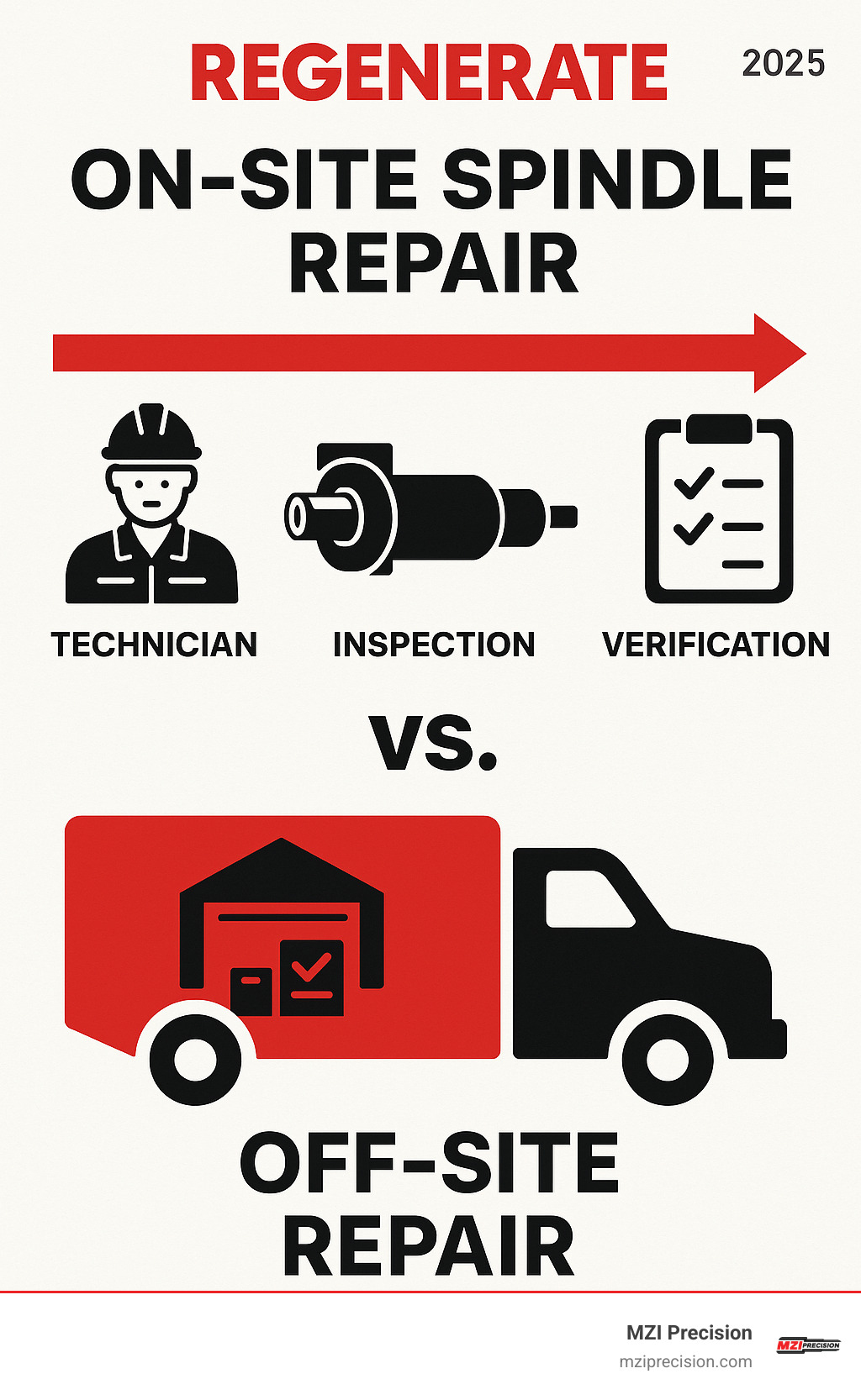
On Site Spindle Repairs vs. Traditional Shop Repairs
The difference between on site spindle repairs and traditional shop repairs is like comparing a quick tune-up to a complete engine rebuild. Both get the job done, but one keeps you running while the other leaves you waiting.
Traditional shop repairs follow a painful timeline. Your spindle fails, production stops, then comes the removal process with all its alignment headaches. Next, you’re packaging and shipping expensive precision equipment, hoping nothing gets damaged in transit. Then you wait for the rebuild shop’s schedule, parts availability, and the complete teardown process. Total downtime: 2-4 weeks.
On site spindle repairs flip this script entirely. A technician arrives within 24-48 hours, sets up portable equipment, and performs precision repairs while your spindle stays put. Quality verification happens in real-time, and you’re back to production the same day. Total downtime: 2-8 hours.
The research shows that on-site taper grinding typically takes just 2-3 hours, while bearing replacement runs 5-8 hours. Compare that to weeks of waiting for traditional off-site rebuilds, and the math becomes pretty clear.
| Comparison Factor | Traditional Shop Repair | On Site Spindle Repairs |
|---|---|---|
| Downtime | 2-4 weeks | 2-8 hours |
| Shipping Risk | High (damage potential) | None |
| Alignment Issues | Common after reinstall | Eliminated |
| Production Loss | $50,000-$200,000+ | $2,000-$8,000 |
| Rush Charges | Often required | Standard service |
| Quality Assurance | Shop-dependent | Real-time verification |
The logistics elimination alone saves thousands. No shipping costs, no handling risks, no reinstallation struggles. Your spindle gets precision care without ever leaving its machine, and you avoid those costly production delays that can make or break monthly targets.
Step-By-Step Process & Tech Behind Mobile Spindle Service
When your industrial manufacturing spindle fails, our on site spindle repair process kicks into high gear with a proven system that’s been refined through thousands of successful repairs. Think of it as bringing a complete machine shop directly to your production floor – except we’re not just moving equipment around, we’re delivering precision that matches what you’d expect from the best rebuild facilities.
The Initial Assessment: Getting to the Root of the Problem
Every repair starts with detective work. Our technicians arrive with portable vibration analysis equipment and immediately begin mapping out what’s really happening inside your spindle. This isn’t just a quick visual check – we’re running comprehensive diagnostics that rival what you’d find in a dedicated spindle lab.
The inspection process reveals the full story. We perform drawbar pull tests to verify tool holding integrity, use precision measurement tools to assess taper contact patterns, and conduct thermal imaging to spot bearing issues before they become catastrophic failures. This data-driven approach means we fix the actual problem, not just the obvious symptoms.
Setting Up Our Mobile Clean Room
Here’s where the magic happens. Within 30-45 minutes, we transform the area around your machine into a controlled environment that rivals traditional shop conditions. Our portable CNC grinding unit gets positioned with surgical precision, while contamination control measures ensure no debris enters your spindle during the repair process.
The setup includes everything from precision gauging equipment to our clean-room assembly cart. We’re essentially building a temporary spindle repair facility that surrounds your machine tool, maintaining the critical relationship between your spindle and its housing throughout the entire process.
The Precision Repair Work
Now comes the heart of the operation. For taper grinding, our portable CNC system can restore worn CAT, BT, BIG-PLUS®, and HSK tapers to OEM specifications while your spindle stays exactly where it belongs. The entire grinding operation typically takes 2-3 hours, and the precision we achieve matches what you’d expect from sending your spindle to the best rebuild shop.
Bearing replacement operations are more involved but equally impressive. Using specialized tools and techniques, we can swap out failed bearings without removing your spindle from the machine. This includes proper preload adjustment and break-in procedures that ensure your new bearings will deliver the performance you need.
Dynamic balancing happens right on your machine using our portable balancing rig. We’re achieving tolerances under 0.1 mil, which means your spindle will run smoother than many new installations.
Quality Control That Proves Itself
Every repair undergoes the same rigorous quality verification you’d expect from a traditional rebuild. We verify taper concentricity, check face-to-taper relationships, and confirm overall spindle performance using real-time QC sensors and precision measurement equipment.
The final testing phase includes runout verification, drawbar force confirmation, and vibration signature analysis. We don’t declare victory until thermal stability testing confirms your spindle is ready for full production loads.
Key Equipment Used During On Site Spindle Repairs
The technology behind mobile spindle repair has come a long way from the early days of “field fixes.” Today’s equipment brings genuine shop-level precision to your production floor, and frankly, some of our portable systems are more advanced than what many traditional rebuild shops are using.
Our Mobile Clean Environment
We establish a contamination-controlled workspace using a mobile clean tent and advanced filtration systems. This isn’t just about keeping dust out – we’re creating conditions that protect your spindle components during the most critical phases of repair work.
Precision Measurement Arsenal
The laser vibrometer provides non-contact vibration analysis that reveals problems invisible to traditional methods. Combined with our air gauging systems for precision taper measurement, we can diagnose issues and verify repairs with remarkable accuracy.
Thermal cameras help us spot bearing problems before they cause catastrophic failures, while our digital runout indicators with data logging capability provide documentation that proves repair quality.
Specialized Tooling and Adapters
Our HSK and BIG-PLUS® adapters ensure we can handle virtually any taper configuration your industrial manufacturing equipment might use. The precision bearing pullers and installation tools are specifically designed for in-machine operations, while our portable hydraulic systems handle bearing preload with the same precision you’d find in a dedicated spindle shop.
Dynamic Balancing Excellence
The portable balancing rig can handle spindles up to 15,000 rpm, providing real-time feedback during the balancing process. This equipment ensures proper balance throughout your spindle’s entire operating range, which is critical for achieving the surface finishes and dimensional accuracy your parts require.
For deeper technical information about our diagnostic capabilities, check out this scientific research on vibration analysis) resource.
On Site Spindle Repairs: Typical Duration & Downtime Impact
Understanding timing helps you plan production schedules around spindle repairs, and the numbers consistently surprise manufacturing managers who are used to weeks of downtime for traditional rebuilds.
Taper Grinding: The 2-3 Hour Solution
Equipment setup takes about 30-45 minutes, followed by comprehensive inspection and measurement (another 30 minutes). The actual grinding operation runs 60-90 minutes, with quality verification requiring an additional 30 minutes. Equipment removal wraps up in 15-30 minutes, putting you back in production during the same shift in most cases.
Bearing Replacement: 5-8 Hour Turnaround
Complete inspection takes about an hour, while bearing removal requires 2-3 hours depending on the spindle configuration. Cleaning and preparation adds another hour, followed by 2-3 hours for new bearing installation. Final testing and verification takes the last hour, and you’re back to cutting parts.
Planning Your Repair Window
The beauty of on site spindle repairs is the flexibility. Schedule repairs during planned maintenance windows when possible, but don’t hesitate to call for emergency service when production demands it. Many of our customers coordinate repairs during off-shifts to maintain continuous operations.
Consider running brief test cuts before full production restart – this helps verify everything is performing as expected and gives your operators confidence in the repair quality. The research shows that same-shift restart is achievable for most common spindle issues, turning what used to be a weeks-long crisis into a manageable maintenance event.
Benefits, Limitations & Cost Considerations
When you’re facing a spindle failure, the clock starts ticking immediately. Every hour your machine sits idle translates to lost revenue, missed deadlines, and frustrated customers. This is where on site spindle repairs truly shine – they can cut your downtime by an incredible 85-95 % compared to traditional shop repairs.
Think about it: instead of weeks of waiting, you’re back in production within hours. That’s not just convenient – it’s transformative for your manufacturing operation.
The financial impact is dramatic. A traditional shop repair might cost you $8,000-$15,000 for the actual work, but when you add shipping costs, handling risks, and weeks of lost production, you’re looking at total costs between $58,500-$216,500. With on-site repairs, that same spindle gets fixed for a total cost of $12,500-$27,000. The math is pretty compelling.
Quality remains uncompromised throughout this process. Our portable equipment delivers the same precision as shop-based systems, and we can verify performance under your actual operating conditions. This means ISO tolerance retention and warranty coverage that matches traditional rebuilds.
The elimination of shipping risks alone saves many manufacturers thousands of dollars. Heavy spindle components are vulnerable during transport, and we’ve seen too many cases where a perfectly good repair gets damaged in transit. When we bring the shop to you, that risk disappears entirely.
Emergency response capability becomes a real competitive advantage. When your spindle fails on a Friday afternoon, you don’t have to wait until Monday to start the repair process. Our technicians can be on-site within 24-48 hours, turning a potential disaster into a minor inconvenience.
Prevention becomes part of the solution. During our on-site visits, we often identify potential issues before they become failures. This preventative insight helps you plan maintenance windows and avoid unexpected breakdowns.
However, honesty matters here. Not every spindle problem can be solved on-site. When you have a cracked spindle shaft, motor rewinds requiring specialized equipment, or extensive contamination requiring complete teardown, traditional shop-based rebuilds remain necessary. We’ll always tell you upfront if your situation requires off-site work.
Complex gear train repairs and certain machining operations simply need the controlled environment and specialized equipment that only a full rebuild shop can provide. But these cases represent a small percentage of typical spindle failures.
The research consistently shows that companies performing over 1,000 spindle repairs annually have accepted mobile solutions because the operational benefits are so compelling. Production continuity, cost predictability, and immediate quality verification create a compelling case for on-site service.
Warranty considerations remain straightforward – our on-site repairs carry the same comprehensive coverage as traditional shop rebuilds. We stand behind our work because our quality control processes ensure reliable, long-lasting repairs that keep your industrial manufacturing spindles running smoothly.
For more information about our comprehensive spindle services, visit our services page.
Preparing Your Facility & Maintaining Precision After Service
Getting your facility ready for on site spindle repairs doesn’t have to be complicated, but a little preparation goes a long way. Think of it like preparing for any important visitor – you want everything ready so they can focus on doing their best work.
Setting Up for Success
The most important thing is giving our technicians room to work. We need about a 10-foot clear perimeter around your machine tool. This isn’t just for convenience – our portable equipment needs space to operate safely and effectively. Good lighting makes a huge difference too, especially when we’re doing precision work that requires careful visual inspection.
Your crane or hoist should be accessible and ready to go. While we try to minimize heavy lifting, some components may need repositioning during the repair process. It’s also helpful to park your tool changer in an easily accessible position before we arrive.
Power and Air Requirements
Our equipment runs on standard 220 V power, so make sure we have access near the machine. We also need a reliable compressed air supply – minimum 90 PSI works fine. Most manufacturing facilities already have these utilities available, but it’s worth double-checking before we arrive.
Coolant containment is another consideration. Our grinding operations are clean, but having containment systems ready shows good planning. Make sure your ventilation systems are working properly too – nobody wants to work in a stuffy environment.
Safety First, Always
Your safety team knows your facility best, so coordinate with them for any hot work permits we might need. Standard lockout/tagout procedures apply, just like any other maintenance work. Brief your team about work area restrictions so everyone knows what’s happening.
Keeping Your Spindle Happy After We Leave
The real magic happens after we finish the repair. Your newly restored industrial manufacturing spindle will perform beautifully, but like any precision equipment, it needs some attention to stay that way.
Those Critical First Days
During the first 48 hours, pay attention to how your spindle sounds and feels. Monitor vibration signatures during initial operation – they should be noticeably improved from before the repair. Listen for any unusual noises or watch for temperature changes. Most importantly, verify that tool holding performance meets your production requirements with some test cuts.
Building a Maintenance Routine
Weekly vibration monitoring for the first month gives you confidence that everything is performing as expected. After that, monthly lubrication system checks and quarterly precision measurements help catch any issues early. We recommend annual comprehensive inspections to keep everything running smoothly.
The beauty of our on-site approach is that we can come back for scheduled preventative maintenance visits. These proactive services help identify potential issues before they interrupt production – much better than waiting for something to break.
Training Your Team
We always take time to train your operators on recognizing early warning signs of spindle issues. This preventative approach can extend spindle life significantly and allows for planned maintenance rather than emergency repairs. Your team knows their machines better than anyone, so combining their knowledge with our expertise creates the best outcomes.
The Long-Term Partnership
Think of this as the beginning of a relationship, not just a one-time repair. Our follow-up vibration monitoring and scheduled lubrication programs integrate seamlessly with your existing maintenance routines. We’re here to help your industrial manufacturing spindles perform at their best for years to come.
For comprehensive information about our maintenance programs and additional services, visit our spindle services page.
Frequently Asked Questions about On Site Spindle Repairs
What spindle problems can be fixed on-site?
When your industrial manufacturing spindle starts acting up, you’re probably wondering if our on site spindle repairs can get you back to production quickly. The good news is that we can handle most of the common problems that shut down CNC machining centers and grinding equipment.
Taper problems are probably the most frequent issues we see. When your tool holding taper gets worn or damaged, it creates runout that ruins your part quality. We can restore those tapers right in your machine using our portable CNC grinding systems. Whether you’re dealing with scoring, galling, or just plain wear, we’ve got the equipment to bring your taper back to OEM specifications.
Bearing failures are another area where our mobile service really shines. Contaminated bearings, improper preload, or lubrication system problems can all be addressed without pulling your spindle. We carry a complete inventory of precision bearings and have the specialized tools to install them correctly while maintaining proper preload.
Drawbar system issues might seem minor, but they can completely shut down your production. When you’re not getting sufficient pull force or dealing with corroded components, we can rebuild the entire drawbar assembly on-site. This includes springs, seals, and hydraulic system components.
The research shows that typical signs requiring spindle repair include unusual noise, decreased machine performance, excessive vibration, or overheating – all of which can often be addressed through on site spindle repairs.
Precision restoration is where our service really proves its value. Excessive runout, dynamic balancing issues, and thermal stability problems can all be corrected while your spindle stays in its original housing. This maintains the critical geometric relationships that often get compromised during traditional removal and reinstallation.
How do I verify the quality matches OEM specs?
This is probably the most important question manufacturing managers ask about on site spindle repairs. After all, you need to know that the work meets the same standards as factory rebuilds.
Real-time measurement is built into every step of our process. We use precision air gauging to verify taper dimensions while we’re working. Our runout measurements confirm geometric accuracy, and vibration analysis ensures smooth operation. Thermal imaging helps us validate bearing condition before we declare the job complete.
Documentation is everything in precision manufacturing. You’ll receive complete before-and-after measurement reports that show exactly what we found and what we corrected. We photograph the repair process and provide calibrated equipment certification. Most importantly, we document compliance with OEM specifications using the same measurement standards your quality department uses.
Performance testing happens under real operating conditions. We verify tool holding performance, confirm dynamic balancing, and monitor operational temperatures. We can even run production-speed tests to ensure your spindle performs exactly as it should.
We use the same precision gauging systems found in traditional rebuild shops, ensuring the correct relationship between face and taper to meet OEM specifications. Our equipment undergoes regular calibration and certification to maintain measurement accuracy that you can trust.
What certifications should technicians carry?
When someone is working on your million-dollar machine tool, you want to know they have the right training and certifications. Our field technicians maintain comprehensive certifications that ensure the highest quality on site spindle repair service.
Technical expertise starts with precision grinding certification and bearing installation training. Our technicians are certified in vibration analysis and hydraulic systems. These aren’t just certificates on the wall – they represent hundreds of hours of hands-on training with the exact equipment we bring to your facility.
Safety certifications are non-negotiable in industrial manufacturing. Every technician carries OSHA 30-hour industrial safety certification, confined space entry certification, and lockout/tagout training. We also maintain hot work permits because precision grinding sometimes requires specialized safety procedures.
Equipment certifications cover every piece of equipment we bring to your facility. This includes portable CNC grinding system operation, precision measurement equipment calibration, and dynamic balancing equipment certification. Our technicians are also trained in clean-room procedures to maintain the contamination control your spindle repair requires.
Manufacturer authorizations might be the most important credentials we carry. We maintain factory-authorized repair certifications for major spindle manufacturers, ensuring our repairs meet or exceed OEM standards. This includes specialized training for BIG-PLUS® and HSK systems that are becoming more common in high-precision manufacturing.
Our technicians undergo continuous training to stay current with evolving technology. The industrial manufacturing spindle repair field changes rapidly, and we invest heavily in keeping our team’s expertise sharp and up-to-date.
Conclusion
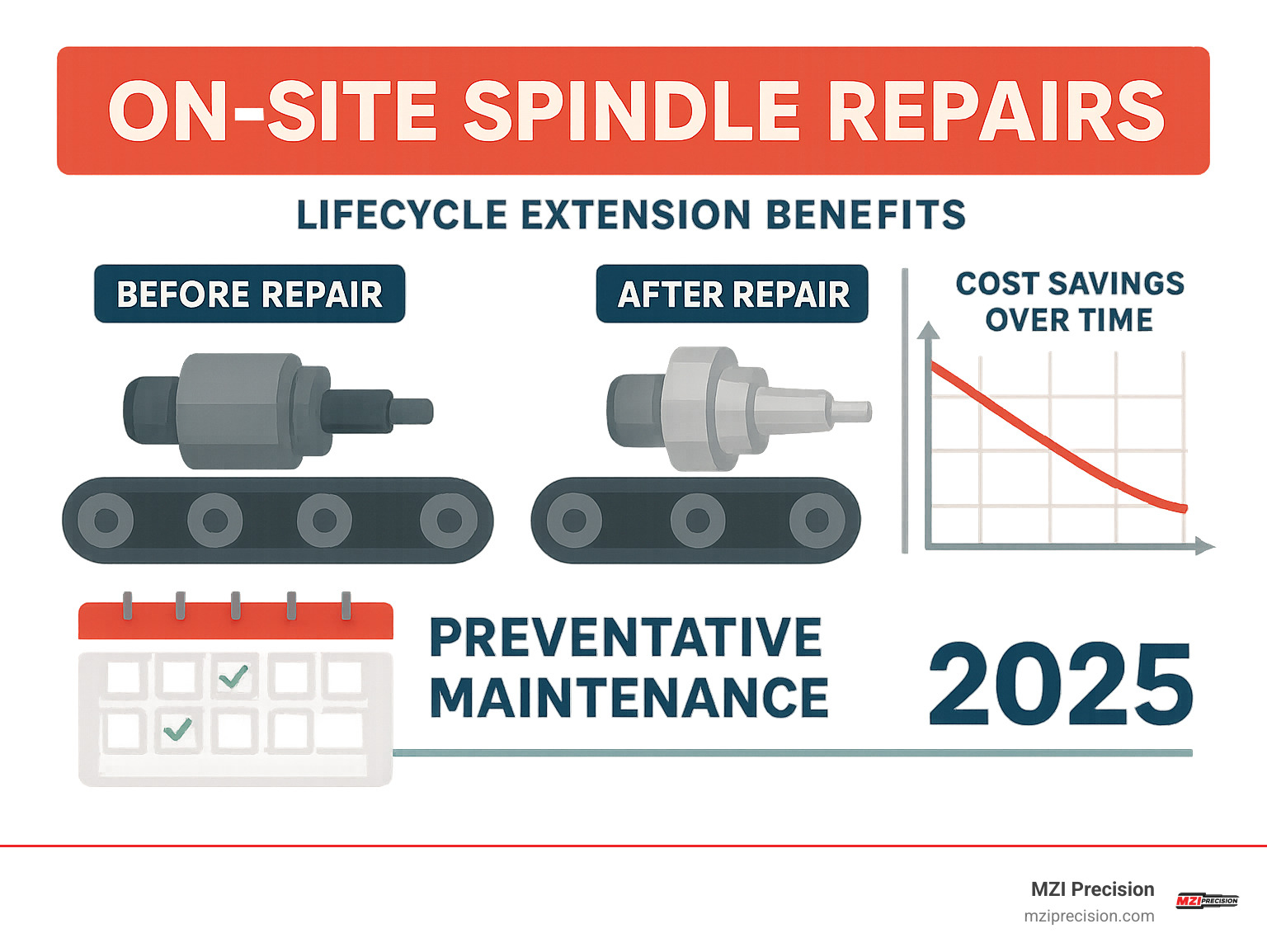
On site spindle repairs represent the future of industrial manufacturing spindle maintenance, offering unprecedented speed, precision, and cost-effectiveness. By bringing shop-level capabilities directly to your production floor, we can restore your spindles to OEM specifications in hours rather than weeks.
The key advantages are clear: 85-95 % reduction in downtime, elimination of shipping risks, preserved machine geometry, and immediate quality verification. These benefits translate directly to maintained production schedules, reduced costs, and improved operational efficiency.
At MZI Precision, we’ve invested heavily in the portable equipment and technician training necessary to deliver these advanced services. Our expertise spans aerospace, defense, automotive manufacturing, and general industrial applications, with a commitment to providing the same precision and reliability you’d expect from traditional shop-based rebuilds.
The research consistently shows that companies utilizing on site spindle repair services experience significant operational improvements. From the 2-3 hour taper grinding services to complete bearing replacements in 5-8 hours, the time savings alone justify the investment.
Most importantly, our preventative maintenance approach helps extend spindle life and allows for planned maintenance rather than emergency repairs. This proactive strategy keeps your production lines running smoothly while minimizing unexpected downtime.
Whether you’re dealing with an emergency spindle failure or planning preventative maintenance, our mobile repair capabilities ensure your industrial manufacturing spindles receive the expert attention they deserve without the traditional delays and complications of off-site repairs.
For more information about our comprehensive spindle repair and rebuilding services, visit our precision spindle rebuilding page to learn how we can keep your manufacturing operations spinning smoothly.