
 (714) 379-6505


Air Spindle Repair: Top 3 Expert Fixes 2025
UNDERSTANDING AIR BEARING SPINDLES AND THEIR CRITICAL ROLE
Air spindle repair is a specialized service for restoring high-tech manufacturing equipment. When these critical components fail, choosing the right repair service prevents costly, extended downtime.
Quick Guide to Choosing Air Spindle Repair Services:
- Experience Level: Look for 15+ years of experience and OEM-trained technicians
- Turnaround Time: Standard repairs take 1-3 weeks, expedited options available in 24-48 hours
- Warranty Coverage: Quality services offer 6-12 months warranty on parts and labor
- Precision Standards: Ensure micron-level grinding capabilities and ABEC 7 or better bearings
- Testing Equipment: Verify they use calibrated test equipment in climate-controlled environments
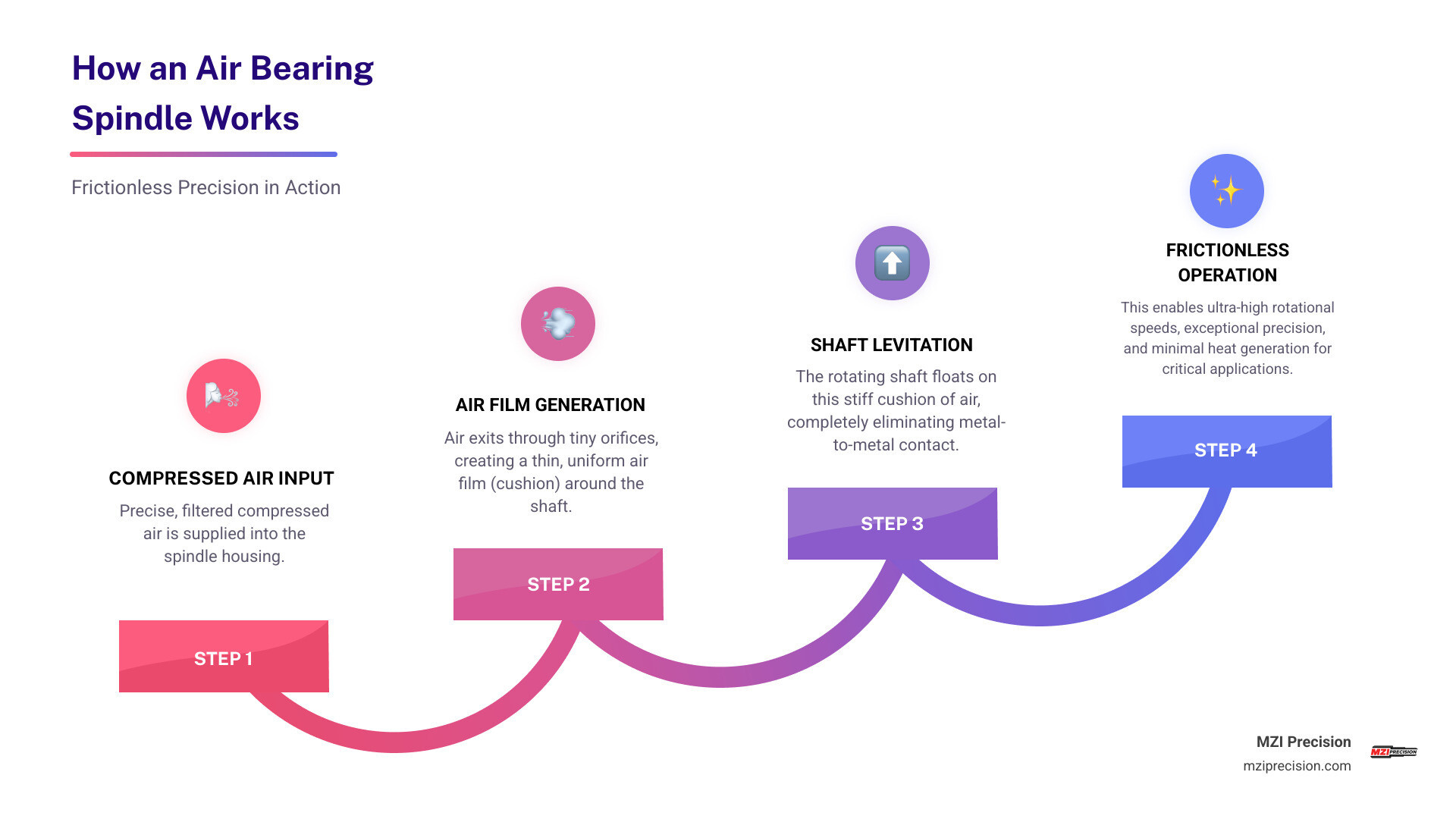
Air bearing spindles float a rotating shaft on compressed air. This frictionless design enables rotational speeds over 100,000 RPM with micron-level precision. Unlike mechanical spindles with ball bearings, air bearing spindles have no metal-to-metal contact. This makes them ideal for ultra-precision tasks like wafer dicing, PCB drilling, and precision grinding, where minimal vibration is critical.
However, this sophisticated technology requires equally advanced repair expertise. The wide range of applications demands specialized knowledge and equipment that not all repair shops possess.
COMMON APPLICATIONS IN HIGH-TECH MANUFACTURING
Air bearing spindles are the heart of precision machinery in high-tech sectors. In the semiconductor industry, they are vital for wafer dicing and grinding, where any deviation causes material waste. They are also essential for PCB drilling, precision grinding, and optics manufacturing—applications requiring ultra-fine finishes and exact tolerances.
These specialized spindles are vital for:
- Aerospace manufacturing
- Defense/military applications
- Solar energy production
- Tooling and machine tool industries
KEY DIFFERENCES: AIR BEARING VS. MECHANICAL SPINDLES
Understanding the distinctions between air bearing and mechanical spindles is crucial when considering air spindle repair.
| Feature | Air Bearing Spindles | Mechanical (Ball Bearing) Spindles |
|---|---|---|
| Bearing Type | Non-contact (floats on air cushion) | Contact (rolling elements/ball bearings) |
| Friction | Virtually zero | Present (from rolling elements) |
| Rotational Speed | Extremely high (e.g., 60,000 RPM to 150,000 RPM+) | High, but generally lower than air bearings |
| Load Capacity | Low to moderate | High |
| Heat Generation | Very low (due to lack of friction) | Moderate to high (due to friction) |
| Accuracy/Finish | Ultra-precision (micron-level) | High precision, but typically less than air bearings |
| Vibration | Extremely low | Higher (inherent from rolling elements) |
| Lubrication | Requires clean, dry compressed air supply | Requires grease or oil |
| Noise Level | Very low | Higher (from rolling elements) |
| Maintenance | Sensitive to air quality, precise handling needed | Requires periodic lubrication |
The non-contact nature of air bearing spindles eliminates friction, wear, and vibration. This allows for higher speeds, superior finishes, and exceptional accuracy. However, they are more delicate and susceptible to damage from impacts or contaminated air. Air spindle repair demands specialized expertise in aerodynamics, precision machining, and ultra-clean assembly, far beyond typical mechanical spindle repair.
IDENTIFYING FAILURE: WHEN TO SEEK PROFESSIONAL AIR SPINDLE REPAIR
Learning to recognize the warning signs of spindle failure can save you thousands in costs and downtime. These precision machines rarely fail without warning, though the signs can be subtle.
The most telling indicator is increased vibration. Since air bearing spindles are designed for smooth operation, any new vibration is a major red flag. Also, listen for audible noise changes, like new grinding sounds or shifts in the operational hum.
Finished parts often reveal problems first. A poor surface finish, with chatter marks or inconsistencies, indicates compromised precision. Likewise, a loss of accuracy in holding tolerances or new runout points to internal issues. Modern CNC machines also generate error codes for spindle problems. Do not ignore these warnings; they indicate a genuine issue.
COMMON FAILURE MODES AND THEIR ROOT CAUSES
Understanding failure causes helps prevent them. The most common culprit is a contaminated air supply. Spindles require ultra-clean compressed air; even tiny amounts of moisture, oil, or particles can damage microscopic air jets and bearing surfaces.
Spindle crashes or impacts are another frequent cause. Even a minor tool crash can misalign components or damage polished bearing surfaces. Coolant jacket corrosion can lead to leaks or overheating, causing extensive internal damage. Delicate bearing surfaces can suffer from scratches or corrosion, affecting performance. Broken tool interfaces and electrical motor failures are other common failure modes.
THE DANGERS OF DELAYING AN AIR SPINDLE REPAIR
Delaying air spindle repair allows minor problems to become major disasters. Ignoring early warning signs can lead to catastrophic failure, turning a manageable repair into a complete rebuild or replacement.
A failing spindle can cause damage to the machine tool. Excessive vibration and heat can transfer to guideways and tool changers, leading to more extensive repairs. The impact includes scrapped parts and material waste. Inaccurate spindles produce unusable parts, leading to unplanned production downtime, lost revenue, and missed deadlines.
Perhaps most seriously, safety hazards from ejected tools pose real risks. A worn drawbar can fail, sending tools flying at high speeds—a dangerous scenario for any shop.
THE ANATOMY OF A PROFESSIONAL SPINDLE REPAIR PROCESS
When an industrial air bearing spindle fails, the professional repair process restores it to peak condition. Professional air spindle repair focuses on identifying the root cause of failure to prevent recurrence. The process occurs in controlled environments to protect the micron-level precision these components require.
Each step demands specialized tools, climate-controlled rooms, and expert technicians, as even a small mistake can compromise the entire repair.
STEP 1: COMPREHENSIVE EVALUATION AND FAILURE ANALYSIS
Upon arrival, the spindle undergoes an intense investigation. The incoming inspection includes a visual examination for damage and wear patterns. Diagnostic testing follows, with vibration analysis to detect internal issues like bearing wear or imbalance. Drawbar pull-force testing verifies the tool clamping system, while runout measurements check for shaft wobble, a critical factor for precision. This failure analysis determines the root cause—be it contamination, a crash, or normal wear—which guides the repair strategy. You then receive a detailed quote and failure report outlining the findings, required work, and cost.
STEP 2: DISASSEMBLY, CLEANING, AND COMPONENT REWORK
After approval, the spindle is moved to a clean room for complete disassembly to prevent contamination. All parts undergo meticulous cleaning to remove debris and residue. Technicians then perform a detailed inspection of bearing journals, housing bores, and tapers using precision measuring equipment. Any surfaces not meeting OEM specifications are reworked via precision grinding to restore original dimensions and finish. Finally, all worn or questionable components, such as O-rings, sensors, and brushes, are replaced to ensure reliability.
STEP 3: PRECISION ASSEMBLY AND DYNAMIC BALANCING
Reassembly to OEM standards is a precise process. Technicians follow exact procedures, especially when using ABEC 7 or better bearings, to ensure proper preload and alignment. The next critical step is balancing rotating components at maximum RPM. This dynamic balancing corrects even the slightest imbalance, which is crucial at high speeds. Ensuring minimal vibration for extended life is the goal, as proper balancing reduces bearing loads, heat, and premature wear.
STEP 4: FINAL QUALITY CONTROL AND TESTING
The final stage is rigorous quality control. Every restored spindle undergoes an in-house test run, gradually brought to full speed while technicians monitor temperature, vibration, and other parameters. Temperature and vibration analysis during run-in identifies issues that only appear under operational load. Verifying runout and compliance measurements confirms the spindle meets or exceeds OEM specifications. The final quality certification process documents all test results, providing a data-backed guarantee of the restoration.
For more information about our comprehensive approach to spindle restoration, visit More info about our services. When your production depends on precision, you deserve nothing less than perfection.
EVALUATING AIR SPINDLE REPAIR SERVICES
Choosing the right air spindle repair service is critical to minimizing downtime. It’s about finding a partner who understands your operational needs. The best services combine years of experience with OEM-trained technicians. Look for a team with 15+ years in the business, as their experience and expertise are invaluable for diagnosing issues and extending spindle life.
While cost considerations are important, prioritize quality over the lowest price. A cheap repair that fails quickly is no bargain. A quality service offers transparent pricing and helps you weigh repair versus replacement, noting that a rebuilt spindle can often outperform a new one.
THE IMPORTANCE OF SPECIALIZED TOOLS AND FACILITIES
Air spindle repair requires specialized facilities, as general machine shops lack the necessary equipment. Key tools include:
- Dynamic balancing machines to balance components at operating speeds, preventing destructive vibration.
- Precision grinding equipment to restore worn surfaces to micron tolerances.
- Climate-controlled clean rooms to prevent contamination during assembly, which can cause premature failure.
- Calibrated diagnostic tools like vibration analyzers and runout gauges for accurate diagnosis and verification.
These facilities demonstrate a commitment to quality. At MZI Precision, our facilities include all this specialized equipment, and we perform precision grinding to micron tolerances right in-house. This means we control every aspect of the repair process, ensuring consistent quality. We’ve worked with spindles from many different manufacturers over the years, including brands like Okamoto and many others.
UNDERSTANDING WARRANTIES AND TURNAROUND TIMES
A quality service provides a solid warranty, typically 6 to 12 months, covering parts and labor for workmanship defects. Understand what the warranty covers and its exclusions, like wear parts.
Turnaround time is also critical. Standard repairs take 1-3 weeks, but rushing can compromise quality. For urgent needs, expedited repair options are often available, sometimes within 48 hours, though usually at a premium. Find a partner who can balance speed and quality to meet your production needs.
PROACTIVE CARE: EXTENDING THE LIFE OF YOUR AIR SPINDLE
While professional air spindle repair is effective, preventing problems is the smartest approach. The foundation of spindle longevity is proper air filtration. Clean, dry, oil-free compressed air is essential, as contaminants can clog air jets and erode bearing surfaces. Regularly monitor and maintain your filtration systems.
Regular machine maintenance is also key. Following the manufacturer’s schedule, including checking coolant systems and alignment, is insurance for your spindle.
Your tooling choice matters. Using balanced tool holders is non-negotiable for high-speed spindles. Unbalanced tools will cause problems even in a perfectly balanced spindle.
Operator training is critical for avoiding crashes and overloads. Air bearing spindles are precision instruments that cannot handle impacts or excessive loads.
Finally, always follow OEM operating procedures. Adhering to speed, temperature, and load specifications, including warm-up and shutdown protocols, ensures reliable service. Taking these preventative steps protects your equipment, production schedule, and bottom line.
FREQUENTLY ASKED QUESTIONS ABOUT AIR SPINDLE REPAIR
Here are answers to common questions about industrial manufacturing spindle repair.
WHAT IS THE TYPICAL COST OF AN AIR SPINDLE REPAIR?
Air spindle repair almost always costs significantly less than replacement. A new spindle can cost tens of thousands of dollars, while a repair is a fraction of that price. The final cost depends on the extent of the damage—from minor surface wear to major component remanufacturing after a crash. Most reputable services offer no-charge evaluations and provide a firm quote before any work begins. This allows you to make an informed decision. Repair extends the life of your equipment, avoids a major capital expense, and a properly repaired spindle can perform as well as a new one.
WHICH AIR SPINDLE BRANDS CAN BE REPAIRED?
Professional air spindle repair services can service spindles from nearly every manufacturer, including Westwind, Excellon, TSK, Disco, Colibri, and Loadpoint. Experienced shops can also reverse-engineer and rebuild discontinued or custom models, even those no longer supported by the original manufacturer. The key is finding a service with the specialized knowledge and tools required for these precision devices.
HOW IS MICRON-LEVEL PRECISION ACHIEVED IN A REPAIR?
Micron-level precision is achieved through a combination of skilled technicians, precision equipment, and rigorous processes. Our senior technicians have over 15 years of experience and OEM training. We use in-house precision grinding to restore components to micron tolerances and perform dynamic balancing at maximum RPM to eliminate vibration. We maintain strict adherence to OEM tolerances, using calibrated equipment in a climate-controlled facility. Finally, comprehensive testing and verification, including run-in analysis and runout measurements, ensure the spindle is certified to perform at or better than new.
RESTORE YOUR OPERATIONS WITH EXPERT SPINDLE REBUILDING
When critical industrial manufacturing equipment fails, every hour of downtime is costly. Professional air spindle repair offers a proven path back to peak performance without the expense of replacement.
The benefits are clear: minimize downtime, restore your spindle to OEM specifications, and extend its life for a fraction of the cost of a new unit. Why replace what can be expertly restored?
At MZI Precision, we have over 50 years of experience, having repaired more than 100,000 spindles for industries from aerospace to defense. We know a failed spindle is a business emergency.
Our OEM-trained technicians, advanced in-house capabilities, and climate-controlled facilities deliver the micron-level precision your operations demand. In a field where speeds exceed 100,000 RPM and tolerances are measured in microns, there is no substitute for experience and quality. Our expertise makes the difference.
For expert evaluation and repair of your critical air bearing spindles, trust the specialists at MZI Precision to restore precision and reliability. Contact us for a repair estimate and let us get your operations back on track.