


Spindle Replacement: 5 Easy Steps Guide
Why Industrial Spindle Replacement is Critical for Manufacturing Success
Spindle Replacement is a critical maintenance procedure that restores precision and performance to industrial manufacturing equipment. When a spindle fails, production stops—and every minute of downtime costs money. Industrial spindles are the heart of CNC machines, rotating cutting tools at high speeds while maintaining micron-level tolerances. A failure can damage workpieces, waste materials, and compromise quality.
The cost of unexpected downtime is substantial, disrupting schedules and delaying deliveries. This guide provides clear, actionable steps for the complete spindle replacement process, helping you minimize downtime and maintain production reliability.
Quick Answer: How to Perform Spindle Replacement
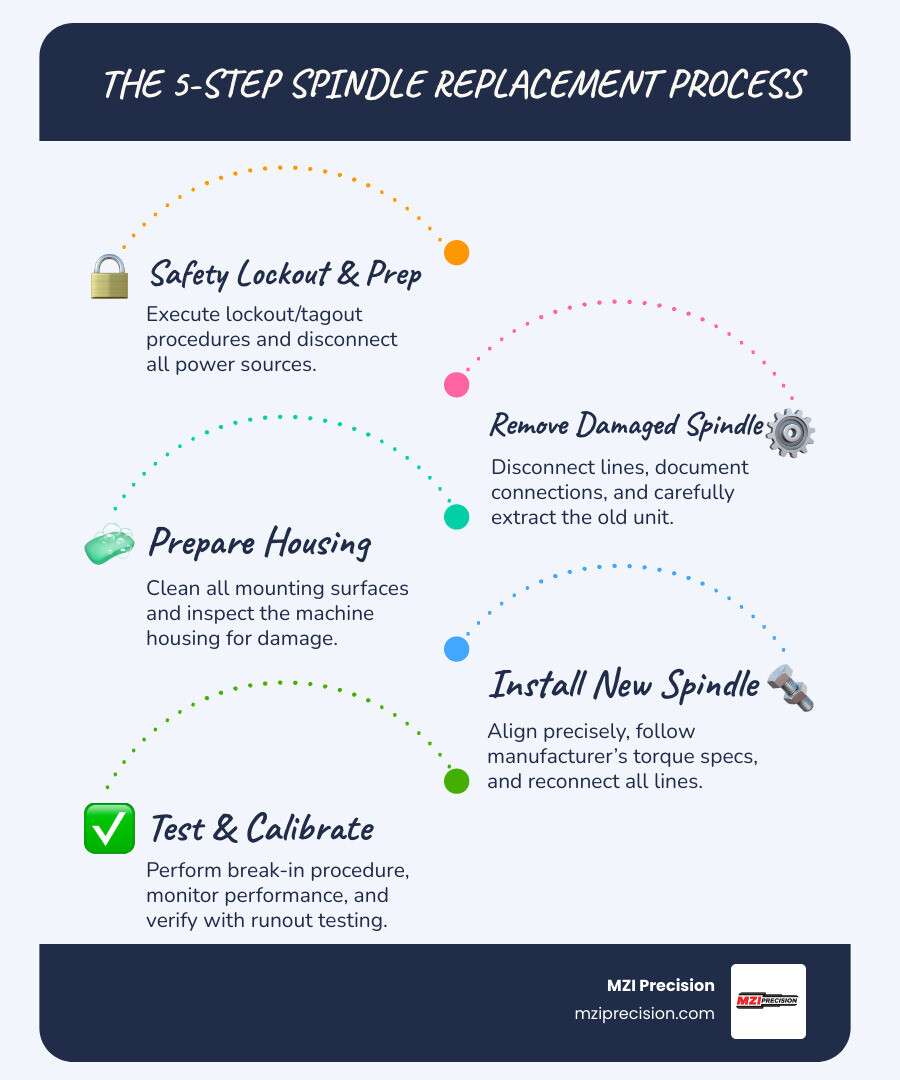
- Safety First – Execute lockout/tagout procedures and disconnect all power sources.
- Remove the Damaged Spindle – Disconnect lines, document connections, and extract the old unit.
- Prepare the Housing – Clean mounting surfaces and inspect for damage.
- Install the New Spindle – Align precisely, torque to specifications, and reconnect all systems.
- Test and Calibrate – Perform break-in procedures and verify performance with runout testing.
PRE-REPLACEMENT ANALYSIS: REPAIR OR REPLACE?
Before committing to a spindle replacement, it’s crucial to determine if repairing the existing spindle is a better option. This decision impacts your budget, schedule, and equipment performance.
What Actually Damages Industrial Spindles?
Most failures develop over time. Key causes include:
- Contamination: Coolant, metal chips, and dust can enter bearings, acting like sandpaper and causing accelerated wear.
- Machine Crashes: An impact can bend the shaft, crack the housing, or destroy bearings instantly.
- Lack of Lubrication: Insufficient grease or oil leads to friction, overheating, and rapid bearing failure.
- Improper Loads: Unbalanced tools or operating beyond rated capacity creates stress and vibration, damaging components.
- Low-Quality Parts: Substandard components from previous repairs often fail prematurely.
Recognizing the Warning Signs
A failing spindle provides clues:
- Increased Noise: Grinding, whining, or rattling sounds indicate worn bearings.
- Excessive Vibration: Points to internal imbalance or a bent shaft.
- Poor Surface Finish: Reduced accuracy or chatter marks on parts suggest spindle instability.
- Overheating: Abnormal heat in the housing signals excessive friction.
- Loose Tool Retention: Weak drawbar force can damage the spindle shaft and ruin parts.
The Difference Between Spindle Repair and Spindle Replacement
Spindle repair (or rebuilding) involves disassembling the unit, replacing only worn parts like bearings and seals, and reassembling it to OEM specifications. It’s often faster and costs 40-60% less than replacement, making it ideal for minor wear. Our OEM rebuilt spindles service ensures your unit performs like new.
Spindle replacement is necessary for irreparable damage, such as a bent shaft or cracked housing. While more expensive, it provides a new component with a full service life. The choice depends on damage severity, cost, downtime, and performance needs.
Why Industrial Spindle Replacement is Critical for Manufacturing Success

When a CNC machine’s spindle fails, the clock starts ticking on lost revenue. Spindle Replacement is a critical maintenance procedure that separates shops that thrive from those that struggle with unexpected downtime. A failed spindle doesn’t just pause production; it damages workpieces, wastes material, and hurts quality. While a professional spindle repair and rebuilding service is cost-effective for minor issues, severe damage—like a cracked housing or bent shaft—makes replacement the only path forward.
Quick Answer: How to Perform Spindle Replacement
- Safety First – Execute lockout/tagout procedures.
- Remove the Damaged Spindle – Disconnect and document all connections.
- Prepare the Housing – Clean and inspect mounting surfaces.
- Install the New Spindle – Align, torque, and reconnect systems.
- Test and Calibrate – Perform break-in and runout testing.
PRE-REPLACEMENT ANALYSIS: REPAIR OR REPLACE?
Before you commit to a spindle replacement, an honest assessment is required: repair or replace? Understanding the root cause of failure helps make the right call.
What’s Really Causing Your Spindle Problems?
Spindle failures are often caused by contamination, where particles breach seals and grind down bearings. Machine crashes can cause immediate, catastrophic damage. Other major factors include lack of proper lubrication, which accelerates wear, and unbalanced tools, which create damaging vibrations. Using low-quality parts in previous repairs can also lead to premature failure, which is why our spindle repair and rebuilding services use only high-quality components.
How to Spot a Failing Spindle
Look for these warning signs:
- Increased noise (grinding, whining)
- Excessive vibration
- Reduced accuracy or poor surface finish
- Overheating of the spindle housing
- Loose tool retention or weak drawbar force
The Difference Between Spindle Repair and Spindle Replacement
Spindle repair (rebuilding) is a comprehensive process of disassembly, inspection, and replacement of only worn components. It is almost always more cost-effective than buying new. Our expertise in OEM rebuilt spindles restores units to peak performance. Spindle replacement is for irreparable structural damage or when upgrading capabilities.
| Factor | Spindle Repair (Rebuilding) | Spindle Replacement |
|---|---|---|
| Cost | Significantly lower—often half the cost or less than new | Higher upfront investment—typically twice the cost of rebuilding |
| Downtime | Usually faster, especially when OEM parts aren’t readily available | Can be longer if sourcing new units from manufacturers |
| Damage Severity | Best for bearing wear, seal failure, and repairable component damage | Necessary for bent shafts, cracked housings, or irreparable structural damage |
| Upgrade Needs | Limited to existing spindle capabilities | Allows for performance upgrades and specification changes |
PRE-REPLACEMENT ANALYSIS: REPAIR OR REPLACE?
Before you commit to a spindle replacement, the decision between repairing and replacing a spindle depends on damage, age, and production demands.
What Causes Spindles to Fail?
Understanding failure causes helps prevent future issues.
- Contamination: Coolant, metal chips, and dust wear down precision bearings.
- Machine Crashes: Sudden impacts can bend shafts or crack housings.
- Inadequate Lubrication: Lack of clean, high-quality lubricant causes friction and heat.
- Excessive Loads: Unbalanced tools or operating beyond rated capacity creates stress.
- Lack of Inspections: Allows minor issues to become catastrophic failures.
Warning Signs Your Spindle Needs Attention
- Increased noise (grinding, whining).
- Excessive vibration not caused by tooling.
- Poor surface finish or dimensional inaccuracy.
- Overheating of the spindle housing.
- Weak tool retention or drawbar force.
The Difference Between Spindle Repair and Spindle Replacement
Spindle repair is cost-effective, often costing 50% less than a new unit. It’s ideal for worn bearings, failing seals, or minor wear. With experienced specialists, a rebuild can be faster than sourcing a new spindle. Our expertise in OEM rebuilt spindles ensures your unit performs like new.
Spindle replacement is necessary for irreparable damage, like a bent shaft or cracked housing. It’s also the right choice when upgrading performance. While the upfront cost is higher, it provides a new unit with a full warranty. For more info about spindle repair and rebuilding services, we invite you to explore what MZI Precision offers.
THE 5-STEP GUIDE TO INDUSTRIAL SPINDLE REPLACEMENT
A spindle replacement requires meticulous attention to detail and strict adherence to safety protocols. This guide outlines the five essential steps for a successful and safe replacement.

STEP 1: SAFETY LOCKOUT AND PREPARATION
Safety is the number one priority. Before any work begins, a thorough safety procedure is mandatory.
- Lockout/Tagout (LOTO): De-energize and lock out all energy sources—electrical, hydraulic, and pneumatic—according to LOTO protocols.
- Disconnect Power: Physically disconnect main power feeds to prevent accidental activation.
- Gather Tools: Have all necessary tools ready, including specialized wrenches, torque wrenches, lifting equipment, and diagnostic tools.
- Consult Manual: The manufacturer’s manual is your guide for disassembly, torque values, and safety warnings.
- Prepare Work Area: A clean, organized workspace prevents contamination and accidents.
STEP 2: REMOVING THE DAMAGED SPINDLE
With safety measures in place, carefully remove the damaged spindle to avoid further damage.
- Remove Covers: Take off protective guarding and covers, noting their location for reassembly.
- Disconnect Lines: Carefully disconnect all coolant, air, and electrical lines.
- Document Connections: Take detailed photos of every connection point before disconnection. Labeling wires and hoses is invaluable for reassembly.
- Unbolt Spindle: Unbolt the spindle cartridge from the machine frame. Use appropriate lifting equipment for heavy spindles.
- Extract Spindle: Gently extract the unit from its housing, ensuring a clear and stable path.
STEP 3: PREPARING THE HOUSING AND NEW SPINDLE
Proper preparation ensures the new spindle is installed in a pristine environment.
- Clean Mounting Surfaces: The mounting area must be spotlessly clean. Remove all old sealant, debris, and oil residue.
- Inspect Housing: Thoroughly inspect the machine’s housing for cracks, wear, or deformation that could compromise the new installation.
- Verify New Spindle: Compare the new spindle with the old one and the machine’s technical specifications to confirm dimensions, mounting patterns, and connectors match.
STEP 4: INSTALLING THE NEW SPINDLE UNIT
This step requires precise alignment and correct torque application.
- Precise Alignment: Carefully guide the new spindle into its housing. Avoid forcing it, as this can cause damage.
- Follow Torque Specifications: Use a calibrated torque wrench to tighten mounting bolts to the manufacturer’s exact specifications.
- Use Correct Bolt Sequence: Adhere to the specified tightening sequence (e.g., a star pattern) to ensure even pressure.
- Reconnect All Lines: Referring to your photos, reconnect all coolant, air, and electrical lines securely.
STEP 5: POST-INSTALLATION TESTING AND CALIBRATION
This final step ensures the new spindle operates correctly and safely.
- Initial Power-On Checks: Power on the machine in a safe or diagnostic mode. Check for leaks or unusual noises.
- Spindle Break-In: Follow the manufacturer’s break-in procedure, typically running the spindle at progressively increasing RPMs without a load.
- Monitor Performance: Gradually increase speed while monitoring for abnormal vibration, noise, or temperature.
- Perform Runout Testing: Use a dial indicator to measure spindle runout at the tool taper. This confirms its concentricity and accuracy.
POST-REPLACEMENT BEST PRACTICES AND MAINTENANCE
A successful spindle replacement is just the beginning. To maximize the lifespan of your new industrial spindle, implement robust maintenance practices.
ENSURING LONGEVITY AFTER YOUR SPINDLE REPLACEMENT
Preventative and predictive maintenance are key to safeguarding your investment.
- Preventative Maintenance Schedule: Adhere to a strict schedule for regular inspections, checking for wear, contamination, or damage.
- Predictive Maintenance: Use technologies like vibration analysis and temperature monitoring to detect early signs of bearing wear or overheating, allowing you to schedule maintenance proactively.
- Proper Lubrication: Use only manufacturer-recommended lubricants and follow specified intervals. Ensure bearings are clean and properly lubricated.
- Operator Training: Educate operators on best practices like proper tool balancing, avoiding excessive loads, and recognizing early warning signs of spindle distress.
COMMON ISSUES WITH SPINDLE REPLACEMENT PARTS
Challenges can arise with replacement parts, even with a meticulous process.
- OEM vs. Aftermarket Quality: OEM parts ensure optimal fit and performance. While some aftermarket parts are cost-effective, quality can vary significantly and lead to premature failure.
- Potential Fitment Problems: Minor discrepancies can exist even in specified parts, sometimes requiring modifications that can cause delays.
- Warranty Considerations: Understand the warranty on both the new spindle and the installation service.
- Sourcing Challenges: Finding parts for older machines can be difficult. A specialized rebuilder like MZI Precision can be invaluable for sourcing or rebuilding these components.
FREQUENTLY ASKED QUESTIONS
HOW LONG DOES AN INDUSTRIAL SPINDLE REPLACEMENT TAKE?
The duration of a spindle replacement varies. A simple cartridge swap may take hours, while a complex, integrated high-speed spindle can take much longer.
- Factors Affecting Time: Replacement time depends on spindle complexity, machine access, and the number of utility connections.
- Total Downtime: Total downtime includes preparation, disassembly, installation, and crucial post-installation testing, including the break-in procedure. Our process is designed for efficiency to get your equipment back online rapidly.
- Part Availability: Sourcing the correct new or rebuilt spindle can be the most significant factor in overall downtime, especially for older equipment.
WHAT ARE THE MOST COMMON CAUSES OF PREMATURE SPINDLE FAILURE?
Premature spindle failure leads to costly downtime. The most common causes include:
- Contamination: Ingress of debris or coolant into bearings is a leading cause of failure, as abrasive particles destroy precision surfaces.
- Machine Crashes: High-impact collisions can cause severe, often irreparable damage to the spindle shaft, bearings, and housing.
- Lack of Proper Lubrication: Insufficient or contaminated lubricant leads to excessive friction, heat, and eventual bearing seizure.
- Improper Loads: Using unbalanced tools or exceeding the spindle’s designed load capacity creates destructive vibrations and stress, leading to rapid component failure.
CONCLUSION
We’ve covered the essential journey of spindle replacement, a process that demands precision and attention to detail. Your industrial spindle is the heart of your manufacturing operation, and understanding the warning signs of failure can save you from catastrophic downtime.
The choice between repair and replacement depends on the extent of the damage and your operational needs. A rebuild can breathe new life into a spindle at a fraction of the cost, while a complete spindle replacement is the right path for severe structural damage or performance upgrades.
At MZI Precision, we have extensive experience with spindle challenges across numerous industries. Our expertise in OEM rebuilt spindles ensures we understand the nuances of these complex components. We are committed to getting your equipment back to peak performance quickly and correctly.
Ready to get your spindle performing like new again? Contact us for expert spindle replacement and rebuilding and let’s discuss how we can minimize your downtime and maximize your productivity.