
 (714) 379-6505


Haas spindle bearing replacement: Restore 2025
WHY YOUR HAAS SPINDLE BEARINGS ARE THE HEART OF YOUR MACHINE
Haas spindle bearing replacement is a critical maintenance task that can save you thousands in downtime and restore your machine’s precision. Whether you’re hearing unusual grinding noises, experiencing excessive heat, or seeing poor surface finishes on your parts, worn spindle bearings are often the culprit. Catching them early can prevent catastrophic failure.
Quick Answer: Key Steps for Haas Spindle Bearing Replacement
- Diagnose the problem – Listen for growling sounds, check for excessive heat (>140°F), measure drawbar force, and inspect for vibration.
- Gather tools and parts – Heavy-duty bearing puller, torque wrench, dial indicator, replacement bearing kit, o-rings, and Belleville washers.
- Remove the spindle – Lock out the machine, disconnect lines, unbolt and lower the spindle cartridge with a hoist.
- Replace bearings – Remove old bearings, clean all surfaces, and press in new bearings with the correct preload.
- Reinstall and test – Torque bolts in a star pattern, run a break-in program, verify runout (<0.001″ TIR), and check vibration levels.
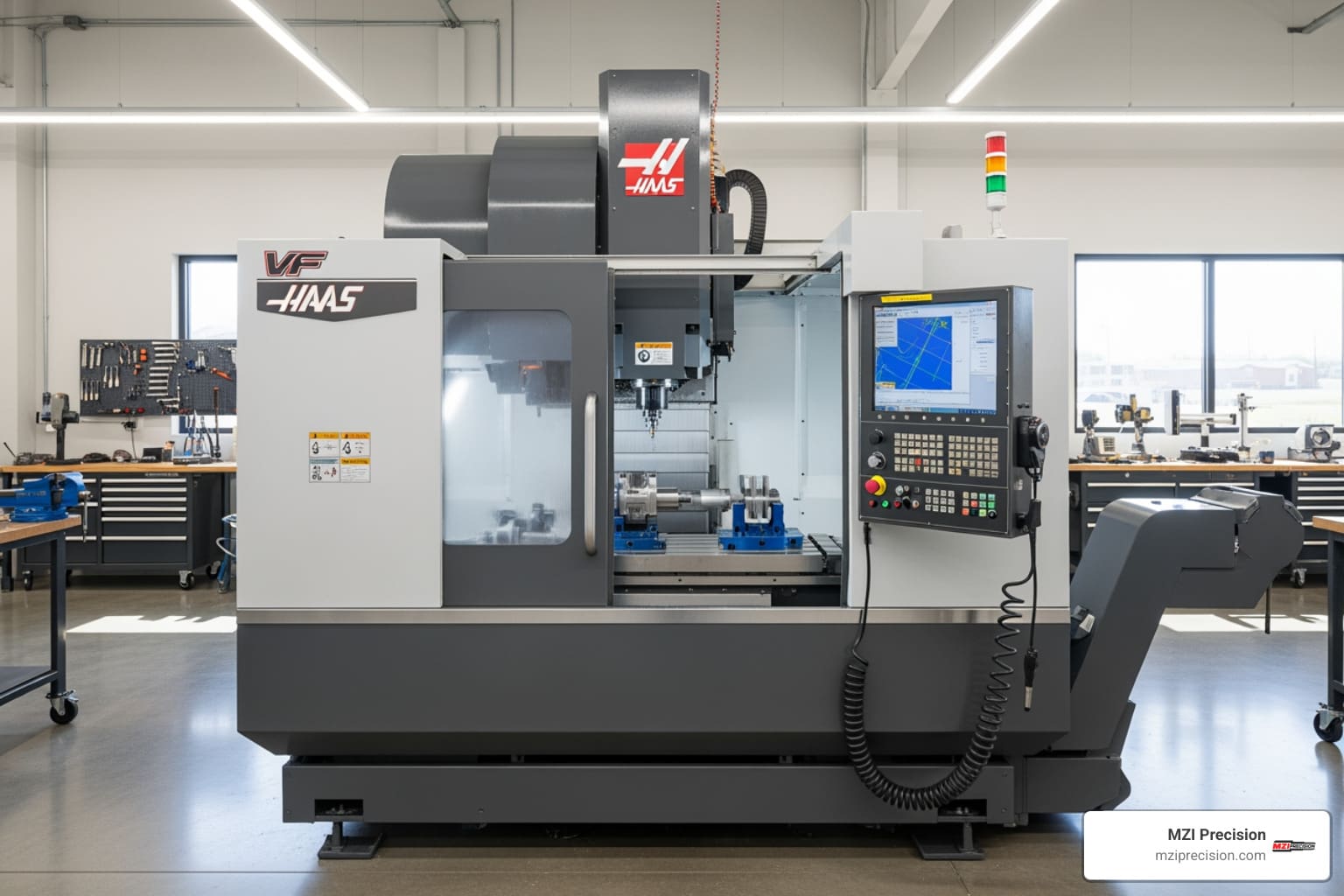
The Haas VF-2, a common vertical machining center, relies on its spindle to produce parts. When a bearing fails, the entire machine stops. The cost of ignoring bearing failure is steep, as degraded grease and contamination often lead to extensive damage, requiring replacement of bearings, seals, and sometimes even costly grinding on the spindle taper.
Modern Haas spindles are complex assemblies where bearing preload, runout tolerances (often within 0.001″ TIR), and proper lubrication are critical. While some maintenance is manageable in-house, spindle bearing replacement requires specialized tools and deep technical knowledge. This guide walks you through the process, helping you understand when professional spindle repair is the smarter choice.
DIAGNOSING SPINDLE BEARING FAILURE: SIGNS, SYMPTOMS, AND CAUSES
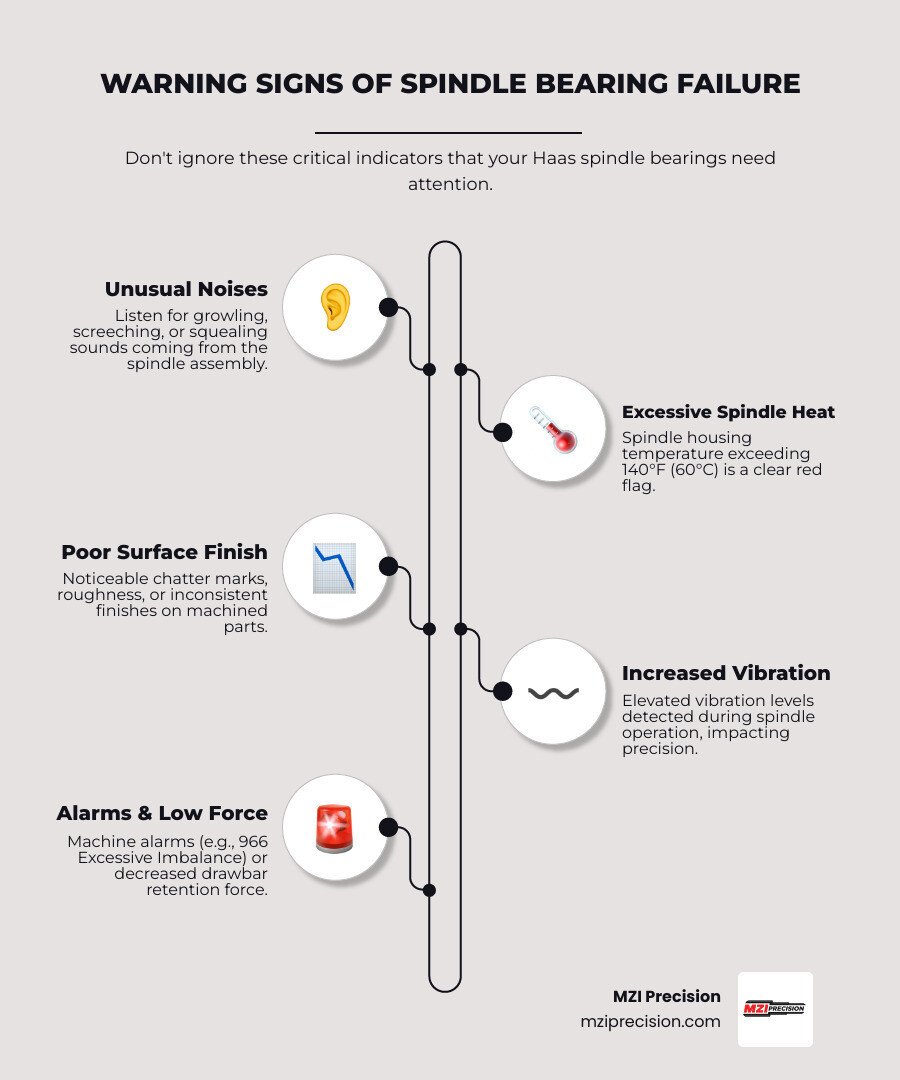
Your spindle provides warnings before it fails. A slight temperature increase or a new noise can signal trouble. Catching these signs early can prevent a manageable Haas spindle bearing replacement from becoming a catastrophic failure that costs days of downtime.
COMMON SIGNS YOUR HAAS SPINDLE BEARINGS NEED REPLACEMENT
- Unusual Noises: A growling sound is the most common sign of internal wear or contamination. This can escalate to a high-pitched screech or squeal, indicating severe damage or lubrication failure.
- Poor Part Quality: Sudden chatter marks or a rough surface finish on machined parts suggests worn bearings are allowing excessive runout or vibration.
- Excessive Heat: Spindle housing temperatures above 140°F are a red flag for friction from worn or unlubricated bearings.
- Control Alarms: Your Haas control may issue alarm codes like 966 Excessive Imbalance. While not a direct indicator of bad bearings, the vibration from worn bearings can trigger it.
- Fretting Marks: Abrasive wear patterns on your toolholders where they contact the spindle taper indicate excessive movement, often from worn bearings or low drawbar force.
- Resistance or Seizure: The spindle should rotate smoothly by hand when off. If it’s difficult to turn or completely seized, the bearings are likely destroyed.
- Low Drawbar Force: Low retention readings suggest problems with the drawbar assembly, such as broken Belleville washers, which can accompany bearing failure.
INVESTIGATING THE ROOT CAUSES OF PREMATURE FAILURE
Understanding why bearings fail is key to prevention.
- Contamination: This is a top bearing killer. Coolant, metal chips, or airborne particles getting past the seals act like grinding compound on precision surfaces. We’ve seen bearings filled with degraded grease and black particulate, and housings filled with rust.
- Improper Lubrication: Spindles require specific grease types and amounts. Too little, too much, or the wrong type will drastically shorten bearing life. For HSK spindles, never mix grease types—use only the specified METAFLUX grease.
- Machine Crashes & Overloading: A crash can instantly damage bearings and bend the shaft. Consistently overloading the spindle beyond its rated capacity also accelerates wear.
- Poor Tool Balancing: Unbalanced tools, especially over 10,000 RPM, create vibration that hammers the bearings with every revolution.
- Failed Supporting Components: Broken Belleville washers or worn retention clips in the drawbar assembly lead to tool fretting and uneven bearing stress.
- Housing Issues: In some cases, the spindle housing in the machine is out of tolerance. If the housing isn’t perfectly round, it puts uneven stress on the bearings, causing them to fail repeatedly regardless of replacement.
PREPARATION: TOOLS, PARTS, AND SAFETY FOR A HAAS SPINDLE BEARING REPLACEMENT
A successful Haas spindle bearing replacement requires careful preparation. This is precision work, and having the right equipment, parts, and safety measures in place is non-negotiable. Think of this phase as setting yourself up for success.
ESSENTIAL TOOLS AND EQUIPMENT
Specialized equipment is necessary for this job. Don’t attempt it without the following:
- Heavy-Duty Bearing Puller: Essential for removing shrink-fit components like pulleys. A light-duty puller will not work.
- Arbor Press: Provides controlled force for pressing bearings and shafts without causing damage.
- Heat Gun or Torch: Needed for removing shrink-fit parts, which may require heating up to 248°F (120°C).
- Torque Wrench: Critical for tightening bolts to the precise specifications in your Haas service manual.
- Dial Indicator with Magnetic Base: Used to measure radial and axial runout to tolerances often tighter than 0.001″ TIR.
- Drawbar Force Gauge: Verifies correct drawbar pull force after reassembly.
- Specialty Tools: An HSK-63A/F test bar is needed for HSK spindles. For belt-driven models, a Gates Sonic Tension Meter ensures correct belt tension.
- Vibration Analyzer: An Octavis Vibration Analyzer is used by professionals to measure and diagnose spindle vibration.
- Basic Shop Tools: A hoist with straps, wood blocks, feeler gauges, hex bits, wrenches, and picks.
SOURCING THE CORRECT PARTS
Prioritize genuine Haas parts or high-quality OEM-equivalents. Your shopping list should include:
- Spindle Bearing Kits: Ensure they are the correct angular contact bearings for your specific Haas model and RPM range.
- O-Rings and Seals: Always replace these to prevent future leaks and contamination.
- Drawbar Components: Replace any broken Belleville washers or worn retention clips and gripper balls.
- Spindle Grease: Use only the specified type, such as METAFLUX paste 70-8508 for HSK spindles. NEVER MIX GREASE TYPES.
- Fasteners: Consider replacing critical bolts, especially if they show wear or corrosion.
CRITICAL SAFETY PRECAUTIONS
Safety is paramount. This is heavy equipment with multiple hazards.
- Lockout/Tagout: Always zero return, power off, and lock out the machine before starting work.
- Personal Protective Equipment (PPE): Wear safety glasses, heat-resistant gloves, and steel-toed boots.
- Lifting: Use a hoist and straps for heavy components like the spindle cartridge (40+ lbs). Never lift manually.
- Heat Safety: Use heat-resistant gloves when handling heated parts, which can exceed 200°F.
- Electrical and Fluid Safety: Disconnect all power sources carefully, taking photos for reference. Use plugs for hydraulic lines to prevent spills and contamination.
- Clean Workspace: A clean, organized area prevents accidents and contamination of parts.
THE STEP-BY-STEP HAAS SPINDLE BEARING REPLACEMENT PROCESS
This section outlines the general approach for a Haas spindle bearing replacement. However, procedures vary significantly between models like a VF-series VMC and an ST-series lathe. Always use this as a roadmap, but refer to your machine’s specific Haas service manual for detailed instructions.
STEP 1: SPINDLE ASSEMBLY REMOVAL
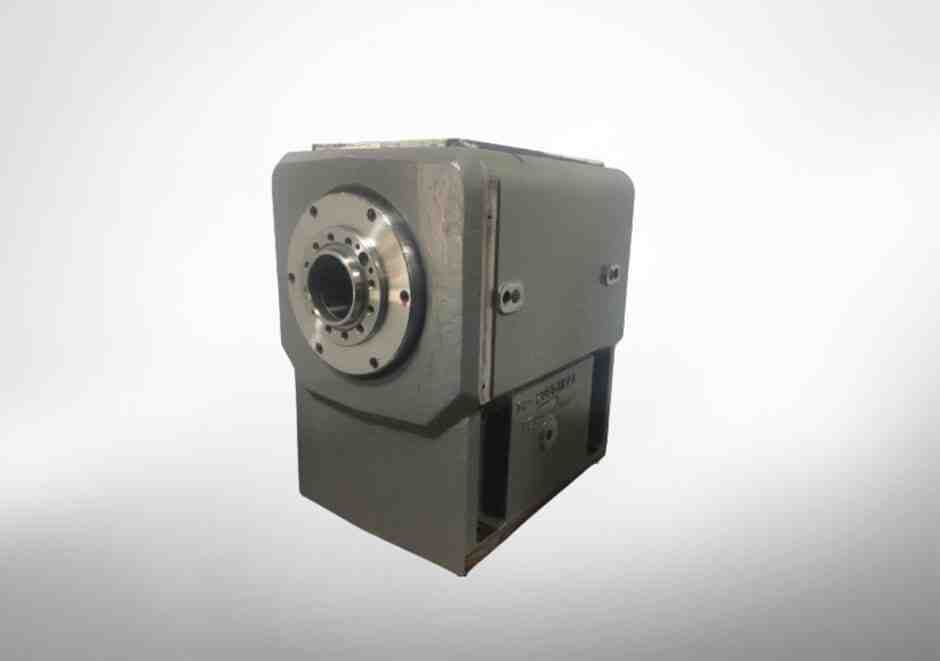
First, safely extract the spindle cartridge from the machine head.
- Preparation: Zero return the machine, power it off, and perform a full lockout/tagout. Remove any tooling from the spindle.
- Access: Remove sheet metal covers, panels, and motor shrouds to access the spindle assembly.
- Disconnection: Carefully disconnect all lubrication lines, air lines, and electrical connections (motor leads, encoders, sensors). Label or photograph everything to simplify reassembly.
- Support: Use a hoist with straps to support the spindle cartridge’s weight before unbolting it. Place wood blocks on the machine table to receive the assembly.
- Removal: Unbolt the mounting bolts securing the spindle to the head casting. Use jacking screws if needed to separate the tight-fitting assembly. Slowly lower the spindle out of the machine head with the hoist.
STEP 2: DISASSEMBLING THE SPINDLE AND REPLACING BEARINGS
This is the most precise and challenging phase. Many shops opt for professional repair at this stage.
- Component Removal: For belt-driven spindles, remove the drive pulley. This is often a shrink-fit part requiring significant heat (400°F+) and a heavy-duty puller. For direct-drive spindles, disassemble the motor coupling.
- Shaft Removal: Press the spindle shaft out of the cartridge housing using an arbor press. Apply steady, even pressure.
- Old Bearing Removal: Carefully extract all old bearings, spacers, and seals, noting their orientation.
- Cleaning and Inspection: Thoroughly clean every component—shaft, housing, spacers—to remove old grease and contamination. Critically inspect bearing journals and bores for wear, fretting, or runout. This is when hidden problems, like an out-of-tolerance housing or worn bearing shoulders, are found. Such issues may require professional machining to correct.
- New Bearing Installation: Press new bearings onto the shaft and into the housing using an arbor press. Never hammer bearings into place. Use correct spacers and shims to set the proper preload.
- Lubrication: Apply the specified type and amount of grease as you install each bearing. For HSK spindles, re-grease the clamping cone and gripper segments. Do not mix grease types.
STEP 3: REASSEMBLY AND INSTALLATION
Careful reassembly is key to a successful repair.
- Cartridge Reassembly: Reinstall the spindle shaft and new bearing stack into the cartridge, followed by internal components like injector nozzles and encoder rings. Use controlled heat for any sweat-fit parts and verify runout is less than 0.001″ TIR.
- Installation: Use the hoist to guide the reassembled cartridge back into the machine head.
- Alignment and Torquing: For direct-drive spindles, align the motor coupler. Secure the spindle and motor bolts to the exact torque specifications from your service manual, using a star pattern for even seating.
- Reconnection: Reattach all electrical, air, lubrication, and hydraulic lines. For belt-driven spindles, install the belt and set the tension using a sonic tension meter per Haas specifications.
POST-REPLACEMENT: CRITICAL CHECKS, CALIBRATION, AND PREVENTION
Completing the Haas spindle bearing replacement is a major step, but the job isn’t finished. The following checks and procedures ensure your repair is successful and long-lasting.
INITIAL CHECKS AND CALIBRATION AFTER A HAAS SPINDLE BEARING REPLACEMENT
Before cutting parts, verify that everything is within specification.
- Spindle Sweep: Perform the spindle sweep procedure per your Haas manual to confirm the taper is running true and aligned.
- Tool Change & Orientation: Check the Z-axis tool change offset and verify the spindle orients correctly (dogs parallel to the Y-axis). Adjust parameters if necessary.
- Runout Measurement: Use a dial indicator to measure radial and axial runout at the spindle taper. You are aiming for inner radial runout under 0.001″ and axial runout under 0.0005″.
- Drawbar Force: Use a gauge to confirm the drawbar pull force meets Haas specifications. Inadequate force leads to tool fretting and premature wear.
- Spindle Deflection: This test verifies correct bearing preload. Apply a known force and measure deflection, which should generally be less than 0.001″ TIR.
- Lubrication Test: For oil-lubricated spindles, perform a bottle test to confirm oil is reaching the new bearings.
THE SPINDLE BREAK-IN PROCEDURE
New bearings require a proper break-in period to seat correctly and distribute lubricant. Rushing this step can cause damage.
Follow the specific break-in program in your Haas service manual. These programs gradually increase spindle speed over several hours. During the break-in, monitor temperature and vibration. The spindle should not exceed 140°F (60°C). Listen for any unusual noises; if you hear grinding or squealing, stop immediately and investigate. This gradual RPM increase allows bearing surfaces to polish and grease to work into all contact points.
EXTENDING THE LIFE OF YOUR NEW BEARINGS
Protect your investment with consistent preventative maintenance.
- Follow a Lubrication Schedule: Use only the specified lubricant and adhere to the recommended schedule. For HSK spindles, this includes weekly re-greasing of the clamping mechanism.
- Balance Your Tooling: Always balance tool holders intended for use over 10,000 RPM. Unbalanced tools create vibration that destroys bearings.
- Keep It Clean: Regularly clean the spindle taper and tool holders to prevent contamination—a leading cause of bearing failure.
- Avoid Crashes: Careful operation and programming protect your spindle from catastrophic impact damage.
- Monitor Vibration: Implement routine vibration analysis to catch early signs of wear before they become major failures.
- Warm-Up the Spindle: Always run a warm-up program before production, especially after the machine has been idle. This simple step can add years to bearing life.
FREQUENTLY ASKED QUESTIONS ABOUT HAAS SPINDLE BEARING REPLACEMENT
HOW MUCH DOES IT COST TO REPLACE HAAS SPINDLE BEARINGS?
The cost of a Haas spindle bearing replacement varies. Key factors include:
- Parts: A set of high-quality angular contact bearings can cost from a few hundred to several thousand dollars. This doesn’t include seals, o-rings, Belleville washers, or specialized grease.
- Downtime: This is often the biggest expense. Every hour your machine is down is lost revenue, which can quickly exceed the cost of the repair itself.
- Labor: If done in-house, consider the technician’s time and the steep learning curve. Mistakes can be costly.
- Extent of Damage: If the spindle shaft, housing, or taper is damaged, costs increase significantly. A repair involving a Grind-Chrome Plate-Grind (GPG) process is more expensive than a simple bearing swap but is often a fraction of the cost of a new spindle.
HOW LONG DOES A HAAS SPINDLE BEARING REPLACEMENT TAKE?
The timeline depends on several factors:
- Machine Model: A simple Mini Mill spindle might take a day or two, while a complex, multi-axis machine could take several days, even for an expert.
- Damage Severity: Swapping bearings is faster than a job that requires additional grinding or component repair.
- Parts & Tools Availability: Waiting for a specific part or tool can turn a two-day job into a two-week ordeal.
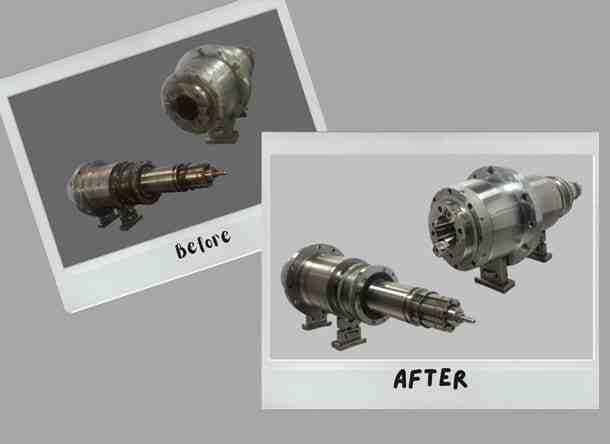
Professional repair services typically offer quick turnarounds, often completing repairs in one to three weeks, which includes full diagnostics, balancing, and testing to ensure the job is done right the first time.
SHOULD I REPLACE THE BEARINGS MYSELF OR CONSULT A PROFESSIONAL SPINDLE REPAIR SERVICE?
While a DIY repair is tempting, modern industrial manufacturing spindles present significant challenges.
Consider a professional service if:
- The Spindle is Complex: Today’s high-speed spindles require precision measured in tenths of a thousandth of an inch. Incorrect bearing preload is a leading cause of premature failure, and setting it correctly requires expertise.
- You Lack Specialized Tools: Professional shops use arbor presses, vibration analyzers, drawbar force gauges, and dynamic balancing equipment. Investing in these for a one-off repair is often not cost-effective.
- There is Deeper Damage: If the taper, housing, or shaft is damaged, or if bearings have failed prematurely after a previous DIY repair, an underlying issue needs professional diagnosis.
- You Need a Warranty: Professional services typically offer a warranty on parts and labor, providing peace of mind. A DIY repair may void the manufacturer’s warranty.
- Downtime is Critical: When production is waiting, the speed, reliability, and diagnostic expertise of a professional service often provide the best return on investment. They can identify root causes and prevent future failures.
CONCLUSION: RESTORING PRECISION AND WHEN TO CALL THE EXPERTS
We’ve walked through the demanding process of a Haas spindle bearing replacement, from diagnosing the first growling sounds to the final break-in. While technically possible for a skilled in-house team, the reality is that modern industrial manufacturing spindles are marvels of precision engineering. Success hinges on factors that are difficult to control without specialized equipment and experience.
Setting bearing preload within thousandths of an inch, achieving runout tolerances under 0.001″ TIR, and performing dynamic balancing are not tasks for the unprepared. An undiagnosed issue, like an out-of-tolerance housing, can cause a new set of bearings to fail within weeks, wasting time and money.
Your production schedule cannot afford extended downtime or repeat failures. When a professional repair service offers quick turnarounds, detailed failure analysis, and a warranty, the initial cost difference often disappears when you factor in the value of guaranteed results and long-term reliability.
At MZI Precision, we restore industrial manufacturing spindles to better-than-new condition. Our team brings decades of specialized experience to shops in aerospace, automotive, defense, and more. We understand the pressure you’re under when a spindle goes down and are committed to getting your machines running at peak precision.
Don’t let a failing spindle become a production crisis. We’re here to provide expert analysis and professional repair that gets you back to making parts—fast.
Contact us for expert Haas spindle repair
Learn more about our spindle repair services