

Industrial Spindle Rebuilding: Top 5 Guide
Why Industrial Spindle Rebuilding Matters for Manufacturing Excellence
Industrial spindle rebuilding is the process of disassembling, diagnosing, repairing, and reassembling worn or damaged spindles to restore them to OEM specifications or better. This comprehensive service addresses bearing wear, contamination damage, and tolerance degradation to return your critical machining components to peak performance—typically at less than half the cost of new replacement.
Quick Overview: What You Need to Know
- What it is: Complete restoration of worn spindles through precision machining, component replacement, and dynamic balancing
- Cost savings: Generally 40-50% less than purchasing new spindles
- Turnaround time: Most rebuilds completed in 2-3 weeks after approval
- Precision achieved: Restored to within 2 microns or better (often exceeding OEM specs)
- When to rebuild: When repair costs are roughly 50% of new spindle price, or before catastrophic failure occurs
When your CNC spindle shows signs of wear—excessive vibration, unusual noise, or reduced accuracy—you face a critical decision. For aerospace manufacturers and precision machining operations where downtime directly impacts your bottom line, understanding the rebuilding process isn’t just helpful, it’s essential.
Every moment your spindle is down impacts your production capacity. The difference between a rushed emergency repair and a planned rebuild can save you 50% on repair costs and prevent cascading damage to other machine components.
Spindles are the heart of your machining operations. Over time, even the best-maintained units experience bearing fatigue, seal degradation, and loss of tight tolerances. Contamination from coolant, metal chips, and environmental factors accelerates this wear. The result? Surface finish problems, dimensional inaccuracies, increased tool wear, and eventually, complete failure.
But here’s what many manufacturers don’t realize: a properly rebuilt spindle often outperforms the original. Modern rebuilding techniques, advanced bearing technology, and precision balancing equipment allow skilled technicians to restore—and even improve—your spindle’s performance characteristics.
Industrial spindle rebuilding word guide:
Understanding the Importance of Industrial Spindle Rebuilding
In the high-stakes world of California’s aerospace and defense manufacturing, precision isn’t just a goal—it’s a requirement. The spindle is the most critical component of your machine tool, responsible for holding and rotating cutting tools at exact speeds and orientations. When a spindle begins to deviate from its original factory tolerances, the entire production chain suffers.
Choosing to rebuild a spindle rather than simply replacing it allows manufacturers to maintain the structural integrity of their existing machine tools while restoring “like-new” performance. For many, the decision of whether to spindle-rebuild-or-replace comes down to a balance of cost, lead time, and the desire to maintain OEM-level accuracy. A professional rebuild ensures that all internal components—many of which are still perfectly viable—are cleaned and inspected, while only the worn elements are replaced or remanufactured.
Common Causes of Industrial Spindle Rebuilding Needs
Why do spindles fail? Even in the most controlled environments in Los Angeles or Huntington Beach, several factors contribute to the need for industrial spindle rebuilding:
- Contamination: This is the leading cause of failure. Coolant, grit, and metal chips can bypass seals, entering the bearing chamber and causing abrasive wear or lubricant breakdown.
- Bearing Fatigue: Most spindles utilize super-precision angular contact bearings (comprising about 90% of the market). Over millions of cycles, the metal eventually fatigues, leading to pitting and noise.
- Lubricant Failure: Whether it’s grease or oil-air, any interruption in lubrication or the use of contaminated lubricant will cause rapid heat buildup and seizure.
- Tooling Imbalance: Running unbalanced tools or holders puts uneven centrifugal force on the bearings, leading to premature wear and vibration.
- Thermal Expansion: Excessive heat from high-RPM operations or poor cooling systems can cause components to expand, closing necessary clearances and causing internal friction.
Impact of Spindle Failure on Production
When a spindle fails, the symptoms are often progressive but the results are always costly:
- Surface Finish: Increased vibration (chatter) leads to poor surface quality, often requiring secondary operations or resulting in scrapped parts.
- Dimensional Accuracy: As bearings wear, runout increases. A spindle that once held 0.0001″ might drift to 0.0005″, making it impossible to meet tight tolerances.
- Tooling Wear: An unstable spindle destroys cutting tools faster. You’ll find yourself replacing expensive end mills and inserts at an alarming rate.
- Unscheduled Downtime: A “screeching halt” failure can stop a production line for weeks. Pulling a spindle before it locks up can actually save 50% of the repair cost by preventing damage to the shaft and housing.
The Step-by-Step Process of Spindle Restoration
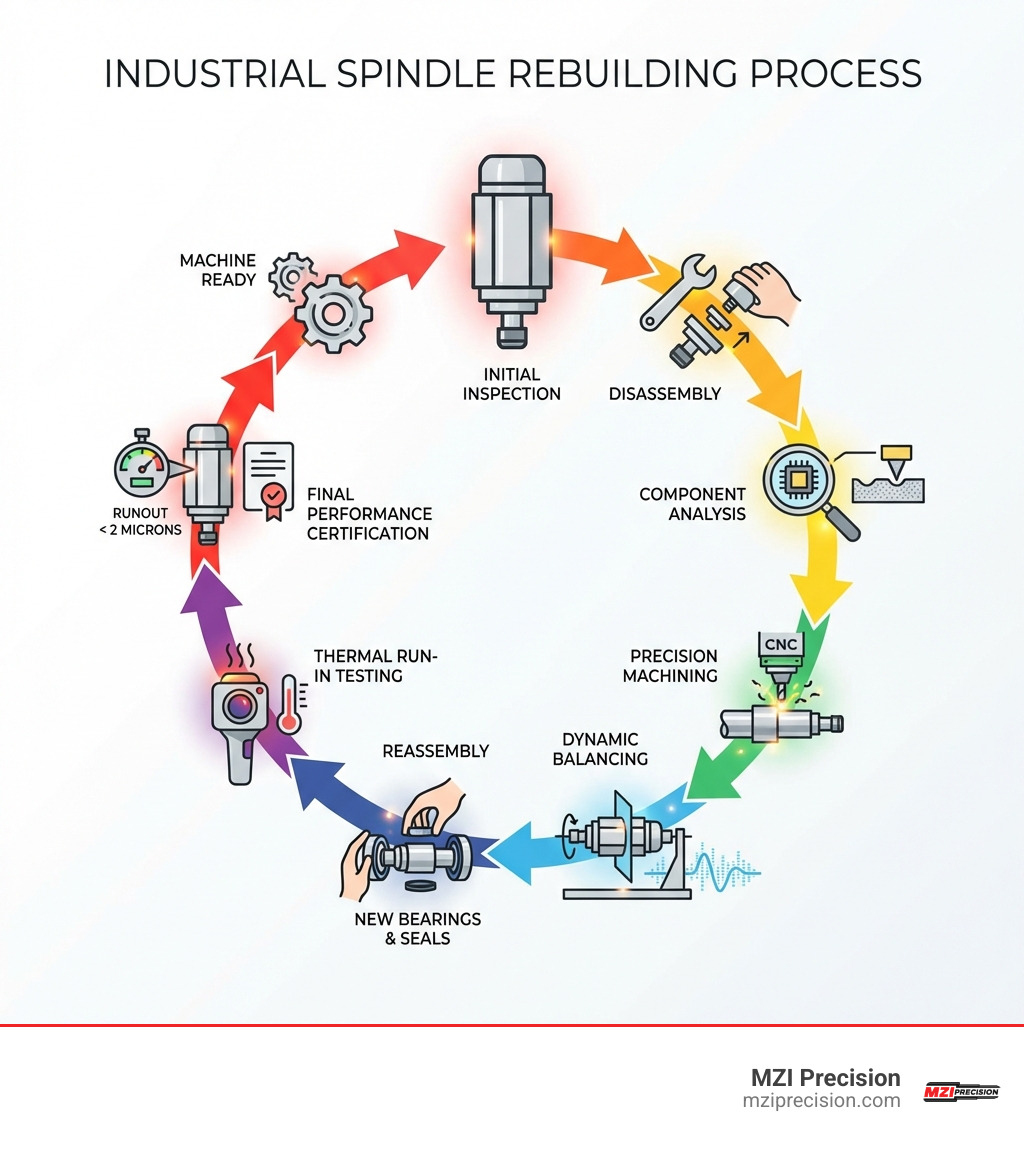
Restoring a spindle to within 2 microns of accuracy is a meticulous process that requires a controlled environment and specialized expertise. At MZI Precision, we treat every rebuild as a precision engineering project.
The process begins with Initial Diagnostics. Before a single bolt is turned, we conduct a vibration analysis and measure runout. This “as-received” data is vital for identifying the root cause of failure. By understanding how the spindle was behaving under power, we can better diagnose internal issues during the teardown. For those looking for a deep dive into the technical requirements, our guide on precision-spindle-rebuild details the nuances of high-accuracy restoration.
Precision Inspection and Component Analysis
Once disassembled and cleaned, every part undergoes a rigorous inspection:
- Digital Gauging: We use electronic gaging to check critical surfaces. Tapers, bearing journals, and housing bores are measured against OEM specifications.
- Geometric Tolerances: We look for “out-of-round” conditions or taper wear. Precision grinding can often restore ODs, IDs, and tapers to 0.000025” TIR or less.
- Microscopic Wear: Technicians inspect bearings and seals under magnification to identify the failure mode—be it contamination, electrical discharge, or lack of lubrication.
- Shaft Straightness: Even a slight bend in the shaft can cause catastrophic vibration at high RPMs.
Reassembly and Testing for Industrial Spindle Rebuilding
Reassembly occurs in a dedicated clean room to prevent the very contamination that causes most failures. We install new super-precision bearings with the exact preload and contact angles required.
The final stage is where the “performance” in performance restoration is proven. This includes:
- Dynamic Balancing: We balance the entire rotating assembly, often to tolerances of 0.1 gram-millimeters or less. This ensures smooth operation and extends bearing life.
- Thermal Run-in: The spindle is run at incrementally higher speeds while we monitor temperature and vibration. This “breaks in” the new bearings and ensures the lubrication is distributed correctly.
- Performance Certification: Every spindle leaves with a report documenting its final runout (often less than 2 microns), vibration levels, and drawbar pull force.
Watch video on custom spindle solutions
Strategic Benefits: Rebuild vs. New Purchase
For many manufacturers, the “repair vs. replace” debate is settled by the numbers. Rebuilding is not just a “fix”; it is a strategic asset management decision.
| Feature | Rebuild / Remanufacture | New OEM Purchase |
|---|---|---|
| Cost | 40% – 50% of New | 100% |
| Lead Time | 2 – 3 Weeks | 8 – 24+ Weeks (Industry Dependent) |
| Precision | OEM Specs or Better (within 2 microns) | OEM Specs |
| Upgrades | Possible (Bearings, Sealing) | Standard Specs Only |
| Sustainability | High (Recycles Core Components) | Low (Requires New Raw Materials) |
Our spindle-restoration-guide highlights how rebuilding keeps your capital in the shop rather than sending it to an OEM overseas.
Performance Upgrades and Customization
Approximately 10% to 15% of industrial spindle rebuilding projects involve upgrades. Since the spindle is already disassembled, it is the perfect time to improve upon the original design:
- Ceramic Hybrid Bearings: These can run faster and cooler than steel bearings, offering better thermal stability and longer life in high-speed applications.
- Enhanced Sealing: If contamination was the cause of failure, we can often upgrade to better labyrinth seals or air-purge systems to keep coolant out.
- Rigidity Improvements: Adjusting preload or bearing configurations can sometimes increase the spindle’s stiffness for heavy-duty milling.
Cost-Effectiveness in Industrial Manufacturing
In the current economic climate, protecting your capital expenditure (CAPEX) is vital. By opting for a rebuild, you are effectively extending the lifecycle of a major asset for a fraction of the cost of a new machine or a new spindle. Furthermore, because a rebuilt spindle is a known quantity that fits perfectly back into your machine without modification, the “hidden” costs of installation and integration are minimized.
Predictive Maintenance and Health Monitoring
The most cost-effective way to handle a spindle repair is to never have a catastrophic failure in the first place. This is where predictive maintenance comes into play.
Modern industrial spindle rebuilding doesn’t just end when the spindle is shipped back. We advocate for a proactive approach. Using real-time data from accelerometers and temperature sensors, manufacturers can detect the earliest signs of bearing distress. This allows for a “planned” rebuild during a scheduled shutdown, rather than an emergency repair during your busiest production week. For more on how this integrates with CNC operations, see our section on cnc-spindle-rebuild.
Extending Spindle Life Through Proper Care
To maximize the interval between rebuilds, follow these best practices:
- Lubrication Intervals: Adhere strictly to the OEM’s lubrication schedule and use only filtered, high-quality lubricants.
- Tooling Balance: Regularly check your tool holders. An unbalanced holder is like a hammer hitting your bearings thousands of times per minute.
- Environmental Control: Ensure your machine’s cooling system is functioning and that the ambient air is as clean as possible.
- Avoid Compressed Air: Never use compressed air to clean around the spindle nose. It forces small particles past the seals and directly into the bearings.
The Role of Condition Monitoring in Industrial Spindle Rebuilding
Condition monitoring involves tracking “vibration signatures.” Just like a doctor uses an EKG to check a heart, we use vibration analysis to check a spindle. By monitoring temperature spikes and collision data, you can catch a failing bearing before it “torpedoes” the shaft or housing, which can save you thousands in remanufacturing costs.
Frequently Asked Questions about Industrial Spindle Rebuilding
What is the typical turnaround time for a spindle rebuild?
Most standard industrial spindle rebuilds are completed within 2 to 3 weeks after the customer approves the quote. Initial inspections and evaluations typically take 2 to 5 working days. If you are facing a critical shutdown, emergency services are often available to expedite the process.
How much can I save by rebuilding instead of buying new?
The general rule of thumb in the industry is that a rebuild should cost less than 50% of the price of a new spindle. In many cases, you can restore a spindle to “better-than-new” tolerances for 40% of the cost of a replacement from the OEM.
What kind of warranty should I expect for a rebuilt spindle?
At MZI Precision, we stand behind our workmanship. While industry standards vary, customers should expect a robust warranty. We typically offer a 1-year warranty on our rebuilds, ensuring that the parts and labor meet the highest standards of manufacturing excellence.
Conclusion
Industrial spindle rebuilding is more than just a repair service; it is a vital strategy for maintaining the competitive edge of your manufacturing facility. Whether you are in aerospace, automotive, or defense, the precision of your spindles dictates the quality of your output.
By choosing to rebuild, you aren’t just saving money—you are often getting a superior component. With the ability to restore components to within 2 microns and the opportunity to upgrade to ceramic bearings or better sealing, a rebuilt spindle is a blueprint for improved performance.
MZI Precision is dedicated to providing the highest level of expertise in oem-spindle-rebuild services. Our team understands that in California’s industrial hubs, downtime is not an option. We are committed to restoring your precision and getting your machines back to work with the least amount of disruption.
Ready to restore your machine’s performance? Contact MZI Precision for Expert Spindle Services today and let us help you optimize your production.