


How Much to Fix a Wheel Bearing Knuckle Spindle Without Breaking the Bank
What Does It Really Cost to Fix an Industrial Spindle Assembly?
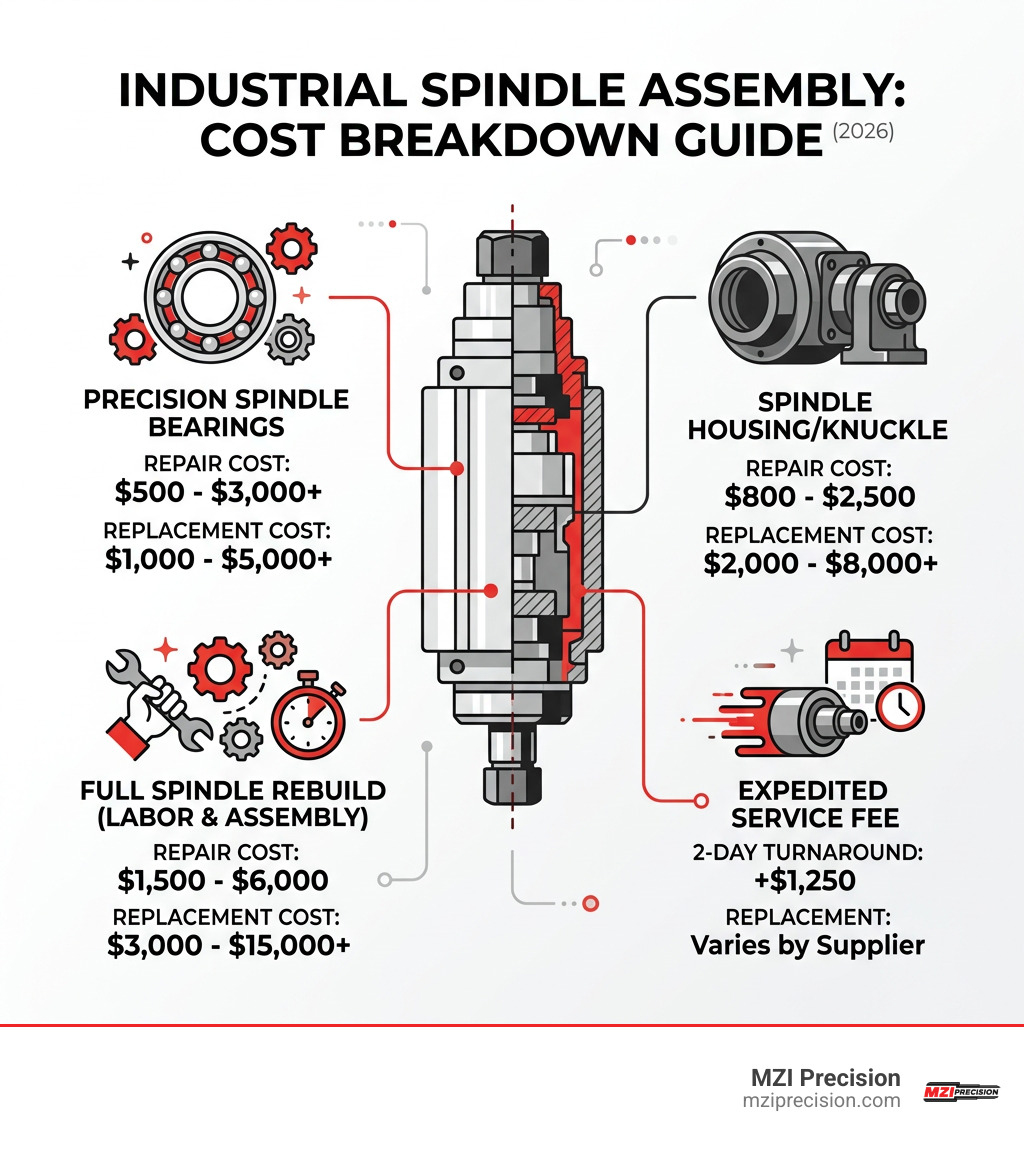
The cost to replace wheel bearing knuckle spindle components in an industrial manufacturing environment typically falls within these ranges:
| Component | Repair Cost Range | Replacement Cost Range |
|---|---|---|
| Precision spindle bearings | $500 – $3,000+ | $1,000 – $5,000+ |
| Spindle housing/knuckle | $800 – $2,500 | $2,000 – $8,000+ |
| Full spindle rebuild | $1,500 – $6,000 | $3,000 – $15,000+ |
| Expedited service fee | +$1,250 (2-day turnaround) | Varies by supplier |
Quick answer: For most industrial spindles, a professional rebuild costs significantly less than full replacement — often half the price or less. Repair is almost always the smarter first option.
When a precision spindle starts showing signs of wear — unusual vibration, noise, heat buildup, or reduced accuracy — the clock starts ticking. For aerospace and high-precision manufacturers, every hour of unplanned downtime has a real dollar cost attached to it.
The challenge is that not all spindle failures are equal. A worn bearing set is a very different problem from a scored shaft or a cracked housing. The repair path — and the price — depends entirely on what failed and how badly.
This guide breaks down what drives industrial spindle repair and replacement costs, so you can make a fast, informed decision without overpaying.
Cost to replace wheel bearing knuckle spindle terms to learn:
Understanding the Industrial Spindle, Bearing, and Housing Assembly
In high-precision manufacturing, a spindle is far more than just a rotating shaft. It is a sophisticated assembly designed to maintain sub-micron tolerances while under immense mechanical stress. When we discuss the cost to replace wheel bearing knuckle spindle components, we are looking at a system where the spindle shaft, precision bearings, and the housing (sometimes referred to in heavy machinery as the knuckle or spindle carrier) must work in perfect harmony.
The spindle shaft is the heart of the machine, providing the rotational force necessary for milling, grinding, or turning. To ensure this rotation is smooth and accurate, the shaft is supported by high-precision rolling-element bearings. These aren’t your standard hardware-store bearings; they are engineered for extreme RPMs and minimal thermal expansion. Finally, the housing or “knuckle” unit provides the structural rigidness required to keep everything aligned. If any one of these components fails, your rotational accuracy drops, and your load capacity is compromised.
For those looking into the specifics of these components, you can find more info about spindle bearing services to understand how they are maintained.
The Role of Precision Bearings in Manufacturing
Precision bearings are the unsung heroes of the factory floor. Their primary job is friction reduction. By using high-grade rolling elements—often ceramic or specialized steel—they allow the spindle to spin at tens of thousands of RPMs without seizing.
Beyond just spinning, these bearings provide thermal stability. In high-speed applications, heat is the enemy. A failing bearing generates friction, which leads to heat, which causes metal to expand, eventually destroying the spindle’s accuracy. This is why the cost to replace wheel bearing knuckle spindle parts often centers on the grade of the bearings used; higher precision equals higher cost but significantly longer operational life.
The Spindle Knuckle and Housing Function
The housing, or knuckle, acts as the protective “skeleton” for the internal components. Its role is two-fold: structural support and alignment integrity. It must be robust enough to withstand the radial and axial loads generated during heavy manufacturing processes while ensuring that the bearings remain perfectly seated.
If a housing becomes warped due to a crash or excessive heat, simply replacing the bearings won’t fix the problem. The alignment will be off, leading to “runout”—a wobbling effect that ruins workpieces and prematurely kills new bearings. Component protection is the final duty of the housing, sealing out the coolants, metal chips, and dust that are common in industrial environments.
Key Factors Influencing Industrial Spindle Repair Costs
Estimating the cost to replace wheel bearing knuckle spindle components isn’t a “one size fits all” process. Several variables dictate whether your invoice will be a few hundred dollars or several thousand.
First, consider the machine type. A spindle from a high-speed CNC mill used in aerospace has much tighter tolerances than a spindle used for basic agricultural equipment. The RPM requirements also play a massive role. Spindles rated for 20,000+ RPM require specialized balancing and high-grade ceramic bearings, which are significantly more expensive than standard steel variants.
Material costs are another factor. With global supply chains fluctuating, the price of specialized alloys and precision-ground components can vary. You can explore more info about spindle replacement costs to see how these factors aggregate in a professional quote.
How Precision Requirements Affect the Cost to Replace Wheel Bearing Knuckle Spindle
Precision is the most expensive “part” of any spindle. When we talk about runout tolerances, we are often measuring in the thousandths of an inch. Achieving this level of accuracy requires specialized diagnostic equipment and highly skilled technicians.
In high-speed applications, balancing is critical. An unbalanced spindle at high RPM acts like a jackhammer, vibrating the entire machine tool and causing poor surface finishes on parts. The labor required to dynamically balance a spindle assembly adds to the total cost to replace wheel bearing knuckle spindle components but is non-negotiable for quality control.
Impact of Component Damage on Total Estimates
The physical state of the spindle when it arrives at our facility determines the repair floor.
- Shaft Scoring: If the bearing has seized and spun on the shaft, it can cause “scoring” or grooving. This requires the shaft to be ground down and plated or replaced entirely.
- Housing Wear: If the bearing seats in the housing (knuckle) are worn out, the housing may need to be bored out and sleeved to restore the proper interference fit.
- Seal Failure: Often, a simple seal failure allows coolant to enter the bearing chamber. If caught early, this is a cheap fix. If ignored, it leads to catastrophic bearing failure.
Repairing vs. Replacing Industrial Spindles
One of the most common questions we hear is: “Should I just buy a new one?” To answer this, we perform a downtime analysis. While a new spindle might seem like a “cleaner” solution, the lead times from OEMs can often stretch into months.
Professional reconditioning often restores a spindle to “better than new” status. By using higher-quality aftermarket bearings or improved sealing methods, a rebuilt spindle can often outlast the original. Check out more info about spindle bearing replacement guides to see the technical depth involved in a proper rebuild.
When to Choose a Full Spindle Replacement
There are times when repair is no longer viable. If a spindle has suffered catastrophic failure—such as a major crash that has cracked the housing or snapped the shaft—replacement is the only safe path. Additionally, if the spindle technology is obsolete and parts are no longer available for reconditioning, an upgrade to a newer model may be more cost-effective in the long run.
The Benefits of Professional Spindle Rebuilding
For most manufacturers in California, from Los Angeles to Huntington Beach, rebuilding is the preferred route. The primary benefit is cost savings; a rebuild typically costs 40% to 60% of the price of a new unit. Furthermore, performance restoration ensures that your machine returns to its original OEM specifications without the long wait for a factory replacement.
| Feature | Professional Rebuild | New OEM Replacement |
|---|---|---|
| Cost | 40-60% of New | 100% Retail |
| Lead Time | 1-2 Weeks (Standard) | 4-16 Weeks |
| Performance | Meets/Exceeds OEM | OEM Standard |
| Warranty | Typically 1 Year | Typically 1 Year |
Average Cost to Replace Wheel Bearing Knuckle Spindle in Manufacturing
When you receive a quote for the cost to replace wheel bearing knuckle spindle parts, it will typically be broken down into labor, parts, and shop fees. Labor rates in the United States for precision spindle work generally range from $100 to $200 per hour, depending on the complexity of the assembly.
Labor and Parts Breakdown for the Cost to Replace Wheel Bearing Knuckle Spindle
A high-quality repair follows a strict protocol:
- Disassembly Time: Carefully taking the unit apart without causing further damage to delicate surfaces.
- Cleaning Process: Using ultrasonic cleaners or specialized solvents to remove all traces of old grease and contaminants.
- Assembly Precision: Pressing bearings in a climate-controlled “clean room” to prevent microscopic dust from entering the races.
- Testing Protocols: Running the spindle at various speeds to check for temperature spikes and vibration levels.
Regional and Industry Pricing Variations
While we serve clients across the U.S., regional factors in California can influence logistics costs. Furthermore, the industry standard matters. Aerospace standards require much more documentation and rigorous testing than general agriculture. Defense requirements may involve specialized coatings or materials that increase the overall cost to replace wheel bearing knuckle spindle assemblies.
Frequently Asked Questions about Spindle Costs
How long does a professional spindle rebuild typically take?
Standard turnaround time is usually 7 to 14 business days. However, for “machine down” emergencies, we offer an expedited service. For a fee of approximately $1,250, we can provide a 2-day turnaround to get your production line back up and running.
What are the risks of delaying spindle bearing replacement?
Delaying a repair is a gamble that rarely pays off. A vibrating spindle will eventually cause secondary damage to the machine’s motor, drive system, and the housing itself. What could have been a $2,000 bearing swap can quickly turn into a $10,000 full-unit replacement if the shaft snaps or the housing cracks.
What is the typical process for an industrial spindle repair at MZI Precision?
Our process is designed for transparency. It begins with receiving and inspection, followed by a detailed quote that explains exactly what failed. Once approved, we move into precision rebuilding and finish with final testing to ensure the unit meets all OEM specs. For a deeper look at our workflow, see more info about spindle replacement procedures.
Conclusion
At MZI Precision, we understand that your spindles are the lifeblood of your manufacturing operation. Whether you are in the aerospace, automotive, or defense sector, we provide the industrial expertise and quality assurance needed to keep your machines running at peak performance. Our commitment to using high-grade components and rigorous testing ensures that your cost to replace wheel bearing knuckle spindle parts is an investment in long-term reliability, not just a quick fix.
Secure Your Production with Expert Spindle Services
Don’t let a failing spindle halt your production. Whether you need a budgetary estimate for internal approval or an emergency 2-day rebuild, our team is ready to help.