

Haas Mini Mill spindle: 10K Ultimate Guide
WHY UNDERSTANDING YOUR HAAS MINI MILL SPINDLE MATTERS
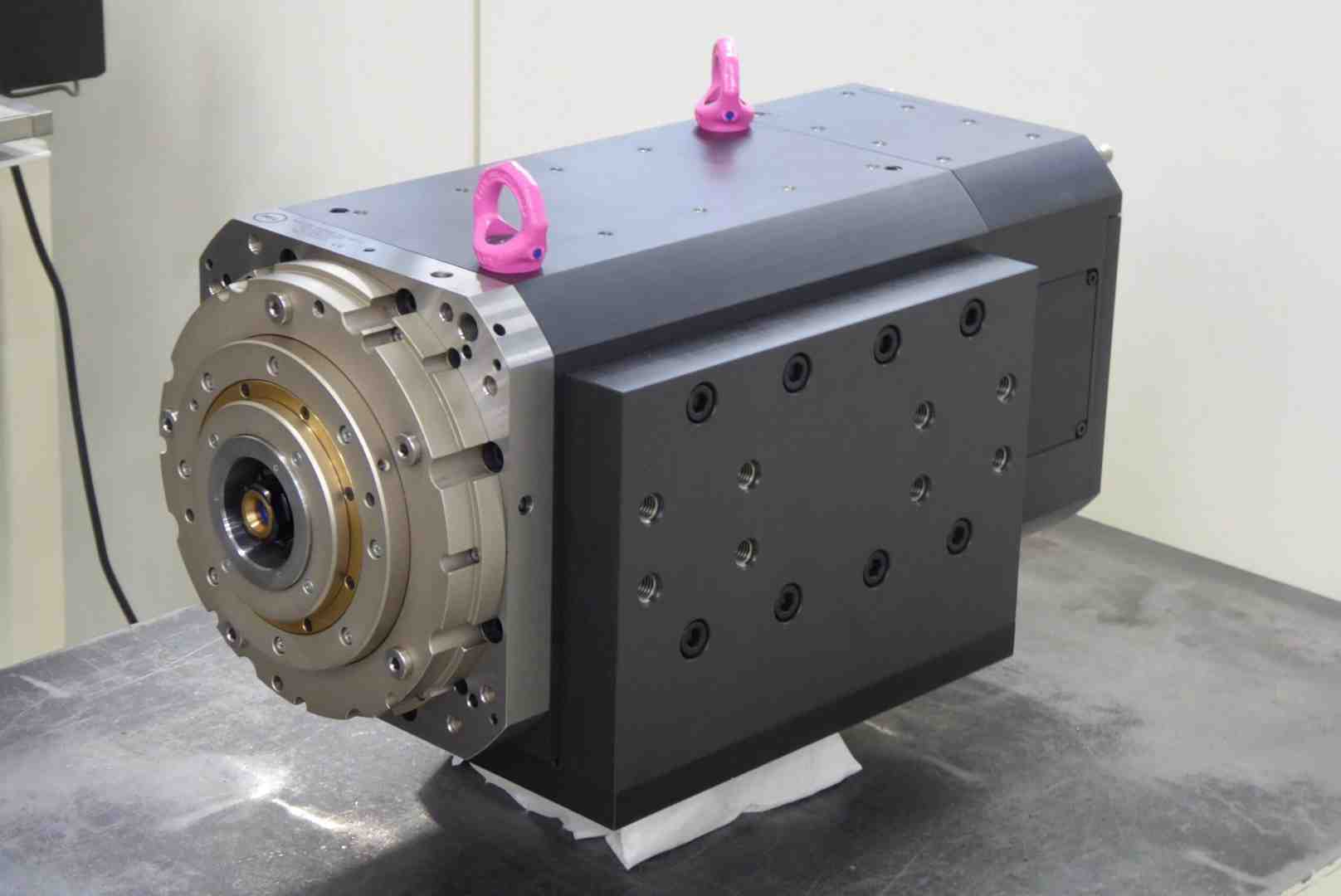
The Haas Mini Mill spindle is the heart of one of the most popular compact vertical machining centers in manufacturing. Understanding its capabilities, maintenance needs, and common issues is crucial for anyone relying on this machine for production.
Quick Answer: What You Need to Know About the Haas Mini Mill Spindle
- Standard Configuration: 8,000 RPM belt-driven spindle with 10 hp (7.5 kW) power and 40-taper toolholding
- Upgrade Option: 10,000 RPM or 15,000 RPM spindles available for Super Mini Mill models
- Key Advantage: 67% faster speeds and feedrates compared to 6,000 RPM spindles for improved performance
- Best Applications: 3D profiling, small cutting tools, and machining softer materials like aluminum and plastics
- Common Issues: Overheating, bearing noise, and contamination from coolant or rust
The Haas Mini Mill revolutionized the industry by offering 40-taper performance in a compact, affordable package. As one customer finded when their spindle started “getting excessively hot and making bearing noise,” understanding your spindle and its warning signs can save thousands in downtime and repair costs.
Your spindle’s reliability directly impacts your bottom line, whether in a startup, a high-production facility, or an educational setting. A failed spindle stops production, damages toolholders, compromises part quality, and causes costly delays.
This guide walks you through everything from the core technology behind Haas spindles to practical troubleshooting steps you can take before calling for professional repair services.
UNDERSTANDING THE HAAS MINI MILL SPINDLE: CORE COMPONENTS AND TECHNOLOGY
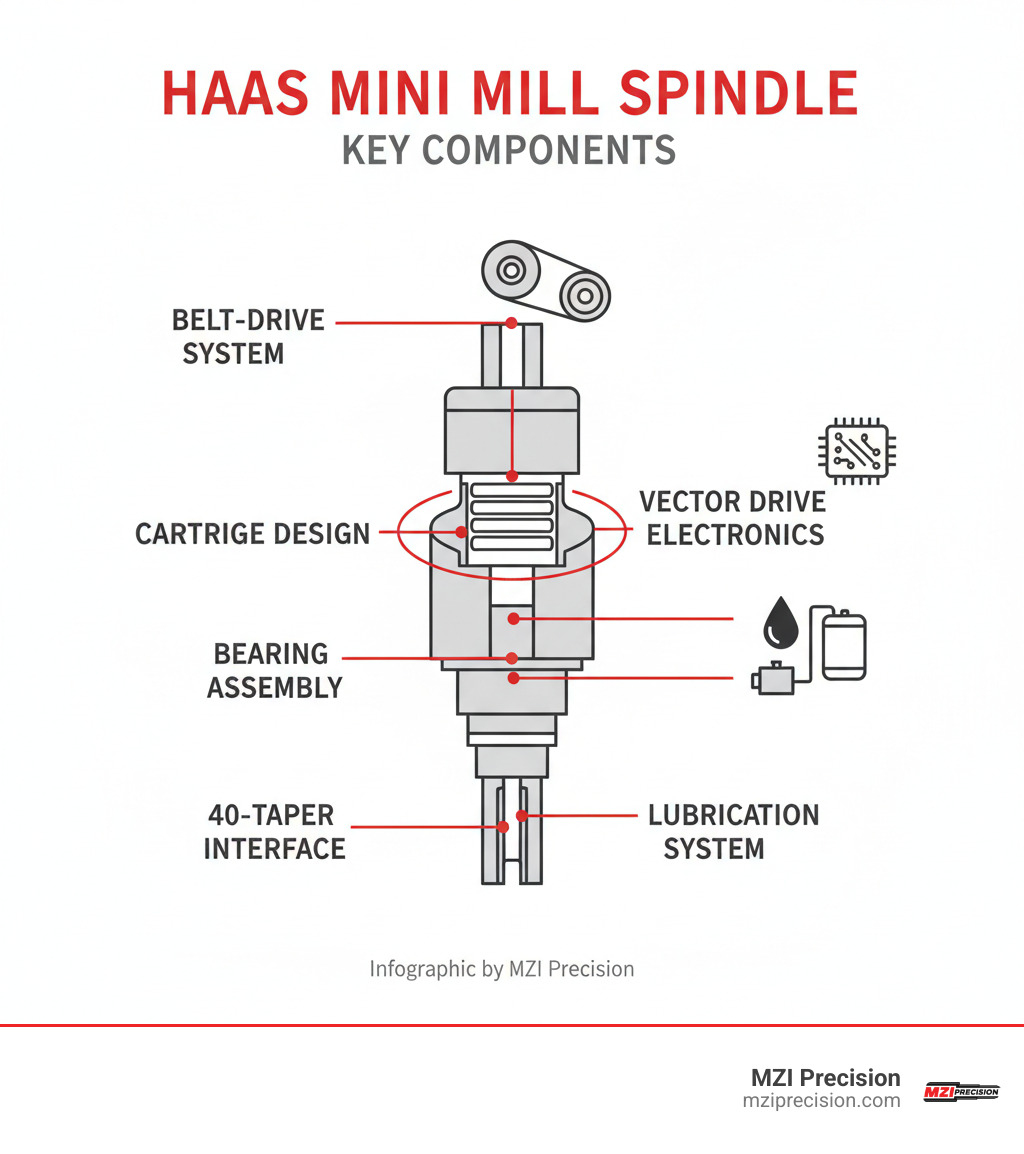
The Haas Mini Mill spindle is a carefully orchestrated system of mechanical and electronic components delivering precision, power, and reliability. After years of rebuilding these spindles at MZI Precision, we’ve learned what makes them work. Let’s break down the technology powering these compact workhorses.
KEY SPECIFICATIONS OF THE 10K-40T-15HP SPINDLE
When machinists discuss upgrading their Mini Mill, the conversation often turns to the 10K-40T-15HP spindle, which transforms a capable machine into a true competitor.
The 10,000 RPM speed enables the use of smaller cutting tools, achieves faster cycle times, and allows for efficient machining of softer materials like aluminum and plastics. This higher rotational velocity fundamentally expands the machine’s capabilities.
Paired with 15 horsepower, the spindle delivers impressive peak performance. It can handle 200% spindle load for 3 minutes, 150% for 10 minutes, and 100% continuously. This reserve power allows the machine to handle tough spots and heavy roughing passes without overloading.
The 40 taper designation defines the tool connection, striking an ideal balance between versatility and rigidity.
The belt-drive system is a smart engineering choice, balancing performance and cost. It delivers excellent torque at low RPMs for heavy cuts and high speeds for finishing, keeping the Mini Mill accessible.
DRIVE SYSTEMS: BELT-DRIVE VS. INLINE DRIVE
The Mini Mill’s belt-drive system offers practical advantages for a compact machine. Belt drives provide balance, delivering high torque at low RPMs for roughing and transitioning smoothly to high speeds for finishing. The belts also absorb motor vibration, acting as a dampening system to improve surface finish.
From a maintenance perspective, belts are simple to inspect and replace, resulting in less downtime and lower long-term costs. The belt-drive approach also manages heat generation, ensuring thermal stability for accuracy during long jobs.
While inline direct-drive spindles (found on larger Haas machines) offer superior thermal performance and higher RPMs, the belt-drive system is the ideal blend of performance and practicality for the Mini Mill’s price point and applications.
MACHINE MODEL AVAILABILITY
The 10,000 RPM spindle comes standard on Haas Super Mini Mill models, reflecting their high-performance design. For standard Mini Mill owners, it represents a significant upgrade from the base 8,000 RPM spindle. Haas also offers a 15,000 RPM spindle option for Super Mini Mills for specialized high-speed applications.
40 TAPER DESIGNATION
The “40 taper” refers to the standardized geometry of the interface between the toolholder and spindle. Rigidity is crucial in machining. The 40 taper’s robust connection minimizes tool deflection under load, preserving accuracy and surface finish. This allows for more aggressive feedrates and depths of cut than smaller tapers can manage.
The 40 taper is also highly versatile, with a vast ecosystem of readily available toolholders for any operation. For the Mini Mill, it hits a sweet spot, delivering enough rigidity for serious metalcutting while supporting the speeds needed for modern techniques.

SPINDLE CONSTRUCTION
Every Haas Mini Mill spindle is designed and built with quality and performance in mind. The clever cartridge design is a self-contained unit including the shaft, bearings, and drawbar. This simplifies service and replacement, as the entire cartridge can be removed as one piece, ensuring consistent quality.
Heat management is a key design focus. Careful bearing separation and alignment minimize friction and heat, leading to greater accuracy and longer bearing life. The housing is pressurized to prevent coolant and chip contamination, a common cause of bearing failure we see at MZI Precision. Automatic lubrication systems ensure bearings receive a steady supply of oil, constantly protecting the components.
VECTOR SPINDLE DRIVES
The Haas Mini Mill spindle is controlled by sophisticated electronics. Haas vector drives use closed-loop digital servo technology for precise speed control across the entire RPM range. These drives enable the power boost capability, delivering up to 200% of the motor’s continuous rating. This power burst helps with chip breaking, interrupted cuts, and unexpected material hardness.
Wye-delta switching happens automatically to optimize motor acceleration and deceleration, resulting in faster cycle times. This control system works invisibly to maintain the speed and power your program demands.
PERFORMANCE BENEFITS AND APPLICATIONS
Upgrading to a higher-speed Haas Mini Mill spindle open ups real-world capabilities that can transform your shop’s efficiency.

The 10,000-rpm spindle option delivers tangible improvements like faster cycle times and better surface finishes. At MZI Precision, we’ve seen many shops realize these benefits after upgrading or properly maintaining their spindles.
PERFORMANCE BOOST: 10,000-RPM VS. 6,000-RPM
The jump from a 6,000-rpm to a 10,000-rpm spindle is a 67% increase in speed, which directly translates to faster feedrates and improved metal removal rates in suitable applications.
The standard Mini Mill’s 6,000-rpm, 10-hp spindle is a workhorse for general milling. But the 10,000-rpm, 15-hp option is in a different league. This extra speed and power is ideal for 3D profiling, using small cutting tools, and machining softer materials like aluminum and plastics. Higher RPMs enable optimized cutting parameters, preventing material melting, improving chip evacuation, and creating superior surface finishes that can eliminate secondary operations.
For example, a small-diameter end mill requires high RPMs to achieve the correct surface feet per minute (SFM). At 10,000 rpm, the tool operates in its sweet spot, cutting cleanly and lasting longer, unlike at 6,000 rpm where it would wear prematurely and produce poor finishes.
IDEAL MACHINING OPERATIONS AND MATERIALS
The 10K-40T-15HP Haas Mini Mill spindle excels in specific industrial manufacturing scenarios.
High-speed profiling for intricate 3D contours in aerospace, medical, or mold making is a key application. Running at 10,000 rpm with smaller step-overs can produce mirror-like finishes directly from the mill.
Engraving and fine detail work is much cleaner at high RPMs. The combination of speed and light cuts produces crisp, professional results for serial numbers, textures, and intricate patterns.
Finishing passes benefit enormously from the speed, often making the difference between an acceptable finish and an exceptional one.
For aluminum machining, the 10,000-rpm spindle is a perfect match. Aluminum, plastics, and graphite machine beautifully at higher speeds. Many shops overlook that small cutting tools require high spindle speeds. A 1/8-inch end mill cutting aluminum is far more effective at 10,000 rpm than at 6,000 rpm, resulting in longer tool life and better performance.
The increased metal removal rates translate to more parts per shift, reduced cycle times, and a healthier bottom line for your industrial manufacturing operation.
MAINTENANCE AND TROUBLESHOOTING YOUR HAAS MINI MILL SPINDLE
A Haas Mini Mill spindle requires proper care to ensure longevity and performance. Proactive maintenance and smart troubleshooting can save you significant downtime and repair costs.
Think of your spindle as the machine’s heart. Addressing signs of trouble quickly prevents minor issues from becoming major failures. Every new or rebuilt spindle should undergo a proper run-in program as detailed in the Haas operator’s manual.
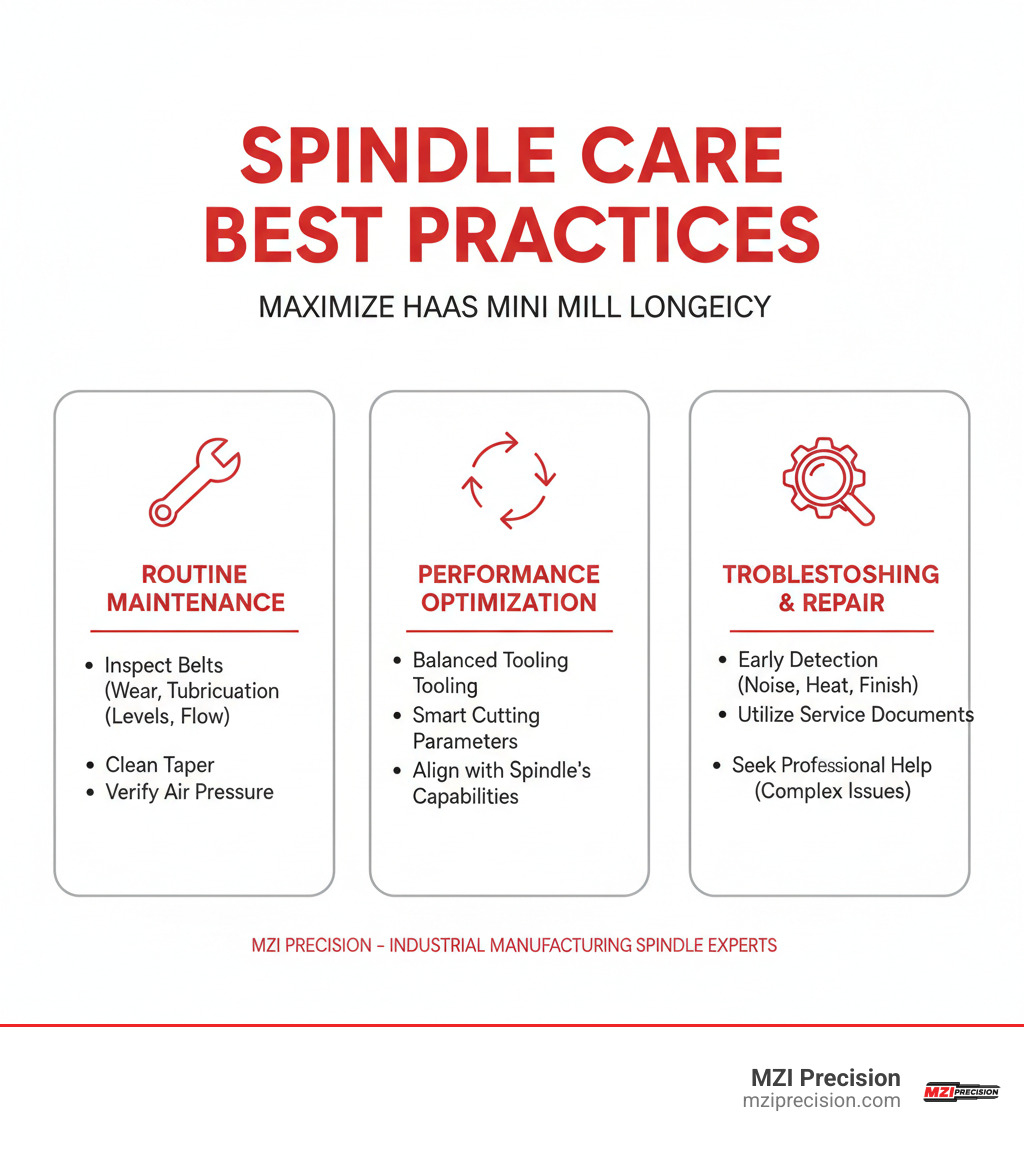
The lubrication system is vital. Maintain proper levels with the correct lubricant (typically SHC 625). While automatic systems do most of the work, regular checks are essential to confirm they are functioning.
Contamination prevention is critical. The spindle is pressurized to keep out coolant and chips, but seals must be intact. With through-spindle coolant, watch the TSC union for leaks that can damage the motor.
Drawbar force needs periodic verification to ensure secure tool clamping. Worn Belleville springs or contaminated retaining balls are common issues. Spindle balancing is also critical at high speeds to prevent vibration and premature bearing wear.

COMMON HAAS MINI MILL SPINDLE PROBLEMS AND SOLUTIONS
Even with excellent maintenance, issues can arise. Here’s what we commonly see at MZI Precision.
Overheating: First, check the lubrication system (oil level, type, flow) and ensure the cooling fan is running. Reduce aggressive cutting loads. A leaking TSC union on through-spindle coolant systems can also cause overheating. Look for Alarm 4.254 (SPINDLE MOTOR OVERHEAT).
Excessive noise or vibration: Inspect drive belts, encoder belt adjustment, and pulley set screws. Check for unbalanced tooling and ensure workholding is rigid. If these external factors are fine and bearing noise continues, professional inspection is needed. This may be accompanied by Alarm 123 (SPINDLE DRIVE FAULT).
Poor part finish or tool runout: Inspect the spindle taper and toolholders for debris or damage. Verify drawbar clamp force and ensure tooling is balanced for high-speed work. These issues directly affect part quality, often without triggering an alarm.
Toolholder sticking or drawbar issues: A contaminated taper is the most common cause, so clean it and toolholders regularly. Verify pull studs have the correct 45-degree angle and that air pressure to the TRP solenoid is 90 psi. Damaged Belleville springs may require drawbar replacement. Watch for Alarm 4136 (DRAWBAR UNCLAMP ERROR).
Spindle motor overload: Reduce your cutting load. If the overload persists with no load, test the motor for shorts and inspect the vector drive and Wye/Delta contactors. This typically triggers Alarm 236 (SPINDLE MOTOR OVERLOAD) or Alarm 123 (SPINDLE DRIVE FAULT).
Other key alarms include Alarm 4.9975 (SPINDLE ORIENTATION FAULT), which points to encoder or mechanical problems.
FINDING SERVICE DOCUMENTS AND TORQUE CHARTS
Haas provides comprehensive technical resources. The Haas Service website at parts.haascnc.com has guides and procedures, while your operator’s manual contains crucial maintenance and troubleshooting information. Always consult the official Haas Fastener Torque Specifications for any fastener work.
While these resources are great for basic issues, complex problems require expert intervention. At MZI Precision, with our locations in California, Los Angeles, and Huntington Beach, we specialize in industrial manufacturing spindle repair. We understand Haas spindles and can diagnose complex issues to get you back to production. When your Haas Mini Mill spindle needs professional attention, we’re here to help.
FREQUENTLY ASKED QUESTIONS ABOUT THE HAAS MINI MILL SPINDLE
At MZI Precision, we’ve answered thousands of questions about industrial manufacturing spindles. Here are the most common ones regarding the Haas Mini Mill spindle.
WHAT IS THE SIGNIFICANCE OF THE ’40 TAPER’ ON A HAAS SPINDLE?
The ’40 Taper’ refers to the standardized size (CAT40 or BT40) of the spindle’s internal cone that holds the toolholder. It’s the industry sweet spot for compact machines like the Mini Mill, offering an ideal balance of robust rigidity for heavy cuts and the high-speed capability needed for finishing. Its main advantages are versatility and tooling availability. The 40 Taper provides a better balance of rigidity and speed compared to smaller 30-taper or larger 50-taper systems, making it perfect for a wide range of industrial manufacturing milling operations.
HOW IS SPINDLE POWER RATED?
Spindle power is rated with both a continuous rating and peak power ratings. For example, the 15 hp spindle can deliver its rated power continuously. However, Haas vector drives allow for power boosts. The Haas Mini Mill spindle can deliver 200% of its rating for 3 minutes and 150% for 10 minutes. This means a 15 hp spindle can briefly output up to 30 hp to power through tough cuts without needing a larger, more expensive motor. This ‘reserve power’ is a game-changer for handling demanding, short-duration work in industrial manufacturing.
WHAT MAINTENANCE IS REQUIRED FOR A BELT-DRIVE SPINDLE?
Belt-drive spindles require simple but crucial maintenance. Regularly perform a belt inspection for wear, fraying, or damage, and ensure proper belt tension to prevent slippage or premature bearing wear. Maintain the lubrication system by checking seals and pressurization to prevent contamination, which is a primary cause of failure. For air/oil systems, verify oil levels and flow. Keep the spindle taper clean to ensure accuracy, and check that drawbar air pressure is at the recommended 90 psi. Following the manufacturer’s preventive maintenance schedule is the key to longevity for any industrial manufacturing spindle.
CONCLUSION: MAXIMIZING YOUR MACHINE’S POTENTIAL
Your Haas Mini Mill spindle is a compact powerhouse that delivers industrial manufacturing precision. With the right attention, it can reach its full potential and provide the reliability your production demands.
Spindle longevity and performance are achieved through proactive care. Consistent maintenance—like checking lubrication, using balanced tooling, and keeping the taper clean—is an investment in uptime. Optimizing performance means using the 10,000-rpm capability for faster cycle times and better finishes on softer materials, but also knowing when to adjust parameters to prevent damage.
Pay attention to your machine’s early warning signs, like a slight temperature increase or change in part finish. Catching problems early is always better than dealing with a catastrophic failure.
While your team can handle routine issues using Haas’s excellent guides, some problems require specialized expertise. Persistent noise, runout, overheating, or complex electronic faults are signs you need a professional for industrial manufacturing spindle repair.
That’s where MZI Precision comes in. Our expertise in OEM rebuilt spindles helps shops restore their Haas Mini Mills to peak performance. We understand that downtime is costly, so we approach every repair with urgency and precision.
Don’t wait for a small problem to become a crisis. For rebuilds, diagnostics, or preventive strategies, our team is here to help. We know industrial manufacturing spindles and are committed to providing the support that keeps your shop running.
GET A QUOTE FOR YOUR HAAS SPINDLE REPAIR
Ready to discuss your spindle needs? Visit our main site at https://mziprecision.com/ to learn more about our capabilities, or reach out directly through our contact page. You can explore our complete range of industrial manufacturing spindle repair and rebuilding services at https://mziprecision.com/services/. We’re here to keep your machines running at peak performance.