

Spindle Restoration: 7 Critical Signs
Why Manufacturing Spindles Are the Heartbeat of Precision Production
Spindle restoration is the comprehensive process of rebuilding worn or damaged industrial manufacturing spindles to OEM specifications, extending their lifespan and restoring peak performance. Here’s what you need to know:
Quick Spindle Restoration Overview:
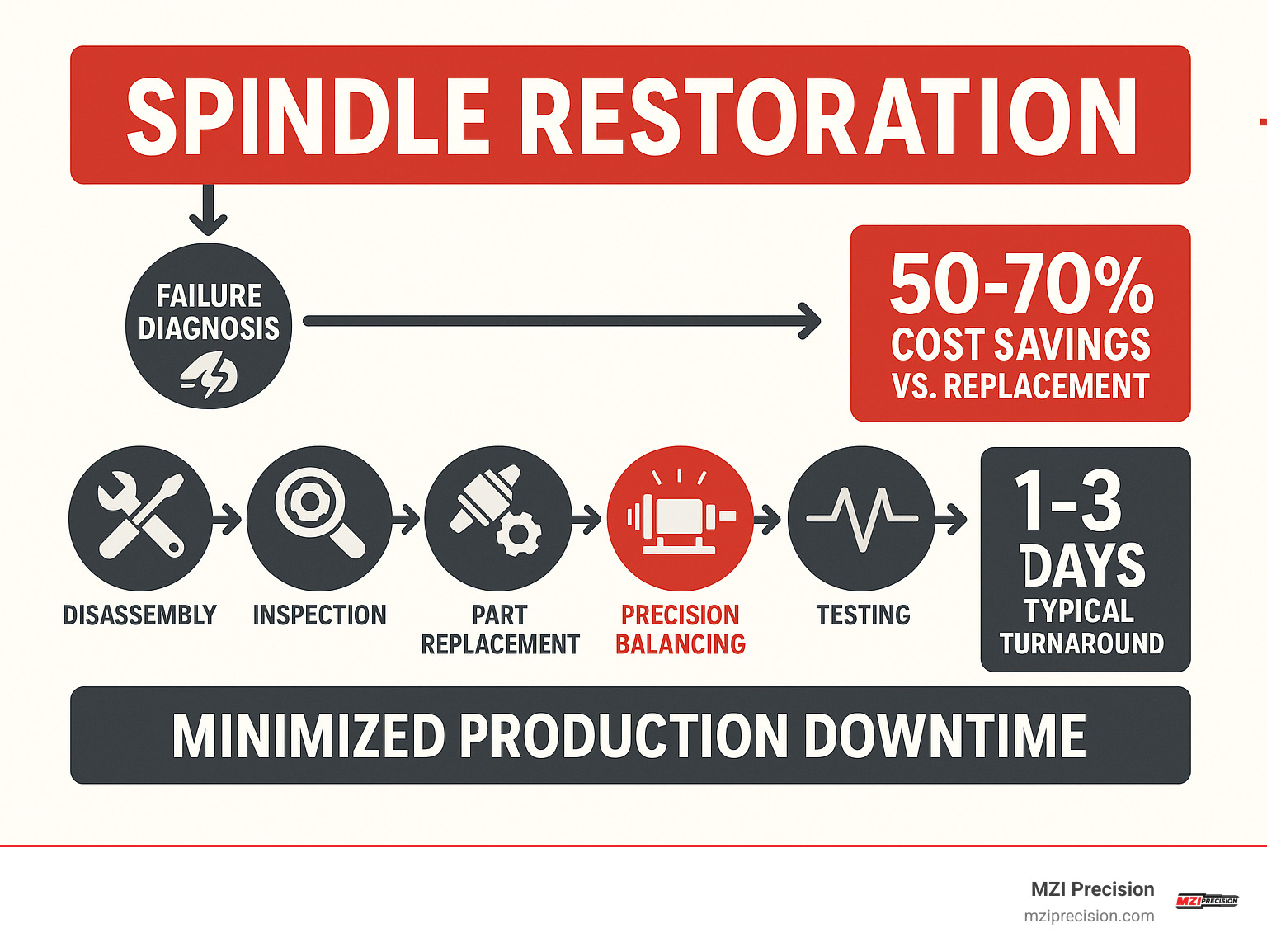
- Process: Disassembly → Component inspection → Part replacement → Precision balancing → Testing
- Timeline: Typically 1-3 days for standard rebuilds (varies by complexity)
- Cost: 50-70% less expensive than buying new spindles
- Result: Like-new performance with OEM specifications restored
- Warranty: Professional services offer 1+ year warranties on workmanship
Manufacturing spindles are the precision rotating assemblies that hold cutting tools in CNC machines, grinders, and other industrial equipment. When they fail, your entire production line stops. The difference between a smooth-running operation and costly downtime often comes down to spindle health.
According to industry data, over 350 OEM spindle brands require specialized restoration services, with repairs handling speeds up to 150,000 rpm. Companies with over 40 years of experience report that proper restoration can extend spindle life significantly while maintaining the precision tolerances your aerospace, medical, or heavy manufacturing operations demand.
“Spindles are essential tools for many industries and applications. Regular maintenance keeps your spindle in the best condition possible, reducing downtime and inefficiencies,” notes one industry expert.
The restoration process involves much more than basic repair. It requires specialized equipment, clean room environments, and certified technicians who understand the critical importance of precision balancing and thermal analysis.
What is Spindle Restoration and Why is it Critical?
Think of spindle restoration as giving your industrial manufacturing spindle a complete makeover – but with the precision of a Swiss watchmaker. It’s the comprehensive process of bringing a worn or damaged spindle back to its original factory glory, ensuring it performs exactly as the manufacturer intended.
But here’s the thing: this isn’t your typical “fix it and forget it” repair job. We’re talking about precision engineering where every measurement matters, and a few microns can make the difference between perfect parts and expensive scrap metal.
The heart of your operation depends on spindle health. Whether you’re running CNC mills, precision grinders, or other industrial manufacturing equipment, your spindle is what keeps everything spinning smoothly. When it’s working perfectly, your parts come out clean, accurate, and ready to ship. When it’s not? Well, that’s when production managers start losing sleep.
Here’s what makes spindle restoration so critical for your manufacturing operation:
Precision gets restored to OEM specifications. We’re not just making things “good enough” – we’re bringing your spindle back to exactly what the original manufacturer designed. This means your runout stays within those tight tolerances, your taper holds tools properly, and your cuts stay true. Think of it as resetting your spindle’s performance clock back to day one.
Your equipment lifespan gets a serious boost. Instead of limping along with a worn spindle until it completely fails, restoration addresses the root problems and replaces the components that matter most. You’re essentially getting years of additional service life from equipment you’ve already paid for.
Performance improvements you can actually feel. A properly restored industrial manufacturing spindle runs quieter, smoother, and cooler than before. Your operators notice the difference immediately, and your parts show the improvement in their surface finish and dimensional accuracy.
The cost savings are substantial. Here’s where restoration really shines – you’re typically looking at 50-70% less cost compared to buying a brand new spindle. For most manufacturing operations, that’s the difference between a manageable maintenance expense and a major capital expenditure that needs board approval.
At MZI Precision, we’ve built our reputation on understanding the unique demands of industrial manufacturing spindles across aerospace, defense, medical, and heavy industry applications. Our expertise in OEM specifications means your restored spindle won’t just meet expectations – it’ll exceed them.
Ready to learn more about how we can help keep your operation running at peak performance? Check out our comprehensive services to see what’s possible for your equipment.
Diagnosing the Problem: 7 Signs Your Spindle Needs Immediate Attention
Your industrial manufacturing spindle talks to you every day. The question is: are you listening? A healthy spindle hums along quietly, delivering precise cuts and smooth operation. But when something goes wrong, it sends clear signals that it needs help.
Think of it like your body telling you when you’re getting sick. First comes a little ache, then maybe some fatigue, and before you know it, you’re down for the count. Industrial spindles work the same way – they give you warning signs before they fail completely.
Excessive vibration is usually the first cry for help. When your machine starts shaking more than a paint mixer, something’s definitely wrong. This could mean worn bearings, an unbalanced spindle, or even a bent shaft. Don’t ignore it – that vibration is destroying your surface finishes and wearing out your tools faster than you’d like.
Listen carefully to unusual noises coming from your spindle area. A healthy spindle should purr like a contented cat, not growl like an angry dog. Grinding, squealing, whining, or rattling sounds are your spindle’s way of screaming for attention. These noises typically point to failing bearings or components that are crying out for lubrication.
Overheating is another red flag that’s hard to miss. If your spindle housing feels hot enough to fry an egg, you’ve got a serious problem on your hands. This usually happens when bearings are worn out and creating excessive friction, or when the cooling system isn’t doing its job properly.
When your surface finish starts looking rough or inconsistent, your spindle might be losing its precision. Those unexpected chatter marks and rough surfaces aren’t just cosmetic problems – they’re signs that your spindle is losing the rigidity it needs to do its job properly.
Loss of accuracy is perhaps the most costly symptom. When your parts stop meeting dimensional tolerances or your machine starts cutting off-center, you’re looking at expensive scrap and rework. A worn spindle simply can’t hold position and rotate as precisely as it should.
Increased runout is a more technical issue, but it’s critical. Even small increases in runout – the deviation from perfect rotation – can severely impact your machining precision and tool life. This one requires professional measurement to confirm, but it’s worth checking.
Finally, tool seating issues can indicate damage to your spindle’s taper. If tools aren’t sitting correctly or you notice unusual wear patterns on tool holders, your spindle’s ability to hold tools securely is compromised.
Common causes of spindle failure include:
- Bearing deterioration from normal wear or contamination
- Worn spindle seals allowing dirt and debris to enter
- Improperly fitting components creating excess friction
- Inadequate lubrication or cooling
- Operating beyond recommended speeds or loads
The good news? Catching these warning signs early means you can often avoid catastrophic failure through professional spindle restoration. Don’t wait until your spindle gives up completely – by then, the damage is usually more extensive and expensive to repair.
The Professional Spindle Restoration Process: A Step-by-Step Guide
When your industrial manufacturing spindle starts showing signs of trouble, you need more than just a quick fix. Professional spindle restoration is like performing surgery on the heart of your manufacturing operation. It’s a careful, methodical process that requires expertise, precision, and the right environment to succeed.
Think of it this way: your spindle has been working hard, possibly for years, spinning at incredible speeds while maintaining tolerances measured in microns. When it finally needs help, it deserves the best care possible.
Failure analysis is where everything begins. The moment your spindle arrives at our facility, we treat it like a patient in an emergency room. We carefully log it into our tracking system and start our detective work. Our technicians begin disassembly with surgical precision, documenting every component as they work. This isn’t just about taking things apart – we’re looking for clues about what went wrong and why.
During the cleaning phase, we remove years of accumulated debris, old lubricants, and contaminants. It’s amazing what you can learn about a spindle’s history just from what comes out during cleaning. This step also prepares components for the detailed inspection that follows.
Component inspection is where our experience really shows. Every bearing gets examined for wear patterns, every seal gets checked for integrity, and every surface gets scrutinized. We use advanced measuring tools like air gauges to check dimensions that are critical to performance. The dimensional inspection phase involves checking tolerances that might be off by just a few thousandths of an inch – differences so small they’re invisible to the naked eye, but huge when it comes to spindle performance.
Once we know exactly what’s wrong, we prepare a detailed quotation that explains our findings in plain English. We believe you should understand what happened to your spindle and what we’re going to do to fix it. This conversation is important – it’s your chance to ask questions and discuss any upgrades or improvements you might want to consider.
Sourcing OEM parts is where our relationships and experience pay off. We prioritize original manufacturer parts because they’re designed specifically for your spindle. When OEM parts aren’t available, we have the capability to reverse engineer and manufacture components to exact specifications. Sometimes we use specialized techniques like hard chrome plating or metal spraying to restore worn components to better-than-new condition.
The grinding and machining phase is where artistry meets engineering. Using precision cylindrical grinding machines, we restore critical surfaces to their original specifications. Tapers get corrected, bearing surfaces get refinished, and everything gets brought back to the tolerances your spindle was born with.
Assembly happens in a controlled environment, often in clean room conditions. New precision bearings and seals go in, and everything gets put back together with the care and attention it deserves. But we’re not done yet – this is where the real magic happens.
The Importance of Precision Balancing in Spindle Restoration
Dynamic balancing is what separates a good spindle restoration from a great one. Think of it like balancing the wheels on your car, except we’re dealing with components that spin at speeds up to 150,000 rpm. Even the tiniest imbalance at these speeds creates vibrations that will destroy bearings and ruin the precision you’re paying for.
Our vibration analysis process uses sophisticated eight-channel data loggers that monitor everything happening inside your spindle during test runs. We track RPM, vibration levels, temperature, and axial displacement in real-time. This data tells us stories about bearing health, balance quality, and overall spindle condition that you simply can’t get any other way.
High-speed testing is where we prove our work. We run spindles at their maximum rated speeds for extended periods – sometimes eight hours or more. This isn’t just a quick check; it’s a thorough workout that ensures your spindle will perform reliably when it gets back to your shop floor.
Tool holding force verification ensures your spindle will grip cutting tools with the proper force. Too little, and tools slip. Too much, and you damage expensive tooling. We use precision force gauges to get this exactly right.
Runout verification is our final quality check. Using 3-point dynamic runout testers, we confirm that your spindle spins true to within two microns – that’s less than one-tenth the thickness of a human hair.
Safety and Quality Control in Spindle Restoration
Our clean room environment isn’t just for show. Contamination is the enemy of precision, and even microscopic particles can ruin a perfect restoration. Critical assembly work happens in controlled conditions that would make a hospital operating room jealous.
Our specialized tools include equipment most shops have never seen: air gauges for measuring internal dimensions, motor analyzers for electrical testing, oscilloscopes for signal analysis, and load cells for force measurement. These aren’t just fancy gadgets – they’re essential for the level of precision your spindle demands.
Certified technicians with decades of combined experience handle every aspect of your restoration. Our engineering team has seen just about everything that can go wrong with an industrial spindle, and more importantly, they know how to fix it right the first time.
Every restored spindle comes with our comprehensive warranty because we stand behind our work. When we say your spindle will perform like new, we mean it. The detailed final inspection report you receive documents every step of the process, giving you complete transparency about what we found and what we did to fix it.
This isn’t just repair work – it’s precision engineering that brings your critical manufacturing equipment back to life, often better than it was when it was new.
Restoration vs. Replacement: Making the Right Financial Decision
When your industrial manufacturing spindle starts showing signs of trouble, you’re faced with a decision that can significantly impact your bottom line and production schedule. Should you invest in spindle restoration or bite the bullet and purchase a brand-new replacement?
While buying new might seem like the obvious choice, professional spindle restoration often proves to be the smarter financial move. Let’s break down the real costs and benefits of each option:
Cost considerations tell a compelling story. Professional spindle restoration typically costs 50-70% less than purchasing a new spindle. That’s not just pocket change – we’re talking about thousands of dollars in savings that can be reinvested in other areas of your operation.
Time is money, and this is where restoration really shines. Standard rebuilds often take just 1-3 days, depending on bearing availability and complexity. Compare that to the weeks or even months you might wait for a new spindle, especially if you need a specialized or custom unit. We’ve had customers drop off their spindle on a Friday and pick it up the following Wednesday, getting back to production with minimal disruption.
Performance-wise, a properly restored spindle delivers like-new performance that meets OEM specifications. You’re not getting a “patched-up” unit – you’re getting a precision-engineered piece of equipment that performs as well as the day it was first installed. New spindles, while obviously new, still require a break-in period and may not offer any performance advantage over a professionally restored unit.
Environmental impact matters more than ever, and spindle restoration is the sustainable choice. By reusing existing components and extending equipment life, you’re reducing waste and minimizing your environmental footprint. It’s good business and good stewardship.
Upgrade opportunities during restoration can actually give you advantages over buying new. We can incorporate design improvements, use better materials, or address known weaknesses in the original design. Sometimes, a restored spindle performs better than the original.
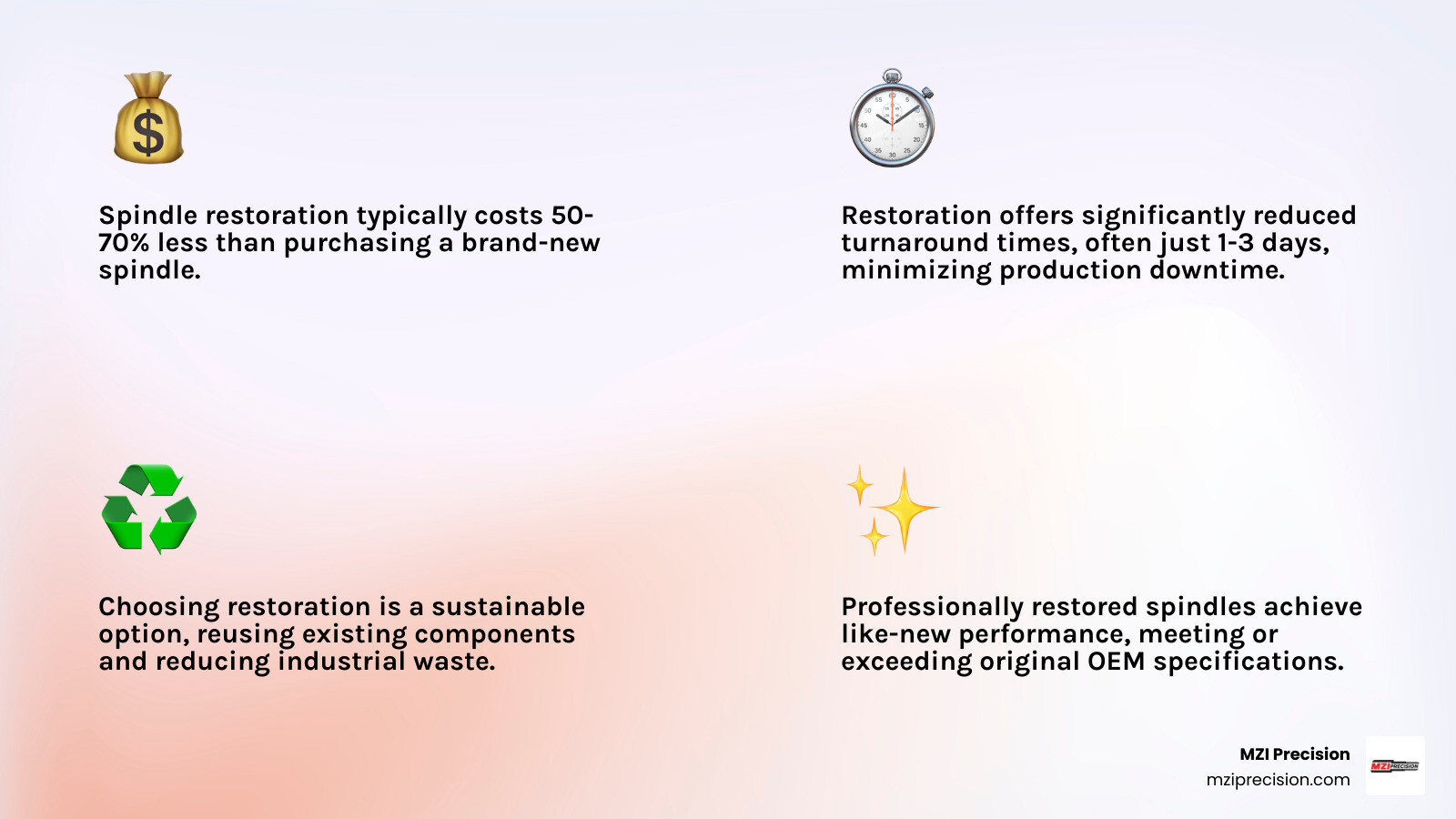
The numbers speak for themselves, but the real value comes from reduced downtime and keeping your production lines moving. Our experience shows that professional spindle restoration delivers optimum performance and reliability at a fraction of the cost and time investment of OEM replacement.
The Role of Preventative Maintenance
Here’s the thing about spindle problems – they’re usually preventable. While spindle restoration can work miracles on damaged spindles, smart preventative maintenance is your best defense against costly failures in the first place.
Think of it like taking care of your health. Regular check-ups and healthy habits prevent major medical issues down the road. Your industrial spindles work the same way.
Regular lubrication is absolutely critical. Using performance-engineered lubricants and ultra-filtered grease designed for super precision applications dramatically reduces friction and wear within the bearings. Regular oil sampling and analysis tells us if your lubricants are doing their job or if contamination is sneaking into the system.
Vibration monitoring acts like an early warning system. Continuous vibration analysis detects subtle changes in spindle health before they escalate into major problems. This means you can schedule maintenance during planned downtime rather than dealing with emergency repairs that shut down production.
Contamination prevention might sound obvious, but it’s often overlooked. Proper sealing and maintaining a clean operating environment prevents dust, coolant, and debris from entering spindle bearings. We offer contamination prevention analysis to help identify and eliminate these risks before they cause damage.
Proper operation extends spindle life significantly. Operating machinery within specified parameters, avoiding excessive loads, and ensuring correct tool handling practices all contribute to spindle longevity. We even offer spindle care seminars to train your team on best practices.
Regular maintenance keeps spindles in peak condition, reducing downtime and inefficiencies. It’s an investment that pays dividends by extending the time between necessary spindle restoration procedures. As one industry expert put it, “Regular maintenance keeps your spindle in the best condition possible, reducing downtime and inefficiencies.”
The bottom line? A little prevention goes a long way toward avoiding bigger problems later.
How to Select the Best Spindle Repair Partner
When your industrial manufacturing spindle needs professional attention, choosing the right spindle restoration partner can make the difference between years of reliable service and ongoing headaches. It’s not just about finding someone who can fix the problem – you need a partner who understands the critical role your spindle plays in your operation.
Industry experience should be at the top of your list. Look for a company that’s been in the spindle service business for decades, not just a few years. At MZI Precision, we bring extensive knowledge of bearings for various applications and understand the unique challenges faced by aerospace, defense, medical, and heavy manufacturing industries. Companies with 40 or 50 years of precision spindle involvement have seen it all – from common bearing failures to complex thermal issues.
The depth of OEM expertise separates the professionals from the amateurs. Your restoration partner should be capable of repairing and rebuilding spindles to exact OEM specifications, maintaining the original design and configuration. We work with over 350 OEM brands, which means we understand the nuances of different manufacturers and their specific requirements. This isn’t just about having the right parts – it’s about understanding how each spindle was designed to perform.
In-house capabilities matter more than you might think. When a company performs all critical work under their own roof – from detailed inspection and grinding to balancing and testing – they maintain tighter quality control and can offer faster turnaround times. Look for facilities equipped with specialized cylindrical grinding machines, advanced testing equipment, and production tracking software. This comprehensive approach eliminates the delays and quality concerns that come with farming out critical work to outside vendors.
Rigorous testing procedures reveal how seriously a company takes your spindle’s performance. Your restoration partner should conduct extensive post-repair testing, including precision balancing, high-speed test runs up to 150,000 rpm, and comprehensive vibration analysis. At MZI Precision, we use advanced data loggers to monitor performance parameters and guarantee less than two microns of runout on our repaired spindles. We also provide detailed test reports documenting every aspect of your spindle’s performance.
A strong warranty policy demonstrates confidence in both workmanship and parts quality. Look for a minimum of a 1-year warranty on repairs. Our 1 Year Warranty policy covers proper workmanship and defect-free parts, giving you the peace of mind that comes with knowing your investment is protected.
Customer support and technical documentation extend far beyond the repair itself. Does the company offer free quotes? Are they available for technical support when you have questions? Do they provide detailed documentation of the repair process and performance certifications? We believe in exceptional service and support, including recommendations for proper maintenance and preventative measures that can extend your spindle’s life.
Finally, consider the expertise of the team handling your equipment. Look for certified technicians and engineers who possess deep understanding of spindle mechanics, materials, and advanced repair techniques. Professional training and engineering degrees matter when you’re dealing with precision equipment that operates at high speeds with tight tolerances.
By choosing a partner that excels in these areas, you ensure that your industrial manufacturing spindles receive the highest quality spindle restoration, maximizing their lifespan and optimizing your production efficiency. The right partnership isn’t just about fixing what’s broken – it’s about building a relationship that keeps your operation running smoothly for years to come.
Conclusion: Restoring Your Spindle for Peak Performance
Your industrial manufacturing spindles are the unsung heroes of your production line. When they’re running smoothly, everything hums along beautifully. But when they start to fail? That’s when you realize just how critical these precision components really are.
Spindle restoration isn’t just about fixing what’s broken – it’s about bringing your machinery back to life with the precision and reliability you depend on. Throughout this guide, we’ve walked through the telltale signs that your spindle needs attention, from that concerning vibration to those unusual noises that make you pause and listen.
The professional restoration process we’ve outlined transforms a worn, struggling spindle into a precision instrument that performs like new. Dynamic balancing, thermal analysis, and rigorous testing aren’t just technical buzzwords – they’re the foundation of quality workmanship that extends your equipment’s life and keeps your production running smoothly.
Think about the numbers: 50-70% cost savings compared to buying new, turnaround times measured in days rather than weeks or months, and performance that meets OEM specifications. For manufacturing operations where every hour of downtime translates to lost revenue, these advantages aren’t just appealing – they’re essential.
At MZI Precision, we’ve built our reputation on understanding that your spindle problems can’t wait. Our decades of experience with over 350 OEM brands means we’ve likely seen and solved whatever challenge your spindle is facing. We know that when you trust us with your critical machinery, you’re trusting us with your business.
Reduced downtime, improved quality, and substantial cost savings – these aren’t just promises, they’re the results our customers experience every day. Our clean room environments, certified technicians, and comprehensive testing procedures ensure that your restored spindle doesn’t just work – it excels.
Your production schedule is demanding enough without worrying about spindle failures. Let our expertise in spindle restoration take that worry off your plate.
Contact us for a free quote today and find how we can restore your spindle to peak performance, keeping your operations running at their best.