


Repair Small Electric Motor: Ultimate Guide 2025
Why Mastering Industrial Spindle Motor Repair Matters for Manufacturing Uptime
Repair Small Electric Motor skills are vital for any manufacturing operation that relies on precision CNC spindles. When a spindle motor on a machining center fails, production halts, costing thousands of dollars per hour in lost productivity and missed deadlines.
Quick Answer: How to Repair a Small Electric Motor (Industrial Spindle)
- Diagnose the failure – Check for bearing noise, vibration, overheating, or electrical faults.
- Disassemble carefully – Mark alignment, document wiring, and use proper pullers.
- Inspect components – Examine bearings, windings, rotor, encoder, and housing.
- Replace worn parts – Install new bearings, repair windings, and clean components.
- Reassemble precisely – Follow alignment marks, torque specifications, and preload settings.
- Test thoroughly – Perform a run-in test, vibration analysis, and verify performance.
The global electric motor market is massive, projected to reach $213.5 billion by 2030. Within this industry, the repair and rebuild segment is crucial, especially for high-value industrial spindles used in aerospace, defense, and precision manufacturing. For these companies, spindle motor repair is about maintaining operational readiness, extending asset life, and avoiding long OEM lead times.
While it may not be worth repairing some common small motors, the economics for industrial spindles are entirely different. These precision components can cost $5,000 to $50,000+ to replace. Professional repair and rebuilding is often 50-70% more cost-effective, making it a smart financial decision.
This guide covers the fundamentals of industrial spindle motor repair, from diagnostics to procedures that can restore your critical assets to like-new performance.
UNDERSTANDING SPINDLE MOTOR FAILURES AND DIAGNOSTICS
Industrial spindle motors rarely fail without warning. Recognizing the early signs and having a systematic diagnostic approach can prevent an emergency shutdown. Proficiency in Repair Small Electric Motor work for spindles begins with understanding common failure modes and using the right tools to pinpoint the problem.
COMMON CAUSES OF SPINDLE MOTOR FAILURE
Industrial spindles operate under extreme conditions, leading to eventual wear. Understanding why they fail is key to early detection and smart repair decisions.
- Bearing Wear: As the most common failure, bearings wear out from high RPMs and heavy loads. This causes noise, vibration, heat, and loss of machining tolerance. Fretting corrosion on bearing supports indicates a loose bearing, accelerating damage.
- Coolant and Debris Ingress: Failed seals allow coolant and metal chips inside, which washes away grease, corrodes windings, and causes electrical shorts.
- Electrical Overload: Aggressive programming or a tool crash can cause windings to overheat, breaking down insulation. For more details, see our guide on Electrical Motor Troubleshooting.
- Voltage Spikes: Electrical disturbances can damage motor windings and control electronics, sometimes with delayed effects.
- Improper Lubrication: Using the wrong type or amount of grease leads to rapid bearing failure and overheating.
- Shaft Imbalance: An unbalanced rotor or tool holder creates vibration that damages bearings and ruins machining precision.
ESSENTIAL DIAGNOSTIC TOOLS AND TECHNIQUES
Accurate diagnosis requires the right tools. Guesswork is costly; a methodical approach saves time and money.
- Multimeter: The first line of defense for checking winding resistance for opens or shorts. Balanced readings across all three phases of an AC motor are critical.
- Megohmmeter (Megger): Measures insulation resistance to detect degraded insulation or moisture ingress, preventing catastrophic shorts to ground. A thorough Electric Motor Inspection always includes megger testing.
- Bearing Pullers: Essential for removing bearings without causing collateral damage to shafts or housings.
- Micrometers and Calipers: Provide precision measurements of shafts, bores, and bearing fits to within thousandths of an inch—a requirement for spindle repair.
- Runout Gauges (Dial Indicators): Measure shaft wobble to identify bent shafts, worn bearings, or assembly issues that affect part quality.
- Vibration Analysis Equipment: Provides objective data on internal conditions. Different vibration signatures can pinpoint bearing defects, imbalance, or misalignment.
- Thermal Imaging Cameras: Instantly reveal hot spots, guiding investigation to overheating bearings, windings, or electrical connections.
- Test Panel for Run-in: Allows for thorough testing of a repaired spindle under controlled conditions, verifying RPM, temperature, and vibration before it returns to service.
THE STEP-BY-STEP GUIDE TO SMALL ELECTRIC MOTOR REPAIR FOR SPINDLES
Repairing an industrial spindle motor is a precision task, far different from working on a simple power tool. Repair Small Electric Motor work on these components demands a meticulous approach. Before starting, always follow lockout/tagout procedures and work in a clean, well-lit area. A crucial tip: document every step with photos to avoid confusion during reassembly.
SAFE DISASSEMBLY AND COMPONENT INSPECTION
Rushing disassembly can create new problems. A careful, methodical process is essential.
- Mark Housing Alignment: Use a scribe or marker to create clear alignment marks on the housing and end bells. This ensures correct orientation during reassembly, preventing vibration and wear.
- Disconnect Sensors: Handle delicate encoders and sensors with care. Photograph and label wiring to prevent electrical issues later.
- Use Specialized Pullers: Always use hydraulic or mechanical pullers to remove bearings and rotors. Hammers and pry bars will damage precision-ground shafts and housings.
- Clean Components: Use approved, non-conductive solvents to remove grease, coolant, and debris. Avoid solvents like acetone that can damage winding insulation.
- Inspect Thoroughly: Examine every component for wear, cracks, or heat damage. Check bearings for discoloration or pitting. Use micrometers to measure shafts and bores for scoring or fretting. Inspect windings for dark spots indicating overheating. On DC motors, check the commutator and brushes for wear. This detailed inspection guides the repair process. For more, see our Mastering CNC Spindle Motor Repair A Step-by-Step Guide.
HOW TO ADDRESS BEARING AND MECHANICAL ISSUES
Bearing performance is critical. Signs of failure include noise (grinding, whining), vibration, hot spots on the housing, and increased motor current draw. For industrial spindles, replacement is the only option for faulty bearings.
- Bearing Selection: Choose the right replacement. While steel bearings are standard, hybrid ceramic bearings offer higher speed capabilities, less friction, and longer life, making them a worthwhile upgrade for high-performance applications.
- Check Fits: Use micrometers to verify shaft and housing dimensions. The bearing’s inner race requires a tight press fit on the shaft, and the outer race needs a precise fit in the housing. Worn shafts or bores may need grinding, sleeving, or machining to restore proper fit.
- Dynamic Balancing: After any rotor or bearing work, the assembly must be dynamically balanced. Even tiny imbalances cause destructive vibration at high RPMs, accelerating wear and ruining part quality.
If damage is too extensive, Spindle Motor Replacement may be necessary, but repair is usually more economical for high-value spindles.
HOW TO REPAIR SMALL ELECTRIC MOTOR ELECTRICAL COMPONENTS
Electrical issues can be intimidating but are manageable with a systematic approach.
- Test Windings: Use a multimeter to check resistance. In a three-phase AC motor, all phase-to-phase readings should be nearly identical. An open circuit will show infinite resistance, while a short may show very low resistance or be revealed by a megohmmeter test.
- Identify Burnt Windings: A distinct burnt smell and dark, charred insulation are clear signs. Electrically, this often presents as a short to ground or between phases.
- Rewinding: Burnt windings can be repaired through rewinding. This specialized process involves stripping the old wire and rewinding the stator or armature to exact original specifications. This is best left to professional Motor Rewind Specialists.
- DC Motor Components: For DC motors, inspect the commutator for wear and brushes for length and spring tension. Worn brushes are easily replaced, and the commutator may need cleaning or turning on a lathe. Modern spindles often use Brushless DC Motor Repair technology, which eliminates these components.
- Secure Connections: Ensure all internal crimps, solder joints, and terminals are solid to prevent future failures.
REASSEMBLY, TESTING, AND ADVANCED CONSIDERATIONS
Reassembly is the final exam of the repair process, where precision and patience are paramount. One misstep can undo hours of work. This phase requires the same methodical care as diagnosis and repair.
PRECISION REASSEMBLY AND FINAL TESTING
Reassembly is more than just reversing the steps. It requires precision to ensure longevity and performance.
- Follow Alignment Marks: Use the marks made during disassembly to ensure every component is correctly oriented.
- Use a Torque Wrench: Tighten all fasteners to manufacturer specifications. Overtightening can warp housings, while undertightening leads to vibration and wear.
- Set Bearing Preload: Correct preload is critical for spindle rigidity and accuracy. It eliminates internal clearance and is set using shims, spacers, or specific torque sequences. Incorrect preload causes either excessive runout or premature bearing failure from overheating.
After reassembly, the spindle undergoes a rigorous test run on a dedicated panel. We monitor vibration, temperature, RPM, and current draw across the entire speed range. Any anomaly, such as unusual vibration or a hot spot, is investigated and corrected. This comprehensive testing, a cornerstone of our Electric Motor Rebuilding Service, ensures the spindle performs to specification before it returns to your facility.
AC VS. DC SPINDLE MOTORS: A REPAIR PERSPECTIVE
While the principles of Repair Small Electric Motor work apply to both, AC and DC spindles have key differences that affect the repair approach.
AC servo motors are the modern standard in CNC machines. Their brushless design is maintenance-free, but repair focuses on winding integrity, bearing condition, and precise encoder/resolver alignment. Misalignment of the feedback device can cause positioning errors or fault codes, making AC Servo Motor Repair a specialist task.
DC servo motors, still common in many facilities, use brushes and a commutator for mechanical commutation. These are wear components that require periodic inspection and replacement. DC spindle repair often centers on servicing these parts, in addition to addressing common bearing and winding issues.
| Feature | AC Servo Spindle Motors | DC Servo Spindle Motors |
|---|---|---|
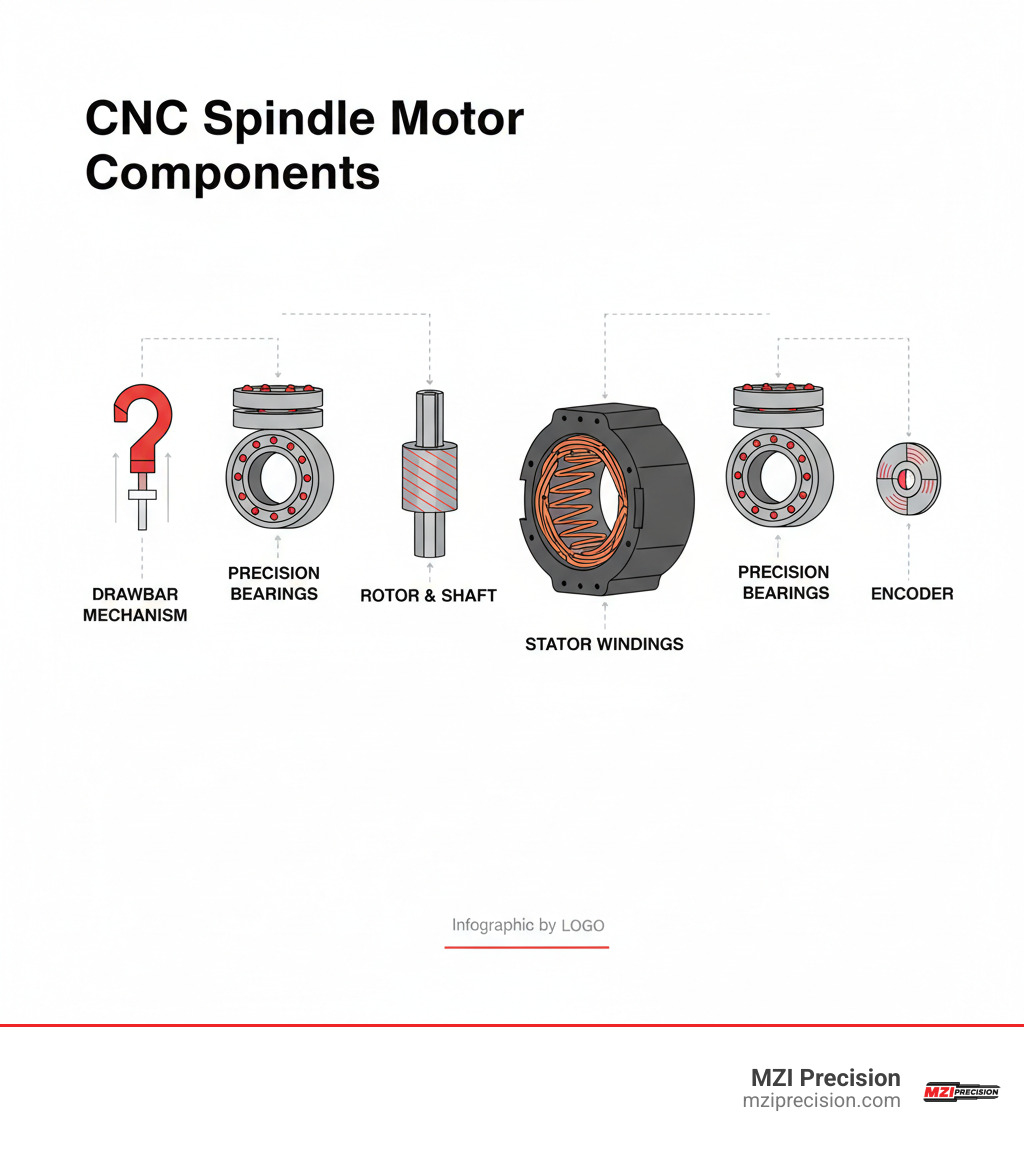
| Key Components | Stator windings, rotor (permanent magnets or squirrel cage), encoder or resolver, electronic commutation | Stator windings (field), rotor (armature), commutator, brushes, encoder |
| Commutation | Electronic (controlled by drive) | Mechanical (brushes and commutator) |
| Common Failures | Bearing wear, winding insulation breakdown, encoder or resolver failure, drive electronics | Bearing wear, brush wear, commutator wear, winding opens or shorts |
| Diagnostic Focus | Winding integrity, bearing condition, encoder signal accuracy, drive fault codes | Brush and commutator health, winding integrity, bearing condition |
| Repair Complexity | Often involves complex encoder alignment and drive diagnostics | Focus on brush and commutator maintenance and replacement |
THE REPAIR VS. REPLACEMENT DECISION FOR SPINDLE MOTORS
For high-value industrial spindles, the question of repair versus replacement almost always favors repair. Here’s why:
- Cost: A new industrial spindle can cost $5,000 to $50,000+. Professional repair typically costs 50-70% less, offering tens of thousands of dollars in savings.
- Downtime: OEM lead times for new spindles can be weeks or months. A specialized repair facility like MZI Precision in California can often complete a repair in days, minimizing costly production downtime.
- Parts Availability: For older or specialized models, OEMs may no longer offer support. Professional repair shops can source hard-to-find parts or even manufacture custom components.
While some complex repairs like armature rewinding or shaft machining require specialized equipment, they are still often faster and more economical than replacement. When a repair exceeds in-house capabilities, partnering with professional Electric Motor Repair specialists is the logical choice.
FREQUENTLY ASKED QUESTIONS ABOUT SPINDLE MOTOR REPAIR
Over the years, we’ve fielded countless questions from manufacturing professionals trying to understand the ins and outs of industrial spindle motor repair. Some questions come up time and time again, so we thought we’d address the most common ones here. These are real concerns from real people trying to keep their production lines running.
WHAT ARE THE SIGNS OF BURNT WINDINGS, AND CAN THEY BE REPAIRED?
When windings burn out, your nose often knows before your diagnostic equipment does. A strong burnt odor is usually the first alarm bell—that distinctive smell of electrical insulation breaking down under extreme heat. It’s not something you’ll mistake for anything else.
Visually, the damage is often just as obvious. The winding insulation will appear dark and discolored, sometimes charred or brittle to the touch. Healthy windings have a consistent color and smooth appearance, but burnt ones look like they’ve been through a fire—because, essentially, they have. When we test these suspect windings with a multimeter, we typically find low resistance readings between phases or to ground, confirming what our eyes and nose already told us.
Here’s the good news: yes, burnt windings can absolutely be repaired. The process is called rewinding, and while it’s highly specialized work, it’s often far more economical than replacing the entire spindle motor. Professional technicians carefully strip away the damaged copper wire and insulation, then carefully re-wind the stator or armature with new wire to exact specifications. This restores the motor’s electrical characteristics—its inductance, resistance, and power output—to original factory standards.
This isn’t weekend warrior territory, though. Rewinding requires specialized equipment, deep technical knowledge, and years of experience to get right. That’s why we always recommend working with Motor Rewind Specialists who have the expertise to restore your spindle motor to like-new performance. For high-value industrial spindles that might cost $20,000 or more to replace, professional rewinding makes tremendous financial sense.
WHAT ARE COMMON PITFALLS TO AVOID WHEN ATTEMPTING A REPAIR ON A SMALL ELECTRIC MOTOR?
We’ve seen well-intentioned repair attempts go sideways more times than we can count. The enthusiasm is admirable, but industrial spindle motors demand precision that’s hard to achieve without proper training and tools.
- Using improper tools is probably the most common mistake we encounter. When someone reaches for a hammer or tries to use a screwdriver as a pry bar, disaster usually follows. These precision components—shafts ground to tolerances of a few ten-thousandths of an inch, delicate bearing surfaces, carefully wound stators—simply can’t withstand that kind of brute force. Specialized bearing pullers and soft-faced mallets exist for good reasons.
- Another frequent oversight is failing to mark component alignment before disassembly. We can’t emphasize this enough: those alignment marks are your roadmap back to proper reassembly. Without them, you’re essentially guessing, and incorrect alignment leads to vibration, reduced efficiency, or catastrophic failure down the road. A simple scribe mark takes seconds but saves hours of frustration.
- Not cleaning parts thoroughly might seem like a minor issue, but contamination kills precision motors. Residual grease, coolant, or even microscopic metal particles can contaminate new bearings, cause electrical shorts, or accelerate wear dramatically. Every component needs careful cleaning with appropriate solvents before reassembly.
- Then there’s incorrect bearing installation—pressing bearings in at an angle, applying force to the wrong race, or getting the preload wrong. Any of these mistakes can damage the bearing internally, and you won’t know it until the motor fails prematurely, sometimes spectacularly, after you’ve put everything back together.
- Finally, skipping the final balancing and testing phase is asking for trouble. The motor might spin after reassembly, but without dynamic balancing and thorough testing for vibration, temperature, and RPM accuracy, you’re essentially hoping for the best. Hope isn’t a maintenance strategy. For industrial applications where precision matters and downtime costs thousands per hour, proper testing isn’t optional—it’s essential.
These pitfalls explain why, for high-value industrial spindle motors, partnering with experienced professionals often makes more sense than attempting a DIY Repair Small Electric Motor project. The investment in expertise pays for itself in reliability and peace of mind.
WHERE CAN I FIND REPLACEMENT PARTS FOR INDUSTRIAL SPINDLE MOTORS?
Finding quality replacement parts can be challenging, especially for older or specialized industrial spindle motors. But you have several good options, each with its own advantages.
The Original Equipment Manufacturer (OEM) is often the first place people look, and for good reason. OEM parts are designed specifically for your motor model, ensuring perfect compatibility. The downside? They can be expensive, and lead times can stretch for weeks or even months, especially for older models or specialized components. When your production line is down, waiting eight weeks for a bearing isn’t always practical.
Specialized industrial suppliers offer an excellent alternative. These companies stock high-quality generic or compatible components—precision bearings, seals, fasteners, and more—that meet or exceed OEM specifications. We work with suppliers who understand that industrial machinery demands aren’t negotiable. A bearing for a 20,000 RPM spindle isn’t the same as one for a conveyor motor, and good suppliers know the difference.
Here’s where things get interesting: professional repair shops like MZI Precision often maintain extensive inventories of common replacement parts for various spindle models. We’ve built relationships with suppliers worldwide and stock components we know our clients need. But it goes beyond just having parts on hand.
For obsolete or hard-to-find components—and we see these regularly with older but still perfectly functional machines—experienced repair shops can sometimes reverse-engineer and manufacture custom parts. We can also provide Remanufactured Electric Motors that meet or exceed original specifications. This capability is particularly valuable when you’re maintaining unique equipment or machines that the OEM no longer supports.
When you’re selecting parts, always prioritize quality over price. A cheap bearing might save you $200 today but cost you $20,000 in downtime and damaged components tomorrow. For industrial spindle motors, the right parts from reliable sources aren’t an expense—they’re an investment in uptime and productivity.
CONCLUSION: ADVANCING YOUR SPINDLE MOTOR REPAIR SKILLS
We’ve covered a lot of ground together in this guide to industrial spindle motor repair. From understanding why these precision components fail to mastering the diagnostic techniques that pinpoint problems, from the careful disassembly process to the exacting standards of reassembly and testing—every step in the repair small electric motor journey requires patience, precision, and a commitment to excellence.
The truth is, becoming proficient in industrial spindle motor repair isn’t something that happens overnight. It’s a continuous learning process, one where each repair teaches us something new about bearing behavior, winding characteristics, or the subtle signs of impending failure. The more we work with these sophisticated components, the better we become at recognizing patterns and anticipating issues before they become catastrophic failures.
What sets industrial manufacturing spindle repair apart from simpler motor work is the uncompromising demand for precision. When we’re talking about components that spin at 20,000 RPM or more, where runout is measured in microns, and where a single failure can halt an entire production line—there’s simply no room for shortcuts or “good enough” solutions. Every bearing must be perfectly seated, every winding must be properly insulated, and every rotor must be dynamically balanced to exacting standards.
For many manufacturing operations, developing basic diagnostic skills in-house makes excellent sense. Being able to recognize the early warning signs of bearing wear, identify burnt windings, or perform basic electrical tests can help you make informed decisions about when to repair and when to call in specialists. But when it comes to complex procedures like armature rewinding, dynamic balancing, or precision encoder alignment, partnering with dedicated experts often delivers the best outcomes for your business and your bottom line.
At MZI Precision, we’ve built our reputation on understanding the critical role that high-precision industrial manufacturing spindles play in your operations. Located right here in California, we’ve worked with companies across aerospace, defense, and precision manufacturing industries, helping them extend the life of their valuable assets while minimizing downtime. We know that when your spindle fails, every hour counts—and we’re committed to getting you back in production as quickly as possible without compromising on quality.
Whether you’re dealing with a subtle vibration issue, complete bearing failure, or mysterious electrical problems, our team brings decades of combined experience to every repair. We don’t just fix symptoms; we identify root causes and implement solutions that prevent recurring failures. From specialized bearing selection to comprehensive Electric Motor Rebuilding Service capabilities, we have the tools, expertise, and commitment to restore your spindles to like-new performance.
The investment you make in mastering spindle motor repair—whether through developing your own skills or partnering with experienced professionals—pays dividends in reduced downtime, extended equipment life, and improved manufacturing reliability. Don’t let a failing spindle become a production crisis.

Contact us for expert electric motor service and repair and find how MZI Precision can help keep your critical manufacturing operations running smoothly, efficiently, and profitably.