


Brushless DC motor repair: 3 Secret Steps
Understanding BLDC Motor Failure in Industrial Spindles
Brushless DC motor repair is critical for maintaining industrial manufacturing spindles. When these high-performance motors fail, production stops and costs skyrocket.
Quick Answer: Essential Steps for Brushless DC Motor Repair
- Safety first – Disconnect power and wear proper PPE
- Diagnose the problem – Test windings, bearings, and controllers
- Disassemble carefully – Document each step for reassembly
- Replace damaged components – Windings, bearings, or sensors
- Test thoroughly – Verify electrical and mechanical performance
- Implement preventative maintenance – Extend motor lifespan
With a global market projected to reach $16.29 billion by 2030, BLDC motors are the first choice in industrial applications for their high performance, low maintenance, and quiet operation.
But even the most reliable motors eventually fail. Motor overload is the most common cause of stator core burnout in brushless motors. Other frequent failure modes include:
- Bearing contamination from particulate matter
- Winding shorts from overheating
- Hall sensor malfunctions
- Controller circuit failures
Industrial manufacturing spindles depend on these motors for precision. When a motor fails, you can replace the entire unit at significant cost or opt for professional repair to restore performance.
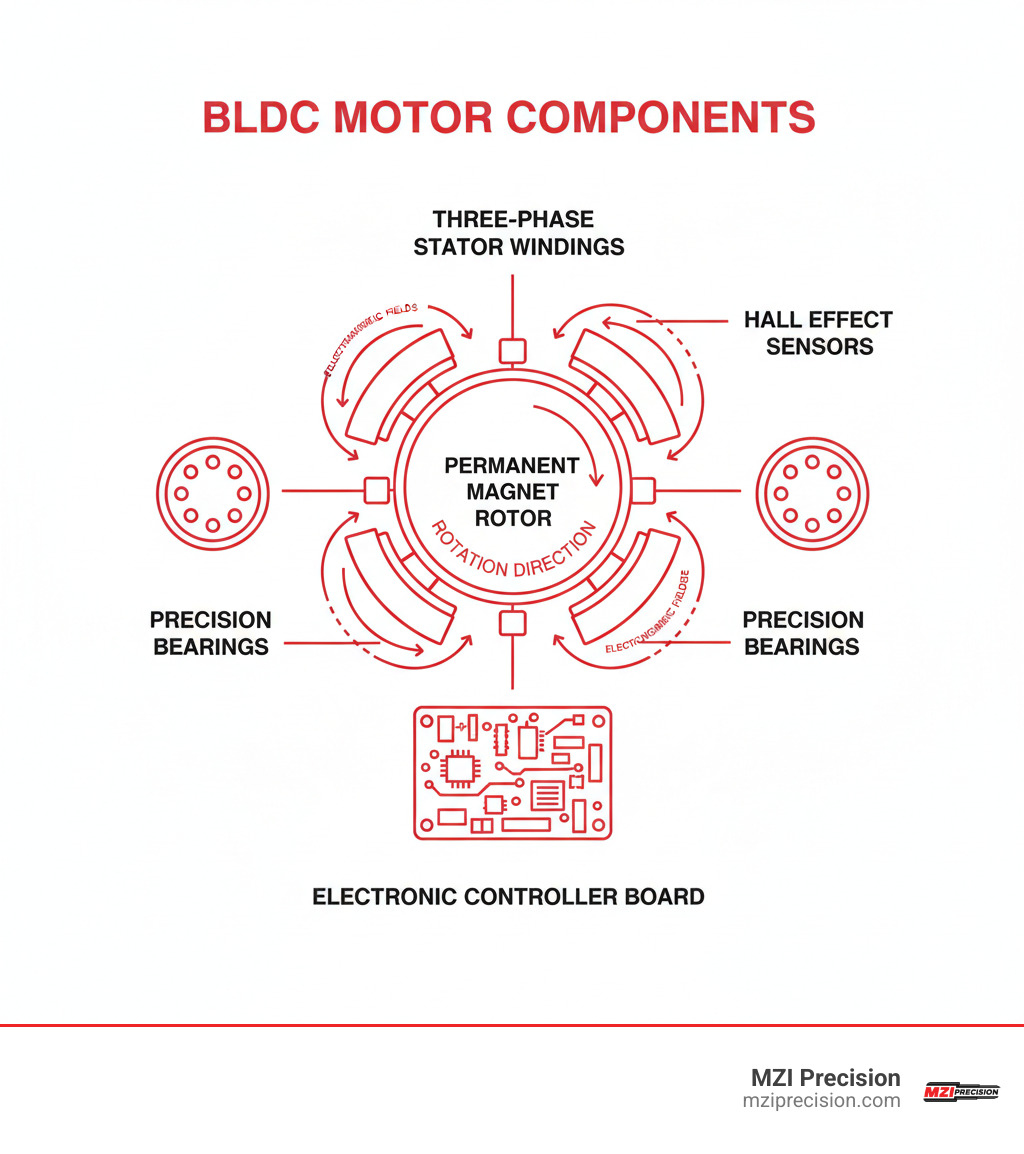
The repair process requires specialized knowledge and tools. Unlike brushed motors, BLDC motors have complex electronic commutation, permanent magnet rotors, and sophisticated control circuits.
Diagnosing the Problem: A Systematic Approach
A methodical diagnostic approach is essential when an industrial manufacturing spindle shows signs of failure. This saves time, money, and prevents further damage.
Visual inspection is always the first step. Look for telltale signs like cracks in the housing, scorch marks from overheating, or loose connections. Sometimes the problem is obvious, like debris clogging cooling vents or oil leaking from bearings.
While the motor runs (if safe), listen for unusual noises. Grinding sounds often indicate bearing trouble, while high-pitched whining can point to electrical issues. A healthy motor should be relatively quiet.
Excessive vibration often points to worn bearings, misalignment, or an unbalanced rotor. While professional analysis tools are best, even hands-on checks can detect abnormal vibration.
Heat patterns reveal hidden problems like overload, poor ventilation, or internal faults. Use an infrared thermometer to map hot spots and identify trouble areas.
Safety comes first, always. Before you touch anything, disconnect the power supply completely and lock it out. Even “dead” motors can bite you with stored energy in capacitors. Wear your safety glasses and insulated gloves—they’re your best friends.
Identifying Bearing Failure
Bearing failure is one of the most common reasons for brushless DC motor repair calls.
Grinding noises are a classic symptom. Manually turning the shaft (with power off) should feel smooth; if it feels gritty or rough, contaminants may be causing damage.
Excessive vibration often follows bearing wear. As the bearings develop play, the rotor starts wobbling, creating vibration that can damage other components if left unchecked.
Increased temperature around the bearing housing is another red flag. Failing bearings create friction, which generates heat. If the bearing area is significantly hotter than the rest of the motor, you’ve likely found the problem.
The manual rotation test is simple but revealing. With the motor safely disconnected, try to move the shaft both radially and axially. There should be minimal play; any significant movement indicates worn bearings that need replacement. The shaft should turn smoothly without binding or rough spots.
When bearings fail in industrial manufacturing spindles, replacement is usually the only viable option. For comprehensive guidance on addressing these issues, check out our spindle motor repair services.
Testing for Winding and Electrical Faults
Winding burnout from motor overload is a common failure in demanding industrial applications.
Short circuits occur when insulation breaks down between winding turns or phases, creating unwanted electrical paths that cause excessive current and heat. Open circuits are the opposite: a break in the conductor prevents current flow, leading to erratic operation or complete failure.
Phase-to-phase resistance testing with a multimeter reveals winding balance. Measure between each pair of motor phases (U-V, V-W, U-W). The readings should be nearly identical; significant differences indicate winding problems.
Phase-to-ground testing checks for dangerous shorts between the windings and motor casing. This reading should show very high (infinite) resistance. Low resistance indicates a serious fault that needs immediate attention.
Insulation resistance testing (a “megger test”) applies high DC voltage to evaluate insulation integrity. This test reveals degradation from age, heat, or contamination that might not appear with basic multimeter tests.
These electrical tests determine whether your motor needs minor repairs or complete rewinding and help guide the repair strategy.
Troubleshooting Controller and Sensor Issues
Modern brushless DC motors rely on electronic controllers and feedback sensors. When these components fail, a healthy motor won’t run properly.
Controller problems can cause a motor to not start, run erratically, or stall. Unstable operation, such as sudden speed changes, often points to issues with the controller’s regulation circuits.
Power supply verification is the first troubleshooting step. Use a multimeter to confirm the input voltage and current match manufacturer specifications. Many controller problems stem from an inadequate or unstable power supply.
Controller error codes can be very helpful. Modern industrial controllers often provide diagnostic codes that point to specific faults. Check the manual for code interpretations.
Hall effect sensors provide crucial rotor position feedback. When these sensors fail, the motor loses its timing. Use an oscilloscope to examine each sensor’s output signal for clean, periodic waveforms. Irregular signals indicate sensor problems.
Signal integrity can be an issue in industrial environments. Electromagnetic interference, worn cables, or poor connections can corrupt sensor signals. Shielded cables and proper grounding help maintain clean signals.
A Step-by-Step Guide to Brushless DC Motor Repair
Repairing an industrial manufacturing spindle’s motor is a challenging process requiring steady hands, the right tools, and a deep understanding of how these motors operate.
Safety comes before everything else. Always disconnect and lock out the power supply. Wear appropriate Personal Protective Equipment (PPE), including safety glasses and insulated gloves, as capacitors can hold a dangerous charge.
Documentation is essential. Document the entire process with photos from multiple angles. Note wiring diagrams, bearing orientation, and any unusual wear. This helps identify the root cause and ensures correct reassembly.
Essential Tools for Brushless DC Motor Repair
Quality tools are essential for a successful brushless DC motor repair.
Your multimeter is your diagnostic partner for testing resistance, continuity, and voltage. For tricky sensor problems, an oscilloscope is irreplaceable for viewing actual waveforms.
Bearing pullers and an arbor press are necessary to avoid damaging shafts and housings when removing bearings. Precision tools protect the shaft and housing from damage.
Your soldering station needs temperature control to make solid connections without damaging wire insulation. High-temperature varnish and epoxy are what separate a professional repair from a temporary fix.
Specialized winding wire must match the original specifications for enamel coating temperature rating and gauge. Insulation paper for the stator slots prevents shorts that could destroy new windings.
Don’t forget precision measuring tools like calipers and micrometers. Industrial spindle motors operate with tight tolerances, where a few thousandths of an inch can make the difference between smooth operation and catastrophic failure.
Motor Disassembly and Component Inspection
Disassembly requires patience. Start by removing the outer casing and end bells, which may be held by corrosion or thread-locking compounds.
The rotor extraction requires care. The permanent magnets are strong and brittle. Use specialized pullers and support the rotor’s weight. Once free, inspect the magnets for chips, cracks, or signs of demagnetization.
The stator core reveals the motor’s history. Heat damage appears as discolored laminations or brittle varnish. Look for separated laminations, which can cause core losses and vibration.
Cleaning everything thoroughly reveals problems that dirt and grease can hide. Use industrial-grade solvents to clean all components.
The Art of Replacing Windings
Rewinding a motor is a meticulous part of brushless DC motor repair that requires professional expertise.
Removing the old windings requires patience. Carefully extract each turn without gouging the stator slots or damaging the core laminations, using plastic tools to avoid scratching.
Stator preparation involves inspecting every slot for damage and repairing any compromised varnish with high-temperature coatings to create a pristine foundation.
Insulating the stator slots properly prevents the new windings from shorting against the metal core. This step cannot be rushed.
Winding the new coils demands precision. The wire gauge, number of turns, and winding pattern must exactly match the original. Mark wire start and end points clearly, as the winding scheme for a three-phase motor affects its magnetic field and rotation.
Termination configuration is critical. Wye and Delta connections offer different speed and torque characteristics. A Delta-connected motor runs about 1.8 times faster with 1.8 times more torque than the same motor in a Wye configuration. The repair must match the original design.
Soldering the connections requires skill. The enamel coating on the wire must be properly removed to ensure solid, low-resistance joints. Poor connections create hot spots that can destroy the motor.
This level of precision is why we’ve specialized as Motor Rewind Specialists. Industrial manufacturing spindles can’t afford amateur repairs that fail under production loads.
Reassembly and Final Testing
The reassembly phase of brushless DC motor repair is a precision operation. After diagnosis and component replacement, careful reassembly brings the motor back to life, requiring the same attention to detail as disassembly.
Component alignment is absolutely critical at this stage. Even the smallest misalignment can lead to vibration, premature wear, or complete failure.
Proper bearing installation is a make-or-break step. New bearings must be seated perfectly with correct clearances and alignment to avoid premature failure.
Proper Reassembly Procedures
Install new, high-quality bearings and seals using an arbor press or controlled heating. Apply even pressure to ensure a snug fit without damaging the bearing races, avoiding any tilting during installation.
Fresh seals go in at the same time to prevent contamination, a top reason for motor failure. This prevents the problem from recurring.
Installing the rotor requires a gentle touch. Guide the rotor carefully back into the stator to avoid contact with the new windings or permanent magnets. One careless move can undo hours of work.
Securing end bells and housing involves more than just tightening bolts. Torque every fastener to the manufacturer’s specifications to prevent vibration, loosening, or housing distortion.
Ensuring proper clearances means checking that everything rotates freely without rubbing. Manually rotate the shaft and feel for any binding or rough spots.
Connecting phase wires is the final electrical step. Route phase wires neatly to their terminals, protect them with heat-shrink tubing, and secure them away from rotating parts.
Advanced Testing After Brushless DC Motor Repair
After reassembly, a comprehensive evaluation is required to validate the brushless DC motor repair.
Winding resistance confirmation starts the testing. Re-measure phase-to-phase and phase-to-ground resistance values to confirm the new windings are properly connected and balanced.
No-load testing comes next. Run the motor without a mechanical load, listening for unusual noises, watching for smooth operation, and monitoring current draw. A healthy motor should run quietly and draw minimal current.
Monitoring current draw under various conditions indicates if the motor is electrically sound. The current should be balanced across all phases and stay within specifications. Unbalanced current often points to winding or controller problems.
Vibration analysis uses specialized equipment to detect unbalance, misalignment, or bearing irregularities that might not be obvious. Catching these issues now prevents catastrophic failures later.
Back-EMF testing measures the voltage generated when spinning the motor manually. This confirms the permanent magnets are strong and the windings produce the expected output.
Full load testing is the final exam. Run the motor under simulated real-world conditions with a full mechanical load to prove it can handle demands without overheating or performance loss.
This comprehensive testing ensures the repaired motor will perform as well as or better than new.
Extending Motor Lifespan: Preventative Maintenance
Preventative maintenance is preferable to emergency brushless DC motor repair. A regular maintenance schedule for industrial manufacturing spindle motors prevents unexpected failures on the factory floor.
Most motor failures are preventable. A well-maintained brushless DC motor can run for decades, while a neglected one might fail within months.
Regular inspection schedules are your first line of defense. For critical industrial applications, check motors at least every six months, or monthly for high-intensity operations. During checkups, look for visible damage, listen for unusual noises, and feel for excessive heat.
Contamination prevention is crucial. Dust, moisture, and debris are harmful to electric motors. Keep cooling vents clear and maintain a clean operating environment to extend motor life.
Follow manufacturer guidelines for lubricant type and quantity. Both over- and under-lubrication can cause problems, with over-lubrication attracting contaminants and under-lubrication leading to bearing failure.
Monitoring operating temperature is non-negotiable. Overheating degrades insulation. Install temperature monitoring systems where possible and ensure adequate ventilation. A motor running too hot needs attention.
Avoiding overload conditions is perhaps the most important preventative measure. Motor overload is the leading cause of stator core burnout. Ensure motors are properly sized for their applications and operate within their design limits.
By implementing these preventative measures, you can dramatically improve motor reliability. For comprehensive guidance, check out our detailed Electric Motor Maintenance Tips.
A small investment in preventative care can save significant repair costs and downtime.
Frequently Asked Questions about BLDC Motor Repair
Here are answers to common questions about brushless DC motor repair for industrial manufacturing spindles.
What are the most common reasons for industrial BLDC motor failure?
Overheating is the top cause, usually from overload or poor cooling, leading to stator core burnout.
Bearing failure runs a close second. Contamination from metal shavings or dirt, along with poor lubrication, causes bearings to fail.
Electrical faults are the third major issue. These include winding shorts from overheating, open circuits from mechanical stress, and controller or Hall effect sensor malfunctions that cause erratic operation.
Most of these issues are preventable with proper maintenance, but professional repair is needed once they occur.
Can a burnt-out BLDC motor be repaired?
Yes. A burnt-out motor might look unsalvageable, but it is often a perfect candidate for professional restoration.
The process is called spindle motor rewinding. It involves carefully removing damaged coils, cleaning and re-insulating the stator core, and winding new copper coils to original specifications.
This job requires professional expertise, as the winding patterns, wire gauges, and insulation materials must be exact to prevent poor performance or another failure. That’s why we’ve built our reputation as spindle motor rewinding specialists—getting it right the first time saves time and money.
How do I know if the motor or the controller is the problem?
Determining the source of the problem requires systematic diagnosis.
If possible, test the suspect motor with a known-good controller. If the problem disappears, the controller is the issue. If the problem persists, the motor is likely at fault.
Check for error codes from the industrial controller. We also use an oscilloscope to check the controller’s output signals and examine the Hall effect sensor signals.
Electrical tests tell the real story. If the controller’s outputs are clean but the motor still fails, the issue is likely internal to the motor (windings, bearings, magnets). If the controller’s outputs are faulty despite proper input power, the controller is the problem.
A systematic electrical diagnosis, including winding resistance and insulation tests, will point to the correct component. For those who want to dive deeper, there are great technical discussions in specialized forums like this motor diagnostics resource.
A proper diagnosis saves time and prevents the frustration of fixing the wrong component.
Conclusion: When to Call in the Experts
Throughout this guide, we’ve walked through the intricate world of brushless DC motor repair for industrial manufacturing spindles. It’s clear that this isn’t your typical weekend garage project. The complexity runs deep—from understanding electromagnetic principles to mastering precision winding techniques that require years of specialized training.
The reality is that brushless DC motor repair demands more than just technical knowledge. You need expensive, specialized equipment like oscilloscopes for signal analysis, precision bearing pullers, and high-temperature winding materials. A single mistake during reassembly can turn a repairable motor into expensive scrap metal.
Consider the risks of attempting complex repairs in-house. Improper winding can create dangerous hot spots that lead to fires. Incorrectly installed bearings will fail prematurely, potentially causing catastrophic damage to your entire spindle assembly. Poor insulation work can create electrical hazards that put your operators at risk.
When precision manufacturing is your business, downtime isn’t just inconvenient—it’s costly. Every hour your spindle sits idle waiting for parts or troubleshooting represents lost production and missed deadlines. Professional repair services understand this urgency and have the resources to get you back online quickly.
At MZI Precision, we’ve built our reputation on understanding the critical role these motors play in your manufacturing operations. Our technicians have seen every type of failure imaginable, from bearing contamination in aerospace applications to thermal damage from overload conditions. We don’t just fix the immediate problem—we identify the root causes to prevent future failures.
The choice is clear: when your industrial manufacturing spindle motor fails, trust the specialists who guarantee their work. Don’t let a failed motor become the bottleneck that shuts down your entire production line.
Ready to get your operations back to peak performance? Contact us for expert electric motor service and repair and experience the MZI Precision difference.