
 (714) 379-6505


What is a CNC Multi-Spindle Machine?
A cnc multi spindle machine is like having several machines working in perfect harmony inside a single frame. These powerhouse systems use multiple working spindles simultaneously, dramatically boosting your production output while shrinking cycle times, saving precious floor space, and cutting energy bills.
Quick Answer: What is a CNC Multi-Spindle Machine?
| Feature | Description |
|---|---|
| Definition | Manufacturing machine with multiple spindles (typically 4-8) operating simultaneously |
| Primary Benefit | Produces up to 6 times more parts than single-spindle machines |
| Cycle Time Reduction | Up to 60% shorter cycle times compared to single-spindle setups |
| Space Efficiency | Uses 70% less floor space than equivalent single-spindle machines |
| Energy Savings | Consumes only 50% of the energy required by multiple single-spindle machines |
| Ideal Applications | High-volume precision parts for automotive, aerospace, medical, and defense industries |
In today’s manufacturing world, the pressure never stops—more parts, faster production, higher precision, lower costs. This is exactly where multi-spindle technology shines brightest.
I’ve heard shop managers say it best: “Multi-spindle screw machines are the most productive lathes in the world.” And the numbers back this up. When comparing a real-world order of 20,000 precision components, a cnc multi spindle machine generated an annual profit of $1,026,009, while a single-spindle lathe managed just $86,750—making the multi-spindle approach nearly 12 times more profitable. That’s not just an improvement—it’s a change.
Gone are the days when multi-spindles were seen as complex beasts that only the most experienced machinists could tame. Today’s systems beautifully blend mechanical reliability with digital precision, offering quick changeovers and the ability to produce intricate parts that once required multiple operations and machines.
For shops wrestling with skilled labor shortages (and who isn’t these days?), floor space limitations, or production bottlenecks, multi-spindle technology offers a compelling solution. As one operator told me with a grin: “We reduced cycle times from 2 minutes to just 12 seconds per part.” That’s not just saving time—that’s revolutionizing production capacity.
Cnc multi spindle machine terms simplified:
– CNC Machine Spindle
– machine spindle
– what is spindle in cnc machine
Want to learn more about whether multi-spindle technology is right for your operation? Check out this latest research on multi-spindles for an in-depth analysis of applications and benefits.
What is a CNC Multi-Spindle Machine?
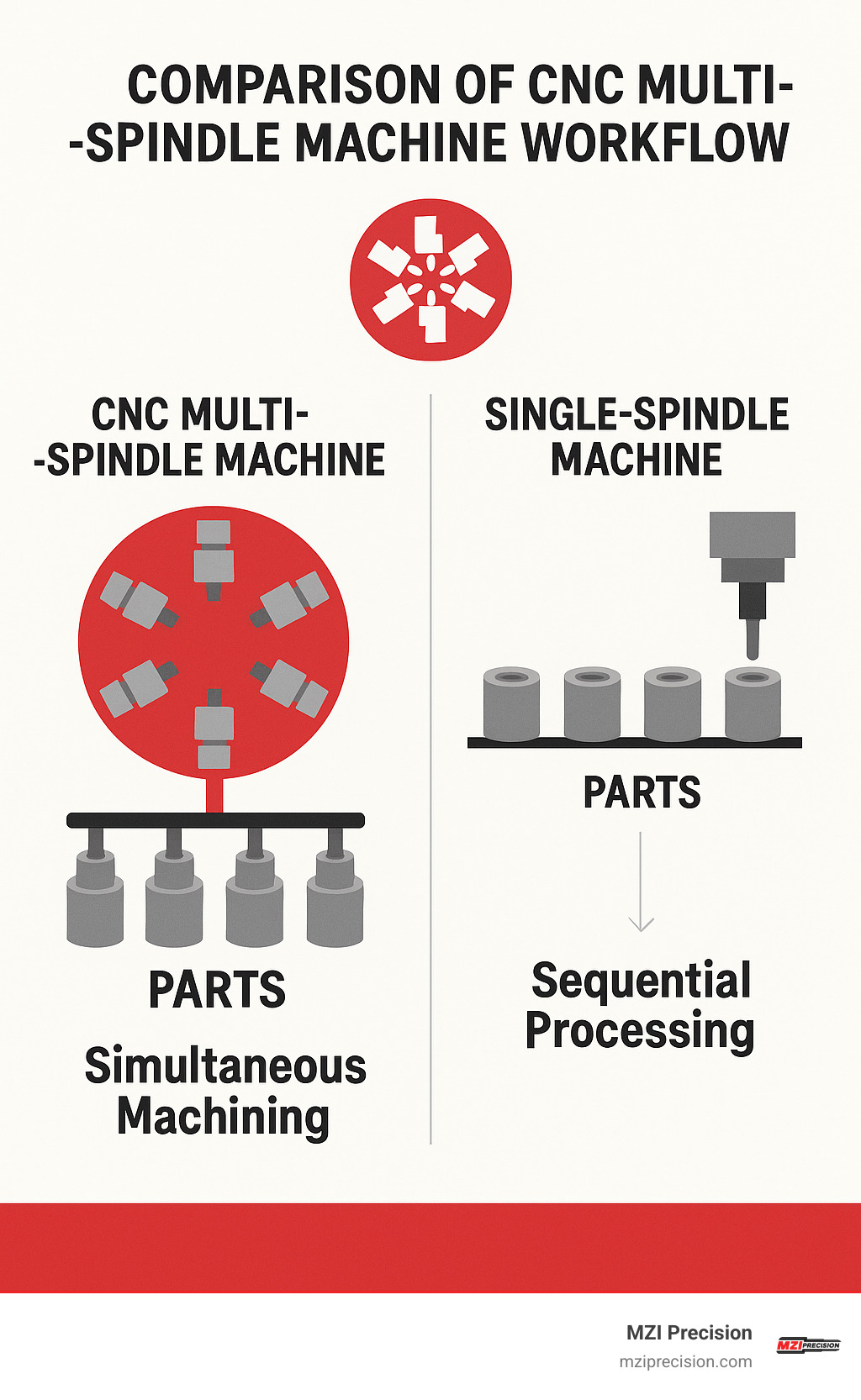
A CNC multi-spindle machine is an advanced manufacturing system that contains multiple working spindles (typically 5, 6, or 8) arranged in a revolving drum. Each spindle holds a workpiece, and as the drum indexes from position to position, different machining operations are performed simultaneously on all workpieces.
This parallel processing approach creates manufacturing magic. While conventional machines work on just one part at a time, cnc multi spindle machines tackle multiple parts simultaneously, each at different stages of completion.
“Think of it like multiple Swiss-style lathes arranged in a circle, all working in perfect harmony,” explains one experienced operator. “Each station performs a specific operation, and when the cycle completes, you have a finished part ready to go.”
The productivity gains aren’t just impressive—they’re game-changing. Multi-spindle automatic lathes yield production levels 4 to 6 times higher than single-spindle machines, with benefits that extend far beyond speed:
| Metric | Single-Spindle Setup | Multi-Spindle Machine | Improvement |
|---|---|---|---|
| Cycle Time | 38 seconds/part | 11 seconds/part | 71% reduction |
| Production Time (20,000 pcs) | 10.6 days | 3.1 days | 71% faster |
| Floor Space | 100% (baseline) | 30% of equivalent capacity | 70% reduction |
| Energy Consumption | 100% (baseline) | 50% of equivalent capacity | 50% reduction |
| Net Profit Per Job | $3,663 | $12,540 | 242% increase |
| Annualized Profit | $86,750 | $1,026,009 | 1,083% increase |
These numbers tell a compelling story about why forward-thinking manufacturers are embracing cnc multi spindle machine technology to stay competitive in today’s challenging market. The profit difference alone—over 1,000% improvement—explains why many consider multi-spindles the crown jewels of high-volume production.
How a CNC Multi Spindle Machine Works
The beauty of a cnc multi spindle machine lies in its neat sequence of operations:
The heart of the system is the indexing sequence, where the central drum containing multiple spindles rotates in precise increments, moving workpieces from one machining position to the next like a manufacturing carousel.
At each position, different cutting tools perform specific operations on all workpieces simultaneously. This parallel processing is what creates the dramatic time savings—while one part is being drilled, another is being turned, and yet another might be getting a thread cut.
Modern machines feature a synchronous spindle at the back end that picks up the workpiece after front machining is complete. This clever design allows for back-end operations without the time-consuming process of re-fixturing the part.
The addition of live tooling in advanced models has revolutionized capabilities. These powered tools enable milling, drilling, and other operations beyond basic turning, making today’s multi-spindles true manufacturing Swiss Army knives.
After indexing through all positions, a completed part is ejected, and a new blank is loaded—continuing the cycle of productivity.
As one machinist puts it: “Each station has a specific purpose and job to do. If one station is idle or taking too long, it can stall the index and reduce throughput, so balancing operations is critical.”
Thankfully, modern CNC controls have largely simplified this balancing act. Advanced software, like the Virtual Machine mentioned in our research from MMSOnline, equalizes processing times across multiple spindles, making programming much more straightforward than in years past.
Types of CNC Multi-Spindle Machines
CNC multi spindle machines come in various configurations to suit different manufacturing needs. Understanding these variations is crucial for selecting the right platform for your specific applications.
CNC Multi Spindle Machine Platforms for Turning
Bar-Fed Multi-Spindle Automatics:
– 5-Spindle Systems: Traditional design with excellent reliability and moderate complexity.
– 6-Spindle Systems: The most common configuration, offering an optimal balance of productivity and flexibility. These machines typically handle bar stock from 32mm to 52mm in diameter and operate at speeds between 5,000-7,000 RPM.
– 8-Spindle Systems: High-productivity platforms that can be configured as dual 4-spindle circuits, effectively doubling output for certain applications.
Most modern turning multi-spindles include back-working attachments with swiveling synchronous spindles that enable complete machining of parts without secondary operations. These machines excel at producing high volumes of complex turned components like transmission parts, hydraulic fittings, and precision fasteners.
Chucker-Type Multi-Spindles:
– These machines are designed for pre-formed blanks rather than bar stock.
– They’re ideal for secondary operations on preformed parts.
– Automated loading interfaces allow for high-volume production with minimal operator intervention.
CNC Multi Spindle Machine Platforms for Milling
While turning applications dominate the multi-spindle landscape, milling-focused multi-spindle machines offer similar productivity advantages for prismatic parts.
Four-Spindle Milling Centers:
– These machines can shorten cycle times by up to 60% compared to four single-spindle machines.
– They typically require 70% less floor space and consume only half the energy of equivalent single-spindle setups.
– Double swivel carriers with four sides can clamp up to 16 workpieces for maximum throughput.
Vertical Multi-Spindle Machining Centers:
– Feature vertical opposed spindles in a linear arrangement.
– Divided into independent work zones allowing tool changes without stopping production.
– Ideal for valve components, hydraulics, and oleodynamics parts.
Multi-Head CNC Routers:
– Primarily used for woodworking, plastics, and non-ferrous metals.
– Multiple spindles (typically 4) run identical patterns simultaneously.
– Some designs incorporate rotary capabilities for 3D cylindrical work.
A unique advantage of modern multi-spindle milling centers is their ability to machine parts in parallel while simultaneously loading and unloading workpieces, further enhancing productivity.
How to Choose the Right Multi-Spindle Platform
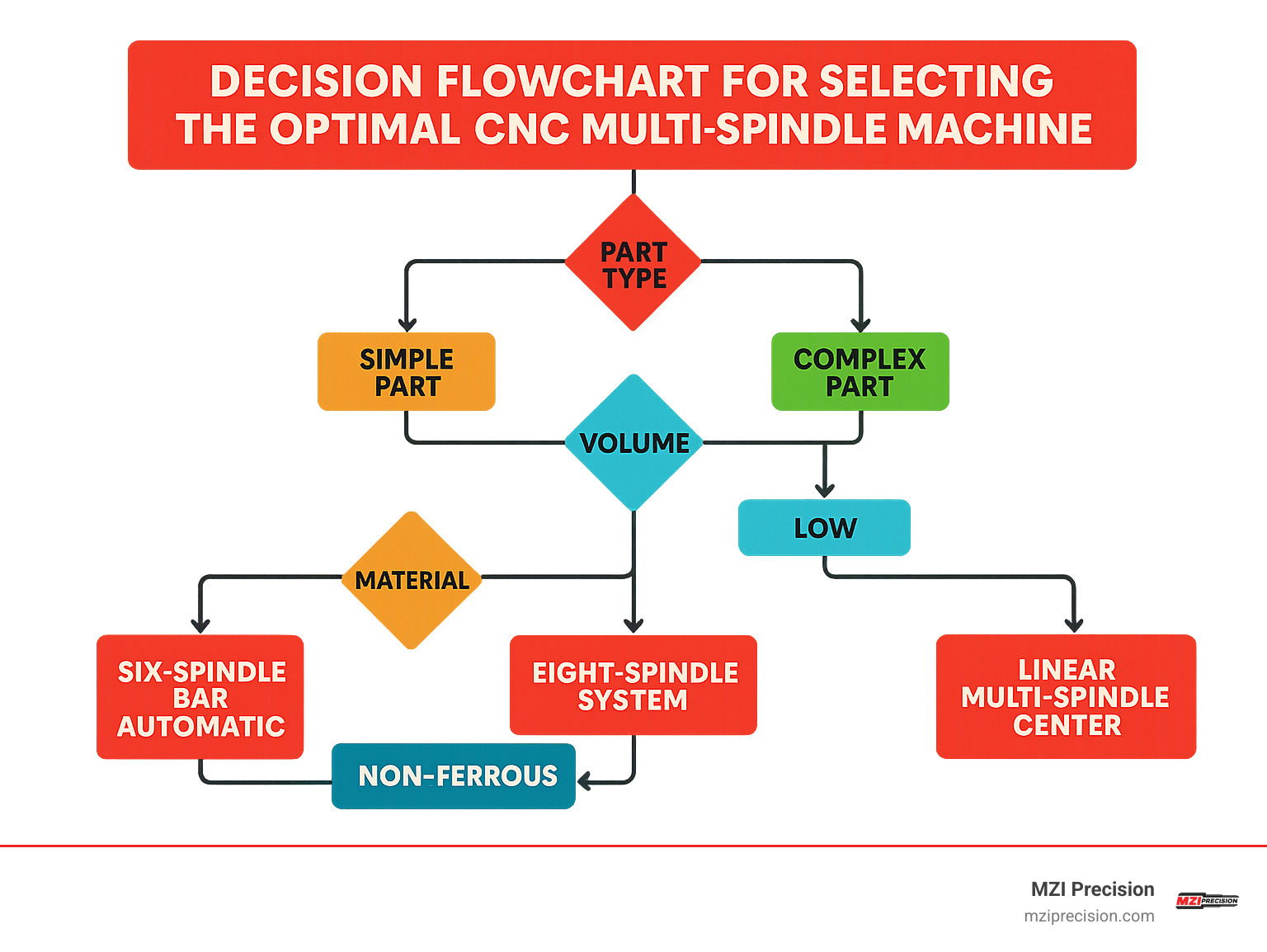
Selecting the ideal CNC multi spindle machine isn’t just about buying equipment—it’s about making a strategic business decision that could dramatically transform your production capabilities. Let’s walk through the key considerations to help you find your perfect match.
Batch Size and Production Volume:
When evaluating multi-spindle technology, start with your typical order sizes. These powerhouse machines truly shine with medium to large batch runs. To put this in perspective, on a 20,000-piece order, a multi-spindle system completed the entire job in just 3.1 days—while a single-spindle lathe needed 10.6 days for the same work. Yes, the initial investment is higher, but the numbers don’t lie: multi-spindle machines can be nearly 12 times more profitable on an annualized basis when properly used.
Material Range:
Today’s multi-spindle machines are incredibly versatile. They can handle virtually any material you throw at them, from standard steel and cast iron to aluminum, titanium, and even exotic alloys. If you primarily work with non-ferrous metals, you might want to consider specialized machines with linear motor drives optimized for these materials. Always think ahead—what materials might you need to machine in the next 3-5 years?
Spindle Count:
More spindles generally translate to higher productivity, but they also bring increased complexity and cost. For most applications, 6-spindle machines hit the sweet spot of capability versus complexity. If you’re pushing for maximum throughput, 8-spindle machines can be configured as dual 4-spindle circuits, essentially giving you two machines in one footprint.
Bar Capacity:
Most multi-spindle machines handle bar stock ranging from 32mm to 52mm in diameter. Larger diameter capacities typically come with a trade-off in maximum spindle speeds. The key is matching the capacity to your typical part dimensions—no need to pay for capacity you’ll rarely use.
Modular Slides and Tooling:
Modern multi-spindle machines feature incredible flexibility through modular tool slides with quick-change capabilities. Look for systems with W-serration locating systems, which provide micrometer-accurate slide changes. The ability to use preset tooling that can be prepared off-machine is a game-changer for minimizing downtime during changeovers.
Control Software and Industry 4.0 Readiness:
The days of intimidating multi-spindle controls are long gone. Today’s machines offer intuitive interfaces that simplify programming and operation. Features like iXpanel operating systems with 18.5″ touchscreens have made these complex machines much more user-friendly. Additionally, connectivity options for production monitoring and predictive maintenance aren’t just nice-to-haves anymore—they’re becoming essential for staying competitive.
ROI Analysis:
Before making any decision, run a thorough ROI analysis. Calculate the total cost of ownership, including acquisition, tooling, maintenance, and energy costs. Compare realistic cycle times and throughput against your current processes. Don’t forget to factor in floor space savings (typically 70% less than equivalent single-spindle setups) and reduced labor requirements.
At MZI Precision, we understand that the spindle is the heart of any CNC machine. Our expertise in spindle repair and rebuilding ensures that your multi-spindle investment continues to deliver peak performance throughout its lifecycle. We’ve seen how proper spindle maintenance can extend machine life and maintain the precision that makes these productivity powerhouses so valuable.
1. Six-Spindle Bar Automatics
When it comes to production powerhouses, six-spindle bar automatic machines truly shine in the cnc multi spindle machine family. These manufacturing champions offer the perfect sweet spot between productivity, flexibility, and cost-effectiveness that makes them the go-to choice for precision parts production.
Think of six-spindle machines as the “Goldilocks” of multi-spindle technology – not too simple, not too complex, but just right for most high-volume applications.
Key Specifications:
These machines typically handle bar stock ranging from 32mm to 52mm in diameter, with spindle speeds reaching an impressive 5,000-7,000 RPM depending on the model. With up to 30 kW of power per spindle and torque capabilities reaching 130 Nm, they have the muscle to tackle serious cutting operations across a wide range of materials.
What makes the six-spindle configuration so popular is its balanced approach. You get enough machining stations to complete complex parts in a single cycle, without the overwhelming setup complexity that comes with higher spindle counts. Each position performs its specialized task, and when the drum completes its indexing sequence, out comes a perfectly finished part.
Hydrostatic Quills: The Secret Weapon
Premium six-spindle machines often feature hydrostatic support on their Z-axis quills – a technology that creates a microscopic film of oil between sliding surfaces. This eliminates metal-to-metal contact, which is a game-changer for precision and longevity.
“It’s like the difference between ice skating and walking,” one operator told us. “The tool glides on a cushion of oil instead of dragging metal on metal.” This seemingly simple innovation delivers non-wearing slides that last for decades, superior vibration damping for mirror-like surface finishes, and improved thermal stability that maintains tight tolerances even during long production runs.
Modular Tooling Revolution
Gone are the days when changing over a cnc multi spindle machine meant days of downtime. Modern six-spindle machines accept modularity with quick-change tool carriers featuring one or two travel axes. Many offer optional Y-axis capability for off-center operations, and the ability to mount multiple tools per carrier maximizes flexibility.
The patented W-serration locating system found on leading machines allows for incredibly precise slide changes measured in microns. This precision engineering dramatically cuts changeover time, making these machines economical even for smaller batch sizes that would have been impractical in the past.
Setup Times: From Days to Hours
Perhaps the most remarkable advancement in six-spindle technology has been the radical reduction in setup times. With preset tooling that can be prepared while the machine is running, modular slides that swap out in minutes rather than hours, and intuitive programming interfaces, changeovers that once took days now happen in a single shift.
Simulation software lets operators optimize cycle times before running the first part, eliminating the trial-and-error approach that wasted so much material and time in earlier generations.
For manufacturers in demanding fields like aerospace, defense, and medical industries – where MZI Precision frequently serves customers – six-spindle machines with hydrostatic support provide the stability and accuracy needed for critical components while delivering the productivity advantages that keep businesses competitive.
The six-spindle automatic has evolved from a dedicated machine for massive production runs into a flexible manufacturing system capable of economically producing medium-sized batches with minimal downtime between jobs – truly the versatile backbone of modern high-volume precision manufacturing.
2. Eight-Spindle Bar Automatics
When it comes to maximizing production output, eight-spindle bar automatic machines truly stand at the pinnacle of CNC multi spindle machine technology. These productivity powerhouses are the go-to solution for manufacturers facing demanding production schedules and complex part requirements.
Key Specifications:
– Bar Capacity: Typically 40mm (with some models handling up to 52mm)
– Maximum Spindle Speed: Up to 7,000 RPM
– Number of Working Spindles: 8
– Control Interface: 18.5″ multi-touch screens with Siemens S840D sl controls
– Weight: Approximately 10,300 kg
– Dimensions: 4,010×2,142×3,216 mm (typical footprint)
What makes eight-spindle machines truly special is their remarkable versatility and output capabilities. As one manufacturer puts it: “Versatility is the strength of the MS40-8. Whether complex parts or manufacturing methods are involved – anything is possible.”
Dual 4-Spindle Circuits
Perhaps the most innovative feature of eight-spindle machines is their ability to function as dual 4-spindle circuits. This clever configuration allows you to simultaneously machine two completely different workpieces, effectively producing two complete parts per cycle instead of one. For shops juggling multiple part families, this capability is a game-changer, dramatically reducing cycle times and boosting overall productivity.
Variable Speed Per Position
Modern eight-spindle machines offer independent speed control for each spindle position – a feature that transforms machining precision. By setting the optimal speed for each cutting operation, you’ll achieve better chip formation and evacuation, superior surface finishes, and significantly extended tool life. This customization means each operation runs at its ideal conditions, rather than compromising across all positions.
Industry 4.0 Dashboards
Today’s eight-spindle machines come equipped with sophisticated control systems that bring your shop floor into the digital age. “The integrated iXpanel serves as an Industry 4.0 cockpit,” notes one manufacturer. These intuitive interfaces provide real-time production monitoring, predictive maintenance alerts, and seamless integration into your digital workflows. With an 18.5″ multi-touch screen, operators can easily access all the information they need to keep production running smoothly.
Compact Footprint
Despite their impressive capabilities, eight-spindle machines maintain a surprisingly compact footprint. At roughly 4,010×2,142×3,216 mm, these machines make efficient use of valuable factory floor space while incorporating integrated chip management systems and ergonomic operator access points. This space efficiency means you can upgrade your production capacity without necessarily expanding your facility.
For manufacturers dealing with high-volume production runs of complex parts, eight-spindle machines deliver best productivity in a relatively compact package. The dual 4-spindle circuit capability adds another dimension of flexibility that makes these machines particularly valuable for shops with diverse part families and changing production needs.
3. Linear Multi-Spindle Machining Centers
Linear multi-spindle machining centers represent an innovative alternative to the traditional revolving drum design found in most CNC multi spindle machines. These unique systems arrange multiple spindles in a linear configuration, offering distinct advantages for certain applications.
Key Characteristics:
– Spindle Arrangement: Vertical opposed spindles in a linear layout
– Work Zones: Divided into independent zones for simultaneous operations
– Changeover Time: As little as 15 minutes for complete retooling
– Applications: Ideal for valve components, hydraulics, and oleodynamics parts
Vertical Opposed Spindles:
Unlike traditional multi-spindles that arrange spindles in a circular drum, linear systems position spindles vertically:
– Opposed spindle design for balanced cutting forces
– Vertical orientation for optimal chip evacuation
– Linear arrangement for simplified automation and part flow
This configuration is particularly well-suited for prismatic parts and components that require machining from multiple sides.
Dual Work Zones:
One of the most significant advantages of linear multi-spindle machines is their division into independent work zones:
– Complete tool changes possible in one zone while the other continues production
– Single-tool replacement can occur without stopping the cycle
– Dramatically reduced downtime during changeovers
“The machine is divided into two fully independent work zones allowing complete tool change without stopping production,” explains one manufacturer. “Set-up time is reduced to just 15 minutes thanks to its linear multi-spindle architecture.”
15-Minute Changeover:
The rapid changeover capability of linear multi-spindle machines makes them exceptionally versatile:
– Modular tooling systems for quick swaps
– Independent zone control for on-the-fly maintenance
– Simplified programming and setup procedures
This quick-change capability makes linear multi-spindle machines economical even for smaller batch sizes, expanding the range of applications where multi-spindle technology delivers a compelling ROI.
Industry Applications:
Linear multi-spindle machines excel in several specific industries:
– Valve Manufacturing: Production of ball valve spheres and components
– Hydraulics and Oleodynamics: Complex fluid control components
– Aerospace: Precision fittings and connectors
– Automotive: High-volume precision components
For manufacturers in these industries, linear multi-spindle machines offer an optimal combination of productivity, flexibility, and quick changeover capabilities. Their unique architecture provides advantages that traditional revolving drum multi-spindles cannot match for certain applications.
Setup, Changeover, and Automation Advances
Gone are the days when CNC multi spindle machines required days of downtime for retooling. Modern systems have transformed these productivity powerhouses into surprisingly flexible manufacturing solutions that can handle smaller batches economically while maintaining their high-volume advantages.
W-Serration Slides have revolutionized how we approach multi-spindle setups. These precision quick-change interfaces use a patented W-pattern that ensures micrometer-accurate positioning every time. What used to take hours now happens in minutes, with tool slides that can be swapped out with minimal adjustment. As one shop owner told me, “The W-serration system paid for itself in the first month just in reduced downtime.”
The ability to preset tooling offline has been another game-changer for multi-spindle efficiency. While your machine continues churning out parts, technicians can measure and prepare complete tool assemblies on dedicated equipment. When it’s time for a changeover, these pre-verified assemblies slip right into place. This approach virtually eliminates the trial-and-error adjustments that used to plague multi-spindle setups, ensuring consistent quality from the very first part after changeover.
Robotic loading systems have become increasingly sophisticated, with integrated robots that handle parts with remarkable dexterity. Modern vision systems verify quality in real-time, while flexible grippers accommodate diverse part geometries without damage. One production manager shared, “Our operators used to spend 70% of their time loading and unloading. Now they focus on higher-value tasks while the robots handle the repetitive work.”
Beyond individual machine automation, gantry transfer systems now link multi-spindle machines into complete manufacturing cells. These overhead transport networks move parts between operations seamlessly, integrating secondary processes like washing, inspection, and packaging into a unified workflow. Cell controllers orchestrate this dance of productivity, creating self-sufficient production lines that maximize throughput while minimizing labor requirements.
Today’s multi-spindle machines also feature remarkable energy-efficient drives that dramatically reduce operating costs. Fluid-cooled motorized spindles with synchronous drives recover energy during deceleration, while intelligent power management systems optimize consumption during idle periods. The result? Overall energy consumption approximately 50% lower than equivalent single-spindle setups—good for both your bottom line and sustainability goals.
At MZI Precision, we’ve seen how these advances have transformed multi-spindle machining. Our spindle repair and rebuilding services help manufacturers maintain peak performance from these sophisticated systems, ensuring they continue delivering the productivity advantages that make them such valuable investments.
The scientific research is clear: automated multi-spindle systems deliver dramatic productivity improvements. According to research on automation benefits, properly implemented automation can increase throughput by up to 300% while reducing labor costs by as much as 80%.
Frequently Asked Questions about CNC Multi-Spindle Machines
How steep is the learning curve for operators?
The learning curve for CNC multi spindle machine operators has become significantly gentler in recent years. Modern control systems have transformed what was once a complex specialty into something much more approachable.
As one seasoned machinist colorfully put it during our research: “I swear it’s just getting to the point that a monkey (random person on the street not the actual monkey) can probably do it.” While that’s a bit of an exaggeration, it does highlight how user-friendly these sophisticated machines have become.
Today’s multi-spindle machines feature intuitive 18.5″ touchscreens with helpful graphical interfaces that walk operators through programming steps. Virtual machine simulation software allows programs to be verified offline before they ever touch actual metal. The standardization of G-code programming across different platforms means skills transfer easily between machines.
Perhaps most impressive is the automatic cycle time balancing capability. The software now handles what used to be a complex manual process of optimizing operations across multiple spindles, taking much of the guesswork out of programming.
For shops making the transition from single-spindle equipment, there is still an adjustment period. The conceptual shift to thinking about multiple simultaneous operations requires a different mindset. However, most manufacturers provide comprehensive training programs, and operators typically become comfortable within a few weeks.
As one forum contributor wisely noted: “Anytime you can learn something new, it’s gonna be better for you.” Adding multi-spindle expertise to your skill set can open new career opportunities in precision manufacturing.
What materials can be processed efficiently?
Modern CNC multi spindle machines are remarkably versatile material handlers. They efficiently process everything from standard ferrous metals like steel, stainless steel, and cast iron to non-ferrous materials including aluminum, brass, copper, and bronze. Even exotic alloys like titanium, Inconel, and Hastelloy can be machined effectively, as can engineering plastics such as PEEK, Delrin, and nylon.
Different multi-spindle configurations excel with specific material categories. Linear-motor multi-spindles are recognized as the fastest options for non-ferrous metals. If you’re working with tougher materials like titanium or hardened steels, high-torque variants deliver the necessary power. Some manufacturers even offer hybrid machines that combine different capabilities for mixed material production.
This material flexibility makes multi-spindle machines valuable across diverse industries. Aerospace manufacturers appreciate their ability to handle exotic alloys with precision. Automotive companies rely on their high-volume capabilities for steel and aluminum components. Medical device makers value their precision with titanium and specialized plastics. Defense contractors and electronics manufacturers similarly benefit from this material versatility.
How do modern controls balance cycle times across spindles?
Balancing operations across multiple spindles used to be one of the most challenging aspects of multi-spindle machining. Without proper balance, one position would inevitably become a bottleneck, limiting the machine’s overall productivity. Modern control systems have largely solved this headache through several clever innovations.
Virtual Machine Technology now simulates and optimizes the entire machining process before cutting begins. Each spindle position can operate at independent speed settings, allowing optimal cutting conditions for each operation. Adaptive feed rate technology automatically adjusts based on real-time cutting conditions, while operation splitting distributes complex machining tasks across multiple positions when needed.
As one industry expert explained: “Advanced software equalizes processing times across multiple spindles, simplifying programming and maximizing throughput.”
The control system continuously monitors performance at each position and suggests optimizations. This transforms what was once a complex balancing act requiring years of specialized knowledge into a largely automated process. Manufacturers can focus more on part quality and overall productivity rather than micromanaging cycle times at each position.
For shops considering the leap to multi-spindle technology, these improved control systems represent one of the most compelling advances. They’ve removed a significant barrier to entry, making these productivity powerhouses accessible to a much wider range of manufacturers.
Conclusion
The evolution of CNC multi spindle machine technology has transformed these powerful manufacturing systems from specialized equipment for massive production runs into flexible, accessible platforms suitable for a wide range of applications and batch sizes.
The compelling advantages are clear and impossible to ignore. Modern multi-spindle machines deliver up to 6 times higher output than their single-spindle counterparts, which translates directly to your bottom line. Real-world case studies have documented nearly 12 times higher annualized profit—a game-changing difference for any manufacturing operation.
Beyond pure productivity, these machines offer practical benefits that address today’s manufacturing challenges. They require 70% less floor space than equivalent single-spindle capacity, a crucial advantage when facility expansion isn’t an option. The 50% reduction in energy consumption aligns with both cost-saving initiatives and sustainability goals. Perhaps most surprisingly to those familiar with older multi-spindle technology, modern quick-change tooling has made these machines economical even for smaller batch production.
For manufacturers navigating today’s perfect storm of skilled labor shortages, supply chain disruptions, and inflationary pressures, multi-spindle technology provides a strategic advantage. The ability to produce complete parts in a single handling—what some call “one-and-done machining”—reduces labor requirements while dramatically increasing throughput.
As we’ve explored throughout this article, today’s multi-spindle landscape offers options for virtually any production scenario. The versatile six-spindle bar automatics serve as the workhorses of production machining. For maximum productivity, eight-spindle systems with dual-circuit capabilities push the envelope of what’s possible. And for those needing rapid changeover capability, linear multi-spindle centers with independent work zones offer an innovative solution.
Your specific choice depends on production requirements, part complexity, typical batch sizes, and material mix. But the ROI analysis consistently shows that for suitable applications, the investment in multi-spindle technology pays dividends both immediately and over the long term.
At MZI Precision, we understand that the spindle is the heart of any CNC machine. Our expertise in spindle repair and rebuilding ensures that your multi-spindle investment continues to perform at peak efficiency throughout its lifecycle. With locations across California, we provide rapid service and support to keep your production running smoothly.
The spindle splendor of modern multi-spindle CNC machines isn’t just about impressive technology—it’s about transformative business results. By choosing the right platform for your needs, you can achieve manufacturing excellence that positions your company for success in today’s competitive landscape.
For more information about how MZI Precision can support your CNC multi-spindle machines with expert spindle services, visit our spindle services page.